Guest Post by GEDCo
Perovskite solar modules have emerged as a promising technology in the renewable energy sector, offering substantial advancements in efficiency, cost-effectiveness, and application versatility. These modules, leveraging perovskite materials, are revolutionising the solar power landscape with their ability to convert sunlight into electricity efficiently.
Perovskite solar modules utilise materials with a crystal structure similar to the mineral perovskite, which enables efficient absorption and conversion of sunlight into electricity. Unlike traditional silicon-based panels, perovskite modules can absorb a broader spectrum of light, including visible and infrared wavelengths, enhancing their performance in various lighting conditions.
Advantages Over Traditional Solar Panels
Compared to silicon solar panels, perovskite modules offer significant advantages.
1. Higher Efficiency and Lower Cost
Perovskite solar cells boast impressive efficiency gains over traditional silicon panels. Initially starting with efficiencies around 3% in 2009, perovskite cells now exceed 25%, approaching the efficiency levels of silicon panels. This higher efficiency means that perovskite cells can generate more electricity from the same sunlight exposure, making them a cost-effective alternative.
2. Flexibility and Adaptability
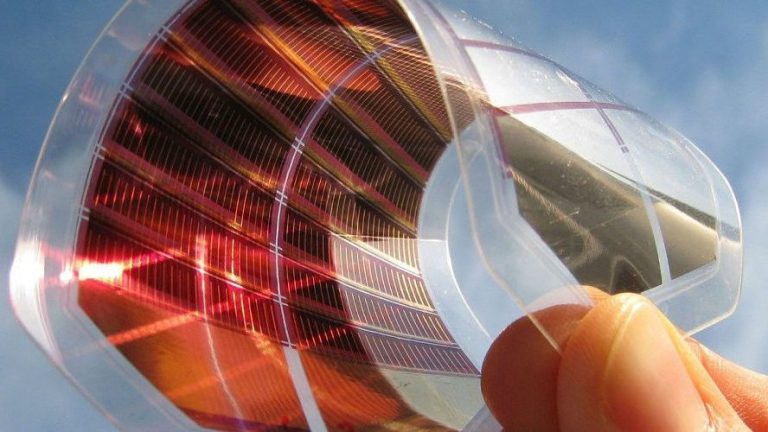
Unlike rigid silicon panels, perovskite solar cells are lightweight, flexible, and can be manufactured using low-cost processes like inkjet printing or roll-to-roll manufacturing. This flexibility allows them to be integrated into various applications, including curved surfaces, windows, or even clothing, expanding their potential use cases beyond traditional solar installations.
3. Wide Bandgap
Perovskite materials have a tunable bandgap, which refers to the wavelengths of light they can absorb. This wide bandgap capability means perovskite cells can harness a broader spectrum of sunlight, including visible and infrared light, more effectively than silicon. As a result, they can maintain higher efficiency levels under varying light conditions, such as cloudy days or low-light environments.
4. Rapid Manufacturing and Scalability
The production of perovskite solar cells is relatively simple and cost-effective compared to silicon panels. They can be produced using solution-based methods at low temperatures, reducing energy consumption during manufacturing. Moreover, their scalability is advantageous for large-scale deployment and crucial for meeting global energy demands sustainably.
5. Environmental Impact
Manufacturing perovskite solar cells typically involves fewer steps and lower temperatures than traditional silicon panels. This results in a reduced carbon footprint during production. Additionally, perovskite materials are more abundant and easily sourced than the rare elements required for silicon panel manufacturing, further reducing environmental impact.
6. Technological Innovation and Research Advancements
The field of perovskite solar cells is rapidly evolving with ongoing research focusing on improving stability, durability, and scaling up production. Innovations such as tandem cells (combining perovskite and silicon) aim to leverage the strengths of both materials to achieve even higher efficiencies and reliability.
For instance, the efficiency of perovskite solar cells has increased from around 3.8% in 2009 to over 25.5% in recent lab demonstrations, approaching the efficiency levels of traditional silicon cells.
Moreover, the development of tandem solar cell designs through combining perovskite cells with silicon or other materials has further pushed efficiency boundaries. Tandem solar cells have achieved efficiencies exceeding 29%, demonstrating the potential for continued improvement.
Applications and Future Prospects
The versatility of perovskite solar modules extends beyond standard solar installations. Their lightweight and flexibility make them suitable for various applications, including integration into windows, facades, and even textiles. These modules hold promise for powering everything from residential homes and commercial buildings to portable electronics and transportation.
Looking ahead, the research aims to enhance stability, scalability, and commercial viability. Collaboration between academia, industry, and government entities is essential for advancing manufacturing techniques and scaling up production to meet global energy demands sustainably.
Conclusion
In conclusion, perovskite solar modules represent a significant advancement in renewable energy technology. With their rapid efficiency gains, cost-effectiveness, and versatile applications, they are poised to play a crucial role in the global transition to sustainable energy solutions. As research continues to innovate and refine perovskite materials, the future looks promising for harnessing solar energy efficiently and economically on a large scale.
By leveraging recent advancements and pushing the boundaries of efficiency and reliability, perovskite solar modules are set to redefine the future of solar power. They offer a pathway towards achieving clean energy goals and combating climate change effectively.