Solar & Storage Live UK 2025 in Birmingham was the essential industry hub where innovators and the energy value chain convened to explore solutions driving the UK’s energy transition.
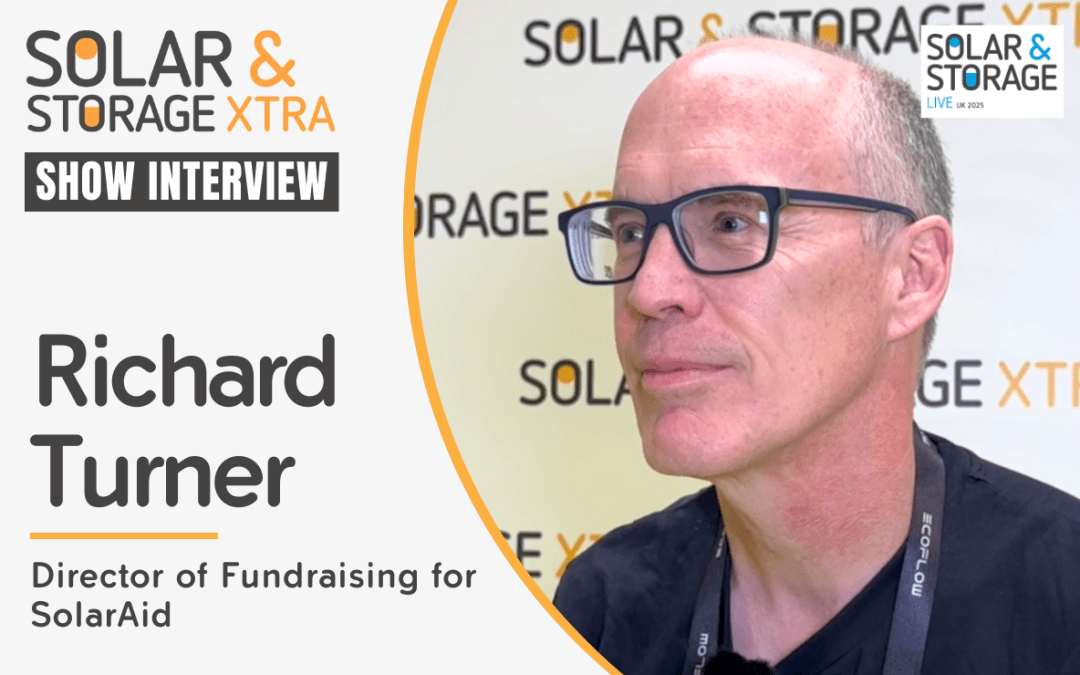
A year after his first interview with Solar&StorageXtra, we caught up with Richard Turner, Director of Fundraising for SolarAid, to hear about the charity’s achievements over the last 12 months.
Richard discussed the success of SolarAid’s ‘Light a Village’ project in Kasakula, Malawi, which has achieved 100% electricity access for one of the poorest communities in the world, and explained its potential for bridging the energy gap for millions across sub-Saharan Africa.
“In contrast to mini-grids, this method of utilising solar home systems allows for rapid deployment and is not significantly constrained by geography.”
Talk to us about the success of your Light a Village project in Malawi.
Kasakula is a community situated in Malawi, and it is recognised as one of the poorest in the country, and Malawi is one of the poorest nations globally.
As such, we deliberately selected this location (in conjunction with the Malawian government) to demonstrate that, if 100% electricity access could be provided to one of the poorest places in Malawi, this achievement could be replicated anywhere.
The Light a Village project has been successfully achieved. The project delivers access to electricity for the first time to many residents; before our intervention, less than 1% of the Kasakula community had access to electricity.
This electricity is financed by the residents through affordable fees, despite 97% of the community living below the poverty line. Therefore, the core challenge was devising a sustainable and workable model for this population.
We devoted significant time to consulting with local leaders, engaging the community, and explaining the concept. The model is fundamentally similar to how most people pay for energy: you don’t pay for the cables or the infrastructure in your home, but you do pay for the energy consumed.
Instead of owning a solar system outright, we install one at no cost to the household, and they subsequently pay a modest daily fee, approximately three pence (GBP), which allows them to activate the unit and have access to lighting. They are also able to charge a mobile phone and potentially a radio.
The initial uptake was significant from the very beginning. We encountered a few unforeseen issues; notably, the rats chewing through the cables, which we had not anticipated.
However, we also gained valuable insights. We discovered that many households would position one of their three provided lights outside their home. When asked about this, they explained that it was a protective measure against the local hyenas!
We proceeded incrementally, starting with 500 homes, then scaling up to 2,500, and this year we successfully reached all 8,813 homes, achieving 100% coverage in Kasakula. We consider this to be a truly significant milestone.
Walk us through the technology and systems SolarAid have brought to Kasakula.
The technology we employ features highly efficient solar home systems. This involves a panel, roughly the size of a laptop, connected to a battery unit, which is mounted on an interior wall of the home.
Once a payment has been made, the unit is activated. The user enters a code to activate it, thereby purchasing seven days’ worth of energy.
The system includes lights which also incorporate wireless switches. Each home receives three of these lights. Furthermore, a battery unit allows for the charging of a radio or a mobile phone, as many residents possess mobile phones.
There are various models available, but we like the one made by Omnivoltaic, manufactured in Hong Kong. We appreciate their willingness to collaborate with us on adaptations. Their model was originally developed for retail, but we require it for a service model, necessitating greater longevity.
Naturally, one component requiring future maintenance, likely after three to five years, is the battery; as such, we are looking to implement enhanced batteries.
To ensure consistent service delivery, we have employed community agents, essentially creating local jobs. They receive a small commission for every payment made, which incentivises them to provide excellent customer care. Throughout the project, we found that the optimal number of customers or households for each agent to manage is 100.
We have community agents who deliver a service directly to the community, with one agent assigned per 100 households. Each agent is also equipped with a specific kit. This includes a graphic displaying the initiative: ‘Light a Village, Kasakula, T/A’, where T/A signifies Territorial Authority.
In fact, Kasakula is named after the Chief, Chief Kasakula, who personally installed the very last light in the 8,813th home. Remarkably, the name of the woman in that household was Charity, which we found particularly apt.
How does working with community agents benefit Kasakulan households?
The community agents are highly effective and mind their customers’ needs. If a replacement is necessary, they manage it because the household does not own the system and therefore bears no risk.
If a lightbulb stops functioning or a battery is somehow faulty, it is replaced at no cost. This is what makes the model viable in a community grappling with such high poverty levels. Moving forward, if we can continue to refine these systems and extend their lifespan, the business model becomes increasingly viable.
We believe this holds immense potential, not just for other regions of Malawi, but throughout sub-Saharan Africa, where 600 million people currently lack access to electricity.
What do you think off-grid solar solutions – such as this project – represent for rural communities worldwide?
We believe the impact is enormous – a paradigm shift. The International Energy Agency (IEA) currently forecasts that by the end of the decade, half a billion people in sub-Saharan Africa alone will still lack access to electricity. This approach can fundamentally alter that prediction.
In contrast to mini-grids, this method of utilising solar home systems, allows for rapid deployment and is not significantly constrained by geography. Traditional grid infrastructure, and even mini-grids, often face challenges due to geographical limitations.
Additionally, the initial cost of deployment for our system is relatively low. We estimate the infrastructure cost to be approximately £100 per household, and the system becomes self-sustaining once the communities begin making payments.
We have established partnerships with other solar enterprises across Africa. The government of Sierra Leone and one of our partners have announced a commitment to reach 40,000 households in Sierra Leone – and have secured funding.
We view this as merely the beginning. We intend to share this model and invite other organisations to participate in this solution. We have established an initiative called REAL, dedicated to enabling others to learn how to develop and implement this energy-as-a-service model.
Can you tell us more about the meet-up session you hosted at Solar & Storage Live UK 2025?
The primary benefit of a meet-up session is the opportunity to network and reconnect with people. SolarAid itself originated from the solar sector. It was founded by a solar business called Solar Century (now acquired), which historically contributed 5% of its annual profits to SolarAid.
A significant number of attendees remember that relationship, including many former employees of that company who now work elsewhere.
As SolarAid has gradually become more widely known, this event serves as a central hub for people to convene, learn about one another’s current activities, receive updates on our progress, and hopefully be inspired to share our story with their own contacts – perhaps within their own organisations.
This type of internal recommendation can sometimes be the decisive factor for a company considering adopting SolarAid as its charity partner.
SolarAid is combating poverty and the climate crisis by collaborating with remote communities on sustainable programmes: creating a local market for solar lights that both provides business opportunities and changes lives for the better.
Donate to SolarAid’s “Big Christmas Challenge 2025” here.
Missed out on Solar & Storage Live UK? Get your free ticket to Solar & Storage Live London – the capital’s most exciting solar event. Or, find a Solar & Storage Live event near you.