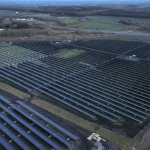
According to UK energy forecaster Cornwall Insight, Britain is set to miss its target of decarbonising the electricity grid by 2030.
Cornwall Insight, a widely well-regarded forecaster, has predicted in its latest Benchmark Power Curve report that solar and wind power will only be 44% of the UK’s electricity mix by 2030. The forecaster’s models predict that a 67% renewable energy majority is needed to decarbonise the entire grid.
The UK’s new Labour government has pledged to 50GW of generation capacity and a zero-carbon electricity system by 2030, which will need solar power’s contribution to triple its current capacity.
Cornwall Insight notes that the pledge must be increased to meet these targets across all renewable energy outputs (such as wind), with solar’s share requiring 55GW capacity. This is 5GW more than the pledge and 10GW more than the forecaster’s projections.
Tom Edwards, Principal Modeller at Cornwall Insight, says:
“While the underlying goal to decarbonise the power system is one that many would agree is crucial for the country’s future, the gap between our current trajectory and the new government’s 2030 target is substantial.
“Without significant intervention, we risk falling far short of the decarbonisation goals.”
Difficulties in achieving the 2030 plan have been attributed to funding, supply chain issues, grid connections, and port capacity. Several solutions have been identified in Cornwall Insight’s model.
- £48bn needs to be added to infrastructure buildout, in addition to the currently predicted 18bn.
- Attracting investment into the UK will be crucial to achieving the targets.
- Funding for schemes such as the Contract for Difference (CfD) should be increased to attract more business.
- A firm commitment to increasing storage deployment, particularly long-term storage, will be required.
Edwards notes that global challenges also threaten the government’s pledge: “International competition for project development coupled with material shortages are challenging issues that often lie beyond a government’s control.
“Our findings highlight the urgent need for a step change in Great Britain’s approach to renewable energy capacity delivery,” is Edwards’ highlighted takeaway from Cornwall Insight’s report.