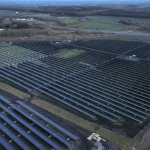
Since the current European Commission took office in 2019, analysis from Ember reveals a significant growth in EU wind and solar capacity, marking a 65% increase (+188GW). This expansion has notably displaced fossil fuel generation and led to a decrease in emissions.
Wind capacity specifically saw a 31% rise (+52 GW), reaching 219GW in 2023, while solar capacity experienced an even more dramatic surge, more than doubling (+113%) from 120GW to 257GW, according to Ember’s findings.8
This surge in wind and solar capacity translated into a 46% combined increase in generation (+226 TWh) from 2019 to 2023, propelling wind and solar’s share in the EU electricity mix from 17% to over a quarter (27%) during the same period.
This growth drove the increase in the total renewables share from 34% in 2019 to 44% in 2023.
Over the same timeframe, fossil generation decreased by 22% (-247 TWh), with significant declines observed in both coal and gas generation. The increase in wind and solar generation (+226 TWh, +46%) managed to displace a fifth of the EU’s fossil generation from 2019 to 2023.
Ember indicates that without the growth in wind and solar, fossil generation would have only decreased by 1.9% (21 TWh) rather than the substantial 22%, as lower electricity demand was offset by decreases in generation from other clean sources.
Germany (+42 GW, +38%) and Spain (+25 GW, +69%) led in wind and solar capacity additions, contributing 22% and 13% respectively to the EU total. However, Ember highlights strong progress across the entire region, with more than half of the 27 Member States doubling or even tripling their wind and solar capacity from 2019 to 2023.
An additional 74GW of wind and solar capacity, representing 39% of the total EU capacity increase since 2019, came from 14 countries excluding Germany and Spain. Notable examples include Slovenia, which added 800MW to reach 1GW in 2023, and the Netherlands, which tripled its wind and solar capacity to 35GW.
Central and Eastern European countries also saw an acceleration in transitioning to clean power, with Hungary quadrupling its solar capacity to 6GW by adding more than 4GW since 2019, and Poland increasing its wind and solar capacity by 3.4 times, adding 18GW or 9% of the total new capacity in the EU over four years.
Thirteen out of 28 countries that installed 1GW or more of solar capacity in 2023 were EU Member States, with only five of these being gigawatt-scale markets in 2019.
Ember concludes that the EU electricity mix ranks among the cleanest globally, significantly surpassing major economies like the US and China. In 2019, the emission intensity of EU electricity generation was less than half the global average at 287 gCO2 per kWh, dropping further to 244 gCO2 per kWh by 2023, marking a 15% decline compared to 2019, which outpaced the global average decline of 4%.