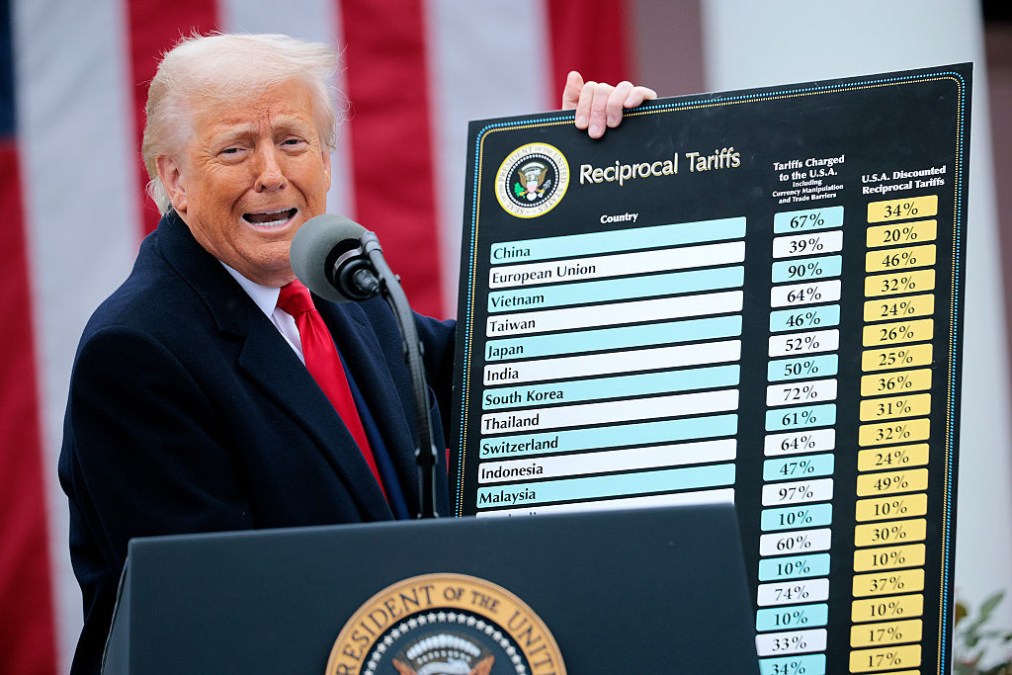
President Donald Trump’s swathe of tariffs this week – ranging from 10% to over 100% on imports from Asia, Europe, and beyond – has created global trade tensions across many industries.
While aimed at protecting American industry the move has wide-reaching consequences, particularly for the clean energy sector, as the new tariff regime reshapes the economics of solar power and intensifies geopolitical frictions.
Domestic short-term pain and uncertain gain
Although the US solar manufacturing sector has grown in recent years, it still heavily depends on overseas imports, particularly from Asia.
In 2024, the country imported nearly 95 million solar panels, the majority of which originated from countries now subject to high tariffs.
Increasing costs
US solar developers face mounting costs due to:
-
- 34% – 82% combined tariffs on Chinese solar and battery imports.
- Tariffs on components for grids and wind turbines from the EU and Canada.
This will drive up electricity prices, reduce profitability, and increase investment hesitancy.
Manufacturing and deployment
While Trump’s tariffs aim to boost domestic manufacturing, the US still lacks the infrastructure to meet demand:
- Most US-made panels still rely on Chinese polysilicon and wafers.
- Domestic production timelines only catching up, and new plants are not yet operational.
The rollback of Biden-era incentives such as the Inflation Reduction Act has compounded industry anxiety. Developers are balancing rising costs, uncertainty about long-term tax credits, and a fragile domestic supply chain.
International disruption and diversification
On 9 April, the European Union votes to pause its retaliatory trade countermeasures for 90 days, as Trump readdressed his tariff rates. But the US’ new tariffs will disrupt global solar supply chains.
Key suppliers like China, Vietnam, Malaysia, and Thailand now face steep levies, impacting exports to the US.
Many manufacturers had already rerouted operations through Southeast Asia to avoid earlier tariffs, but those regions are now targeted. As a result, solar panel prices are expected to rise globally.
However, countries like Turkey, Australia, and Pakistan may benefit from the glut of Chinese solar exports redirected away from the US. This may fast-track their clean energy ambitions, creating a divergence in global adoption.
China in conflict
At the centre of this tariff war lies China: a dominant player in solar manufacturing controlling 80% of the world’s solar panel supply chain. Following his refiguration of tariff rates on 9 April, China’s rate has shot up to 125% “effective immediately”.
Since Trump’s first-term tariffs targeting solar in 2018, Chinese firms have shifted production to Vietnam, Malaysia, and Cambodia to reach US markets. But Trump’s new tariffs have also hit these territories.
In retaliation, China imposed 34% tariffs on US goods – then increased to 84% on 10 April – and is deepening partnerships with Southeast Asian allies to preserve its supply chains.
Meanwhile, Chinese exports, which are already dominant in solar materials, may continue to flood other markets as US demand falls.
Metals and fossil fuels
Despite the slogan “Drill, baby, drill” (repeatedly used by Trump but originally coined at the 2008 Republican National Convention), the fossil fuel industry hasn’t been spared.
Tariffs on steel, aluminium, and uranium have raised costs for drilling and nuclear power projects, and imports from Canada, Kazakhstan, and others are now more expensive.
Regarding batteries, the Financial Times reports that combined tariffs of up to 82.4% are hitting lithium-ion battery imports – 90% of which currently come from China. This could derail US energy storage growth, with 18.2 GW of battery storage capacity planned for 2025 now at risk.
A Western solar power vacuum
Trump’s latest tariffs may have been designed to stimulate US industry, but they risk undermining the nation’s drive towards clean energy hegemony in the West.
Consequences will likely be observed in increased consumer costs and America’s isolation from cheap global supply chains.
While China adapts and even accelerates its dominance, the US faces a critical juncture: invest rapidly in domestic capacity or fall behind in the green energy transition.
[Image credit: Chip Somodevilla / Getty Images]
This article follows on from our coverage of President Trump’s second inaugural address in January. That content can be read here.