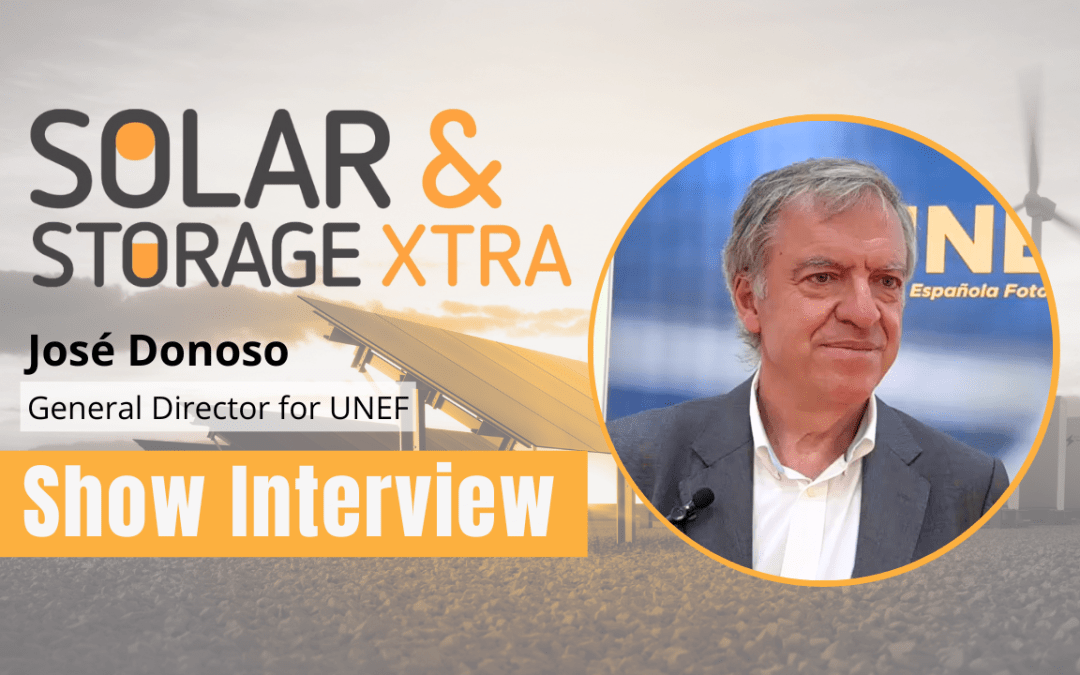
At the 2024 edition of Intersolar, Xtra caught up with José Donoso, General Director for UNEF.
José discussed his panel session on major European markets, issues that have arisen in Spain and wider Europe’s solar markets, and the benefits of attending international solar events for all aspects of the supply chain.
Interview with José Donoso, General Director for UNEF
“On the one side, we need storage so that we can extend the time when we can sell electricity. On the other, we need to increase demand and sell to meet it when the price will be more expensive.”
Xtra: Can you talk to me about your session at the conference yesterday?
José Donoso: The panel yesterday discussed the situation with Europe’s major markets. The situation stands that [Europe] has the five biggest markets, in the sense that last year was very good.
But, at the same time, in all these markets we see some challenges for the future. One situation is that we have one marginal system. It is not the best system for technology; we don’t have marginal costs.
The governments need to make some movement to avoid this problem because when electricity produced by renewables goes to the market and the price is zero, this is not the real cost. We need to face the real possibility, and then we need to be part of the solution.
On one side, we need storage so we can extend the time when we can sell electricity. On the other, we need to increase demand and sell to meet it when the price will be more expensive.
We need to increase electrification. In most countries, the policies decarbonising the electricity sector that use technology were failures. We are very slow, and we need to increase the speed with both administrative measures and incentives.
We need all these kinds of measures to continue the process of decarbonisation.
Xtra: Can you suggest some solutions to three problems currently facing the Spanish solar market?
José Donoso: The problems in the Spanish solar market are common today in all markets, including issues with the marginal system.
The sector needs to do things in not only the right way but in an excellent way. Because every time we have more problems, where we think we have competitive and economic interest in the land’s use related to the policies of political parties – including the far right and far left.
They believe that they can have a political stand against PV. Then, they don’t provide reasons for this to the people and don’t give it any chance.
For our association, we have an excellent certification to assure people that those who deploy PV have notice of their positive integration with biodiversity and that they maximize positive local socioeconomic impact.
Xtra: Why is it important to attend international solar events, and what are the benefits?
José Donoso: It’s good to have the possibility to connect with many different people from different parts of the world. Simultaneously, to get updated on technological development on different platforms, working, and knowledge. These are crucial keys to a solar event
Xtra: What insights are you hoping to gain by attending the show?
José Donoso: There are many insights from different markets and different people, but I can summarise two [of them]:
One, if the local development is continuous, the market is continuing. This is very exciting news, especially for the rising cost of batteries. But there is much exciting news from a technological point of view that gives us more hope if we continue on our way.
The other part is that seeing the progress at a national level is [similar] in many other countries – not only in Europe.
Xtra: What trends do you see shaping the future of the solar industry in the next five years?
José Donoso: I think that we are on the right side of history. There are two alternatives: if policymakers and some players don’t do things in the best way, then our advance [towards clean energy] will be postponed.
Or, if everybody plays the game in the right way, we will advance very quickly to achieve decarbonised energy and cheaper energy which will ensure that electricity will [be received by] everybody, everywhere in the world.