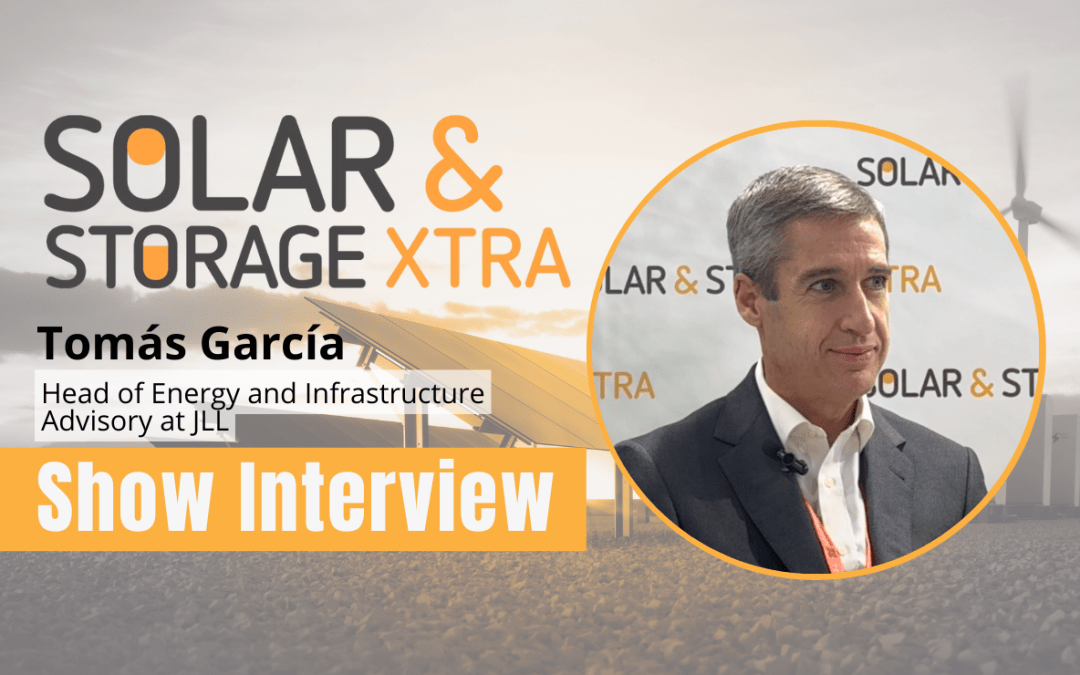
At the first edition of Solar & Storage Live España, Tomás García, Head of Energy and Infrastructure Advisory, Iberia at JLL, sat down with Solar&StorageXtra to discuss key trends and challenges in the renewable energy sector.
Tomás shared insights on the current challenges facing solar plants and energy storage assets, and the growing importance of revenue management over cost optimisation in the industry.
Interview with Tomás García Head of Energy and Infrastructure Advisory, Iberia at JLL
“Renewable energy plants can benefit from multiple revenue streams, and we believe the future will prioritise optimising these sources to maximise revenue rather than solely minimising costs.”
Xtra: What is JLL’s role in the solar industry?
Tomás: The Energy and Infrastructure Advisory Team within JLL are financial advisors specialising in renewable energy and storage transactions.
We support our clients in acquiring, disposing, or financing renewable energy or storage assets, portfolios or platforms.
Xtra: What solar industry challenges are most relevant to JLL at the moment?
Tomás: Solar plants are currently facing challenges such as low capture prices and curtailment events.
For storage assets, there is high uncertainty around future revenue streams, including ancillary services, capacity markets, and arbitrage. I believe this is the main challenge at the moment.
Xtra: As an advisor, which industry topics has JLL been tackling?
Tomás: As a financial advisor, JLL has a strong understanding of the balance between supply and demand in the market.
This includes the supply of renewable energy projects available for sale and their quality, as well as the demand from investors looking to acquire or invest in these projects through equity or debt.
We often observe imbalances in this supply-demand equilibrium. This is a dynamic situation influenced by various factors that continuously shape the industry.
Xtra: Can you talk to us about your presentation at Solar & Storage Live in Barcelona?
Tomás: Our presentation focused on the transition from a cost-centric approach in the renewable energy industry – where the levelized cost of electricity is the key metric – to a future centred around revenue management.
Renewable energy plants can benefit from multiple revenue streams, and we believe the future will prioritise optimising these sources to maximise revenue rather than solely minimising costs.
While both aspects are important, we see revenue management becoming increasingly critical.
Xtra: What are the benefits of attending Solar & Storage Live in Spain?
Tomás: It has been great to be here at the Spanish event. For me, the two key benefits have been:
Firstly, the opportunity to listen and learn. There are many insightful presentations and knowledgeable speakers and panellists. Attending forums and discussions allows for continuous learning, which is invaluable.
Secondly, networking. The event provides a chance to meet and connect with industry professionals.
Often, the most valuable interactions happen during networking breaks, where quick conversations can lead to meaningful follow-ups. These in-person exchanges are crucial for both learning and relationship-building.
With the London edition of Solar & Storage Live only weeks away, don’t forget to register for your free ticket and join us at the London ExCeL from 2-3 April 2025 – or find a Solar & Storage Live event closer to home.