LONGi’s tandem research team has reported a record 34.6% power conversion efficiency (PCE) for perovskite-silicon tandem solar cells, as published in Nature on 7 July 2025 under the title “Efficient perovskite/silicon tandem with asymmetric self-assembly molecule.”
Tandem solar cells combine perovskite and silicon layers to reduce energy losses and surpass the theoretical efficiency limit of 33.7% for single-junction cells.
However, progress has been limited by interfacial non-radiative recombination – energy lost at material junctions.
In earlier research published in Nature in September 2024, LONGi introduced a bilayer passivation method using lithium fluoride and diammonium diiodide.
This approach achieved a certified efficiency of 33.9%, marking the first tandem cell to exceed the Shockley-Queisser limit. “This work is a milestone achievement in photovoltaics,” said the research team.
To build on this, LONGi collaborated with Soochow University to develop a new asymmetric self-assembled molecule (SAM), HTL201, designed as a hole-selective layer.
Unlike conventional symmetric SAMs, HTL201 offers better coverage on textured silicon surfaces and reduces recombination at the buried interface. Combined with a double-side-textured silicon bottom cell, it enabled a PCE of 34.6%.
In a separate project with the Changchun Institute of Applied Chemistry, researchers developed donor-acceptor diradical SAMs.
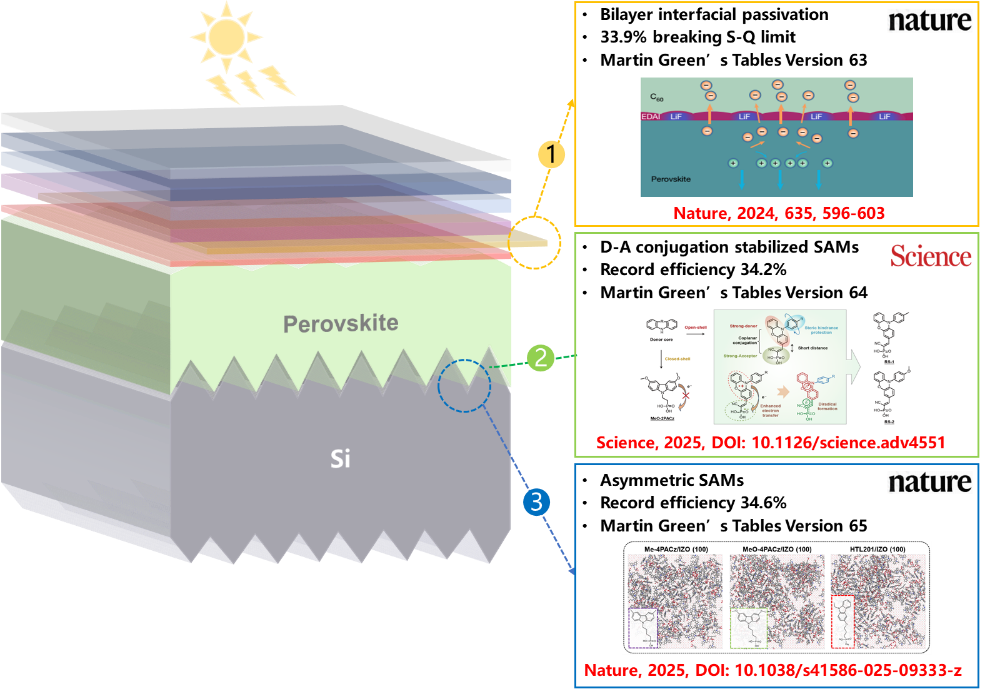
Published in Science on 26 June 2025, the study noted these materials offer “exceptional carrier transport properties, remarkable structural stability under practical operating conditions, and superior assembly uniformity.”
LONGi’s recent innovations – spanning bilayer passivation, asymmetric SAMs, and stable diradical materials – correspond to world-record efficiencies of 33.9%, 34.2%, and 34.6% These are featured in Martin Green’s Solar Cell Efficiency Tables.
The company highlighted its collaborative research model as key to driving progress in next-generation photovoltaic technology.
[Image credit: LONGi]