Press Release
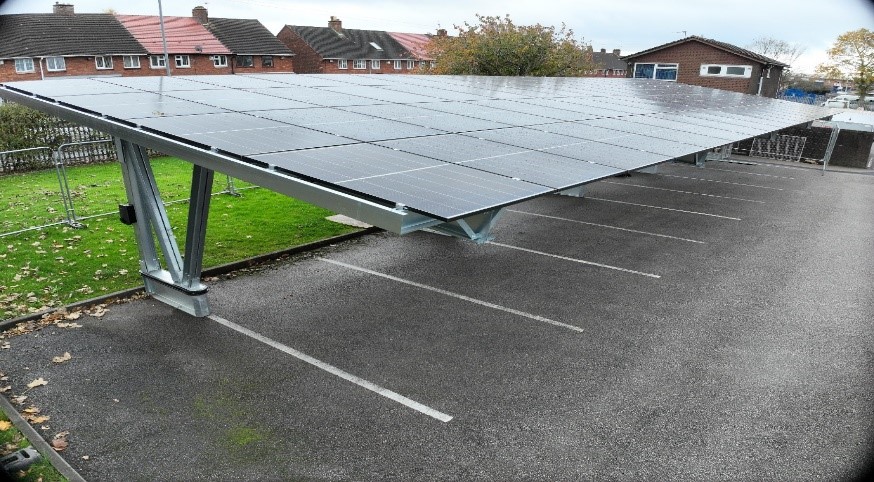
A new market insight report by Energy Positive Assets sheds light on the vast, untapped potential of solar canopies in UK car parks, focusing on the education sector.
The report reveals that solar car parks across schools and colleges in England and Wales could generate over £750m worth of renewable energy annually, transforming educational estates into sustainable power hubs.
With an estimated 1.7m parking spaces in educational institutions (England and Wales) and a growing demand for on-site renewables, the report provides a deep dive into commercial opportunities, regulatory landscapes, and financial considerations shaping the future of solar car parks in the UK.
Policy and market growth drivers
The report highlights growing policy momentum in the UK, influenced by European initiatives such as France’s major solar carport programme.
As the UK government prepares to release its full Clean Power 2030 strategy later this year, early indicators – such as Ed Miliband’s December statement – suggest strong support for solar car parks as a key component of the country’s renewable energy transition.
The convergence of solar and battery advancements, net-zero commitments, and EV infrastructure growth is positioning solar carports as a transformational asset for education institutions.
By leveraging redundant spaces like car parks, schools and colleges can not only generate clean energy but also create valuable revenue streams and lower their operational costs.
Key findings and market potential
- Energy cost savings – A solar carport covering 100 parking spaces can generate over £90,000 worth of energy per year, with estimated savings of £30,000+ under a Power Purchase Agreement (PPA).
- Carbon reduction and net-zero targets – The UK’s legally binding 2050 net-zero commitment and Clean Power 2030 policies are accelerating investment in renewables.
- Rising EV charging demand – With over 1.3m EVs on UK roads, the need for integrated charging infrastructure is growing rapidly.
- Financial incentives – Schemes like the Workplace Charging Grant and the Smart Export Guarantee (SEG), alongside PPAs, enhance the financial viability of solar carports.
The report estimates that even with a conservative deployment of 1 million parking spaces, the market could support £10bn in capital investment and generate over £750m in annual energy revenues.
Further revenue streams could come from EV charging, battery storage, and grid services, making solar carports a financially compelling proposition for schools and colleges.
Recommendations for stakeholders
To maximise the benefits of solar carports, the report recommends:
- Flexible financing models – Leveraging PPAs and leasing structures to minimise upfront costs.
- Battery storage integration – Optimising revenue through EV charging, energy storage, and dynamic pricing.
- Government incentive utilisation – Tapping into existing and upcoming funding schemes, particularly under the Clean Power 2030 framework.
A catalyst for change
While the main challenge remains the £10,000 per parking bay capital cost, financing solutions like PPAs allow educational institutions to implement solar carports with zero upfront investment. Schools can achieve an estimated £300 per parking space in net annual savings while achieving a projected 10% IRR on investments.
By converting underutilised parking areas into energy-generating assets, solar carports are set to become a cornerstone of the UK’s clean energy transition – delivering sustainability, financial resilience, and enhanced energy security for schools, businesses, and public sector institutions.
Access the full report
Read the complete findings here: https://www.solevenergygroup.co.uk/reports/uk-solar-car-parks-education-estates-report-2025
[Image credit: Energy Positive Assets]
Want to publish a press release? Submit your content here for review by our editorial team.