The U.S. Energy Information Administration (EIA) has forecast that solar power will account for more than half of new electric generating capacity coming online in 2025.
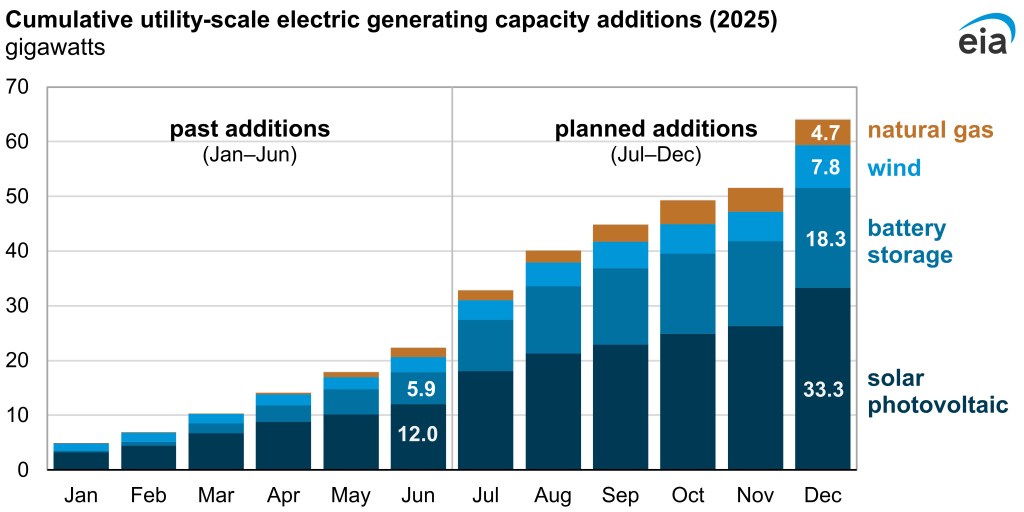
According to the EIA’s latest survey of planned capacity changes, developers added 12GW of utility-scale solar in the first half of the year.
A further 21GW is expected during Q3-Q4, meaning solar could represent over half of the 64GW of new capacity scheduled to be installed this year.
Battery storage, wind, and natural gas will make up most of the remainder.
If all planned projects are completed, 2025 would set a new record for US generating capacity additions, surpassing the 58GW added in 2002. That earlier record was driven almost entirely by natural gas, which contributed 57GW.
While developers have continued to add natural gas capacity since then, the EIA noted that “other technologies such as wind, solar, and battery storage have become more prevalent options for new capacity.”
PV and storage growth
Both solar photovoltaic and battery storage are expected to add more capacity this year than in any previous year. Much of this growth is being driven by activity in Texas.
The state was responsible for 27% (3.2GW) of new solar capacity installed in the first half of 2025, with developers planning to add another 9.7GW before the end of the year. Texas overtook California in 2024 as the state with the most utility-scale solar capacity.
Battery storage was the second-largest contributor to new capacity in the first half of the year, representing 26% (5.9GW). Around half of this was installed in Arizona and California.
Developers in Texas are also expected to bring 7GW of storage online in 2025, most of it in the latter half of the year.
In contrast, relatively little generating capacity has been retired. Of the 8.7GW that operators planned to retire in 2025, only 2GW had closed in the first six months. Some retirements have also been postponed or cancelled.
If current retirement plans proceed, coal-fired power plants will account for 71% of closures in 2025, with natural gas at 19%.
[Graph credit: U.S. Energy Information Administration, Preliminary Monthly Electric Generator Inventory, June 2025]