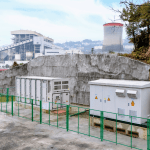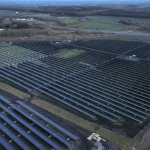
Above: the thermal trap features a cylinder of quartz which reached 1050°C in experiments and glowed
Researchers in Switzerland want to use heat from the sun to smelt steel and cook cement, rather than relying on burning fossil fuels.
On May 15, the researchers published a proof-of-concept study in the research journal Device, which demonstrated the use of synthetic quartz to trap solar energy at temperatures over 1,000°C (1,832°F).
Predicting a big impact on carbon-intensive industries, the new method has a potential future in the clean energy space.
Corresponding author Emiliano Casati of ETH Zurich, Switzerland, said: “To tackle climate change, we need to decarbonise energy in general.
“People tend to only think about electricity as energy, but in fact, about half of the energy is used in the form of heat.”
Glass, steel, cement, and ceramics are high-demand everyday components, but they demand temperatures over 1,000°C to manufacture and rely heavily on burning fossil fuels for heat—industries such as these account for about 25% of global energy consumption.
New tech
A clean-energy alternative using solar receivers has been explored, which uses concentrated and built-up heat with thousands of sun-tracking mirrors. However, this technology struggles to transfer solar energy above 1,000°C. efficiently.
To boost the efficiency of solar receivers, Casati turned to semi-transparent materials such as quartz was used to boost the solar receivers’ efficiency, due to their ability to trap sunlight via the thermal-trap effect.
The team crafted a thermal-trapping device by attaching a synthetic quartz rod to an opaque silicon disk as an energy absorber.
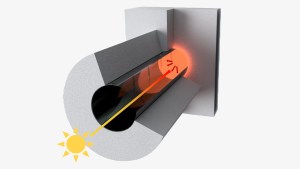
Diagram of a thermal trap
“Previous research has only demonstrated the thermal-trap effect up to 170°C (338°F),” says Casati. “Our research showed that solar thermal trapping works not just at low temperatures, but well above 1,000°C. This is crucial to show its potential for real-world industrial applications.”
The team were also able to simulate the quartz’s thermal-trapping efficiency in different conditions. This showed that the process achieves the target temperature at lower concentrations with the same performance, or higher thermal efficiency for equal concentration.
“Energy issue is a cornerstone to the survival of our society,”Solar energy is readily available, and the technology is already here. To really motivate industry adoption, we need to demonstrate the economic viability and advantages of this technology at scale.” – Emiliano Casati, ETH Zurich
Casati and his colleagues are now developing the thermal-trapping effect and investigating new applications. By exploring other materials, such as different fluids and gases, they were able to reach even higher temperatures.
[Images credit: ETH Zurich / Emiliano Casati]