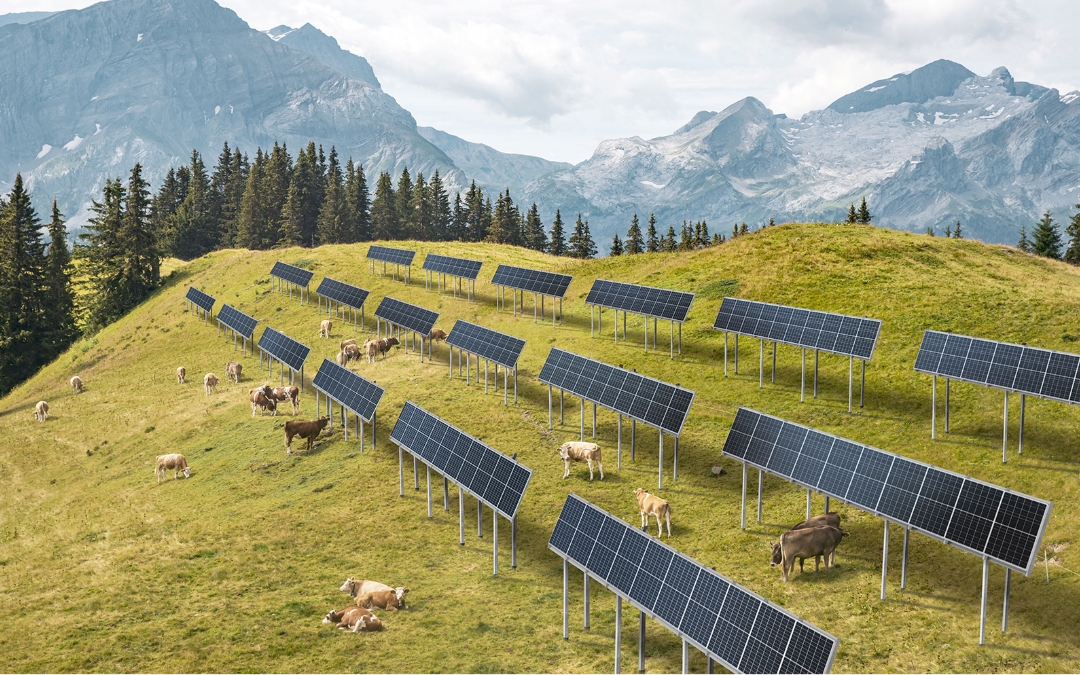
(Image Credit: Impact Gstaad)
Click here to view the official Solar and Storage Live Swiss Solar Market report
The Swiss solar market is taking off. Demand for electricity generated by renewable sources is at an all-time high. Growing concerns around rising carbon emissions have caused the Swiss Government to launch multiple policies regarding the development and deployment of renewable projects in Switzerland.
With an annual GDP volume of over 120billion Swiss Francs, which is more than 20% of Switzerland’s GDP, Zurich accounts for the greatest economic performance and value added in Switzerland.
At its current rate, the Swiss Solar market is expected to register a Compound Annual Growth Rate of 5.1%. A range of policies and objectives have been put into place by the Swiss Government to ensure that this growth continues.
Swiss Government Policy for Solar Growth
In 2019, the Swiss Government announced that Switzerland would reach net-zero gas emissions by 2050. To do this, a planned climate policy has been put into place and will be assessed in 10year intervals. The main objectives of this policy are:
- To decrease carbon emissions by 75-85% by 2050.
- To decrease the emissions per capita to 1t of CO2 by 2050.
- To increase the power generated by renewable sources by 1Twh (from 3.7Twh in 2017 to 4.7Twh in 2020).
With such policies in place, the Swiss government have placed an emphasis on the most cost-effective technology in renewable generation. The declining cost of Solar PV and Solar installation started to drive up the market demand for Solar generation in Switzerland.
Solar PV modules are now 80% cheaper than what they were in 2009 and such a shift has enabled the Swiss Solar market to skyrocket.
What technologies are being deployed?
The current technologies the Swiss Solar market is focusing on deploying are Solar PV modules and Concentrated Solar Power (CSP).
Both technologies are being deployed at residential, commercial and industrial (C&I) scale and at utility scale to maximise Solar generation on Switzerland.
Solar Market trends in Switzerland
Now that the solar technology has been deployed, Solar PV based panels represent the largest segment of the Swiss Solar energy market. This is due to the increased installation of modules at both commercial and residential scale.
Solar PV technology is predicted to dominate the Swiss Solar market in the coming years. A particular emphasis is being placed on thin-film PV modules. The technology is being considered a break-through technology by many because of its increased Solar power sector share.
The Worldwide price decline of Solar PV has been a major factor in the growth of the Swiss Solar market. The cost of electricity generated by Solar assets has decreased by 75% between 2015-2019 and have continued to decline with the technological developments, mass production and increased efficiency of Solar PVs.
In addition to this, the levelized cost of electricity produced from utility scale Solar PV plants is estimated to have fallen by 82%.
In 2021, the average price of Solar PV modules decreased by 68%. This decline has increased the number of solar capacity installations across Switzerland by 53.9%. Decreased price and increased solar capacity installation has led to the rising demand of Solar PVs in Switzerland.
The continuous rise in demand and deployment of Solar PVs in Switzerland provides an opportunity for more companies to enter the Swiss Solar market.
The Swiss Solar energy market is a partially consolidated market with a small number of major players supplying and deploying Solar PV projects in the country. The key players include, Swiss Solar AG, Anerdgy, APAK Energy, ARS Solaris Hachler, and Solaronix SA.
The partially consolidated Swiss Solar market, eventually, will need an increased amount of supply to keep up with government policies in place around reaching net zero targets and renewable energy generation.
New supply chains for the Swiss Solar market are essential to the future success of Solar’s development and deployment in Switzerland.
What is happening in Switzerland?
In May 2021, The Swiss Government allocated close to 470million Swiss Francs for Solar rebates in 2021. This figure represents 20% of the investment costs of Solar projects in Switzerland.
In February 2022, Alpiq announced plans to build the Gondostor bifacial power plant at an approximate cost of 42million Swiss Francs. The objective is for the plant to generate 23.3million Kwh of electricity per year.
In the same month, Megosol Energie AG also announced the launch of the 500w bifacial solar module with an estimated power conversion efficiency rate of 23.2%.
Conclusion
The Swiss Solar market is in an upward trajectory with Government objectives on target to being achieved in the short term. However, without new supply chains, Switzerland’s supply of Solar PV may not be able to keep up to demand in the long term. Increased supply will help continue the positive growth of renewable electricity generation in Switzerland for years to come.
To enquire about interviews, submit news and press releases please contact our Editor, Regan Slaymaker, regan.slaymaker@terrapinn.com.
For sponsorship and exhibition enquires please contact Tom Moon, tom.moon@terrapinn.com.