Statkraft, Europe’s largest renewable energy producer, announced on Thursday that they are scaling down their plans to build new solar and wind plants because of high costs and low prices.
This paring back indicates a wider industry issue, demonstrated by statistics in the S&P Global Clean Energy Index. These show that solar panel and wind turbine producers have dropped 25% in the last year.
Statkraft
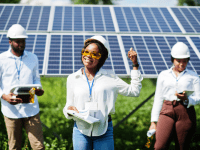
April saw Birgitte Vartdal (pictured above) take up the mantle of Statkraft’s CEO, who promised to “sharpen” the company’s strategy to match the harder landscape of the renewable sector. In her announcement, Vartdal said:
“The transition from fossil to renewable energy is happening at an increasing pace in Europe and the rest of the world. However, the market conditions for the entire renewable energy industry have become more challenging.”
Statkraft now sights 2-2.5GW of onshore solar, battery storage, and wind installation from 2026 and beyond (equal to powering around 2.5m households). This is a drop from the former target of 2.5-3GW from 2025 onwards, and 4GW annually from 2030.
The company has also cut its hydrogen target, which is reduced now from 2GW by 2035 to 1.2GW.
Worldwide
Meanwhile, other European companies, such as Ørsted and Engie, have also announced plans to reduce the scale of their plans for growth despite widespread international political encouragement to pursue renewable energy – most notably at COP28 in 2023.
Rystad Energy’s VP and head of renewables and power, Vegard Wiik Vollset, commented: “Projects have become much more challenging and relative returns simply aren’t there.”
“I would argue that this is not great for the energy transition. Its relative speed is put into question.”