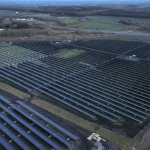
As countries begin implementing policies regarding floating solar plants, several universities in Switzerland have begun researching the country’s alpine solar plants – both ground-mounted and floating.
As Switzerland has invested in a “Solar Express Law” encouraging the construction of solar farms in the Alps, 10% of solar PV production is expected to go back into the national grid by 2025 and 100% by 2030.
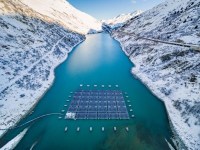
A large factor in this development are floating solar PV plants, one of which is the world’s first high-altitude floating solar farm due to Switzerland’s focus on the Alps. The Lac des Toules plant rests at 1,810 metres altitude and has 35 bifacial solar panels which cover 2% of the reservoir.
The floating platforms are secured to the bottom of the Lac des Toules – allowing them to float during June – December when the water is supplemented by snowmelt, and stay secure in place from January – May.
Floating solar
Researchers from the Zurich University of Applied Sciences discovered that the 448kW Lac des Toules solar farm, built in 2019 by Romande Energie, found that the plant would make back its energy investment in just over two years,
Furthermore, the plant was found to emit 94g of CO2 per kWh over its life cycle. In contrast, traditional ground-mounted solar arrays have been found to have a less efficient energy yield and require more land.
These findings demonstrated a positive development in Switzerland’s move towards a green future.
“The present study adds to the scarce knowledge regarding the environmental performance of FPV systems and gives an insight into the environmental impacts of such installations at high altitudes,” the researchers commented on the study.
“The study thereby identifies leading points for improving environmental performance while highlighting the potential that this technology holds.”
However, the alpine “floatovoltaic” plant was also considered “environmentally intensive”. The floating farm needs up to 8x more aluminium for its mounting system than the ground-mounted one.
The researchers did have a counter for this hurdle: “This can either be done by reducing general amounts of aluminium, focusing on the use of recycled aluminium or replacing aluminium with an alternative material.”
Alpine solar
Switzerland’s other alpine plants have also been under analysis in a database from:
- Bern University of Applied Sciences
- Eastern Switzerland University of Applied Sciences
- University of Applied Sciences and Arts of Southern Switzerland
- Zurich University of Applied Sciences.
The database compares alpine PV plants which are currently operating, in planning, and rejected to accurately assess data. The research found that alpine farms both in development and recently announced have a 939GWh annual yield and 563GWh in active planning.
Overall, studies into Switzerland’s alpine solar farms have demonstrated that this Swiss solution is both effective and environmentally conscious.
Switzerland Energy Week marks the leadup to Solar & Storage Live Zürich, taking place 17-18 September. Haven’t registered yet? Don’t miss out on your free ticket by securing your place here.