by Catie Owen | Nov 19, 2024 | Innovation, Video
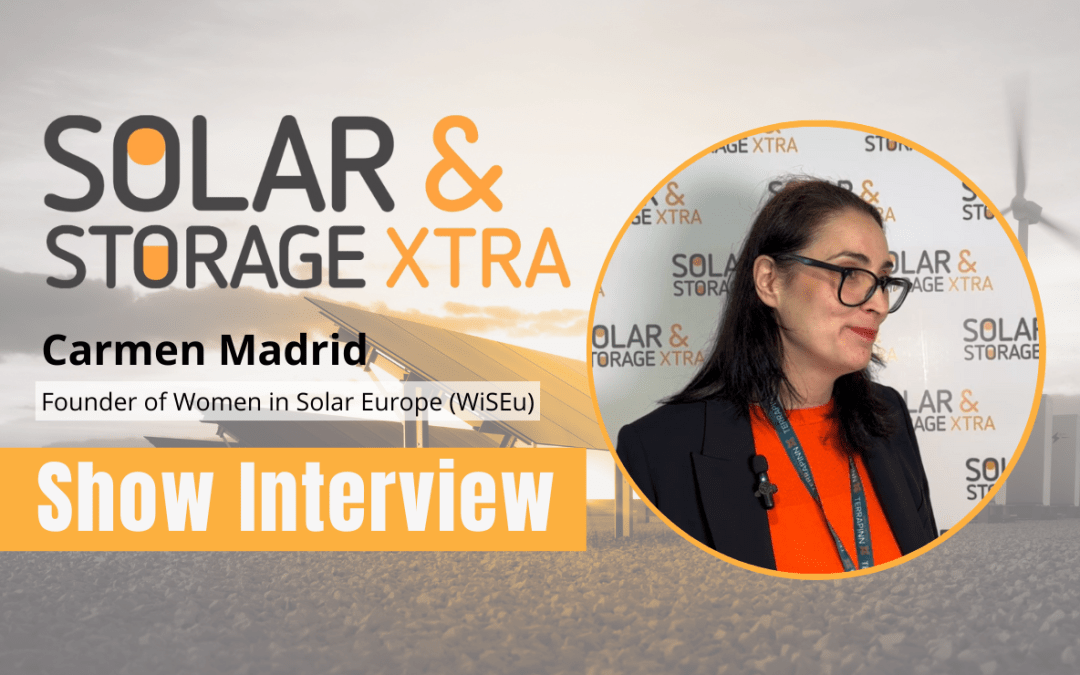
At September’s Solar & Storage Live in Zurich, Solar&StorageXtra had the opportunity to talk to Carmen Madrid, Founder of Women in Solar Europe (WiSEu) and Founding Director of Circular Synergies.
Carmen discussed WiSEu’s mission and work in the renewable energy sector, the initiative’s new mentoring platform, and the importance of creating a psychologically safe environment for all employees.
WiSEu’s strides were evident again at Solar & Storage Live in Barcelona (13-14 November), where members and allies again came out in full force to network and catch up.
Interview with Carmen Madrid, Founder of Women in Solar Europe
“For some, DEI naturally feels like the right thing to do, but for those more focused on business outcomes, it’s important to show the rewards of making an effort.”
Xtra: What is WiSEu’s mission in the industry?
Carmen: We are a network of women – a network for the professional development of women in the solar energy, storage, and EV charging industries. We aim to bring women together, not just to network, but also to guide them through leadership topics.
Contrary to what some might think, the network is not about criticising. It’s about understanding our realities, which are often shaped by cultural backgrounds, and helping to create a new future for the solar and energy industry.
We run workshops, host webinars online, and will soon launch our mentoring program – or rather, a mentoring platform.
Xtra: Has WiSEu shared any announcements (in Zurich)?
Carmen: We have announced the launch of our mentoring platform, which will allow women in the industry across Europe to connect with mentors and mentees anytime. It will let them find matches by fields of activity or specific topics they want to improve in.
Mentoring can be difficult for women to access for a simple reason: there are fewer women in leadership roles, which reduces the pool of potential mentors. Male mentors, meanwhile, are often more inclined to mentor other men.
There’s a lot of data supporting this – people tend to mentor like-minded individuals, which creates barriers for women. This is what we hope to address and resolve with our Women in Solar Europe mentoring platform.
Xtra: Can you talk to us about both your panel session and the WiSEu meetup?
Carmen: Today, at Solar & Storage Live Zurich, we were thrilled to host a panel discussing the business case for diversity, equity, and inclusion (DEI).
Often, it’s women talking about these issues, but there’s a strong business case for DEI. Reports from McKinsey, EY, and the big four (organisations) show that companies with more diverse workforces and more women in leadership positions perform better financially.
For some, DEI naturally feels like the right thing to do, but for those more focused on business outcomes, it’s important to show the rewards of making an effort.
Industry leaders need to understand the significant benefits for their businesses when they embrace DEI.
Xtra: How can solar businesses investing in DEI develop inclusive leadership?
Carmen: There are many ways companies can implement DEI policies and activities. However, one major challenge, as highlighted by the EY index, is that leaders often believe their companies are better at DEI than they actually are. This is why leaders must take responsibility.
Everyone in the organisation is responsible for creating a psychologically safe environment, but that is key to fostering diversity, equity, and inclusion.
Psychological safety allows everyone to feel secure in expressing their ideas without fear of judgment. This starts with awareness of biases. Bias is natural – our brains use shortcuts to make quick decisions – but these shortcuts can lead to stereotypes.
Companies need to provide training to help employees identify and overcome biases. Everyone in the organisation, regardless of their level, is responsible for contributing to a psychologically safe environment, but leaders must lead by example.
Xtra: How can businesses in the solar industry learn how to make inclusive environments?
Carmen: For smaller businesses, especially in the solar industry where many companies have fewer than 50 employees, a good starting point is implementing existing DEI policies that provide guidance.
Another important element is to join networks like Women in Solar Europe. These networks ensure that women, even if they don’t find the support they need within their organisations, can access the resources and sense of belonging they need to thrive.
Even if a company is not yet perfect in its DEI efforts, demonstrating a willingness to improve is critical. There is support available from associations and networks to you get there.
Xtra: What are the benefits of attending Solar & Storage Live in Zurich?
Carmen: The benefits of attending Solar & Storage Live go beyond learning about the latest industry trends in technology and project development. A key ingredient is networking.
What I appreciate about this event is the growing effort in networking. Bringing thousands of people together is great, but the focus on one-on-one and smaller group interactions adds real value.
For example, through the Women in Solar Europe network, we’ve hosted meetups here, which have been incredibly helpful.
This event is unique because it combines technology showcases, industry trends, and excellent networking opportunities through the app and dedicated spaces.
Missed out on Solar & Storage Live, or want to come back for more? Don’t miss the London edition from 2-3 April 2025.
by Catie Owen | Oct 15, 2024 | Innovation
Solar&StorageXtra caught up with Claire Gardner, Marketing Manager for Solis Europe after the Women in Solar Europe Network (WiSEu) hosted their first “speakeasy” event at Solar & Storage Live’s HQ – which was a great success!
Claire also discussed Solis Europe’s experience at Solar & Storage Live in Birmingham this September, her talk at the show, and her crucial role in helping the Solar Taskforce inspire fresh talent.
“We’re in the industry now and know good it is, so it’s our responsibility to talk about it and get the message out there.”
Interview with Claire Gardner, Marketing Manager for Solis Europe
Xtra: What is Solis Europe’s role in the industry?
Claire: We have a broad standard mission, which is to develop technology that drives clean energy and supplies clean energy to the world.
We’re doing that through innovation and technology, and we operate through a span of sectors, from very small inverters for balcony systems to large utility-scale across Europe and globally.
We tailor our products specifically to the needs of certain markets. For example, South Africa has very different needs to the German market and the North American market. To that end, we’re very clear on supplying local knowledge and local teams to support local markets. Thinking globally but acting locally.
Xtra: Can you talk to us about your role in the Solar Taskforce?
Claire: The Solar Taskforce has got lots of different elements to it, and I’m specifically part of the skills and workforce. That is also broken up into different areas because there’s a vast array of skills within our industry’s workforce.
We look at specific apprenticeships and other aspects such as the need for leadership, training, and coaching.
Xtra: How did this experience feed into your talk at Solar & Storage Live?
Claire: In my talk, I explained that there are two jobs to be done, in my eyes. We haven’t got enough physical on-the-ground skills to install all the solar that we need to hit our net-zero targets. Therefore, there are short-term targets and requirements to reach this.
There’s also of longer-term – how do we just make our industry more visible and desirable to attract this talent?
People need to see and understand the vast amount of careers that are within the solar industry. They see solar panels and think of electricians, but there’s so much more to it than that. There are roles familiar to many such as marketing, sales, media, law, business, civil engineering, and more.
Solar can be a sort of hidden industry that’s doing great things, so my talk centred around that as well as kind of delivering against purpose. A lot of people want to work in a business and industry that plays to their purpose, where we’re all striving for the same goal.
We’re in the industry now and know how good it is, so it’s our responsibility to talk about it and get the message out there. For example, do the careers fairs, or do a presentation at your children’s schools! You never know what great talent you might inspire.
Xtra: How does your Solar Taskforce role work alongside your role in WiSEu?
Claire: One of the Solar Taskforce subgroups that I’m chair of is the Diversity, Equity, and Inclusion (DEI) work stream, which is specifically looking at those elements. That work overlaps with what we’re doing in WiSEu, so I’m able to bring in those learnings.
We’re working on sort of frameworks that we could perhaps use as a trade association, frameworks on D and I that companies can draw on. Some companies are doing all the right practices without even thinking about it, but there are still improvements to be made.
We know that we don’t have a gender-balanced workforce, so we focus on that as a priority because a lot of other imbalances will naturally decline once it’s evened out. Of course, gender balance is an issue across lots of industries – not just ours – but we have a huge amount of highly talented women in our industry who we can use as voices.
Alongside this, we can work with senior and male allies within our industry to help drive forward change.
As part of the Solar Taskforce, we can create some tools to help businesses improve what they’re doing and build on the knowledge of those companies that are doing it well.
Xtra: Touching on your work with WiSEu, can you talk to us a bit about last Monday’s event?
Claire: Monday’s event (07/10/2024) was the first of our “speakeasies”. This event was open to our key allies and voices in our network. This doesn’t only include our female members, but everyone who can come together to share learnings, insights, and experiences.
We’re driving a healthy conversation about the positive actions the network can do, and I liked a lot that many of the faces engaging in the conversation were men.
They’re members of companies who are doing great things not because they want to tick a box, but because they understand the business benefits of having a gender-balanced workforce.
We’re hoping to drive this conversation and build upon it further through a series of informal events which are all about getting together in a relaxed environment. Hence, the “speakeasy” format.
These events will be planned around other big events going on because no one needs extra commitments in their diaries. For example, this speakeasy was planned in London for around the same time as a large Bloomberg event for which many of our members would’ve planned to be in town for anyway.
Again, we organised our WiSEu breakfast networking event at Solar & Storage Live in Birmingham, which many members already attended.
Xtra: How did Solis find Solar & Storage Live?
Claire: Solar & Storage Live in Birmingham this year was much bigger. Everyone I spoke to, whether it be other exhibitors or visitors, was wowed by the scale. It’s a visual representation of the UK solar industry, where it’s going, and how it’s performing.
There was a huge amount of positivity in the room for us specifically as an exhibitor. It’s always great to reconnect with our installers and chat with them directly.
These events are important to us because we really get to engage and give installers the chance to come and meet their service support team.
Missed out on Solar & Storage Live, or want to come back for more? Don’t miss the Barcelona edition from 13-14 November.