by Catie Owen | Sep 25, 2025 | Everything Installer, Innovation, Press Release
Press Release
SkyVisor, a global leader in drone-based software solutions for the renewable energy sector, announced the launch of SkyVisor Solar Construction, a cutting-edge platform designed to meet the increasing demands of PV plant construction.
As the solar industry evolves at a rapid pace – with larger project scopes, tighter deadlines, and stricter budgets – SkyVisor Solar Construction offers a transformative solution that allows teams to bring inspections in-house and streamline project management from pre-construction to operations.
“Construction projects demand precision and efficiency to ensure timely completion and optimal performance,” says Fabien Sauvage, co-founder & CTO of SkyVisor.
“With SkyVisor Solar Construction, we aim to revolutionise the solar plant construction process by providing advanced tools and technologies that enable real-time monitoring, anomaly detection, and coordination, ultimately enhancing overall project outcomes.”
An all-in-one platform tailored for solar construction
SkyVisor Solar Construction consolidates every aspect of site monitoring and task management into a single integrated system. The platform includes an automatic flight DroneApp, AI-powered Asset Management Platform WebApp and a FieldApp for on-site collaboration.
By syncing seamlessly with existing data and design tools, it enables construction teams to stay on schedule, reduce delays, and ensure build quality across every stage.
Utilising state-of-the-art drone technology, SkyVisor Solar Construction delivers precise orthorectified imagery, seamlessly stitching together images to provide a comprehensive view of the construction site from above.
It offers unparalleled precision in monitoring construction progress, enabling project managers to identify deviations and address issues promptly, thereby minimising delays and optimising built quality.
Furthermore, by harnessing the power of AI algorithms, the solution enables automated anomaly detection and data analysis, allowing for proactive problem-solving and decision-making.
In addition to its technological innovations, SkyVisor also offers personalised consultation, training, and support to ensure clients maximise the benefits of the software.
Real results for renewable energy builders
Early adopters like PHOTOSOL have reported saving up to 42% of project management time per week, thanks to SkyVisor’s streamlined workflows and actionable insights. From solar rooftops to utility-scale PV plants, the software supports teams in delivering faster, higher-quality builds with fewer resources.
Plus, SkyVisor Solar Construction now leverages the DJI Dock 3 to enable fully automated drone-in-a-box operations. This technology allows drones to autonomously take off, perform scheduled inspection flights, and return to the dock for charging and data upload.
By combining SkyVisor’s AI-powered platform with DJI’s reliable Dock 3, construction teams can maintain continuous, real-time site monitoring, accelerate progress tracking, and ensure consistent data quality even on large-scale PV projects. This approach significantly reduces operational constraints, improves safety, and provides teams with instant access to actionable insights anytime, anywhere.
“SkyVisor enabled us to fully digitalise and monitor our PV plant construction independently using drones and software. It eases reporting and high-scale quality control, enabling us to focus on what matters and more custom project supervision,” says Julian Lesly, Maintenance Technician, PHOTOSOL.
For more information, please visit www.skyvisor.ai.
Want to publish a press release? Submit your content here for review by our editorial team.
by Catie Owen | Sep 24, 2025 | Europe, Innovation
On 23 September 2025, the UK solar and storage sector gathered at The Vox, Birmingham, to honour excellence at the Solar & Storage Live Awards.
Across 13 categories, companies, projects, and individuals were recognised for their achievements in innovation, inclusion, community benefit, and large-scale deployment.
This year’s shortlist highlighted the diversity of the industry, from pioneering contractors and innovative technology developers to grassroots community projects and emerging leaders.
The winners reflect the strength and breadth of the sector – showing how solar and storage are delivering impact at every level, from households to utility-scale.
2025 Winners
- Contractor of the Year
Associated Clean Technologies
- Commercial Project of the Year
Custom Solar: Lakeside Harbour Solar Carport Project
- Diversity & Inclusivity Impact Award
Sonnedix
- EV Infrastructure Project of the Year
Instavolt: Winchester Superhub Project
- The Lucy Aitchison Women in Energy Award
Jo Parker-Swift, CEO, Solivus
- Innovation Award
Genius Roof Solutions: SpeedFlash Kit
- Operations and Management Award
Ecovision Asset Management
- Residential Project of the Year
North Devon Homes/RES Devon/NEA: Evaluating Solar PV with Electric Heating Project
- Rising Star Award
Hemal Morjaria, City Plumbing
- Alan Clark Award for Local/Community Energy
Staffordshire Community Energy Keep Well (KWKW) Project
- Utility-Scale Project of the Year
Sungrow & BW ESS: Bramley Battery Energy Storage System (BESS)
- Wholesaler/Distributor of the Year
Segen
- Lifetime Achievement Award
Stephen Barrett, Chairman and Founder, SolarSense
The winners showcase a sector that is both ambitious and people-focused, demonstrating the scale and technical excellence needed to meet the UK’s growing energy demand.
Congratulations to all the winners and shortlisted organisations for their contributions to building a cleaner, fairer energy system.
Don’t miss out on your free ticket to Solar & Storage Live London – the capital’s most exciting solar event. Or, find a Solar & Storage Live event near you.
by Catie Owen | Sep 23, 2025 | Europe, Innovation, Press Release
Press Release
Freedom, an NG Bailey Group company and a leader in high-voltage electrical infrastructure, proudly announces that its pioneering innovation, the POC-MAST, originally developed as a forward-thinking solution for enhanced grid efficiency and resilience, has now been adopted and added to the G81 register for use on their networks by four DNOs, and is currently under consideration by the remaining DNO.
Originally launched to address the growing demand for sustainable, cost-efficient and future-ready high-voltage solutions, the POC-MAST has undergone extensive testing and proven successful in long-term deployment at 132kV across multiple network zones and is now fully in service across a three DNO networks.
“This is a landmark moment not only for Freedom, but for the wider energy industry,” said Martin Buckland, Innovation Director at Freedom.
“The adoption of the POC-MAST into business-as-usual practice proves that large-scale transformation in the high-voltage sector is both achievable and sustainable, setting a clear path for the future of resilient grid infrastructure.”
Key features and benefits of POC-MAST include:
- Value engineering: Significant reduction in connection costs against traditional tower connections
- Environmental sustainability: Lower Carbon Footprint than traditional tower connection methods
- Installation efficiency: Reduced on-site assembly time improves project delivery speed and workforce safety
- Improved network reliability and resilience: POC-MAST requires significantly less time to connect.
The adoption of this innovation as standard practice is already delivering tangible benefits across capital delivery projects, while directly supporting industry-wide goals to decarbonise infrastructure, strengthen resilience, and accelerate the energy transition.
Its rollout has also established a new benchmark for collaboration between engineering teams, regulators, and supply chain partners. Building on this success, Freedom is now working closely with industry peers to share best practice and unlock further opportunities for innovation at higher voltage levels.
For more information about the POC-MAST and how it’s shaping the future of high voltage electricity, visit http://www.freedom-group.co.uk or come and see us at stand A10 during the exhibition.
Want to publish a press release? Submit your content here for review by our editorial team.
by Catie Owen | Sep 22, 2025 | Electric Vehicles, Europe, Innovation
As the UK accelerates its journey toward net zero, innovative solutions are becoming a critical test for the EV transition. From delivery fleets to public charging access, the pressure is on to ensure infrastructure can keep pace with soaring demand.
With EVCharge Live UK opening its doors this week, we caught up with Giles Shrimpton, Country Director UK for Last Mile Solutions, to discuss how Europe’s largest e-mobility platforms are preparing for the next phase of growth.
Your platform connects over 240,000 charge points, supports more than 850,000 roaming points, and processes over 3.5 million transactions monthly across 22 countries.
How do you maintain reliability and scalability at such a scale?
Giles: We’ve experienced exponential growth in recent years – the number of charge points doubles every year. Reliability in this industry must be built before it’s needed, so we design our systems to anticipate tomorrow’s demand.
That means investing ahead of the curve in both infrastructure and processes. Automation and quality are central, and we were the first in the segment to achieve triple ISO certification in quality, security, and privacy. Our network runs 24/7, 365 days a year, with most incidents resolved automatically before they affect customers.
We’re already testing architecture proven to handle over 500,000 charge points, with scalability to 1 million – the level we believe is necessary for the next phase of the industry.
On roaming, today we connect hundreds of specialist CPOs across Europe. With our one card, you can access over 850,000 charge points. That’s only possible through strict adherence to open standards and close collaboration across the industry – something that makes EV charging unique.
Talk to us about your project with Shell.
Giles: Large-scale migrations are critical operations – it’s not just technical integration, it’s doing it without disrupting end users or operator revenue. This year, with Shell Recharge Solutions and 50five, we’re executing the largest migration in European history: over 100,000 charge points, 10,000 of which are in the UK.
Success depends on four things:
- Certification: Our platform supports over 300 models, covering 98% of charge points in Europe.
- Connectivity: Newer stations with eSIMs can be integrated automatically, but older ones need physical SIM swaps, requiring coordinated changeovers to avoid disruption.
- Data integrity: We clean, reformat, and validate all data before migration.
- Testing: Every station is tested before going live.
Speed matters, but trust is crucial – migrations must never come at the cost of reliability.
We’ve taken over part of Shell’s business while they focus on DC charging. Our partner 50five, a major Dutch installer, is handling Shell’s home and commercial business. This reflects a broader trend in the industry: companies refocusing rather than fully divesting.
Talk to us about your partnership with Visa and its wider impact.
Giles: This combines two market leaders: we lead in EV fleet and roaming technology, while Visa leads in global payments. Together, we’re creating a unified solution for fleet and company car drivers across Europe.
Fleet drivers today mainly use RFID cards running on OCPI. Visa has developed its Fleet 2.0 technology, which brings open-loop payments into the mix, letting customers manage and report on EV charging transactions like corporate credit cards.
The market is evolving. Around 80% of public chargers in Europe are AC with RFID readers, while 20% are DC fast chargers with payment terminals. Regulation is pushing more payment terminals – in the UK, terminals are mandated for chargers over 8kW, and in the EU for over 50kW. In practice, RFID and terminals will co-exist for years.
Our joint offering with Visa ensures fleets can operate seamlessly in both worlds, giving CPOs flexibility to meet future customer and regulatory needs.
What are the biggest challenges you see in 2026 for charge point operators and e-mobility platforms?
Giles: The challenge isn’t just rolling out more charge points – it’s making them active participants in the broader energy system. As Europe shifts from fossil fuels to renewables, charging networks must help stabilise the grid.
We already have projects enabling this future. For example, DHL in the Netherlands uses our EDGE Smart Controller to charge twice as many vehicles overnight, prioritising solar and storage within existing grid connections.
In Rotterdam, with Equans and SMATCH, 15,000 public charge points act as a virtual power plant, balancing supply and demand. And in Utrecht, with Renault and We Drive Solar, we’re piloting vehicle-to-grid technology, enabling EVs to feed power back to the grid during peak demand.
Operators will need to see charge points not just as endpoints, but as intelligent, flexible assets in the wider energy ecosystem.
As Gold Sponsor at EVCharge Live UK, how does your presence at the show reflect your European market strategy?
Giles: The UK is a strategic growth market for us, and EVCharge Live offers the right balance – focused on e-mobility but embedded within the UK’s largest solar and storage event. It attracts CPOs, energy companies, and infrastructure partners.
Our strategy is to be present wherever the energy transition conversation is happening – charging, generation, grid, storage. That’s where the real innovations happen, and EVCharge Live is an ideal platform.
Will you be showcasing any projects at EVCharge Live UK?
Giles: Yes. We’ll showcase our EDGE Smart Charging solution, which optimises charging between stations, the grid, solar, and storage.
We’ll also present our partnership with Mastercard on cloud-based payment terminals. This lets CPOs manage charge points and payment terminals on a unified, hardware-agnostic platform. We believe this cloud-based approach will be the most future-proof solution for CPOs facing rapid growth and evolving payment regulations.
This series covers the developing electric vehicles market of the UK and its increasing infrastructure, as the nation advances its net-zero goals.
For all things EV, don’t miss out on your free ticket to EVCharge Live UK – taking place 23-25 September 2025.
by Catie Owen | Sep 22, 2025 | Electric Vehicles, Europe, Innovation
From democratising access to charging with its wide AC and DC product range, to integrating scalable battery storage solutions and tackling grid constraints, technology manufacturer Vestel is positioning itself at the forefront of the UK’s charging infrastructure rollout.
Ahead of EVCharge Live UK (23–25 September 2025), we heard from Sally Bailey, Head of EVC Sales – UK for Vestel Mobility, to explore how the company is shaping the UK’s electric vehicle (EV) charging landscape.
What is Vestel’s role in the EV sector?
Sally: Vestel Mobility is about driving forward the change to decarbonised transport through democratising EV charging. From 7kW AC consumer chargers like our popular Libra model to the largest DC units with optional BESS, our entire range is designed, engineered and built in Europe.
This significantly reduces transport time, the carbon footprint, and, thanks to our economies of scale as one of Europe’s largest electronics manufacturers, costs. We aim to make EV charging simple, accessible, reliable, and affordable for everyone.
How are Vestel’s BESS solutions being integrated with charging infrastructure in the UK?
Sally: BESS is a significant part of our European portfolio, as we offer a range of products across the full spectrum of the charging industry. Our residential battery systems are gaining traction across Europe for their reliable and low-cost design, while our commercial BESS systems are modular and can be scaled to support our largest 1 MW+ chargers.
These are exceptionally useful for providing reliable charging infrastructure to rural villages where there is no grid supply to support peak-time usage by multiple vehicles. These larger systems will be the first Vestel mobility BESS in the UK, with several exciting projects that we will announce shortly.
How is Vestel preparing to address the UK’s fast‑charging infrastructure needs?
Sally: We have identified the major pain points of evolving the UK’s rapid and ultra-rapid charging network as grid supply, reliability and cost. So, we are developing Europe’s most comprehensive portfolio of DC charging products designed to address these very issues.
At the heart of Vestel’s operation is a large-scale, low-cost, and highly reliable European electronics manufacturer, and we are leveraging those USPs through Vestel Mobility’s portfolio.
The modular construction and scalable architecture of our DC charger products enable CPOs, public authorities, and fleet operators to start small and scale with demand. We see these up-front cost-reducing initiatives as vital in helping speed the rollout of UK charging infrastructure.
Our reputation for reliability, data security, value and speed to fulfilment, built on over 40 years of European manufacturing, means we are already the trusted OEM partner to most of the world’s biggest-name consumer and commercial electronics brands.
We are bringing those same values to our entire Vestel Mobility portfolio to address the rising demand for fast-charging infrastructure across the UK.
What are the greatest challenges for scaling EV infrastructure in the UK, and how is Vestel addressing those?
Sally: Grid supply and the cost/time demand of upgrading connections are the biggest challenges for UK EV charging infrastructure, and we don’t see that changing for some time.
Demand for ultra-rapid EV charging is already outstripping grid capacity at peak times in many areas of the UK, necessitating load-balancing measures that result in slow charging irrespective of the charge points’ advertised output. That is not helping to sway corporate or public opinion to EVs, as slower charging means slower adoption.
We see BESS as a fundamental in addressing the UK’s fast charging infrastructure. Not just in rural areas but also in UK towns and cities, where plans and timeframes to upgrade the grid are a long way behind the predicted growth in EV transportation.
Products like our 1.2MW DC Stella M will only accelerate the grid supply bottleneck. Yet this size of product is fundamental to the transition of haulage, HGV and PSVs to electric, as the sector cannot afford lengthy downtimes for charging.
BESS is a straightforward solution in many cases, particularly when backed up with local renewable energy generation and, eventually, two-way V2G infrastructure.
What are your targets for charger installations, partnerships, and revenue over the next 2–5 years?
Sally: The next 2-5 years will be fundamental to EV sector development in the UK, and we aim to be at the forefront of democratising charging for everyone, everywhere in the UK. Our scale and reputation for reliability mean low-cost and low-maintenance products.
Our European manufacturing base means unrivalled speed to fulfilment, lower costs, and a lower carbon footprint. And our UK operation, with its highly experienced team, means the highest level of service and support for all our UK customers.
Over the next five years, we have all the ingredients to become one of the UK’s go-to suppliers for EV charging products. From high-volume AC units for residential markets to the highest capacity DC infrastructure models, and scalable BESS solutions to renewable integration.
We boast one of the best manufacturing bases in Europe, are set up to OEM and white-label for larger operators, offer a CPMS-agnostic platform, and have top-notch business partners for those looking for a one-stop solution, including our software partner Electric Miles.
We tie that all together with an experienced UK team delivering local sales and support.
Which Vestel products and innovations will you be showcasing at EVCharge Live, and what are the benefits of attending as title sponsor?
Sally: We have taken the title sponsor of the UK’s leading EV charging trade show to demonstrate our commitment to the UK market, meet customers from around Europe, and unveil a groundbreaking new product!
The event will see the world’s first unveiling of our new 1.2MW DC Stella M, which will be Europe’s first ultra-high capacity (over 1MW) commercially available EV charger!
This series covers the developing electric vehicles market of the UK and its increasing infrastructure, as the nation advances its net-zero goals.
For all things EV, don’t miss out on your free ticket to EVCharge Live UK – taking place 23-25 September 2025.
by Catie Owen | Sep 17, 2025 | Europe, Innovation, Press Release
Press Release
Levelise, the UK’s leading – and only – company delivering flexibility services directly to households, has announced the launch of its next-generation home energy device: Hub 2.
Now 80% smaller and 90% lighter, the Hub 2 is quicker to install and easier to integrate into homes, while continuing to deliver savings and direct payments to homeowners.
The new Hub 2 takes energy optimisation even further for homes with solar and battery systems, maximising both savings and earnings. For homeowners, the compact Hub 2 fits seamlessly into the home, intelligently managing energy use to lower bills by optimising when and how stored energy is used, all without compromising comfort.
Homeowners remain free to choose their energy supplier, while Levelise takes care of the rest – automating home comfort and generating direct income through smart energy trading. By syncing with time-of-use energy tariffs, the Hub also ensures you buy electricity at the cheapest rates and use stored energy when prices peak.
Installers can now get systems fully installed and commissioned in just 20 minutes, thanks to enhanced connectivity. The process is smarter and faster than ever: quick-fit wall mounting, plug-and-play connectors (no hardwiring required), and a simple three-step app-based commissioning flow mean you’re up and running in no time.
Iván Castro, Operations Director at Levelise, said: “With Hub 2, we’re making it easier for both installers and homeowners to be part of the energy flexibility future.
“Households can turn their solar and battery systems into income-generating assets while supporting a greener, smarter grid. Intelligent optimisation extends battery life and maximises energy savings, so with the Hub 2, your battery works smarter, lasts longer, and performs better.”

By aggregating thousands of home batteries across the UK, Levelise has built a powerful Virtual Power Plant (VPP). This enables households to participate in grid flexibility services – earning income by trading excess capacity into the energy markets and providing balancing support to the National Energy System Operator (NESO).
Since its inception in 2019, Levelise has focused on innovation and continuous improvement. Over 5,000 Hubs are already installed across the UK and it remains the only operator trading solely with home assets at scale.
Their proven trading success has translated directly into financial results for households, having paid over £2m to its domestic customers with batteries to date, with 94% exceeding their projected flexibility payments since 2019, and with average earnings and savings for homeowners at £490 per year.
Furthermore, Levelise flexibility payments can now be included in finance deal assessments, helping reduce the effective payback period and improve the overall value proposition. This means future flexibility income can be factored into affordability checks and financial modelling, making it easier to access financing for smart battery installations.
The Levelise hub is now compatible with seven battery manufacturers, including Solax, Alpha and Afore. The Hub 2 will be available to installers as part of a package, including a hybrid inverter, a 10kWh battery and the Levelise Hub 2, priced from £3,100 (exc. VAT). Other packages are also available.
UK Solar Week marks the leadup to Solar & Storage Live UK, taking place 23 – 25 September. Haven’t registered yet? Don’t miss out on your free ticket by securing your place here.
by Catie Owen | Sep 9, 2025 | Innovation, Storage
Press Release
Sungrow, leading provider of renewable energy solutions, is expanding its market presence in Switzerland. Sungrow’s portfolio includes PV inverters, energy storage systems (ESS), and EV charging solutions.
The company is working with distributors Krannich, Sonepar, Fankhauser, and Solarmarkt to ensure comprehensive sales coverage of the Swiss market.
To actively participate in industry discussions in the country, the company has joined the solar association Swissolar and will be present at the upcoming Solar&Storage Zürich from September 16 to 17.
“We see a growing demand for smart energy solutions and high-quality services in Switzerland,” says Christian Welz, Country Manager DACH at Sungrow Europe. “Locally, we are already working with strong companies and will continue to expand our presence.”
For over 18 years, Sungrow has been active in Europe, offering innovative products, local sales, technical support, and after-sales services. The company currently operates with over 750 employees, more than 25 local offices, and two R&D teams.
Record expansion of PV in Switzerland
Switzerland aims to increase the share of renewable energies and reduce dependence on fossil fuels with the Energy Strategy 2050.
Last year, a record addition of 1.8MW of PV capacity was installed. By the end of 2024, PV systems with a cumulative capacity of almost 8.2GW were in operation.
In recognition of the needs of the Swiss market, Sungrow has established a local team of experienced professionals for comprehensive technical and commercial support.
From residential and C&I projects to large-scale ground-mounted systems, Sungrow offers solutions with the highest performance and reliability while complying with local standards.
Customer support at the highest level
To provide the best possible support to customers, Sungrow has established a comprehensive structure.
This includes a dedicated service hotline and extensive documentation, a strong sales network through Krannich, Sonepar, Fankhauser, and Solarmarkt, as well as a dedicated team of experts, including a Partner Success Manager (PSM) who supports local distributors, installers, and partners.
To further increase the efficiency and safety of installations with Sungrow products, the company regularly organises meetings and training programs, both online and in person.
These are free, tailored to the Swiss market, and aim to educate technicians, installers, and other key players in the PV sector.
Solar & Storage Zürich
Sungrow will be present at Solar & Storage Zürich from September 16 to 17 with a large booth and numerous experts. The entire product portfolio of efficient energy solutions from residential and C&I solutions to large-scale systems will be showcased, among other things:
- Micro-inverter portfolio (450-1600W), which allows households to efficiently improve their green energy supply.
- The scalable and modular battery storage PowerStack for commercial and industrial applications (C&I) up to 455kWh.
- The liquid-cooled large-scale ESS PowerTitan 2.0 with a capacity of up to 5MWh.
- The software solutions iHomeManager 2.0 and iSolarCloud for effective data and energy management.
- AC and DC charging stations for electric vehicles from 11 to 480 kW for private, commercial, and public customers.
Visit the Sungrow booth C20 to learn about the latest industry developments and products.
More information about Sungrow can be found on the Sungrow Europe LinkedIn account and by subscribing to the Sungrow newsletter.
Swiss Solar Week marks the leadup to Solar & Storage Live Zürich, taking place 16-17 September. Haven’t registered yet? Don’t miss out on your free ticket by securing your place here.
by Catie Owen | Sep 9, 2025 | Electric Vehicles, Europe, Innovation
On World EV Day, we celebrate the vast leaps we’ve made in EV technology, share the benefits of adopting EVs, and encourage the wider transition to sustainable transportation.
The UK’s EV market is thriving, and EVCharge Live has risen to meet its needs. We go behind the scenes with Claudia Davidson, General Manager – Infrastructure at Terrapinn, who is working behind the scenes to ensure EVCharge Live UK meets industry experts where they are.
“What excites us most is how the market is broadening – investment is moving into fleets, storage solutions, grid upgrades and new business models.”
Why launch EVCharge Live UK now?
The UK charging market has shifted from vision to delivery. EV adoption is rising fast, government targets are ambitious, and serious investment is being made in infrastructure.
That creates the need for a national meeting point where everyone involved – policy makers, operators, investors and innovators – can come together.
By co-locating with Solar & Storage Live, we’re taking it a step further. The show will connect EV charging with renewable generation, energy storage and grid flexibility.
That’s where the big opportunities lie – in bi-directional charging, in turning EVs into an energy asset, and in creating a smarter, cleaner system that benefits everyone.
On World EV Day, what UK milestones stand out?
We’re celebrating over a million EVs now on UK roads, and a charging network that’s grown by more than 50% in the last two years. Rapid and ultra-rapid hubs are becoming the new norm.
But what excites us most is how the market is broadening – investment is moving into fleets, storage solutions, grid upgrades and new business models.
We’re also seeing innovative payment systems and bi-directional charging projects gaining real traction. These milestones show that EVs are no longer just about vehicles – they’re becoming a core part of the energy ecosystem.
What does the industry need next – and how will the show help?
The industry needs a clear long-term policy, faster grid connections, a bigger, skilled workforce and charging that’s genuinely customer-friendly. But we also need to think beyond today’s challenges.
Storage, vehicle-to-grid, and the integration of charging with energy flexibility are going to be critical. EVCharge Live UK is designed to reflect that. We’ll have fresh perspectives from new exhibitors and innovators, alongside established players.
The conference will cover regulation, finance, skills and tech, while the exhibition will showcase everything from next-gen chargers and bi-directional solutions to software that makes charging seamless.
Who should attend, and what will they find?
Anyone shaping the EV charging market – investors, charge point operators, local authorities, fleets, and technology providers.
Attendees will get both strategic debate and practical insight. They’ll hear how investment flows are shifting, how fleets are managing transition, and how local authorities are navigating rollout.
On the show floor, there’ll be a mix of established names and new exhibitors bringing fresh ideas, especially around energy storage and bi-directional charging.
And because the event is co-located with Solar & Storage Live, it’s also the perfect place to explore how EVs link into wider energy innovation.
Where is the show heading in future?
We want EVCharge Live UK to become the annual home of the sector – the place where the industry comes together to do business and shape its future.
Over time, the show will broaden as the market broadens. Expect to see more on new business models, international case studies and the deep integration of EV charging with renewable energy, storage, and smart city infrastructure.
Each year, the event will evolve, bringing in new voices, new exhibitors and fresh perspectives that reflect where the industry is really heading.
This series covers the developing electric vehicles market of the UK and its increasing infrastructure, as the nation advances its net-zero goals.
For all things EV, don’t miss out on your free ticket to EVCharge Live UK – taking place 23-25 September 2025.
by Catie Owen | Sep 9, 2025 | Americas, Commercial & Industrial Solar, Europe, Innovation
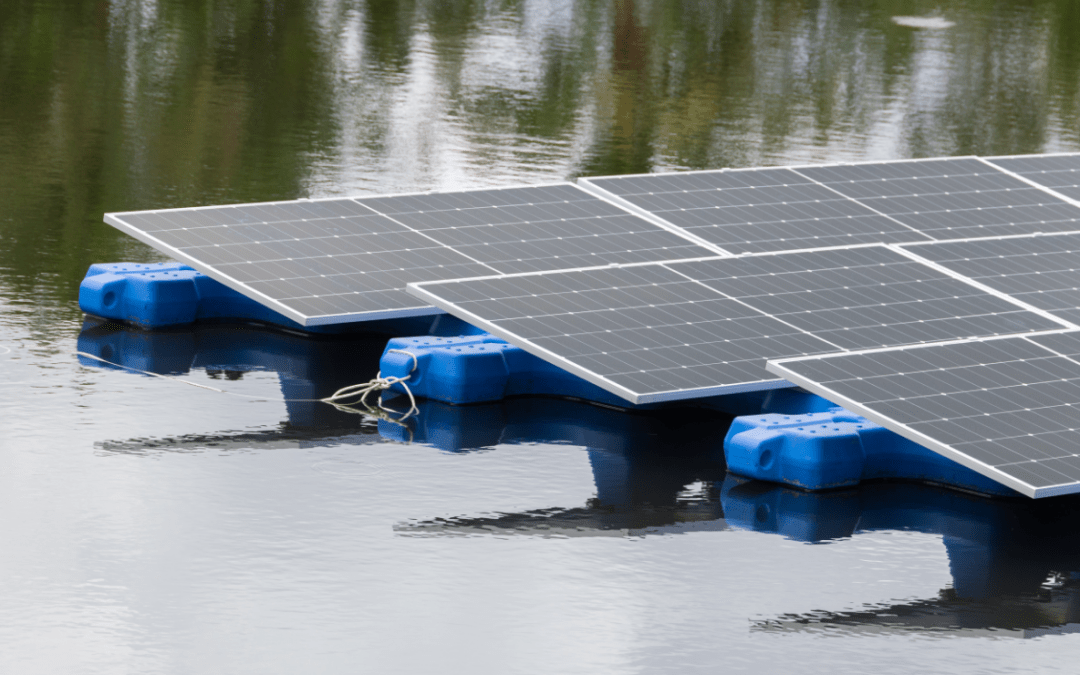
The Regulatory Authority of Bermuda (RA) has launched a Request for Expression of Interest (RfEoI) for the development of a floating solar photovoltaic (FPV) power plant, marking the first stage in a multi-step procurement process.
The project forms part of Bermuda’s 2019 Integrated Resource Plan (IRP), which targets 85% renewable energy penetration by 2035.
With limited land available, the RA views FPV technology as a viable solution for expanding solar capacity. The government has authorised the use of designated seabed areas for such development.
According to the RA, the project could deliver up to 10 MW of floating solar capacity, either at a single large site or across multiple smaller sites. Proposed systems are expected to connect to Bermuda’s 22 kV electricity network. Preliminary sites include locations on the east and west sides of Finger.
Through the RfEoI, the RA seeks to identify experienced developers capable of managing a full FPV project, from feasibility studies and system design to installation, commissioning, and potential operation.
The process
The tender process will follow three stages: Expression of Interest (current stage), Request for Qualification (RFQ), and Invitation to Tender (ITT).
Only bidders that pass the prequalification stage will advance to later phases. The successful developer will be remunerated through a long-term power purchase agreement (PPA) with BELCO, Bermuda’s Transmission, Distribution and Retail (TD&R) licensee.
An Evaluation Panel (EP), comprising representatives from the RA, government departments, and other stakeholders, will oversee the process.
Assessment will be based on criteria such as technical and managerial capacity, financial stability, relevant experience, and cost estimates for power generation.
The indicative timeline sets the deadline for Expression of Interest submissions at 4 November 2025, with evaluation continuing through the end of the year.
The RFQ stage is scheduled to begin in January 2026, with tenders expected by the third quarter of 2027. The winning and reserve bidders are due to be announced in early 2028.
by Catie Owen | Sep 8, 2025 | Europe, Innovation, Storage
As Switzerland accelerates its transition to renewable energy, Solar & Storage Live Zürich has quickly established itself as a key meeting point for the sector.
Mark Lewis, Commercial Director for Solar & Storage Live Zürich, shares what’s new for 2025 and how the show is helping to shape Switzerland’s energy future.
“Our free educational content ensures that everyone – from utilities to small installers – leaves with insights, practical knowledge, and new connections.”
Why did Solar & Storage Live choose Zürich, and what were the key learnings from the inaugural edition?
Terrapinn has been organising the Solar & Storage Live portfolio worldwide for over a decade. We entered Europe around seven or eight years ago, and in early 2022, we looked at how to expand further.
By 2023, we decided to take the event across Europe, continuing our model of connecting technology suppliers and providers with local audiences of installers, project developers, and large end users.
The challenge was to identify countries with both business potential and government support for renewable energy, while avoiding markets that already had established events. Switzerland stood out: there were smaller conferences, but nothing offering a full trade exhibition and conference for the entire supply chain.
Solar energy in Switzerland has grown exponentially. In 2022, solar accounted for 4.7MW – about 6% of total electricity. By the end of 2025, it is projected to reach 8.1MW.
This growth stems from government legislation: the Swiss Energy Strategy 2050 and the Energy Act of 2022, which aim to phase out nuclear power, cut greenhouse gas emissions, and boost renewables.
The Swiss government also supports solar through one-off payments for small and large installations. This created a strong case for launching in Zürich, benefitting both local players and international manufacturers exploring the Swiss market.
As for learnings, the first show was pulled together quickly. We had limited resources, limited local knowledge, and language challenges. But the response was clear: the Swiss audience wanted this type of event and appreciated the format, which differed from the conferences they were used to.
Some expected more international exhibitors, and many assessed the market in year one before committing fully.
Now, we’ve established events not only in Switzerland but also in Spain, and this year in France and Italy, in addition to the UK. That portfolio shows we’re offering regionally distinct audiences and real business opportunities.
What is your overarching vision for the Zürich event’s role in Switzerland’s energy transition?
For our Zürich event specifically, it’s already becoming a one-stop shop for the entire supply chain, tackling unique challenges like Alpine terrain, while showcasing how technology is being adapted to meet them.
We want Solar & Storage Live Zürich to become a marketplace for innovation. This year we’re seeing many new start-ups, often spun out of academic institutions. Zürich itself is known for its innovative start-up culture, particularly in AI and IT, which we’re also seeing reflected in solar software solutions.
The show is also a platform for local cantons, government, and utilities to engage, debate, and collaborate. For project developers and installers, it’s about identifying specific benefits of solar adoption and solutions for major storage projects, ensuring energy is effectively stored and integrated into the grid for both consumer and industrial use.
Can you highlight some stand-out features of this year’s show?
The most striking thing is how quickly the event has grown. This year, we have over 100 speakers across four conference streams, covering academia, government, utilities, and the supply chain, alongside almost 100 exhibitors.
Visitors will see a mix of international brands and Swiss distributors, 50 new exhibitors, plus 13 start-ups – many of them university spin-outs – which bring real innovation to the floor.
We’ve introduced an installer zone for hands-on engagement, where local installers can meet suppliers and explore solutions to challenges like Alpine conditions.
Networking is also a key feature: structured meet-ups and informal sessions bring together cantonal authorities, project developers, utilities, and technology firms. Switzerland’s mix of German, French, and Italian-speaking regions adds to the value, making it a true meeting point.
Finally, our free educational content ensures that everyone – from utilities to small installers – leaves with insights, practical knowledge, and new connections.
Who will benefit from attending?
Utilities, installers, and project developers from across Switzerland – and beyond, including Austria, Germany, and northern Italy – will benefit. International brands such as SolarEdge, SIG Energy, and 7 Sun are on board, reinforcing the event’s credibility.
From the distributor side, we have established names like Solomart, Tritec, Solexis, and Solvetica, alongside newer players such as EP and Fergalen. This shows we’re representing the entire Swiss market.
Importantly, we also have international exhibitors from Spain, Italy, China, the UK, the Netherlands, and even the Middle East. But the event works because of the strong local element: installers, start-ups, and dedicated meet-ups for the supply chain.
End users, such as hospitals, schools, and large businesses, can explore technology options, costs, and suppliers. Installers and developers, many with backgrounds in electrical or heat pump trades, can discover new opportunities and technologies suited to Switzerland’s unique climate.
For example, exhibitors will showcase PV systems designed to withstand heavy snowfall – something also needed in France or Spain.
Can you talk about the topics on the conference programme?
The conference spans four streams: utility-scale, commercial and industrial, storage, and residential. In Switzerland, commercial, industrial, and residential take centre stage.
We’ll cover the impact of the new Swiss Electricity Act, PV integration, battery storage applications, and agri-photovoltaics for farming. Community energy projects and urban carports are also on the agenda, alongside decarbonising buildings with solar.
We’re also very pleased to have the President of the Swiss Green Party speaking.
What’s on the horizon for Solar & Storage Live Zürich’s future editions?
Now that we’re firmly on the map, the next step is further internationalisation. This year we already have Chinese delegations attending, recognising Zürich as a gateway to central Europe. In future, we’re looking at pavilion groups and broader international participation.
At the same time, the local audience remains central. Swiss exhibitors are eager to engage not only with international players but also with German, Austrian, and other central European businesses viewing Switzerland as a growth area.
Outside the UK, Zürich is already our most successful European event, and we look forward to building on that success in year three and beyond.
Swiss Solar Week marks the leadup to Solar & Storage Live Zürich, taking place 16-17 September. Haven’t registered yet? Don’t miss out on your free ticket by securing your place here.
Companies looking to confirm their stand at next year’s event should contact Mark Lewis at , or meet the sales team in person on stand F50 at next week’s event in Zürich
by Catie Owen | Sep 5, 2025 | Asia, Innovation
Press Release
LONGi’s Hi-MO 9 module, powered by its advanced HPBC2.0 technology, has recently been awarded the Product Carbon Footprint Label Certification by the China General Certification Center (CGC).
This achievement not only fills a gap in the implementation of such standards(SJ/T 11926-2024)within China but also sets a benchmark for the photovoltaic industry in terms of data localisation.
Moreover, it provides a credible, localised model for carbon footprint assessment in China’s PV sector.
Designed specifically for utility-scale applications, the Hi-MO 9 module boasts up to 24.8% conversion efficiency and a maximum power output of 670W. This certification highlights several key breakthroughs:
Full Life-Cycle Coverage:
The assessment covers the entire 25-year product life cycle.
Innovative Use of Localised Database:
For the first time, a localised electricity emission factor that accurately reflects China’s energy structure was applied, significantly enhancing evaluation accuracy.
Deep Decarbonisation at Source:
By integrating green electricity into production and adopting low-carbon Bill of Materials (BOM) solutions – such as selecting low-energy-consumption raw materials and optimising supply chain carbon pathways – the product’s carbon footprint has been substantially reduced.
This milestone not only demonstrates LONGi’s strong capabilities in green manufacturing and low-carbon technology but also establishes a replicable pathway for carbon footprint management based on local standards.
It will further accelerate the low-carbon transformation of China’s photovoltaic industry.
Want to publish a press release? Submit your content here for review by our editorial team.
by Catie Owen | Sep 4, 2025 | Europe, Innovation
The 2025 Pride in Energy survey, released on 3 September, has found widespread concern that political debates around diversity are threatening progress on inclusion in the UK energy sector.
According to the report – titled Defending Inclusion – 71% of respondents said they were worried that criticism of equity, diversity and inclusion (EDI) by political figures could undermine workplace progress.
Joshua Atkins, founder and chair of Pride in Energy, noted:
“Many of our hard-won rights and protections are under fresh assault. Not only do this year’s findings suggest discrimination is still concerningly high but there is also deep concern from many of our respondents about the permissive impact of anti-inclusion rhetoric on progress in UK energy workplaces.”
He added: “The charged social and political context reinforces the need for all of us to redraw lines in the sand, and to be loud and proud in defending inclusion.”
Discrimination remains high
The survey, now in its fifth year, received 243 responses from staff across the sector, including engineers and corporate employees.
It found that 42% of respondents had experienced or witnessed LGBTQIA+ discrimination in the past five years, with 18% reporting such incidents in the last year alone.
While 68% rated their own employer as very inclusive, only 24% felt the wider industry deserved the same description. This “perception gap,” which the report warns could affect recruitment, has persisted since the survey began in 2021.
Examples of workplace issues highlighted in the report included casual homophobia, derogatory responses to LGBTQIA+ content on internal platforms, and a lack of facilities for transgender staff.
“There’s still a boys’ club/’bloke’ culture among a lot of field staff which needs updating,” a respondent said.
“Consideration is needed, much as there already is with women, as to the barriers to the LGBTQIA community and why they do not feel motivated to pursue careers in our field.”
Impact on trans colleagues
Transgender protections emerged as a key concern. Following the UK Supreme Court ruling on the definition of sex in the Equality Act, 73% of respondents expressed strong concern about the implications for trans employees.
Some respondents reported that their colleagues are feeling fear about the future of human rights: “The community in my workplace are really scared. Which rights will be taken away next?”
Driving change
Networks and support
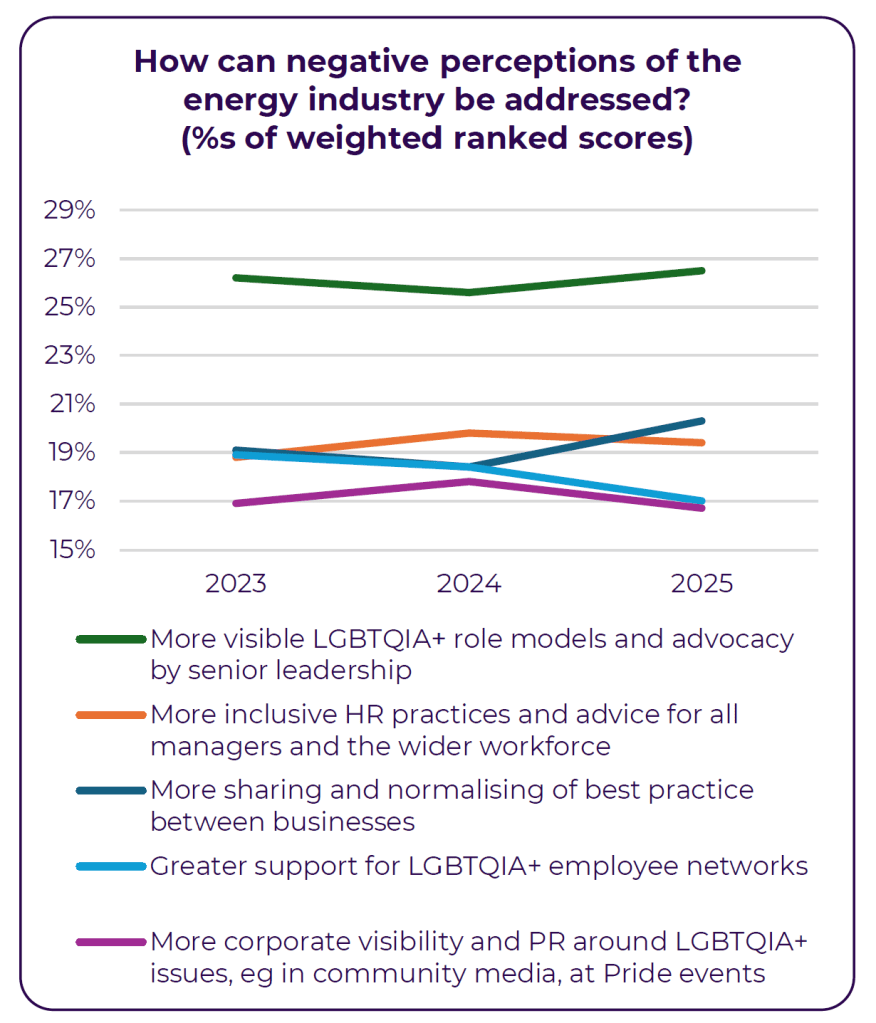
Almost three-quarters (73%) of respondents said their organisation had an LGBTQIA+ network. However, experiences of their effectiveness varied, with some describing a strong advocacy and others citing limited resources and a lack of engagement from management.
The report notes that a robust LGBTQIA+ network offers avenues for support and change within the workplace:
“Where discrimination happens, (our) network is very good at catching it, escalating as appropriate, and safeguarding community members going forward,” one respondent said.
Calls for leadership
Respondents identified visible advocacy from senior leaders as the most important factor in improving perceptions of the sector. Yet 20% said they had no visible role models or allies at senior levels in their organisation.
Atkins stressed that leadership visibility was essential: “An inclusive, welcoming and safe workplace is essential to a fulfilling working life and for businesses means they can attract and retain the best employees.”
Overall, the report concludes that defending inclusion in the energy sector requires action at all levels – from senior leadership to grassroots employee networks.
Solar & Storage Live in Birmingham is on the horizon, so don’t miss out on your free ticket to the UK’s largest solar and storage show. Or, find a Solar & Storage Live event near you.
by Catie Owen | Aug 29, 2025 | Electric Vehicles, Europe, Innovation
Drivers can now access discounts of up to £3,750 on new electric vehicles (EVs), as six models have been added to the government’s Electric Car Grant (ECG) scheme.
From 28 August 2025, the Ford Puma Gen-E and Ford e-Tourneo Courier qualify for the maximum grant of £3,750, while four models from PEUGEOT and DS Automobiles are eligible for £1,500 savings.
Transport Secretary Heidi Alexander said:
“We’re putting money back in people’s pockets and making it easier and cheaper for families to make the switch to electric, by delivering discounts of up to £3,750 on EVs.
“Our measures are driving competition in the UK EV market, boosting economic growth and supporting jobs and skills as part of our Plan for Change.”
The government has committed over £4.5 billion to accelerate EV adoption, with Britain confirmed as Europe’s largest EV market in 2024. According to Autotrader, interest in eligible cars has risen by up to 80% since the scheme began.
Nicola Dobson, Managing Director at PEUGEOT UK, commented: “This government support is welcome to help make the switch to electric more accessible and give consumers greater confidence to choose the electric PEUGEOT that best fits their lifestyle, while driving forward the UK’s transition to cleaner mobility.”
Industry voices also noted the importance of affordability.
Edmund King, AA President, said: “Drivers frequently tell us that the upfront costs of new EVs are a stumbling block to making the switch to electric.
“It is great to see some of these more substantial £3,750 discounts coming online because for some drivers, this might just bridge the financial gap to make these cars affordable.”
Ian Plummer, Commercial Director at Autotrader, stated: “The Electric Car Grant prompted the highest uptick in consumer demand for EVs in 3 years on Autotrader, and interest in cars priced below £37,000 almost doubled.”
The six new eligible models are the Ford Puma Gen-E, Ford e-Tourneo Courier, PEUGEOT E-308, PEUGEOT E-408, DS 3 and DS Nº4.
This series covers the developing electric vehicles market of the UK and its increasing infrastructure, as the nation advances its net-zero goals.
For all things EV, don’t miss out on your free ticket to EVCharge Live UK – taking place 23-25 September 2025.
by Catie Owen | Aug 27, 2025 | Electric Vehicles, Europe, Innovation
Zerova, spun out of Phihong Technology to focus solely on EV charging, has quickly expanded across the USA, EMEA, and APAC, serving clients from Audi to Shell Recharge.
Ahead of EVCharge Live UK (23–25 September 2025), we heard from Keith Wotton, Business Development Director UK & Ireland for Zerova.
Keith discussed the company’s rapid growth, its approach to future-proofing EV infrastructure, and its role in enabling megawatt charging for heavy-duty transport.
Why did Phihong Technology spin out Zerova into a standalone company, and what has the success story been since then?
Phihong spun off Zerova to focus exclusively on the rapidly growing EV charging market. As a standalone brand, Zerova could move faster, innovate more freely, and bring tailored charging solutions to market at a global scale.
Since the spinout, Zerova has grown rapidly across the USA, EMEA and APAC – delivering solutions for major names like Audi, Shell Recharge, and Zenobe, and setting up local operations in key markets.
Our success is built on engineering excellence, global reach, and the agility to tailor solutions to different customer segments – from retail to heavy-duty logistics.
How do features such as dynamic power management and intelligent load balancing help your customers save money or energy?
These features are designed to optimise energy use across multi-charger sites. Dynamic power management ensures that available grid power is distributed intelligently across active charging plugs, while intelligent load balancing shifts power where it’s needed most – avoiding peak demand charges and reducing the need for costly grid upgrades.
For fleet operators and commercial real estate owners, this means lower operational costs and smarter energy use, especially during high-demand periods.
With EV software moving so fast, how do you make sure the chargers you install today won’t feel outdated in the future?
Our hardware is built with future-proofing in mind – modular, upgradable, and built to support the latest communication protocols. Just as important is our software platform, which enables remote updates, diagnostics, and integrations.
Whether it’s adding support for ISO 15118, Plug & Charge, or adapting to new OCPP versions, Zerova chargers stay current through continuous updates. Our goal is to provide peace of mind – that a charger installed today will be compatible with the demands of tomorrow.
You supply chargers to everyone from Audi to Shell. How do the needs of a luxury car brand compare to those of a freight fleet?
The use cases are vastly different. Car brands often need high-performance chargers with sleek design, user-centric interfaces, and seamless integration with the vehicle’s onboard systems – it’s about brand experience as much as power delivery. Freight fleets, on the other hand, prioritise durability, uptime, and load management.
They need a charging infrastructure that can operate 24/7 under demanding conditions, often at depots with limited grid availability. Zerova’s strength lies in being able to serve both – with scalable, customisable solutions built on a single, robust platform.
Everyone’s buzzing about megawatt charging. Is the technology fully ready yet, or is there more work to do before that’s a reality?
Megawatt charging is progressing fast, but we’re still in the early phases of real-world deployment. The technology is ready in principle – we already offer a 1MW charging solution – but infrastructure, standards, and heavy-duty vehicle readiness are catching up.
Widespread adoption will require collaboration across OEMs, utilities, and policymakers.
At Zerova, we’re actively involved in pilot projects and standardisation efforts to help bring this vision into reality. It’s not a question of if, but when – and we’re ready.
Talk to us about your involvement in EVCharge Live in September.
We’re proud to be part of EVCharge Live this September – it’s a key moment to connect with industry leaders, policymakers, and clients shaping the future of e-mobility.
As a sponsor and exhibitor, we’ll showcase our latest fast-charging technologies, including solutions for fleet depots, highway corridors, and urban environments.
More than just presenting hardware, we’re there to listen, collaborate, and explore how we can help our partners accelerate their transition to electrified transport.
This series covers the developing electric vehicles market of the UK and its increasing infrastructure, as the nation advances its net-zero goals.
For all things EV, don’t miss out on your free ticket to EVCharge Live UK – taking place 23-25 September 2025.
by Catie Owen | Aug 26, 2025 | Africa, Innovation
The community of Kasakula in Malawi has become the first in the country to achieve universal access to solar power, marking a milestone for clean energy access in rural areas.
The achievement comes through SolarAid’s Light a Village programme, which provides households with affordable, reliable solar energy using a community-led, Energy-as-a-Service model.
The approach enables families to pay a small daily fee for home solar systems, with maintenance and support included, making electricity access both sustainable and affordable.
Kasakula, home to 8,813 households, previously relied on candles, kerosene lamps, and grass fires for lighting.
With the roll-out complete, every home, 12 schools, and a health clinic now have access to Tier 1 electricity, improving safety, education, and healthcare in the community.
SolarAid’s model emphasises training local agents to install and maintain solar systems.
This ensures skills remain within the community.
The programme aims not only to bring immediate access to light but also to strengthen local capacity and economic resilience.
While Malawi has set a national target of universal electricity access by 2030, more than 80% of the population still lacks power. Kasakula’s success demonstrates that decentralised solar solutions can accelerate progress towards this goal.
John Keane, SolarAid’s CEO, has described Light a Village as proof that energy access can be achieved within a shorter timeframe than anticipated, even in remote regions.
At Solar & Storage Live in London earlier this year, Solar&StorageXtra spoke to John, who said:
“The growth of the solar industry has been a huge benefit to our work in many ways. Technology has improved, and prices have dropped, making solar energy more accessible.
“Even a small solar system can transform a rural household or community overnight, and that’s something that still excites me after 25 years in this field.”
Kasakula’s transition highlights the potential of solar power to deliver immediate, tangible improvements to rural communities while contributing to Malawi’s broader electrification goals.
[Images credit: SolarAid]
Solar & Storage Live in Birmingham is on the horizon, so don’t miss out on your free ticket to the UK’s largest solar and storage show. Or, find a Solar & Storage Live event near you.
by Catie Owen | Aug 21, 2025 | Asia, Innovation, Press Release
Press Release
GoodWe have launched a fully integrated all-in-One liquid-cooled energy storage solution designed for commercial and industrial (C&I) applications with 125 kW nominal output power and 261 kWh storage capacity.
The new ESA Series 125kW/261kWh can cover a wide spectrum of use cases in factories, farms, EV charging stations, commercial complexes, and other grid-connected or off-grid applications.
By integrating the Power Conversion System (PCS), battery cells, Energy Management System (EMS), and Battery Management System (BMS) within a single cabinet, the ESA Series streamlines installation, operation, and maintenance while supporting flexible capacity expansion.
This architecture enables scalability from hundreds of kilowatt-hours to multi-megawatt-hours, supporting up to 15 units in parallel with a total capacity reaching up to 3.91MWh in on-grid scenarios.
“The ESA series is engineered to deliver the high performance, reliability, safety, and environmental adaptability that today’s commercial and industrial customers expect,” said Jie Zhang, Managing Director of GoodWe Europe GmbH.
“GoodWe has a history of constantly innovating storage solutions, tailoring towards the needs of the market for operational efficiency and ensuring long-term investment security.”
Performance and safety
With a compact footprint of only 1.47 square meters and an energy density of 177.6 kWh per square meter, the ESA cabinet is ideal for sites where space is at a premium.
It incorporates top-brand 314Ah lithium iron phosphate (LFP) cells and advanced liquid cooling technology to maintain temperature consistency across cells and battery packs, even under extreme environmental conditions.
Supporting 6,000 cycles and operating reliably in temperatures from -25°C to 55°C, the storage is built for continuous operation in energy-intensive applications.
The ESA 125kW/261kWh was tested using UL 9540A methodology, meeting the strictest standards regarding safety requirements for installation, fire prevention and emergency response.
Drawing on GoodWe’s established safety solutions for C&I storage, the ESA features a six-layer protection strategy from the cell to system level, combining active and passive measures for robust fire prevention and suppression.
Aerosol-based firefighting modules are integrated in the battery packs as well as the cabinet, which is also equipped with smoke detectors, thermal sensors, and combustible gas detection. Pack-level humidity monitoring with automatic dehumidification ensures optimal internal conditions, further enhancing long-term reliability and operational security.
The ESA 125kW/261kWh has been certified by TÜV Rheinland for its comprehensive environmental adaptability, confirming the product’s reliability across multiple environmental domains in climatic, mechanical, chemical, electromagnetic, and specialised scenarios.
Operating projects demonstrate scalability and versatility
The ESA system supports diverse operating modes, including peak shaving, demand control, participation in energy trading, and off-grid backup power, ensuring fast response and precision control.
The scalability of up to 15 units connected in parallel makes the all-in-one solution well-suited for a wide range of applications. For on-grid scenarios, for example, in combination of ESA storage with GoodWe GT Series inverters, a single or multiple parallel units function together with a GoodWe SEC3000C Smart Energy Controller to support up to 40 string inverters.
Early commercial deployments in China have already reported substantial reductions in power costs and accelerated returns on investment.
At GoodWe’s Guangde manufacturing site, nine ESA 125kW/261kWh cabinets were installed in parallel, setting a new benchmark for large-scale C&I storage deployment in Chinese factories.
Another project in De’an, China, features seven ESA cabinets with a combined storage capacity of 875 kW/1,827 kWh, which is claimed to be the country’s first charging station project integrating wind, solar, and energy storage.
Designed specifically for the heavy-duty truck industry, the project sets a new benchmark for future smart, zero-carbon industrial parks.
[Image caption: GoodWe ESA with 875kW – 1827kWh integrated C&I storage for Wind-Solar-Storage-Charging project. Image credit: GoodWe]
Want to publish a press release? Submit your content here for review by our editorial team.
by Catie Owen | Aug 20, 2025 | Electric Vehicles, Europe, Innovation
The UK government has confirmed that grants supporting the purchase of electric vans and trucks will continue until at least 2027.
Currently, the plug-in van and truck grant offers discounts of up to £2,500 for small vans, £5,000 for large vans, £16,000 for small trucks, and £25,000 for large trucks.
According to the official government statement, grant levels for the 2026–27 financial year will be announced soon.
Industry figures suggest businesses could save over £2,800 annually on fuel by switching to electric vehicles.
The extension is designed to help companies cut costs, expand operations, and strengthen supply chains, while also reducing emissions from commercial transport, which accounts for more than a third of CO2 on UK roads.
Future of Roads Minister Lilian Greenwood commented: “Extending these grants is another decisive step to power Britain’s transition to cleaner transport while backing the industries that keep our economy moving, driving new investment in EVs and helping businesses cut costs and expand.
“Every EV on our roads means healthier communities and new economic opportunities across the country, which is why grants like these are crucial to both accelerating that transition and building a resilient, competitive economy.”
On the news, Checkatrade CEO Jambu Palaniappan said: “This news is a big boost for tradespeople across the UK. Lower running costs, freedom from charges like ULEZ, and the ability to plan ahead with confidence – it all adds up to real, practical support.”
The grant is available to both businesses and individual drivers, offering greater certainty for fleet operators of all sizes. It builds on recent measures, including a £30m investment announced in July to install over 3,000 new depot chargepoints.
John Boumphrey, UK Country Manager at Amazon, added: “Decarbonising the transportation network is a critical step to enable us to achieve our goal to reach net-zero carbon emissions across our operations by 2040.”
This series covers the developing electric vehicles market of the UK and its increasing infrastructure, as the nation advances its net-zero goals.
For all things EV, don’t miss out on your free ticket to EVCharge Live UK – taking place 23-25 September 2025.
by Catie Owen | Aug 20, 2025 | Commercial & Industrial Solar, Europe, Innovation
Jaguar Land Rover (JLR) has announced the opening of an 18MW solar farm at its Gaydon headquarters, covering 26ha – the size of 36 football pitches.
The installation, which went live this summer, will provide up to 31% of the site’s energy requirements and is the first of the corporation’s three UK solar projects.
In Wolverhampton, work is nearing completion on an expanded rooftop solar array at JLR’s Electric Propulsion Manufacturing Centre (EPMC).
Due this autumn, the 10.7MW system will feature more than 18,000 panels, making it the UK’s largest automotive rooftop solar array. Together with an existing installation, it will generate around 9,512MWh annually, meeting nearly 40% of the site’s demand.
JLR’s joint venture in China, CJLR, has also expanded its rooftop solar facility by 20MW. Operational since May 2025, the system now generates over half of the plant’s monthly energy use while also providing workshop shading.
Looking ahead, the company plans to install more than 10MW of solar car ports at its Halewood site in 2026. Billed as the UK’s largest solar car port project, the scheme will integrate EV charging points, walkways, and sheltered parking.
Andrea Debbane, JLR’s Chief Sustainability Officer, said: “JLR is proud to have delivered these renewable energy milestones. They are important because they directly reduce our global operational emissions and help move us closer to our net zero goal, whilst delivering tangible value today and for the long term.”
UK Industry Minister Sarah Jones added: “The UK is a world leader in renewables, so I’m delighted to see JLR is leading the way and helping the UK become a clean energy superpower.”
Native wildflowers and hedgerow restoration have also been introduced to enhance biodiversity at the Gaydon site.
[Image credit: JLR]
Solar & Storage Live in Birmingham is on the horizon, so don’t miss out on your free ticket to the UK’s largest solar and storage show. Or, find a Solar & Storage Live event near you.
by Catie Owen | Aug 6, 2025 | Electric Vehicles, Europe, Innovation
New figures released by the Society of Motor Manufacturers and Traders (SMMT) have shown that battery electric vehicle (BEV) sales in the UK climbed 9.1% in July, despite a broader decline in new car registrations.
The overall market saw registrations fall by -5.0% to 140,154 units, marking the weakest July performance since 2022 and sitting -10.8% below the same month in 2019.
Demand fell among both private and fleet buyers, down -3.2% and -6.5% respectively, while the smaller business sector saw growth of 10.4%.
The growth in BEV registrations, though positive, slowed compared to the 34.6% rise seen in the first half of 2025, making July the second weakest month of BEV growth this year after April.
BEVs now account for 21.3% of the new car market – up from 18.5% a year ago – but still short of the 28% required by the Zero Emission Vehicle (ZEV) Mandate.
The SMMT attributed the deceleration in part to uncertainty surrounding the newly announced Electric Car Grant (ECG).
While the ECG promises a discount of up to £3,750, full model eligibility has yet to be confirmed, which is reportedly causing some consumers to delay purchases.
“July’s dip shows yet again the new car market’s sensitivity to external factors, and the pressing need for consumer certainty,” SMMT Chief Executive Mike Hawes said.
“Confirming which models qualify for the new EV grant, alongside compelling manufacturer discounts on a huge choice of exciting new vehicles, should send a strong signal to buyers that now is the time to switch.
“That would mean increased demand for the rest of this year and into next, which is good news for the industry, car buyers and our environmental ambitions.”
Despite July’s slump, the market remains up 2.4% year-to-date, with total registrations at 1.18m units – including over 250,000 BEVs. The full-year outlook has been revised upward to 1.9m units, with BEVs projected to take a 23.8% share.
This series covers the developing electric vehicles market of the UK and its increasing infrastructure, as the nation advances its net-zero goals.
For all things EV, don’t miss out on your free ticket to EVCharge Live UK – taking place 23-25 September 2025.
by Catie Owen | Aug 5, 2025 | Europe, Everything Installer, Innovation, Video
Earlier this year at Solar & Storage Live, we caught up with Hannah Magowan, Lead Engineer for Storage & Renewables at Dale Power Solutions.
As an engineering professional, Hannah’s career began with an apprenticeship and has since spanned the evolving energy sector.
In this interview, she reflects on the importance of early engagement with schools to break down gender stereotypes in STEM, the real-world challenges businesses face on the road to net zero, and how Dale Power Solutions is helping customers navigate rising energy costs and grid constraints.
“I think rather than just doing school visits to universities, we should be getting young people into industry early – showing them the variety of jobs, the atmosphere, and what it’s actually like.”
You started your career as an engineering apprentice in the energy industry and have stayed in the sector ever since. How can we better encourage other young women to join the energy sector?
Hannah: For me, it’s not so much about running women-in-engineering campaigns. They’re great, but they can sometimes do as much harm as good – people might see it as special treatment.
The biggest thing we can do is work more closely with schools and education to get people into industry at a younger age.
One of our favourite events is Scarborough Science and Engineering Week. It brings together all the local STEM companies for a big show, and we invite all the primary and secondary schools in the area.
You can really see the difference between primary schools, where there are no preconceived ideas about who should be in what job. Additionally, in secondary schools, gender stereotypes have already started to form. There’s so much more engagement and excitement from younger kids of all genders.
It’s also difficult because, when I left school ten years ago, there wasn’t much in the way of careers advice – at least not before age 16. You knew what your parents did, but not much beyond that.
The first time I stepped into an engineering business was for a job interview, and it was kind of by fluke that I found it.
I think rather than just doing school visits to universities, we should be getting young people into industry early – showing them the variety of jobs, the atmosphere, and what it’s actually like.
Unless you’ve seen and experienced it for yourself, you’re not necessarily going to consider it as a career – especially if you’re a high academic achiever.
What is Dale Power Solutions’ role and mission in the solar industry, and how does it inspire your work?
Hannah: We’re a full EPC provider of battery storage and solar. We’re actually a really old company – our core products are generators and uninterruptible power supplies. We do full design and engineering on those.
As solar and storage have become more prominent in the UK, we’ve been focused on supporting our customers on their journey to net zero and helping them reduce their energy bills – two huge challenges everyone is facing.
We want to be the leading turnkey provider for behind-the-meter energy storage and solar, although we also work on front-of-the-meter, larger-scale projects.
Can you talk to us about DPS’ exciting new UK BESS contract award?
Hannah: We’ve just won a project with one of the major UK banking groups. It’s a four-megawatt-hour battery coupled with about 1.4MWp of solar. It’s a huge project.
They’ve installed the solar across carports because they don’t have rooftop space, but their consumption is extremely high. The site is the largest in the UK for that company; it’s a technology centre with a data centre and other high-demand infrastructure.
They needed battery storage because they couldn’t get DNO approval to connect all that solar directly to the grid. So, by adding a battery, they can use 100% of the solar energy they generate and get around the grid constraints they were facing.
What challenges are your customers frequently facing, and what solutions has DPS devised?
Hannah: Energy bills are rising – we’re all feeling that – and that’s driving a lot of interest in self-generation. Many companies also have ambitious sustainability goals as part of their net-zero commitments.
The government is pushing for EV fleets and heat pumps, both of which massively increase a site’s energy consumption.
The problem is that the grid can’t keep up. When companies apply for a grid upgrade, they’re sometimes told it’ll take 10 years – which obviously isn’t viable.
Battery storage and solar help in two ways: first, they reduce energy bills by allowing companies to generate and use their own power; and second, the battery acts as a buffer.
If a business is expanding and its grid connection isn’t large enough, the battery can be charged overnight or with solar and used during the day.
It gives companies flexibility – and options they wouldn’t otherwise have.
Solar & Storage Live in Birmingham is on the horizon, so don’t miss out on your free ticket to the UK’s largest solar and storage show. Or, find a Solar & Storage Live event near you.









 It found that 42% of respondents had experienced or witnessed LGBTQIA+ discrimination in the past five years, with 18% reporting such incidents in the last year alone.
 Almost three-quarters (73%) of respondents said their organisation had an LGBTQIA+ network. However, experiences of their effectiveness varied, with some describing a strong advocacy and others citing limited resources and a lack of engagement from management.


 Kasakula, home to 8,813 households, previously relied on candles, kerosene lamps, and grass fires for lighting.