by Catie Owen | Jul 30, 2024 | Large Scale Utility Solar, Market Reports
Four universities in Switzerland have collected and analysed data from the country’s Alpine power plants, some of which are in the planning stages and some are already in operation.
The universities involved have published the alpine-pv.ch database: Bern University of Applied Sciences, the Eastern Switzerland University of Applied Sciences, the University of Applied Sciences and Arts of Southern Switzerland, and the Zurich University of Applied Sciences.
The database aims to present which alpine solar plants are in operation, in planning, or have been rejected, to encourage transparency around the process. The database currently says that six alpine solar plants are connected to the grid.
The Swiss government is encouraging the construction of alpine PV plants through its Solar Express Law, which requires 10% of solar PV production to be fed to the grid by 2025, aiming for 100% in 2030.
The platform additionally includes the available data and findings on the alpine PV plants, alpine research, and pilot plants. For example, data on annual production, yield, and performance can be found per plant.
All alpine PV plants either in development or newly announced in the high Alps have a 939GWh annual yield – with 563GWh in active planning. 373GWh of projected solar production has been either rejected or withdrawn.
Utilising the high Alps for solar PV plants is popular due to their effectiveness during winter months, when they generate half of their solar capacity.
Don’t miss Solar & Storage Live Zurich, taking place in Messe Zürich from 17-18 September.
by Catie Owen | Jul 26, 2024 | Large Scale Utility Solar, Market Reports
The UK government has shared new data that indicates that, as of the end of June 2024, the UK reached a solar capacity of 16.9GW.
The Department of Energy Security and Net Zero (DESNZ) reported an 8.5% increase (1.3 GW) in solar capacity over the previous year, distributed across more than 1.5 million domestic and commercial installations.
In 2023, there were 196,782 new solar projects, marking the second-highest number of new installations in a year, surpassed only by 2011’s 208,586 installations.
Despite this high number of new projects, the DESNZ noted that the overall capacity added in 2023 ranked only fifth on record, as most of these installations were relatively small.
June 2024 saw the completion of 15,807 new installations, contributing 65MW of capacity. Although this was fewer than May’s 16,333 installations, it remains significantly higher than the average monthly figures from 2016 to 2021, just above the median number of monthly installations over the past year (15,000).
Domestic solar installations dominate the UK market, with over 1.4 million of the nearly 1.6 million total installations being residential.
However, these domestic installations only account for 30% of the UK’s total solar capacity. In June 2024, residential buildings hosted 78% of new installations, up to 48MW of capacity.
by Catie Owen | Jul 26, 2024 | Market Reports
The European Environmental Bureau (EEB) has reported that there is ample land available in Europe to expand solar and wind energy without affecting food production or natural habitats.
The report titled “Land for Renewables: Briefing on spatial requirements for a sustainable energy transition in Europe” notes that 2.2% of the EU’s total land area is needed for current and future solar and wind projects to phase out fossil fuels and nuclear power, aiming for climate neutrality by 2040.
The report builds on data and preliminary analysis by the EU’s Joint Research Centre, estimating that 5.2% of the EU’s land is suitable for renewable energy projects. Most of this suitable land is located in rural areas, with 78% designated for ground-mounted solar installations – excluding areas of high natural or agricultural value.
The study concludes that urban and industrial areas alone are insufficient to meet Europe’s solar energy needs.
A large amount of the suitable rural land is degraded agricultural land with low productivity and a high risk of abandonment, with the report highlighting an opportunity to reinvest in these areas and their local economies, and create much-needed jobs.
The report advocates for the coexistence of renewables with agriculture and nature through agrivoltaics, urging for clear guidelines on facilitating the adoption of such systems in rural regions.
The need for a European interconnected supergrid to balance disparities is stressed by the report. For example, while Germany and Italy face land limitations, Spain and Romania have a surplus.
Cosimo Tansini, EEB Policy Officer for Renewables, says: “Renewable energies can thrive without harming food supplies or natural habitats. Evidence suggests that Europe has ample land for a sustainable expansion of renewables, excluding biodiversity-rich zones and productive agricultural lands, particularly in rural regions.
“By adopting participatory processes and robust mitigation measures to minimize environmental impacts, we can use renewable energy to restore land, benefit communities, and support rural economies.”
by Catie Owen | Jul 25, 2024 | Market Reports, Storage
New data from the Microgeneration Certification Scheme (MCS) shows that the adoption of solar panels, battery storage systems, and home heat pumps are on the rise in the UK.
MCS’ latest data shows that 2024 has been a record-breaking year for solar and storage installations in the UK, noting that more domestic energy storage systems were installed January – June 2024 than throughout the whole of any other year.
Totalling almost 8,000 installations, MCS explains that this is evidence of solar and storage’s “remarkable rise” in the wake of 2021’s new installation standards and an increased appetite from consumers for price-stable energy.
The findings additionally show that over 80,000 homes were fitted with solar panels from January – July 2024, and that number is still rising rapidly. The UK solar industry’s milestone of 1.5m MCS-scale solar installations was surpassed in spring.
Chris Hewett, CEO of Solar Energy UK, hails the discovery as proof of a “golden era for smaller-scale sustainable energy,” adding:
“I am glad that consumer demand for solar energy has remained both substantial and stable over the first half of the year, buoyed both by high energy bills and undoubtedly by environmental concerns too
“This should provide installers with the confidence to invest in their staff, particularly in recruiting the new people we need to grow the sector.”
Demonstrating the rise of renewable energy in the UK, MCS notes that installations of domestic heat pumps are also likely to break records in 2024, with January – June seeing 27,000 installations. This was an increase of 43% of the same period in 2023.
To this end, Ian Rippin, CEO of MCS, links government support for heat pump installations to the increase in customer appetite – highlighting that government support is crucial to decarbonising homes:
“It is no coincidence that the record number of certified heat pump installations has coincided with a record number of BUS applications in 2024, which is ensuring more homeowners have access to low-carbon technology.
“It’s something that we hope the government will continue to support as home-grown energy becomes more mainstream in UK homes.”
by Catie Owen | Jul 23, 2024 | Market Reports
According to UK energy forecaster Cornwall Insight, Britain is set to miss its target of decarbonising the electricity grid by 2030.
Cornwall Insight, a widely well-regarded forecaster, has predicted in its latest Benchmark Power Curve report that solar and wind power will only be 44% of the UK’s electricity mix by 2030. The forecaster’s models predict that a 67% renewable energy majority is needed to decarbonise the entire grid.
The UK’s new Labour government has pledged to 50GW of generation capacity and a zero-carbon electricity system by 2030, which will need solar power’s contribution to triple its current capacity.
Cornwall Insight notes that the pledge must be increased to meet these targets across all renewable energy outputs (such as wind), with solar’s share requiring 55GW capacity. This is 5GW more than the pledge and 10GW more than the forecaster’s projections.
Tom Edwards, Principal Modeller at Cornwall Insight, says:
“While the underlying goal to decarbonise the power system is one that many would agree is crucial for the country’s future, the gap between our current trajectory and the new government’s 2030 target is substantial.
“Without significant intervention, we risk falling far short of the decarbonisation goals.”
Difficulties in achieving the 2030 plan have been attributed to funding, supply chain issues, grid connections, and port capacity. Several solutions have been identified in Cornwall Insight’s model.
- £48bn needs to be added to infrastructure buildout, in addition to the currently predicted 18bn.
- Attracting investment into the UK will be crucial to achieving the targets.
- Funding for schemes such as the Contract for Difference (CfD) should be increased to attract more business.
- A firm commitment to increasing storage deployment, particularly long-term storage, will be required.
Edwards notes that global challenges also threaten the government’s pledge: “International competition for project development coupled with material shortages are challenging issues that often lie beyond a government’s control.
“Our findings highlight the urgent need for a step change in Great Britain’s approach to renewable energy capacity delivery,” is Edwards’ highlighted takeaway from Cornwall Insight’s report.
by Catie Owen | Jul 18, 2024 | Innovation, Market Reports
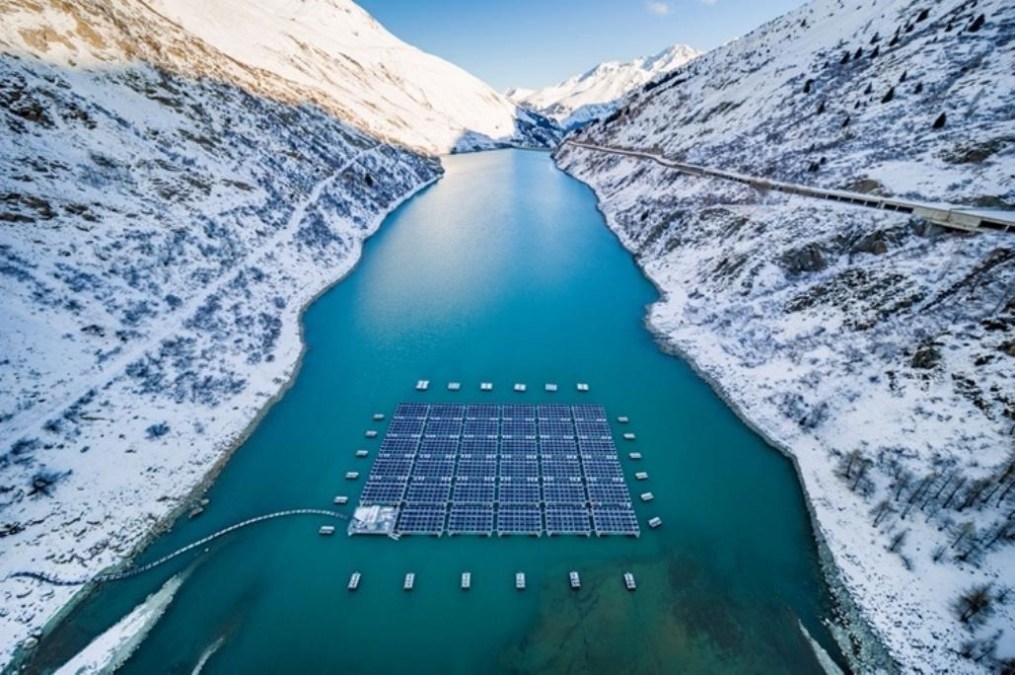
[Image: The FPV system on the Lac des Toules reservoir. Image credit: Romande Energie]
New research from the Zurich University of Applied Sciences has been released and explores the life-cycle environmental impact assessment (LCA) of an Alpine floating PV system.
Researchers found that the world’s first high-altitude floating installation has an energy payback time of only 2.8 years. According to the report, primary data from the Alpine array was provided by the “energy company concerned” and covered the entire lifecycle of the FPV system.
The 448kW installation itself was built in 2019 by Switzerland-based Romande Energie on the Lac des Toules reservoir in the Alps – at an altitude of 1,810 metres. The installation comprises 35 platforms with bifacial PV panels, covering 2% of the lake’s surface and 2,240m2 total.
This LCA also included considerations of the processes required to extract raw materials, used in the system from construction to obsoletion, followed by comparisons of the installation’s environmental impact against lowland structures in different scenarios.
Findings demonstrated that the FPV installation emits 94g CO2-eq per kWh of produced electricity over its life cycle. The researchers concluded that the array had a lower environmental impact compared to other systems, as they also have a lower energy yield and increased land use.
However, the array’s mounting systems were labelled “environmentally intensive” due to their complex design requiring up to 8x more aluminium than their ground-mounted counterparts.
To combat this, the researchers suggest reducing the amount of aluminium in the mounting system for both environmental benefits and cost savings: “This can either be done by reducing general amounts of aluminium, focusing on the use of recycled aluminium or replacing aluminium with an alternative material.”
In conclusion, the researchers said: “The present study adds to the scarce knowledge regarding the environmental performance of FPV systems and gives an insight into the environmental impacts of such installations at high altitudes.”
“The study thereby identifies leading points for the improvement of environmental performance while highlighting the potential that this technology holds.”
The full report can be read on ScienceDirect: Are alpine floatovoltaics the way Forward? Life-Cycle environmental impacts and energy payback time of the Worlds’ first High-Altitude floating solar power plant
Stay in touch with Switzerland’s solar industry by attending Solar & Storage Live Zurich, September 17-18 2024
by Catie Owen | Jul 16, 2024 | Market Reports
According to a new report by Montel Analytics, energy generation from fossil fuels in Europe reached a record low in Q2 2024 while demand for solar power increased.
The new report also demonstrates that Q2 saw a record high of solar and wind energy generation. Notably, the generation of solar power increased to 86.2TWh – an increase of 15%.
This helped create an increased amount of negative day-ahead electricity prices in Europe.
The current expansion of solar and wind capacity contributed to Europe’s trend of decreasing electricity demand. Following this, the number of hours with say-ahead prices increased – to at or below €0/MWh.
Current events in the Middle East and Russia interrupting shipments and gas flows, and reduced supplies from Norway due to maintenance issues, contributed to a rise in gas prices during Q2 2024.
The TTF price for gas rose to €31.49 per MWh, which was a 15% increase from Q1’s figure of €27.45 per MWh.
Director of Montel Analytics, Jean-Paul Harreman, comments on the impact of renewable energy on gas prices: “The key drivers behind this trend include higher renewable generation and steady demand.”
Highlights
- Fossil fuel production totalled 131.9TWh – 24% down from Q2 2023
- Gas fell by 27%, coal fell by 28%
- Wind rose to 107.6TWh – an increase of 9%
- The UK, Italy, France, and Germany saw the largest declines in gas energy generation – at 8.42TWh, 8.22TWh, 6.84TWh, and 5.60TWh respectively
- Germany, Poland, and the Netherlands saw the biggest decreases in coal energy production – at 2.37TWh, 1.38TWh, 1.29TWh, and 1.27 TWh respectively
by Catie Owen | Jul 12, 2024 | Market Reports
A recent study published on Thursday 11th July by US think tank Global Energy Monitor revealed that nearly two-thirds of the world’s large wind and solar energy production plants are located in China.
Currently, China has 339 gigawatts (GW) of capacity under construction, comprising 180GW of solar and 159GW of wind. This is almost double the combined capacity under construction in the rest of the world, according to the think tank.
In comparison, the USA (which ranks second), is constructing a total of just 40GW.
China’s surge for green energy suggests that the global goal of tripling renewable capacity by the end of 2030 is “well within reach,” even without additional hydropower.
The study encourages Beijing to enhance its climate targets in its upcoming pledges to the United Nations.
China’s solar landscape
Despite being the largest emitter of greenhouse gases, China’s expanding renewable capacity has reduced coal’s share in electricity generation to record lows. The country aims to peak carbon emissions by 2030 and achieve net zero emissions by 2060.
However, the renewable energy boom faces challenges as the national grid still relies on coal plants to meet rising power demands. The country struggles with transmitting renewable energy, including solar, from its remote northwestern regions to the eastern economic and population centres.
China’s combined solar and wind capacity is expected to surpass coal this year, according to Global Energy Monitor’s report. In May, coal accounted for 53% of China’s electricity generation, a record low and a decrease from 60% in May 2023, as per an analysis by Carbon Brief.
According to Lauri Myllyvirta, a senior fellow at the Asia Society Policy Institute, 44% of electricity was generated from non-fossil fuel sources, indicating that China’s carbon emissions may have peaked last year if this trend continues.
by Catie Owen | Jul 10, 2024 | Market Reports
Data from energy transition analysts Wood Mackenzie has demonstrated that over 5.4TWac of new solar and wind capacity will come online from 2024 -2025. This will bring the worldwide cumulative total to 8TWac.
This will be an increase from 2023’s 500GW figure of newly installed solar and wind capacity and will have an average annual figure of 560GW over 10 years. In addition to this, the analysts predict that energy storage capacity will increase by 600% – with an anticipated 1TW of new capacity expected for 2014-2025.
Wood Mackenzie’s analysis determines that this is due to the international collective effort to reach decarbonisation targets and electrify economies.
Luke Lewandowski, VP, Global Renewables Research, comments:
“Global demand for renewables has reached unprecedented levels, driven by country-level policy targets, technology innovation, and concerns over energy security.
“Integrated power technology solutions will continue to evolve, evidenced by a significant increase in storage-paired capacity growth, despite inflation, grid constraints and permitting challenges.”
The data also predicts that China will continue to lead the charge in solar, storage, and wind implementation – forecasting the country to connect 3.5TWac to the grid between 2024-2033.
Lewandowski adds: “Solar PV leads the deployment race, accounting for 59% of global capacity due to come online between 2024 and 2033.
“Energy storage will have the most balanced geographic footprint over the outlook due in part to its important role in helping to make renewable power available.”
Highlights
- Wood Mackenzie anticipates that global PV will increase by 4.7TWdc between 2024-2025 – with China leading on 50% of the growth.
- Europe’s thriving distributed PV market has begun to decline, with residential installations contracting over 30% in Germany and more than 50% in the Netherlands in Q1 – due to reduced retail rates.
- Global energy storage will most likely reach 159GW/358GWh by 2024’s end.
- Between 2024-2033 there will be a 636% increase in installed energy storage (926 GW/2789GWh).
- China is anticipated to also lead in the energy storage market, expecting around 42 GW/120 GWh annual capacity added over the next decade.
by Catie Owen | Jul 5, 2024 | Market Reports
Fresh statistics from the UK’s Department for Energy Security and Net Zero (DESNZ) have shown that the UK exceeded 16GW of solar capacity in May 2024, marking a year-on-year increase of 1.2GW.
Additionally, the capacity total for April 2024 was revised by government organisations to 0.9GW. May 2024 saw the completion of 16,333 installations contributing 69MW of capacity.
While this number is the highest monthly figure for 2024 so far, it is lower than the volumes installed at the start of 2023.
However, these latest figures, although possibly revised in the future, are significantly higher than the average figures recorded between 2016 and 2021.
Looking ahead
The UK’s new Labour government, which came to power on July 5th, is also expected to bolster solar energy support as the party is committed to triple solar power, double onshore wind and quadruple offshore wind by 2030.
Trade association Solar Energy UK has called on the new government to publish a Solar Roadmap drafted by the Solar Taskforce and increase the Contracts for Difference Allocation Round 6’s budget.
Labour’s promise to triple solar power aligns with Solar Energy UK’s call for the UK to achieve 50GW of solar generation capacity by 2030 – with the UK expecting 20GW of solar and 8GW of battery energy storage by 2024’s end.
“Labour’s first year in power is going to be a critical period for the solar and energy storage sectors – essential for future energy security, lowering energy bills and addressing the climate emergency,” comments Chris Hewett, Chief Executive of Solar Energy UK.
“To meet Labour’s objective of decarbonising the grid by the end of the decade, it must hit the ground running.”
by Catie Owen | Jul 2, 2024 | Market Reports
According to data from grid operator Redeia, almost 60% of Spain’s electricity was made up of renewable sources during the first half of 2024.
Redeia attributes the uptick to recently installed solar capacity and increased output from hydropower plants.
Spain’s government plan, published last year, outlines its goal to generate 4/5 of its electricity from renewable sources by 2030.
Its primary form of non-renewable power is nuclear, but having produced 18.6% of Spain’s electricity in 2024 so far, almost 80% of the country’s power was carbon-free.
Highlights
- For the entirety of 2023, renewable electricity accounted for 51% of Spain’s power
- Solar power plants generated a total of 16.3% in 2023, hydropower accounted for 15.9%, and wind 24.4%
by Catie Owen | Jun 25, 2024 | Market Reports
The Middle East and Africa (MEA) will see its solar PV installations grow by 15% during 2024 to 17.1GW, according to a new report by SolarPower Europe.
The Global Market Outlook for Solar Power 2024-2028 report indicates that 2023 saw the MEA region grow 78% during 2023 – with 14.8GW of new solar energy outpacing the 2022 record of 8.3GW.
According to the report, this is due to increased installations during 2023. This is a situation SolarPower Europe expects will continue.
2023 also saw an additional 447GW in solar PV capacity: 87% more than in 2022 (239GW installed). Globally, installed capacity rose to 1,624GW by 2023’s end. This was 38% more than in 2022 (1,177GW).
A deeper look
Despite the MEA region’s growth, the report notes that this did not change its position as the smallest solar region in the world, or its 3% market share. The region made up three of the 31GW-scale 2023 solar markets (countries that installed at least 1GW).
The UAE added to its GW capacity for the first time since 2019 due to the completion of the Al Dhadra solar project in Abu Dhabi – contributing 2GW to the UAE’s overall installation of 3.1GW over the year.
South Africa installed 3.2GW, which resulted in a 142% growth rate. This was due to “private utility-scale” solar projects which bloomed after changes to regulations in 2022 and an increased demand for home solar installations.
Meanwhile, Saudi Arabia installed 1.9GW overall. This was due to the initial phase of the Sudair Solar Project – contributing 1.5GW.
The report predicts that South Africa and Saudi Arabia will maintain their positions in the GW-scale international scene, with South Africa expecting to take the top spot for the second year running. South Africa’s growth is expected to raise the MEA region’s capacity from 3.5GW, while Saudi Arabia is expected to only contribute 20% – a decrease of 1.5GW.
As it will likely only provide 5% (0.8GW) of capacity to the MEA region, the UAE is not anticipated to feature in the 2024 GW-scale market. This is a marked decline from 2023’s figure of 21%, as no large solar PV projects are taking place this year.
by Catie Owen | Jun 24, 2024 | Market Reports
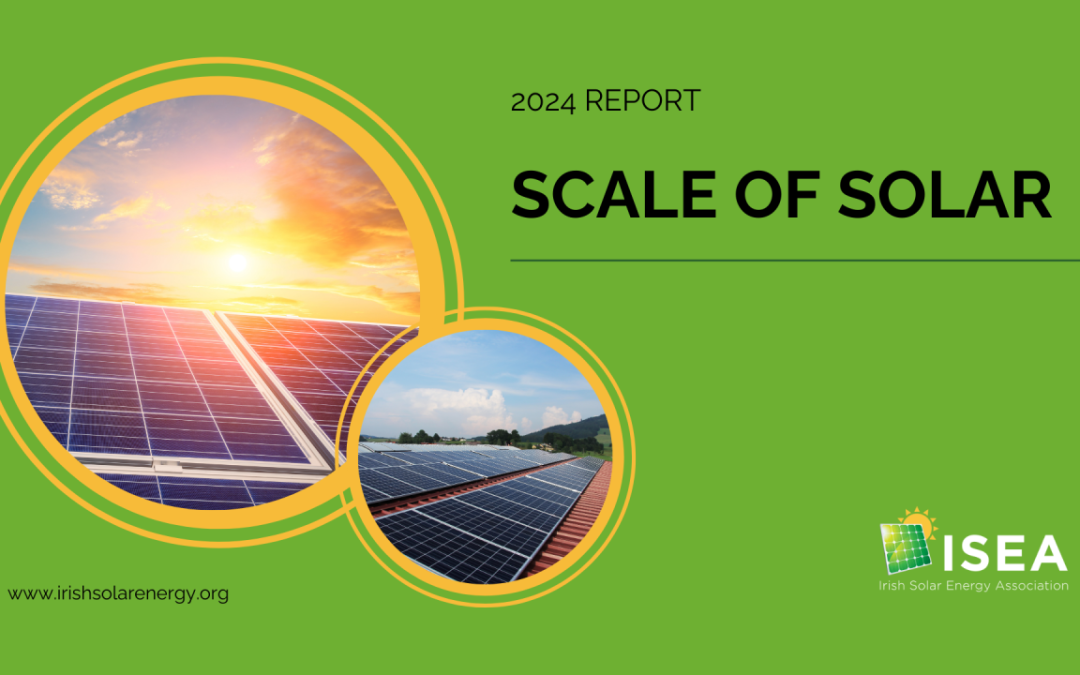
The Irish Solar Energy Association shared its second Scale of Solar Report on June 21st, the second European Solar Day.
The Day calls on the renewable sector and beyond to celebrate the impact and potential of solar energy during the summer solstice (the longest day of the year).
To introduce the report, ISEA shared that Ireland’s solar capacity had grown staggeringly from 680MW to 1,1185MW over the last year – equivalent to powering 280,000 homes per annum. Carbon emissions were reduced by 270,000 tonnes, with domestic rooftops contributing 373MW of solar energy.
The report contains information on the contributions of both large solar farms and individual domestic installations, to demonstrate the collaborative impact of large and small efforts on climate action.
The ISEA additionally noted that it hopes that by “celebrating these achievements”, younger audiences will become invested in solar energy:
“We aim to inspire the next generation to embrace and advocate for renewable energy solutions.”
Highlights
Rapid Growth: In the last 12 months alone, 505MW—42.6% of the total—was delivered, highlighting the significant potential and swift expansion of solar energy in Ireland.
Utility Scale Solar Farms: Large solar farms (over 5MW) now generate 594MW, up from 349MW in 2023.
Mini-Generation: Solar capacity from businesses and farms has increased to 26MW, rising from 5MW.
Microgeneration: Domestic rooftop solar installations saw an impressive 80% increase, reaching 373MW, up from 208MW in 2023.
Forecast: ESB Networks projects nearly 1,600MW of solar capacity by the end of 2024, with plans to add 400MW in the next six months.
Conall Bolger says: “In just two years since the first solar farm was energised, Ireland now boasts 13 solar farms on the grid, supplying 594MW with more under construction. Notably, individual householders investing in rooftop solar panels have contributed 373MW, underscoring Ireland’s commitment to climate action.
“Today, on the longest day of the year, solar energy will benefit over 94,000 homes, with an average of 65 homes daily joining the solar revolution.”
The full report can be found here.
by Catie Owen | Jun 18, 2024 | Market Reports
In 2023, global solar installations surged by 87% compared to the previous year, adding 447GW of new capacity, according to a new report.
SolarPower Europe’s annual Global Market Outlook for Solar Power 2024-2028 shows that the world’s total solar capacity is now nearing 1.6TW. The cumulative global installed capacity is expected to reach 2TW by the end of 2024, following the milestone of 1TW in 2022.
The report projects that by 2028, annual solar installations could reach 1TW.
However, achieving this will require unlocking financing and enhancing energy system flexibility. An estimated $12tn is needed to meet the global goal of tripling renewable energy capacity by 2030.
SolarPower Europe’s report highlights growth rates not seen since 2010 when the global solar market was just 4% of its current size. In 2023, solar power accounted for 78% of all new renewable energy installations worldwide.
This trend is supported by the IEA World Energy Investment 2024 report, which shows that investment in solar PV surpassed all other energy sources combined in 2023.
Walburga Hemetsberger, CEO of SolarPower Europe, says: “The extent of solar growth will depend on equitable access to financing and the political will to create flexible energy systems suitable for renewable energy.”
Markets
In 2023, the top 10 markets accounted for 80% of global solar installations, predominantly from advanced economies.
The number of advanced solar markets, defined as those installing at least 1GW annually, increased to 31 countries, up from 28 in 2022. However, emerging economies are still underrepresented.
Michael Schmela, Director of Market Intelligence at SolarPower Europe, adds: “By 2028, we could be installing more than 1TW of solar annually. It’s crucial to set realistic targets and address common challenges such as permitting, regulatory frameworks for profitable business models, and system flexibility through extensive battery storage capacities.
“The sector is ready to provide a decarbonised energy system, and policymakers need to recognize the climate and energy security solutions at their doorstep.”
China remains a key driver of global solar growth, although it is a dynamic and unpredictable market. In 2023, China installed 253GW, which is 57% of the global capacity and equivalent to the global installations in 2022.
The massive scale-up in manufacturing capacity has led to a significant drop in solar panel prices, about 50% last year, and increased consolidation within China’s solar manufacturing industry.
Sonia Dunlop, CEO of the Global Solar Council, comments, “China continues to set the pace for the global solar transition. To maintain the 1.5°C climate target, it’s essential for the industry to stay united.
“No single country or company can achieve this goal alone. We must collaborate to develop new markets, build fair and resilient supply chains, and secure substantial financing to ensure solar leads the energy transition.”
by Catie Owen | Jun 14, 2024 | Market Reports
According to data from Bloomberg, seven Chinese solar companies have a larger share of the energy market in the 21st century than the “Seven Sisters” of oil had in the 20th.
The names of the solar companies are:
- Tongwei Co.
- GCL Technology Holdings Ltd.
- Xinte Energy Co.
- Longi Green Energy Technology Co.
- Trina Solar Co.
- JA Solar Technology Co.
- Jinko Solar Co.
Meanwhile, the Seven Sisters of oil are cited as being:
- Exxon Mobil Corp.
- Chevron Corp.
- Shell Plc
- BP Plc
- TotalEnergies Se
- ConocoPhillips
- Eni SpA
The findings note that, despite being behind the Chinese companies, the Seven Sisters are still giants of the energy market – producing vast quantities of oil.
Bloomberg explains that companies such as Tongwei, GCL, and Xinte, who produce polysilicon for solar panels, can now go “head-to-head” with large oil companies such as BP, Eni, and ConocoPhillips when it comes to production – with panel makers not far behind.
It makes the point that Tongwei’s plans to build a 400,000tn polysilicon plant in Inner Mongolia will almost double the company’s current output – possibly overtaking oil giant ExxonMobil.
A large part of this success is attributed to the longevity of the solar industry’s infrastructure. While oil and gas made in 2024 will be consumed in a few months, a single solar panel from Longi would be expected to produce useful energy for several decades.
This leads Bloomberg’s data to demonstrate that, in the long term, energy provided by the Chinese solar companies vastly outweighs the annual output of the Seven Sisters.
by Catie Owen | Jun 10, 2024 | Commercial & Industrial Solar, Market Reports
Ukraine could install five times more solar energy capacity than currently planned, according to a new study by Berlin Economics, commissioned by Greenpeace.
Greenpeace campaigners are urging Ukraine to adopt a ‘Solar Energy Marshall Plan,’ reminiscent of the US-funded post-WWII European recovery program.
“Addressing the energy crisis must be central to the Ukraine Recovery Conference,” says Andree Böhling, a Greenpeace energy expert. “A rapid and massive expansion of solar energy should play a key role.”
Since Russia’s full-scale invasion in 2022, over half of Ukraine’s power generation has been destroyed or captured, with power plants targeted by missile and drone attacks.
This has led to nationwide blackouts and fears of a harsh winter without adequate energy supply. Svitlana Romanko, Director of Campaign group Razom We Stand, highlights the urgent need for action to ensure energy security.
Solar energy offers a solution, being easy to deploy, cost-effective, and resilient to attacks. Decentralised solar installations can quickly provide reliable energy to communities.
Romanko sees a “silver lining” in the devastation, presenting an opportunity to rebuild Ukraine’s energy infrastructure in a smarter, localised manner.
Ukraine’s government plans to add 0.7 GW of solar capacity by 2027. However, the Berlin Economics study suggests that 3.6 GW in the next three years is feasible and economically beneficial, potentially growing to 14 GW by 2030.
Realising this potential hinges on international support. Key obstacles include a lack of investor incentives, insufficient grid stability, and workforce shortages. Greenpeace calls for partner countries to offer financial aid, technical expertise, and battery storage technologies.
Current laws in Ukraine need to better define “decentralised electricity generation” and regulate energy storage systems. Simplifying grid access is crucial for more secure projects. EU investment in new interconnection projects and cross-border ventures is also essential.
The Ukraine Recovery Conference in Berlin on June 11-12 presents an opportunity to advance these goals. Svitlana Romanko emphasises the potential for Ukraine to become the first post-war country rebuilt on renewable energy, setting a global precedent for infrastructure-centred climate actions.
Despite a broad focus on recovery and modernisation, energy topics are underrepresented on the conference agenda.
by Catie Owen | Jun 10, 2024 | Market Reports
Independent energy think tank Ember has released a report demonstrating a major milestone for the EU.
April saw fossil fuels generate under ¼ of the EU’s electricity in a month, with renewable energy from solar and wind leading the way.
The full report can be found here.
Highlights
Record Low Fossil Fuel Generation:
- In April 2024, fossil fuel generation in the EU fell to a record low of 23% of total electricity generation.
- This is down from 27% in May 2023.
- Fossil fuel generation in April 2024 was down 14.8 TWh (-24%) compared to April 2023, reaching its lowest monthly level at 46 TWh.
Wind and Solar Energy Growth:
- Wind and solar energy generated more than a third (34%) of EU electricity in April 2024, a record high.
- The previous record was 31% in May 2023.
- Wind and solar energy output reached 68 TWh in April 2024, more than double the electricity generated from hydro (32 TWh).
- Wind and solar accounted for 62% of all renewable generation in April 2024.
Renewable Energy Share:
- Renewables produced over half (54%) of EU electricity in April 2024, the highest-ever share.
- Hydropower output rose 28% (+6.9 TWh) compared to April 2023, increasing its share from 12.3% to 15.7%.
Decline in Coal and Gas:
- Coal generation fell to 8.6% of the EU’s electricity mix in April 2024, its lowest share ever, down 7.3 TWh (-30%) from April 2023.
- Gas generation made up 12.1% of the EU’s electricity mix in April 2024, its lowest share in at least eight years, down 6.8 TWh (-22%) from April 2023.
Emissions Reduction:
- Power sector emissions fell 22% year-on-year in April 2024.
- Record low monthly power sector emissions in April 2024 at 38 MtCO2, down 10% from the previous record in May 2023 (42 MtCO2).
- For January-April 2024, power sector emissions were down 18% compared to the same period in 2023.
Country-Specific Data:
- Germany saw the largest fall in fossil generation compared to April last year, at 4.8 TWh (-26%), representing 32% of the total EU fall.
- Italy experienced a 2.2 TWh (-24%) fall, contributing 15% to the total EU decline.
- Seven lignite-fired power plant units with a combined capacity of 3.1 gigawatts were closed in Germany at the end of March 2024.
Electricity Demand:
- Electricity demand increased by 0.4% year-on-year over January-April 2023.
- Despite the increase in demand, fossil fuel generation continued to decline.
Long-Term Trends:
- The decline in fossil fuel generation and increase in renewables are part of an established shift in the EU’s electricity transition.
- The first four months of 2024 saw an 18% year-on-year decline in fossil fuel generation.
by Catie Owen | Jun 7, 2024 | Everything Installer, Market Reports
The first quarter of 2024 saw a significant boost in solar panel manufacturing capacity in the US, according to a report by the Solar Energy Industries Association (SEIA) and Wood Mackenzie.
During this period, 11GW of new solar module manufacturing capacity was added, marking the largest growth in US solar manufacturing history. This addition brings the total annual manufacturing capacity to over 26GW.
In the same quarter, 11.8GW of new solar capacity was installed nationwide, pushing the national total to 200GW. The utility-scale solar market experienced substantial growth, particularly in Florida and Texas, with New Mexico and Ohio also showing notable increases.
However, the residential solar segment faced difficulties, especially in California, due to recent policy changes.
Despite these challenges, the report projects that US solar capacity will double over the next five years, reaching 438GW by 2029.
Abigail Ross Hopper, SEIA president and CEO, comments: “This quarter proves that new federal investments in clean energy are revitalising American manufacturing and strengthening our nation’s energy economy.”
by Catie Owen | Jun 6, 2024 | Commercial & Industrial Solar, Market Reports
Global investment in low-carbon electricity will surge to ten times that of fossil fuel energy this year. The International Energy Agency (IEA) predicts this will be driven by increased spending on solar projects.
The IEA forecasts that investment in clean energy—which includes renewables, nuclear power, electric vehicles, power grids, energy storage, low-emissions fuels, efficiency improvements, and heat pumps—will reach USD $2tn this year.
2023 marked the first time global clean energy investment surpassed fossil fuels, with further investments expected to be double the $1tn forecast for coal, gas, and oil in 2024.
“For every dollar going to fossil fuels today, almost $2 are invested in clean energy,” said Fatih Birol, the IEA’s executive director. Despite this shift, Birol warned that spending on oil and gas remains too high to meet global climate targets.
Investment in coal continues to rise, with over 50GW of new unabated coal-fired power approved last year, the highest since 2015.
International oil and gas investments are anticipated to increase by 7% in 2024, reaching $570 billion, following a similar rise in 2023. According to the energy watchdog, this was driven mainly by state-owned oil companies in the Middle East and Asia.
Birol continued that, despite o claiming to be part of the solution, oil and gas companies are spending on average only 4% of their investment budgets on clean energy projects, with even less being spent by national oil companies.
The figures so far
Investments
Spending on solar farms has driven global clean energy investments, which are on track to reach $500bn this year. This will overtake investment in all other electricity generation technologies combined.
Investment in low-carbon electricity is anticipated to reach $900bn in 2024 – ten times the investment in gas and coal power generation.
In the West
Europe and the US are predicted to invest $370bn and $315bn respectively. When reviewing these figures, Birol stressed:
“[Clean energy investment needs to reach] the places where it is needed most, in particular the developing economies where access to affordable, sustainable and secure energy is severely lacking today.”
Chinese competition
This surge in clean energy investment is likely due to a 30% fall in solar technology costs over the past two years and rapid expansion of solar farms, particularly in China, which added as much new capacity in 2023 as the entire world did the previous year.
China is expected to lead global clean energy investment this year, with an estimated $675bn directed towards solar, lithium batteries, and electric vehicles.
by Catie Owen | Jun 5, 2024 | Market Reports
A new International Energy Agency (IEA) report has found that, following COP28 in 2023, several countries’ targets and implementation plans are not yet in line with the key goals set at the conference.
The report also notes that the participating countries have a chance to develop clearer plans for encouraging renewable energy – which will bring them in line with the COP28 goal of tripling global capacity by 2030.
The report, COP28 Tripling Renewable Capacity Pledge: Tracking countries’ ambitions and identifying policies to bridge the Gap, reiterates that the official commitments for participating countries currently amount to 1,300GW of global capacity. This is only 12% of the goal set at COP28.
There is an appetite for improvement, as the IEA’s analysis of 150 countries demonstrates. These findings show that governments’ domestic goals are 8,000GW of installed capacity. If these domestic goals are included in the countries’ Nationally Determined Contributions (NDCs), 70% of the 2030 goal would be reflected instead.
“At COP28, nearly 200 countries pledged to triple the world’s renewable power capacity this decade, which is one of the critical actions to keep alive hopes of limiting global warming to 1.5 °C,” said IAE Executive Director Fatih Birol.
“By delivering on the goals agreed at COP28 – including tripling renewables and doubling energy efficiency improvements by 2030 – countries worldwide have a major opportunity to accelerate progress towards a more secure, affordable and sustainable energy system.”
The role of renewables
Many countries have embraced renewable energy sources such as solar and wind, as costs have drastically decreased over the last decade, and because of governments investing in more resilient energy systems with lower emissions.
Policy support, economies of scale, and technological progress have decreased by over 40% over the same period – making them competitive with traditional fossil fuel sources. Meanwhile, the international amount for added renewable capacity has tripled since the signing of the Paris Agreement in 2015.
Solar at COP28
Solar-oriented goals established at COP28 include:
- Tripling renewable energy capacity by 2030.
- Accelerating solar’s global deployment by a factor of four this decade.
- Accelerating solar’s global deployment by a factor of ten by 2050.
- To “transition away” from fossil fuels
- And more.