by Catie Owen | Dec 10, 2025 | Large Scale Utility Solar, Oceania, Press Release
Press Release
More renewable energy solutions are coming online in Australia, including battery energy storage. To support the education and training needs of this evolving sector, the TAFE Centre of Excellence Clean Energy Batteries launched its inaugural round of competitive Applied Research Grants.
The round attracted 16 proposals from universities, vocational education and training providers, industry, and not-for-profit organisations. Seven projects were selected, and nearly $1.2 million was awarded – exceeding the initial $1 million allocation. Overall, the research will be carried out over 12 months or less.
Successful round one applicants
Australian National University
Australian National University has been awarded $194,252 to develop consumer engagement training to help installers guide consumers through complex energy technology decisions.
CQUniversity
CQUniversity will receive $171,407 to develop safety and recycling training for the battery energy storage system workforce, with a focus on regional Queensland.
Queensland Farmers’ Federation
The Queensland Farmers’ Federation has been awarded $150,000 to fund energy in agriculture training, helping farmers better understand battery options to support their operations.
Queensland University of Technology
Queensland University of Technology will receive $200,000 to review Australia’s lithium-ion battery disposal against international standards to inform battery lifecycle management training.
South Metropolitan TAFE
South Metropolitan TAFE has been awarded $199,694 to review battery energy storage system workforce needs and develop targeted training aligned to job descriptions and tasks.
Sustainable Lithium Cells Australia
Sustainable Lithium Cells Australia will receive $77,633 to develop affordable, scalable second-life lithium battery systems for mobile solar energy use, developing training to support workers to safely assess, build and manage the systems.
TAFE Queensland Commercial
TAFE Queensland Commercial has been awarded $197,200 to create practical training and career pathways to support emerging occupations in Australia’s mining and critical minerals sectors.
The funding will drive the development of innovative training that tackles industry challenges, supporting the Centre to share best practice teaching and learning with TAFEs nationwide, strengthening the vocational education and training system for the benefit of all Australians.
Further Applied Research Grant funding through the Centre will be available in the coming years, with round two opening in January 2026.
To learn more, visit: tafeqld.edu.au/tce-grants
A joint statement from the Queensland and Australian Governments about the round one funding can also be found here: https://statements.qld.gov.au/statements/104131
Join us at Solar & Storage Live Queensland, 18-19 March, to hear from Queensland Farmers’ Federation’s Andrew Chamberlin, Project Manager – Energy.
Want to publish a press release? Submit your content here for review by our editorial team.
by Catie Owen | Dec 3, 2025 | Oceania, Press Release, Storage
Press Release
The Centre, led by TAFE Queensland, is a joint initiative between the Australian and Queensland Governments to support the growth of current and emerging battery technologies through innovative education and training.
With demand for battery installations rising, driven by the Federal Government’s Cheaper Home Batteries Program, the pilot program responds to urgent workforce needs by offering funded training.
Developed in close consultation with industry, the pilot program aims to address skill gaps and reduce safety risks.
The TAFE Centre of Excellence Clean Energy Batteries Executive Director Shawn O’Sullivan said the training is open to the entire energy workforce, including trade assistants, apprentices and licensed electricians.
“The funded training aims to reduce barriers to access, participation and skill development across the industry,” O’Sullivan said. “Through the Centre’s pilot program, seven micro-credentials and one skill set will be delivered by TAFE Queensland.
“Five micro-credentials are open for enrolment now, with the remaining courses launching in early 2026. The micro-credentials can be completed in a few hours, they’re self-paced and online, providing accessible learning opportunities for battery workers across Australia,” he said.
The pilot program will also promote the harmonisation of delivery in battery installation standards across Australia’s TAFE network, with educators also able to access the funded courses, equipping them with the skills to deliver consistent, high-quality training.
Energy and battery workers can enrol in the free online micro-credentials by visiting the Centre’s website.
Want to publish a press release? Submit your content here for review by our editorial team.
by Catie Owen | Nov 19, 2025 | Europe, Oceania, Storage
Recurrent Energy, a global solar and battery storage developer and a subsidiary of Canadian Solar, has announced the sale of its Australian hybrid solar and battery project to an undisclosed European infrastructure and investment group.
The Gunning Energy Park, located in New South Wales, Australia, combines a 275MWdc solar farm with a 120MW battery energy storage system (BESS).
The project is slated to connect to the National Electricity Market via a Transgrid transmission line and is expected to generate enough clean electricity to power more than 76,000 homes.
The sale is another achievement for Recurrent Energy in the Australian market, following a recent series of milestones.
These include reaching financial close on the Carwarp Energy Park, a 171 MW solar farm in north-west Victoria, and the development and sale of the Mannum BESS project in South Australia, a 100 MW / 200 MWh battery energy storage system.
Ismael Guerrero, CEO of Recurrent Energy, commented: “This milestone builds on our continued success in the country, highlights our ability to develop innovative, large-scale renewable energy projects, and marks an important step in advancing Australia’s transition to a cleaner and more reliable energy system.”
by Catie Owen | Nov 19, 2025 | Oceania, Storage
Trina Storage, a division of Trinasolar, and Pacific Green Energy Group have signed a Memorandum of Understanding (MoU) to deliver up to 5GWh of BESS between 2026 and 2028.
According to an official statement from Trina Storage, the MoU signifies one of the largest collaborations in the energy storage sector.
The resulting projects will be capable of storing and dispatching up to five billion watts per hour into the grid, aiming to strengthen reliability and accelerate the clean energy transition toward a low-carbon future.
Under the agreement, Trina Storage will supply its advanced grid-scale battery systems, while Pacific Green will oversee development and project delivery across multiple sites in Australia and other international markets.
Helena Li, President of Trinasolar, commented that the partnership underscores her company’s ongoing commitment to advancing global clean energy goals.
“A 5GWh supply commitment demonstrates the scale and confidence driving our partnership with Pacific Green,” Li commented.
“Together, we are combining innovation, global expertise, and local execution to enable a more resilient and sustainable energy future.”
Scott Poulter, CEO of Pacific Green, echoed this sentiment, adding that the partnership enables the company to deliver its growing global pipeline efficiently and at scale: “accelerating the deployment of projects that support the clean energy transition.”
For Trinasolar, the agreement reinforces the company’s role in delivering integrated solutions across the Asia-Pacific region, building upon earlier collaborations such as the Limestone Coast North Energy Park Project in South Australia.
Pacific Green currently manages a global storage pipeline of 11GWh.
[Image caption: The MoU was exchanged by Scott Poulter, CEO of Pacific Green (Left), and Helena Li, President of Trinasolar (Right). Image credit: Trina Storage]
by Catie Owen | Nov 12, 2025 | Commercial & Industrial Solar, Oceania
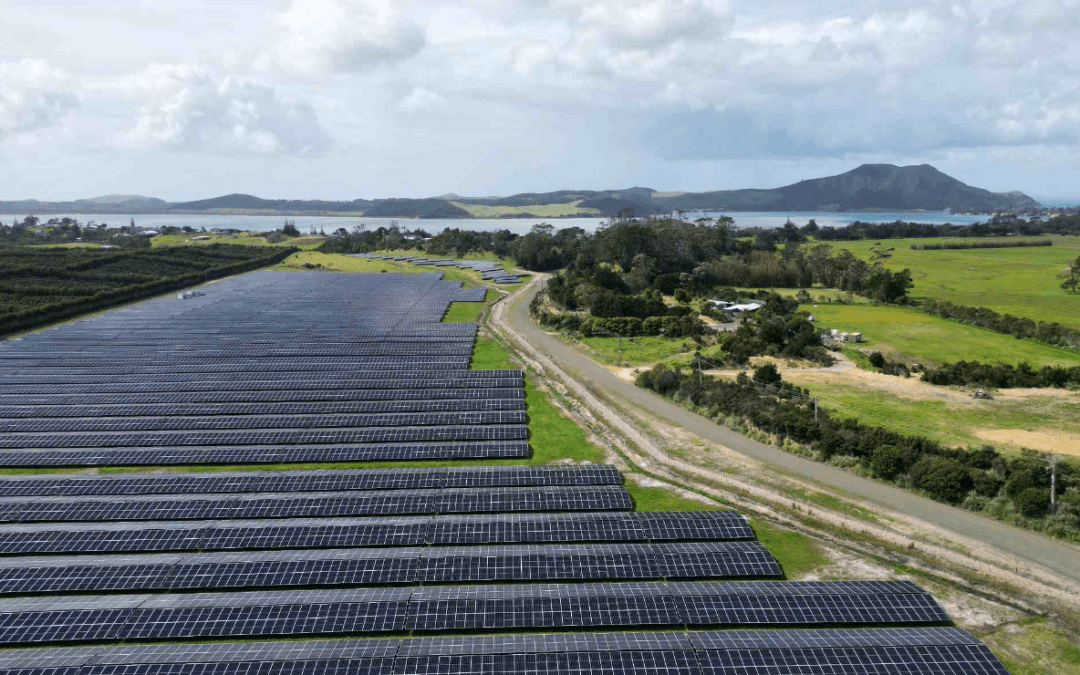
Photon Energy Group has announced the successful energisation and commissioning of the 20.8MWp Pukenui Solar Farm in New Zealand’s Far North.
The project was co-developed by Aquila Clean Energy APAC and Far North Solar Farm (FNSF), with Photon Energy providing engineering, procurement and construction (EPC) services, as well as two years of operations and maintenance (O&M) support.
“We are proud to see the Pukenui Solar Farm energised and contributing to New Zealand’s renewable energy future,” said Georg Hotar, CEO of Photon Energy Group.
“This milestone highlights our ability to deliver high-quality solar projects with leading investors and developers on a global scale.”
The solar farm comprises 35,000 high-efficiency PV modules connected to the Top Energy network. Development and construction involved close collaboration with local Māori communities, businesses and partners.
The Pukenui project marks Photon Energy’s first utility-scale development in New Zealand and is among the first delivered by Aquila Clean Energy and FNSF in the country. Photon Energy will continue to provide O&M services for the site.
Earlier in 2024, Photon Energy signed an EPC and O&M contract for a 38MW solar power plant in Romania with Hyperion, a Portuguese renewable energy developer, expanding its international project portfolio.
[Image credit: Photon Energy Group]
by Catie Owen | Oct 30, 2025 | Europe, Oceania, Storage
Finnish technology group Wärtsilä has announced plans to deliver a major energy storage system in Australia – the company’s second DC-coupled project in the country and the largest of its kind within the National Electricity Market (NEM).
Once operational, the system will have the capacity to power up to 120,000 homes and businesses, supporting Australia’s renewable energy ambitions. The order will be booked by Wärtsilä in Q4 2025, with completion expected in 2028.
DC-coupled systems directly connect solar generation with battery storage via a DC/DC converter, helping to minimise energy losses and capture solar power that would otherwise be curtailed.
This approach improves system efficiency and grid stability, addressing the challenges of increasing solar and wind curtailment across the network.
The project recently secured approval for its Generator Performance Standards (GPS), a key milestone in advancing the design and integration of large-scale renewable generation and storage.
Supported by a 20-year service agreement, the system will utilise Wärtsilä’s optimisation technology to ensure reliable performance.
“This project is significantly larger than our earlier DC-coupled project, underscoring the need for this type of technology in expanding at scale,” said David Hebert, Vice President of Global Sales Management, Wärtsilä Energy Storage.
“DC-coupled technology is a breakthrough for hybrid renewable plants and a critical step towards establishing a financially viable renewable energy future. The project is a prime example of how hybrid renewable energy and storage solutions can help stabilise Australia’s grid while advancing decarbonisation goals.”
Wärtsilä’s GEMS software will manage the integration of the storage system and solar assets, ensuring coordination and optimised energy management.
This project marks Wärtsilä’s ninth battery energy storage system in Australia, expanding its local portfolio to 1.5GW / 5.5GWh of capacity, and contributing to the nation’s target of net zero emissions by 2045.
[Image caption: Stage 1 of the 700 MW / 2810 MWh Eraring battery in New South Wales, Australia, is currently under delivery. Image credit: Wärtsilä]
by Catie Owen | Sep 8, 2025 | Commercial & Industrial Solar, Large Scale Utility Solar, Oceania
The Australian Renewable Energy Agency (ARENA) has announced the second funding round of its $1bn Solar Sunshot program, aimed at developing a resilient domestic solar PV manufacturing sector.
Round 2 will provide $150m to strengthen critical parts of the solar PV supply chain, including framing, solar glass, junction boxes and deployment technologies.
ARENA Chief Executive Officer Darren Miller said the program represented a key opportunity for Australia.
“Australia has the opportunity to build high-quality products across the solar PV supply chain. Although we have a very small production capability today, we have the skills, partnerships and raw materials to establish a strong base that can be built on over the next decade,” he said.
The program launched in May 2024, with Round 1A dedicating up to $500m to module manufacturing. Round 1B, offering up to $50m for feasibility and engineering studies, has been extended until November 2026.
Funding from the first stages has already supported several Australian companies. This included up to $46m for 5B to expand its Maverick solar deployment system, $34.5m to Tindo Solar to increase domestic solar PV production, and $11m across three feasibility studies into upstream solar manufacturing.
Solar Sunshot forms part of the Government’s Future Made in Australia policy, designed to secure renewable energy supply chains and maximise the use of domestic resources. ARENA said the initiative will help create “diverse, secure and resilient supply chains that support thriving green energy industries.”
Round 2 of the Solar Sunshot program will open for submissions on 23 September 2025.
by Catie Owen | Aug 28, 2025 | Oceania, Storage
Pacific Energy has completed a 26MW off-grid power system for Tronox’s Atlas-Campaspe mineral sands operation near Hatfield in southwest New South Wales (NSW).
The hybrid system comprises an 11MW solar farm, a 3MW/6MWh battery energy storage system, 12MW of diesel generation, and 13km of high-voltage transmission lines. The project has consolidated power supply into a single location, reducing the number of diesel generators on site from 41 to six.
Delivered under a 10-year build-own-operate power purchase agreement, the facility is now fully operational following successful testing on the mine’s processing plant.
In a statement on its social media channels, Pacific Energy said the system incorporates a “hydrocarbons off” function and will “provide up to 40% renewable energy to the mine’s total power supply, reducing annual carbon emissions by approximately 13,000 tonnes and displacing nearly five million litres of diesel per year.”
The project is Pacific Energy’s first power generation facility in NSW and forms part of its expansion into eastern Australia. Future developments include a 30MW hybrid system for Iluka Resources’ Balranald mineral sands project, also in southwest NSW.
The Atlas-Campaspe site is the latest in a series of renewable energy projects delivered by the Western Australia-based developer.
Earlier this year, Pacific commissioned a 61MW hybrid renewable system for the Tropicana gold mine in Western Australia, combining a 24MW solar farm, four 6MW wind turbines, and a 13MW grid-forming battery alongside an existing 54MW gas-fired power station.
The company has also secured agreements to deliver a 35MW solar project for Gold Fields’ St Ives mine and a 20-year power purchase agreement with Horizon Power to supply the Exmouth region with 80% renewable energy.
Pacific Energy, owned by Queensland government investment manager QIC, currently manages 946MW of contracted capacity across 48 sites nationwide.
[Image credit: Pacific Energy]
by Catie Owen | Aug 21, 2025 | Everything Installer, Large Scale Utility Solar, Oceania
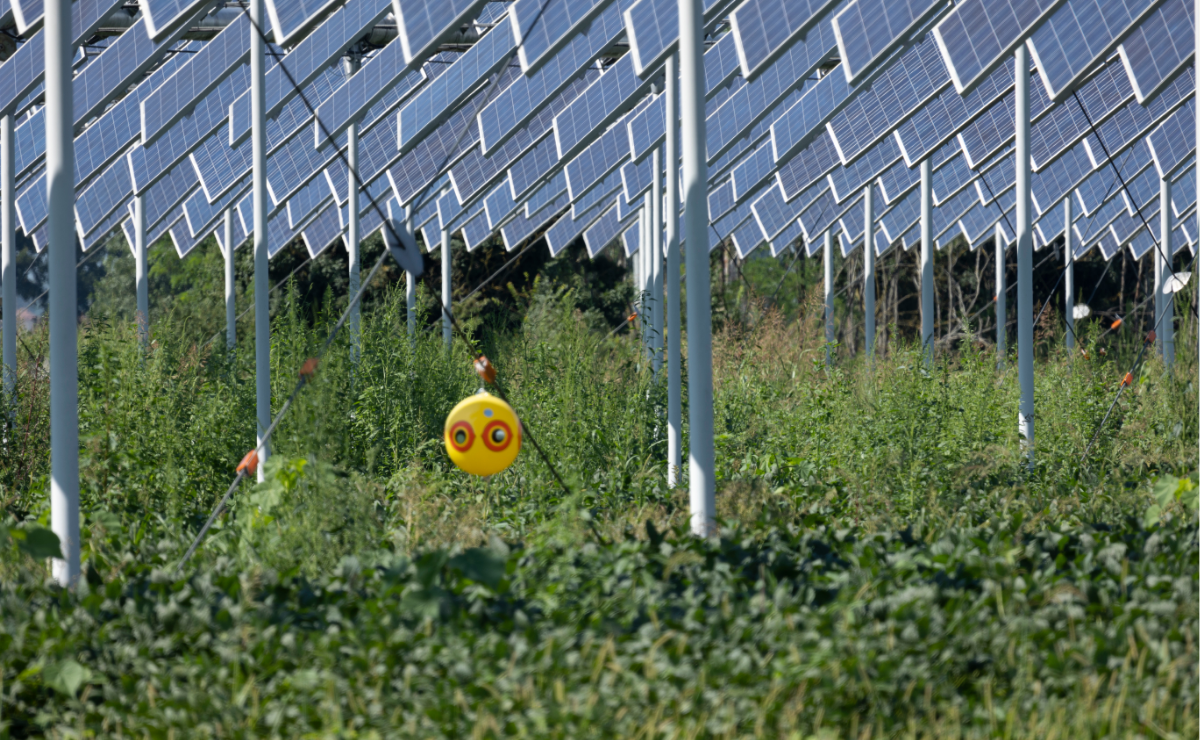
A new handbook on agrivoltaics from EnergyCo sets out how combining agriculture with solar energy can help meet renewable energy targets while supporting food production and rural economies.
Designed for both solar developers and landholders, the handbook contains research from industry leaders and insights from farmers themselves.
“This is the first comprehensive guide to assist developers and landholders to design and plan solar developments for grazing sheep,” explained Farm Renewables Consulting Director Karin Stark, who worked on the report with EnergyCo, on a LinkedIn post sharing the report.
“It also covers considerations for growing crops under solar and outlines case studies for cattle under solar.
By drawing on Australian case studies and international research, the document positions agrivoltaics as a solution with worldwide relevance for balancing renewable energy growth with the protection of farmland.
EnergyCo described the purpose of the handbook in a statement on social media: “The handbook reflects our commitment to informing local communities as we modernise the NSW energy grid.”
Benefits for farmers
The publication highlights the resilience that a secondary income stream provides. “For farmers, a secondary income earned from leasing land to solar developers builds financial resilience,” it states.
Panel shading also offers production benefits. In grazing systems, sheep use panels for shelter from extreme heat and wind, while the microclimates beneath panels help pastures stay green for longer.
Dubbo grazier Tom Warren, who runs around 250 merino sheep on 54 hectares within a solar farm, reports carrying “25% more sheep overall, compared to land without panels, due to increased soil moisture retention and the concentration of moisture in green pasture strips during dry periods.”
Warren has also observed improvements in wool quality, attributing this to reduced dust and burr contamination under panels.
For horticultural systems, panel cover can reduce crop losses. International trials cited in the handbook suggest reduced heat and hail damage for fruit and vegetable growers, as well as greater water efficiency.
Benefits for the solar industry
For developers, agrivoltaics provides an inexpensive way to manage vegetation while strengthening the industry’s “social licence” in rural areas.
The handbook notes that “solar grazing reduces vegetation management costs and increases social acceptance if the land is kept in production.”
The cost savings are significant: slashing vegetation mechanically costs $100 to $250 per hectare, while sheep grazing offers a cheaper and more sustainable alternative.
In addition, community acceptance improves when energy projects retain visible links to farming. “The retention of agricultural production on the same footprint as large-scale solar development is a critical aspect of delivering community benefit and gaining community acceptance for the energy transition to renewables,” the report states.
Towards wider adoption
While the handbook is designed for New South Wales, it draws on local, national, and international case studies. Its practical checklists for developers and landholders – from paddock layout to stocking rates – are applicable worldwide.
Agrivoltaics is already highly discussed internationally as a method for increasing investment in solar. Research from the UK’s University of Sheffield found that the country’s solar expansion goals could be achieved via agrisolar – without sacrificing farmland.
Overall, handbook authors stress that success depends on collaboration. Input from graziers, agronomists, and landholders during the design phase ensures that solar infrastructure supports continued agricultural use.
The report concludes that agrivoltaics is still an evolving practice, but one with clear potential: “Agrivoltaics is not a silver bullet, but it offers a practical and scalable solution to deliver food and energy security hand in hand.”
Solar & Storage Live in Birmingham is on the horizon, so don’t miss out on your free ticket to the UK’s largest solar and storage show. Or, find a Solar & Storage Live event near you.
by Catie Owen | Aug 15, 2025 | Commercial & Industrial Solar, Oceania
Malaysian clean energy company Gentari Renewables has begun construction on its 243MWp Maryvale solar-plus-storage project in New South Wales, Australia.
The facility will combine 243MWp of solar generation with a 172MW/409MWh battery energy storage system (BESS), making it one of Australia’s first large-scale DC-coupled solar and storage sites.
Located around 37km southeast of Dubbo in the Orana region, the plant will span 360 hectares. The Australian Energy Market Operator (AEMO) Services signed a long-term energy service agreement in 2024 to secure supply from the project.
PCL Construction will act as the engineering, procurement and construction (EPC) contractor. TrinaSolar will supply the solar PV technology, CATL the battery system, and Ingeteam the inverters. Commercial operations are expected in early 2027, with a projected lifespan of 25 years.
The project’s DC-coupling design integrates solar and storage on the DC side of the inverter, which can improve efficiency, reduce equipment costs, and allow excess solar energy to be stored for use during peak demand or low sunlight periods.
Other Australian projects using DC-coupling include Octopus Australia’s Blind Creek and Fulham sites, while Western Australia’s 128MW Cunderdin hybrid project began operating in April 2025.
Claire Elkin, head of Gentari Australia, said: “As one of the first large-scale DC-coupled solar and storage projects in the country, it embodies our ambition to deliver clean energy solutions at scale while supporting grid resilience.”
Gentari has been expanding its Australian renewables portfolio through acquisitions and new developments.
Its operating assets include the Whitsunday and Hamilton solar farms (69MWp each) and the 89MWp Clermont Solar Farm in Queensland, as well as the 60MWp Gannawarra Solar Farm in Victoria, alongside the 110MWp Wemen and 149MWp Glenrowan plants.
by Catie Owen | Aug 4, 2025 | Europe, Oceania, Storage
London-based investment firm VH Global Energy Infrastructure plc has energised a hybrid solar and battery storage facility in New South Wales, Australia.
The project was delivered “on time and on budget,” the company said in a stock market filing on Monday.
The facility combines a solar photovoltaic plant with a direct current-coupled, two-hour battery energy storage system (BESS) with a capacity of 4.95 MW. It is currently operating under a ramp-up process defined by the network operator.
VH Global plans to energise another hybrid project in Australia in the third quarter of 2025.
Once complete, the company’s total capacity in the country will reach 37 MW and 60 MWh across seven assets located in New South Wales, Queensland, and South Australia.
Solar & Storage Live in Birmingham is on the horizon, so don’t miss out on your free ticket to the UK’s largest solar and storage show. Or, find a Solar & Storage Live event near you.
by Catie Owen | Jul 29, 2025 | Commercial & Industrial Solar, Oceania, Storage
Investment firm KKR has announced plans to invest A$500m in CleanPeak Energy, supporting the expansion of distributed solar, battery storage, and microgrid solutions across Australia’s commercial and industrial sectors.
Founded in 2017 by Philip Graham and Jon Hare, CleanPeak Energy delivers fully financed, integrated solar and storage systems for corporate clients nationwide.
The company operates over 50 distributed generation sites, with a portfolio exceeding 140MW of solar assets and 35MWh of battery storage. It is currently undertaking more than A$200m in construction projects.
CleanPeak CEO Philip Graham said: “KKR is a perfect strategic partner for us as we seek to rapidly expand renewable energy solutions for our customers.
“They bring deep energy transition expertise, financial strength and a partnership mindset that will allow CleanPeak to continue to offer net-zero solutions at the same time as accelerating our growth plans through bolt-on acquisitions. Together, we will deliver reliable, lower-carbon energy for corporate Australia.”
The investment will come through KKR’s Global Climate Transition strategy, representing its first investment in the Asia-Pacific region and the sixth globally. Completion is expected in the second half of 2025, subject to regulatory approvals.
Neil Arora, partner and head of KKR’s climate transition strategy for Asia, commented: “Australia’s C&I energy market is at an inflection point as corporates seek bankable pathways to better energy efficiency, reliability and affordability.
By combining CleanPeak’s proven operating platform with KKR’s global network, operational expertise, and deep experience across our energy and infrastructure teams, we are well-positioned to unlock significant opportunities for corporate customers looking to decarbonise and reduce their energy bills.”
KKR recently agreed to acquire Zenith Energy from a consortium of Pacific Equity Partners, OPTrust, and the Foresight Group.
by Catie Owen | Jul 18, 2025 | Africa, Americas, Asia, Europe, Large Scale Utility Solar, Middle East, Oceania
Global renewable energy capacity grew by more than 15% in 2024, according to the Renewable Energy Statistics 2025 report released by the International Renewable Energy Agency (IRENA) this week.
However, the agency warns that regional disparities in growth are widening.
Asia accounted for 71% of new capacity additions, maintaining its lead for a second consecutive year. Europe and North America followed, contributing 12.3% and 7.8% respectively.
In contrast, Africa, Eurasia, Central America, and the Caribbean together made up just 2.8% of global additions. Despite its potential, Africa’s renewable capacity increased by only 7.2%.
IRENA Director-General Francesco La Camera said: “The renewable energy boom is transforming global energy markets, driving economies and creating vast investment opportunities.
“However, the growing regional divide highlights that not everyone is benefiting equally from this transition.”
He added: “Bridging the divide and closing the investment gap between countries and regions is critical. It requires targeted policies, international financing, and partnerships that unlock capital and technology where they are needed most.”
UN Climate Change Executive Secretary Simon Stiell echoed these concerns, saying: “The global shift to renewables is increasingly inevitable, but its massive human and economic benefits are not yet being shared across all countries and regions.”
“To deliver on the global agreement at COP28 to triple renewables by 2030, we need to move much further and faster… The investments required will pay huge dividends – cutting emissions, driving economic growth, creating jobs, and supporting affordable, secure energy for all.”
Despite a record-breaking 582 GW being added last year, IRENA notes that the world remains off track to meet the 11.2 TW target needed by 2030.
by Catie Owen | Jul 15, 2025 | Commercial & Industrial Solar, Oceania, Storage
Australian renewable energy developer Edify Energy has submitted plans for a 300MWac solar-plus-storage project in Victoria under the Environment Protection and Biodiversity Conservation (EPBC) Act.
The proposed Nowingi Solar Power Station would be located 47km south of Mildura, near the New South Wales border. The project comprises a 300MWac solar PV plant and a BESS of up to 300MW/2,400MWh, with an 8-hour discharge duration.
Spanning 637 hectares in a farming zone managed by the Mildura Rural City Council, the site is currently used for agricultural purposes. Edify aims to maintain this usage through agrivoltaics – also used in its Peninsula (80MW) and Muskerry (250MW) solar projects in Victoria.
According to EPBC documents, the project will connect to the National Electricity Market via an existing 220kV transmission line owned by Ausnet, running between Red Cliffs and Horsham.
Construction is expected to take around 18 months, employing about 250 people at its peak, with five full-time roles once operational.
In Queensland, Zen Energy has secured EPBC Act approval for a 100MW solar-plus-storage project in partnership with Taiwan’s HD Renewable Energy under the ZEBRE joint venture.
The co-located BESS will be a 200MW system with a duration of 4–8 hours (800–1,600MWh). The project will be developed on 267 hectares of mostly cleared land near Woolooga in the Gympie Region.
“This was made possible because the 267-hectare project site was designed so its environmental impacts were minimised,” said Environment Minister Murray Watt.
“It will be located on predominantly cleared land… demonstrating once again that there’s ways for renewables and agriculture to work together.”
[Image credit: Edify Energy]
by Catie Owen | Jul 14, 2025 | Large Scale Utility Solar, Oceania, Storage
Ingeteam will provide technology for a hybrid solar and battery energy storage project in New South Wales, Australia.
The project, owned by clean energy company Gentari, will combine 243MWp of solar PV capacity with a 172MW/2.4-hour battery energy storage system (BESS).
Gentari has issued a notice to proceed, allowing PCL Solar to begin engineering, procurement, and construction (EPC) work.
Ingeteam said it is the first DC-coupled solar-plus-storage hybrid plant being developed in eastern Australia.
As part of its agreement, Ingeteam will supply 32 power stations with 61 central PV inverters and 488 DC-DC storage converters rated at 430kW each.
It will also deliver a hybrid plant controller to manage nearly 400,000 solar panels and 122 battery containers on site.
The project will use DC coupling, enabling batteries to charge directly from solar panels without converting electricity from DC to AC.
Ingeteam said this method reduces energy loss, improves efficiency, and extends the solar farm’s operating range by storing energy during low-price periods and discharging it during peak demand.
Ana Goyén, Ingeteam’s solar PV and BESS director, said, “We are delighted to continue contributing our technology to decarbonising the energy mix of the Australian National Electricity Market.”
She added, “Projects integrating solar and storage technology aim to balance sustainability and energy security, while offering greater potential for managing the solar resource and generating energy much more efficiently.”
The plant will have a maximum export capacity of 172MW and is expected to generate over 520GWh of clean energy annually, enough to power around 82,000 homes and avoid nearly 412,000 tonnes of carbon dioxide emissions.
It is due to begin operation in Q2 2027.
by Catie Owen | Jul 9, 2025 | Commercial & Industrial Solar, Oceania
The Australian Renewable Energy Agency (ARENA) has launched an AUD 60m funding round to support research and development aimed at advancing the federal government’s ultra-low-cost solar goal.
This initiative targets reducing the installed cost of solar to AUD 0.30 per watt and lowering the levelised cost of electricity (LCOE) to under AUD 20 per megawatt-hour by 2030.
Funding will be divided evenly across two streams: one focused on solar cells and modules, and the other on balance of system, operations, and maintenance.
ARENA CEO Darren Miller said the funding offers an opportunity for universities, research institutions, start-ups and entrepreneurs to contribute to lowering solar costs.
“Demand for renewable electricity is expected to increase significantly as Australia moves towards net zero,” he said. “Ultra low-cost solar PV is a critical source of electricity to meet this demand and will be a crucial enabler of the energy transition.”
The funding round will focus on six priority areas. These include improving the efficiency, stability and cost-effectiveness of cells and modules, reducing system deployment and maintenance expenses, lowering LCOE, and boosting energy yields.
ARENA has previously subsidised early large-scale solar farms in Australia, helping reduce construction costs across the sector.
Since its inception, it has invested over AUD 120m in solar R&D and AUD 104m in the Australian Centre for Advanced Photovoltaics (ACAP).
“ARENA has been at the forefront of investing in solar innovation since the Agency was established 13 years ago,” Miller said.
“This funding round is seeking the pioneering innovation Australia is so well known for in solar PV to achieve that vision.”
Expressions of interest are now open.
by Catie Owen | Jul 4, 2025 | Commercial & Industrial Solar, Europe, Innovation, Oceania, Press Release
Press Release
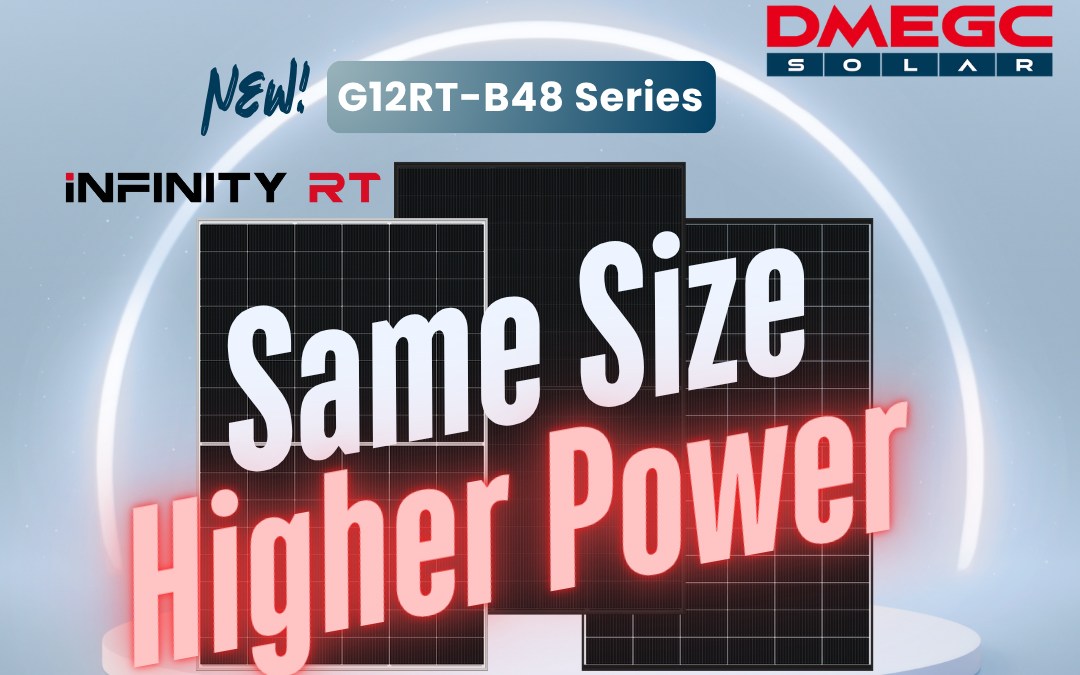
DMEGC Solar has launched a new range of PV modules for residential, and commercial and industrial markets.
The upgraded module features larger silicon wafers, expanding from 187.5 × 182.2mm (M10R) to 210 × 182.3mm (G12R). The increased cell size boosts module current, while the reduced number of cells in series results in a lower voltage compared to the M10RT-B54.
Despite these electrical changes, the module dimensions (1762 × 1134mm) and encapsulation structure remain identical, ensuring easy integration with existing installations.
DMEGC Solar confirms that the mounting position and mechanical load specifications remain unchanged, meaning installers can transition smoothly to the new series without modifying racking systems.
The higher power output per module makes the G12RT-B48 ideal for both residential rooftops and C&I projects, where maximising energy yield within limited space is critical.
Mass production of the G12RT-B48 series is scheduled to begin by the end of June 2025, with DMEGC Solar gradually phasing out the M10RT-B54 line.
This shift underscores the company’s focus on advancing solar technology while ensuring a seamless transition for partners and customers.
As demand for high-efficiency solar solutions grows, the G12RT-B48 series positions DMEGC Solar to better serve both homeowners and businesses seeking cost-effective, high-performance PV modules.
The modules’ improved energy density makes them particularly attractive for C&I applications, where higher power output can significantly reduce system costs and space requirements.
With this launch, DMEGC Solar reinforces its commitment to innovation, offering a versatile solution that meets the evolving needs of the global solar market.
Want to publish a press release? Submit your content here for review by our editorial team.
by Catie Owen | Jul 2, 2025 | Innovation, Oceania, Storage
Press Release
Queensland’s TAFE Centres of Excellence are leading the way in Australia, becoming the first to open competitive applied research grants.
TAFE Queensland spearheads the TAFE Centre of Excellence Clean Energy Batteries, and the
TAFE Centre of Excellence Health Care and Support, joint initiatives between the Australian and Queensland Governments, through to 2028.
Funding of $1m is available in the TAFE Centre of Excellence Clean Energy Batteries’ first round of applied research grant opportunities, closing 31 July 2025.
TAFE Queensland Chief Executive Officer John Tucker said the grants will aid the development of innovative training solutions to address industry-identified challenges.
“As Australia progresses towards its Net Zero emissions target, Queensland’s energy transformation alone is predicted to support up to 100,000 direct and indirect new jobs by 2040,” Mr Tucker said.
“With strong future job growth predicted, the Centre’s applied research grants will support the development of targeted training to build a skilled clean energy battery workforce, ensuring the long-term growth and sustainability of this vital industry,” he said.
Applied research investigates solutions to everyday problems, bridging the gap between theory and practice with evidence-based insights that drive innovative solutions.
In the first round of grant opportunities, being offered nationally, the Centre is calling for proposals across a range of clean energy battery focus areas.
These include accessible education and training models for people in rural, regional and remote areas, culturally appropriate and safe training, and workforce participation.
“With $1m in grant funding available, we anticipate a highly competitive first round, and look forward to collaborating with researchers, universities, industry, and community groups to find real solutions to industry challenges,” Mr Tucker said.
Since 2024, 12 TAFE Centres of Excellence have been announced across the country and the Centres at TAFE Queensland are the first to launch grants, with several funding rounds planned over the coming years.
For more information about the TAFE Centre of Excellence Clean Energy Batteries’ first round of applied research grant opportunities, visit the TAFE Queensland website tafeqld.edu.au/tce-grants and apply before the application portal closes on 31 July 2025.
[Image credit: TAFE Centres of Excellence. Image caption: TAFE Queensland applied research grants]
Want to publish a press release? Submit your content here for review by our editorial team.
by Catie Owen | Jun 9, 2025 | Africa, Americas, Asia, Commercial & Industrial Solar, Europe, Middle East, Oceania
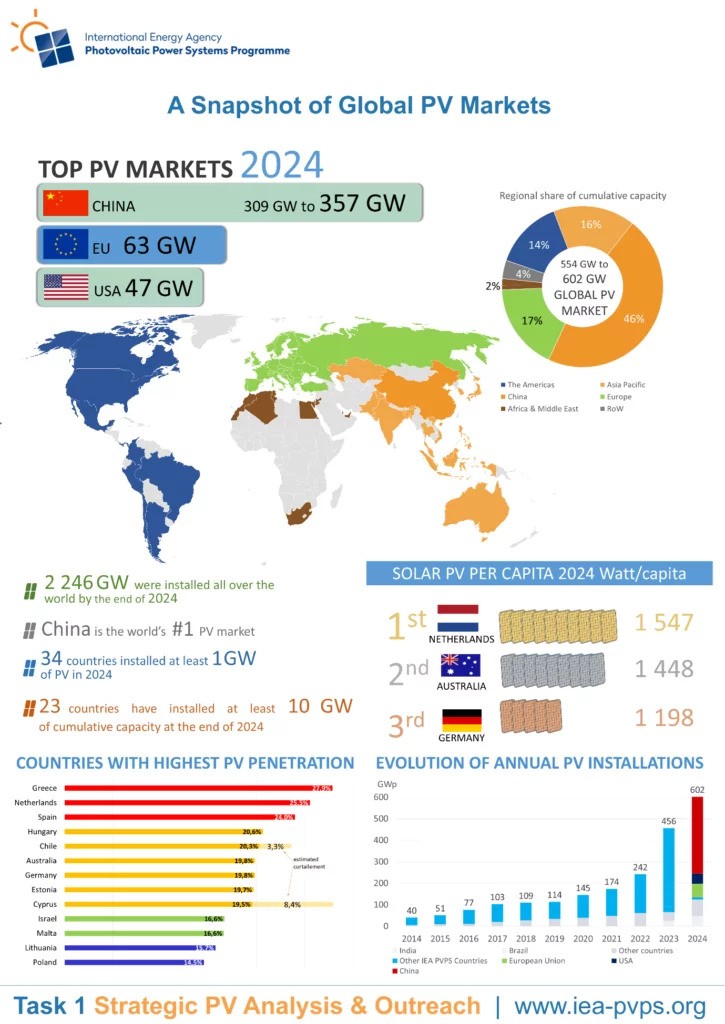
The International Energy Agency’s (IEA) PVPS 2025 Snapshot of Global PV Markets reveals record-breaking growth in solar PV worldwide, with over 600GW of new PV capacity added in 2024.
This pushed global cumulative installed capacity to more than 2.2TW, up from 1.6 TW the previous year.
China accounted for nearly 60% of all new PV installations, commissioning between 309GW and a possible 357GW, bringing its cumulative total to over 1TW – almost half the global total.
The rest of the world contributed 244.6GW, with strong growth in Europe (71.4GW), the USA (47.1GW), India (31.9GW), and Brazil (14.3GW).
Expansion and fall
While the global PV market expanded by over 30%, the growth rate fell from 89% in 2023.
Oversupply in module manufacturing has driven prices down but strained profitability for producers. According to IEA’s data, this price drop catalysed market growth, especially in utility-scale segments, which dominated 2024 installations.
PV provided over 10% of global electricity consumption for the first time. In 27 countries – including Greece, the Netherlands, and Germany – solar generation surpassed 10% of national electricity use, though curtailment is increasingly an issue where grid flexibility lags behind deployment.
Policy developments in 2024 focused on energy transition goals, storage integration, and boosting local manufacturing.
However, local production faces challenges amid intense price competition from Chinese imports. The USA, India, Türkiye, and Brazil responded with tariffs and incentives to protect or stimulate domestic PV industries.
Forecast
Looking ahead, the IEA expects steady growth in most markets, though local policy shifts and infrastructure bottlenecks may influence deployment.
As storage, hybrid systems, and new applications like green hydrogen scale up, global solar deployment must exceed 1 TW annually to match manufacturing output and decarbonisation targets.
For stakeholders in the international solar and storage industry, 2024 underscored the urgency of grid adaptation, the risks of supply chain overcapacity, and the continued rise of solar as the dominant renewable power source.
Infographic credit: IEA-PVPs
Explore the international solar landscape through our series of Market Reports, available for free here.
by Catie Owen | Apr 23, 2025 | Commercial & Industrial Solar, Oceania
Acciona Energia, a Spanish renewable energy developer, has announced the completion of the 380 MW Aldoga Solar farm in Australia – seven months ahead of schedule.
Construction of the AUD $500m Queensland solar farm was announced only in April 2024, with the company anticipating installation of around 820,000 solar modules.
Around 480 MWp of energy will come online as the site is connected to the National Electricity Market (NEM) over the next six months. Commissioning of the solar site is expected for the end of 2025.
Acciona Energia partnered with global solar equipment provider Nextracker to use tubing made from Australian steel, sourced locally at the Brisbane Orrcon Steel Facility.
“Large-scale solar projects are one of the fastest and most affordable means of delivering new electricity into the NEM,” says ACCIONA Energía managing director Brett Wickham.
“We’ve delivered this milestone project safely and faster than expected. It’s a credit to the 350 men and women who have built it.”
Stanwell CEO Michael O’Rourke adds: “First energy production from the Aldoga Solar Farm marks an exciting milestone… Stanwell is building a diversified energy portfolio of thermal and renewable energy.
“Stanwell will offtake 100% of the output from the Aldoga Solar Farm. This energy will be sold into the spot market or retailed to our commercial and industrial customers, ensuring that they receive affordable, reliable and sustainable energy, now and into the future.”
[Image caption: Aldoga Solar Farm. Image credit: Acciona Energia]









 In Queensland, Zen Energy has secured EPBC Act approval for a 100MW solar-plus-storage project in partnership with Taiwan’s HD Renewable Energy under the ZEBRE joint venture.

 Applied research investigates solutions to everyday problems, bridging the gap between theory and practice with evidence-based insights that drive innovative solutions.
 While the global PV market expanded by over 30%, the growth rate fell from 89% in 2023.