China has introduced policy changes designed to improve energy efficiency across key industries, as per two recent government plans released on Wednesday.
These measures reflect China’s efforts to reduce carbon emissions while maintaining economic growth.
Curtailment
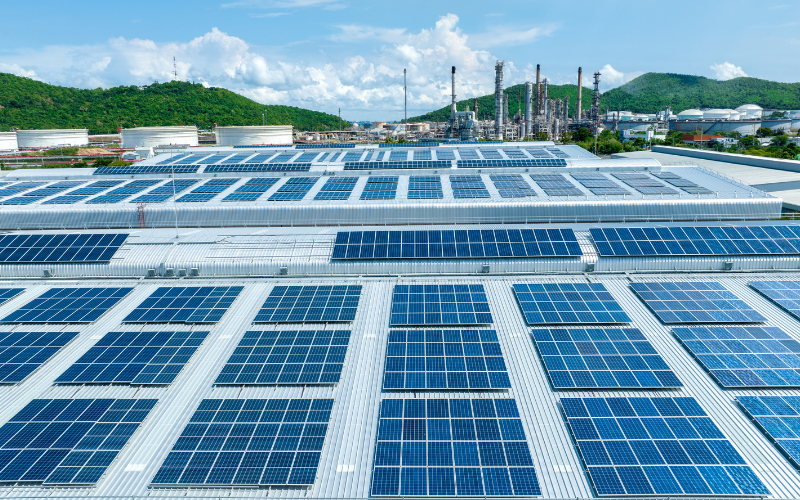
Firstly, China’s central government has relaxed curtailment limits on new solar and wind installations. Previously capped at 5%, the new policy outlined in the government’s work plan allows up to 10% curtailment in regions with favourable resource conditions.
The idea behind the change is to alleviate grid congestion and enable more renewable energy projects in areas previously considered overcrowded. However, this adjustment may impact the profitability of renewable energy plants, as increased curtailment means more generated power might be cut off.
With some regions seeing renewable power capacity outstrip the ability of the distribution system and batteries to use or store the power, experts estimate that the new curtailment rule could facilitate an additional 30GW of solar capacity.
China experienced a marked rise in curtailment rates this year, following record-breaking solar and wind power installations in 2023. The relaxed curtailment limits are expected to benefit manufacturers who have faced a price war due to excess production capacity.
The State Council’s action plan for 2024 and 2025, dated May 23, also emphasises the deployment of new production capacities for metals like silicon and the need for higher standards in new polysilicon and lithium battery manufacturing.
The plan targets at least 40GW of new-type energy storage, primarily battery storage, by the end of 2025, a 33% increase from the previous goal as of Q1 2024. The government also aims to gradually lift restrictions on new energy vehicle purchases nationwide and implement supportive policies.
CO2
At the same time, China aims to cut carbon dioxide emissions in key industries by about 1% of the 2023 national total. This is part of a wider strategy to enhance energy efficiency in steel production and transportation sectors.
The central government has set a target to reduce the economy’s energy consumption by 2.5% per unit of GDP growth in 2024. Achieving this will require improvements in industries including building materials and petrochemicals.
Despite missing its energy intensity goal last year, the central government continues to emphasise its movement towards a balance between reducing emissions and fostering economic growth. However, China’s aim to increase economic growth and improve its standard of living is often at odds with its environmental goals.
The action plan reaffirms the country’s target for non-fossil energy sources to comprise about 20% of China’s total energy use by 2025 (up from around 18.9%), through large-scale renewable power complexes and other renewable sources.
Lauri Myllyvirta, a senior fellow at the Asia Society Policy Institute, said China’s CO2 emissions might have peaked in 2023. This was driven by stagnant oil demand and wind and solar power expansion.