A new report from energy think tank Ember suggests that electrification powered by homegrown renewable energy – such as solar – could cut the European Union’s reliance on fossil fuel imports in half by 2040.
The study, Shockproof: How Electrification Can Strengthen EU Energy Security, argues that switching to electric technologies across transport, buildings and industry is key to improving energy security and reducing costs.
Currently, 58% of the EU’s primary energy supply comes from imported fossil fuels – a level of dependence far greater than that of China (24%) or India (37%).
Although reliance on Russian gas has decreased since 2022, the bloc now depends heavily on other major suppliers, including the United States, Norway and Qatar. According to the report, this concentration of supply leaves Europe vulnerable to price shocks and political pressure.
During the 2021–2024 energy crisis, the EU spent €1.8tn on fossil fuel imports – €930bn more than it would have at pre-crisis prices. In contrast, the report notes that electrification, driven by local wind and solar generation, could provide a more stable and affordable alternative.
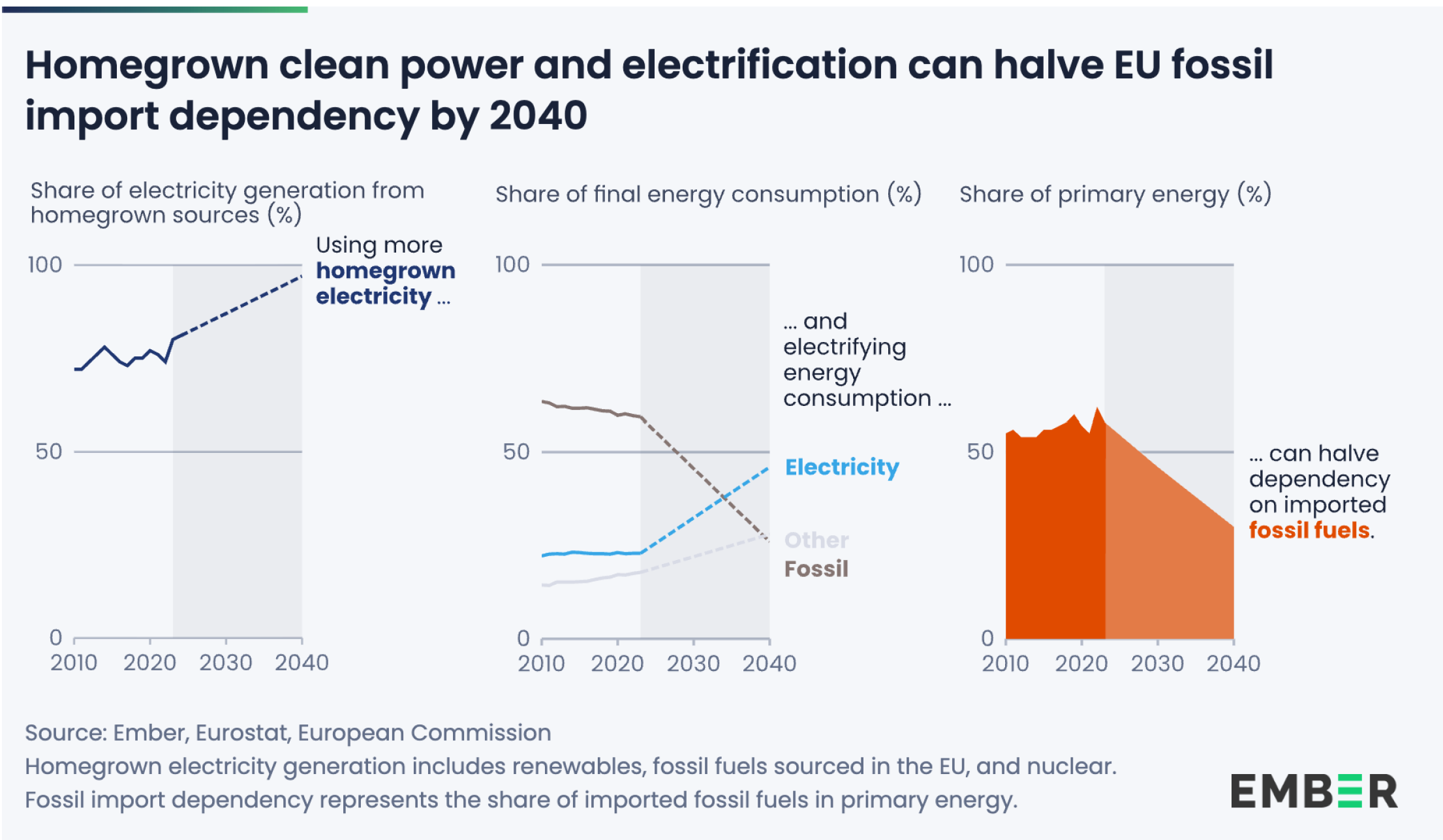
The power sector already shows progress: only 19% of EU electricity generation relies on imported fossil fuels, compared with 88% in transport. Electric vehicles and heat pumps are helping to displace oil and gas imports.
Denmark’s EV fleet, for instance, reduced oil use by 11% in 2024, while Dutch heat pumps offset 10% of residential gas demand.
Study author and Senior Energy Analyst for Ember, Dr Chris Rosslowe, commented:
“Imported fossil fuels are no basis for a secure and affordable energy system – something Europe has learned the hard way. Homegrown energy sources, such as wind and solar, take on more strategic value in a world faced by frequent crises.
“The full potential of Europe’s homegrown power supply is being wasted by a lack of urgency to electrify. Unblocking electrification is the game changing move that can shield the continent from over-reliance on volatile fossil fuel suppliers.”
Despite some gains, just over one-fifth of EU energy demand is currently electrified. The report finds that two-thirds of remaining energy use could be converted using mature technologies, particularly in road transport and heating.
Ember’s policy recommendations include reducing electricity taxes, maintaining the 2035 combustion engine ban, and prioritising grid expansion to accommodate higher electrification.
The report concludes that “unblocking electrification” is Europe’s most effective route to energy independence, cost stability and decarbonisation.
[Infographic credit: Ember]