Danish renewable energy developer European Energy has secured a €145m green loan to finance a hybrid renewable project in Anykščiai, Lithuania.
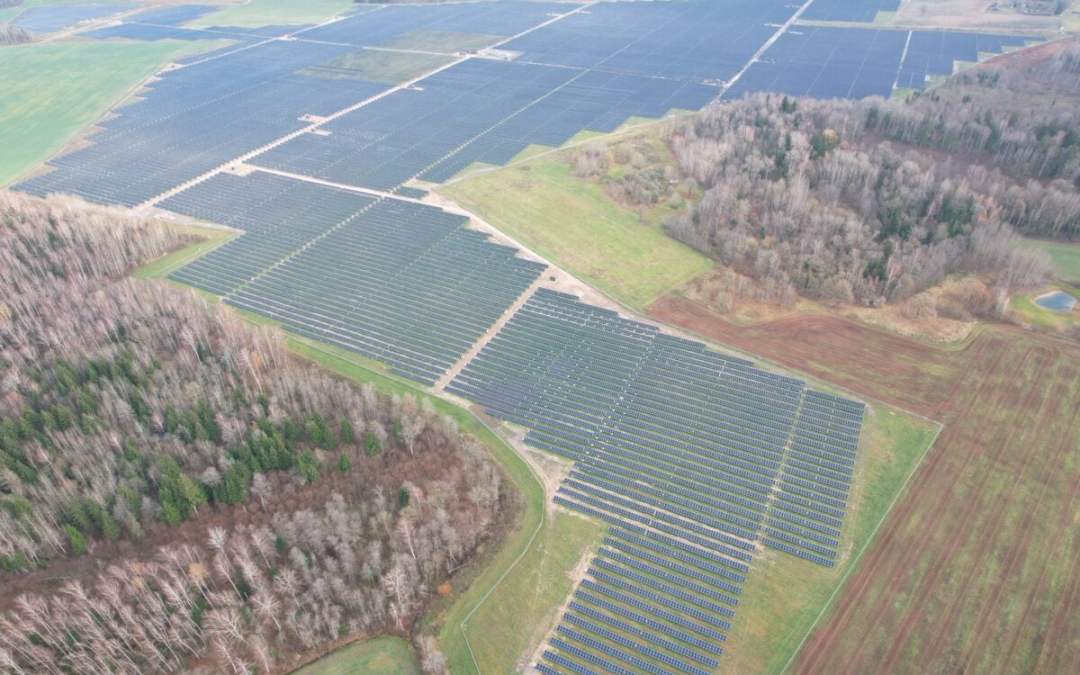
The project includes a 78.5MW solar park co-located with a 50MW battery energy storage system (BESS), with the battery facility expected to begin operations in 2026.
The loan, provided by SEB Lithuania and Swedbank Lithuania, will also fund two 60MW wind farms – Telšiai I and Telšiai II. The combined output of these assets is anticipated to generate around 0.5TWh of electricity annually, supplying approximately 4% of Lithuania’s electricity demand.
said Jens-Peter Zink, deputy CEO of European Energy, commented: “Adding battery storage to our portfolio in the Baltics strengthens our renewable energy production, supporting energy independence and contributing to the fight against climate change.”
The initiative forms part of the company’s broader strategy to expand wind, solar, and storage capacity across Lithuania.
According to its 2024 Annual Report, European Energy completed 2.2GW of ready-to-build projects, signed 1.8GW in power purchase agreements (PPAs), and won 650MW in Contracts for Difference (CfD) auctions.
It also connected 479MW to the grid across Denmark, Poland, Italy, Germany, and Australia, and generated 2,080GWh from its own portfolio.
In Lithuania, the firm has built about 450MW of renewable capacity and is developing a further 200MW of solar and storage assets.
Elsewhere, European Energy’s Latvian subsidiary, Stelo Orienta SIA, recently secured €68 million to develop a 148MWp solar PV plant in Brocēni. Operations are expected in early 2026. Announced in 2023, the plant is projected to produce around 120,000MWh annually.
These developments align with Lithuania’s legal mandate to achieve energy independence by 2030, although the country still imported roughly 44% of its electricity in 2024.
[Image credit: European Energy]