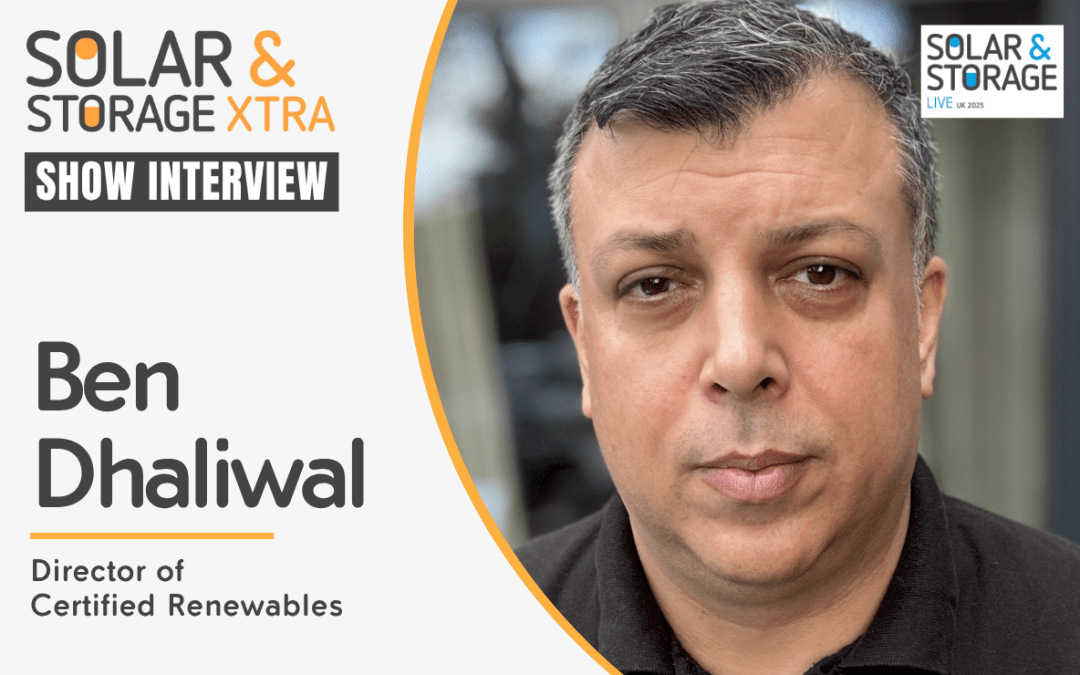
At this year’s Solar & Storage Live UK in Birmingham, industry leaders gathered to showcase the latest technologies shaping the energy transition.
As a young but ambitious company, Certified Renewables is carving out a space in residential and commercial solar, battery storage, heat pumps, and EV charging.
Speaking at the show, Director Ben Dhaliwal discussed the company’s mission, the challenges facing installers, and his vision for scaling nationally while maintaining high installation standards.
Can you walk us through Certified Renewables’ mission and how it’s evolved?
Ben: Sure. In the renewables industry, there are lots of different areas to focus on. In our first year, we concentrated on the domestic market – residential solar, battery storage, and air source heat pumps.
We’ve since moved into EV charging and recently completed our first commercial installations, combining air source heat pumps with solar for business centres and office blocks.
Going forward, we’re focusing more on EV solutions, which is why this show is valuable – it’s great to see the technologies developing in that space. We’ve already received orders for commercial car charging, and events like this allow us to compare solutions side by side, rather than just online.
As we grow, we’re moving further into the commercial sector. Although that can be a challenge for a young company, it’s a welcome challenge for us!
Our long-term ambition is to deliver fully funded large-scale solar projects with storage and potentially enter the data centre sector.
We’re currently building up the right teams, skills, and experience to ensure we can deliver effectively when those opportunities arise.
What are the biggest challenges Certified Renewables sees installers facing today – regulatory, funding, or technical?
Ben: We are very lucky that, on the solar side, capacity isn’t an issue for us. Through my existing network, we can fit five to seven systems a day anywhere in the country. The challenge now is building market presence – making people aware of us, building trust in the brand, and showing the quality of what we deliver.
We’ve recently become a Which? Trusted Trader, and we are actively engaging with other certification bodies to continually enhance the quality and standards of our work. The first year has been focused on gaining those accreditations, which we hope will establish trust and credibility.
On the heat pump side, we’re taking a careful approach, focusing on London and the South East. I personally oversee every installation with my team to ensure standards remain high – because unlike solar, when you’re moving water in someone’s home, a lot can go wrong.
Likewise with solar, you are often dealing with someone’s largest investment, and proper care must be taken to protect the integrity of the roof and ensure the home’s electrical safety.
We’re also looking to grow through partnerships. For example, if a solar company wants to add an air source heat pump division, we can white-label that service. Likewise, if a plumbing company wants to offer solar, we can support them.
We’re also working with builders – we have seven or eight already on our books, providing a steady stream of business. Ultimately, partnerships are key to growth, both for us and for the wider installer community.
What milestones do you want to see Certified Renewables achieving in the next 3–5 years?
Ben: Of course, financial growth is important, but our real goal is to reduce carbon. We aim to expand to a national network for air source heat pumps, just as we have with solar, and to become a trusted brand in renewables – known for customer care and high standards.
That means going beyond the traditional “fit and forget” approach. With solar, we revisit every year to check tariffs and optimise systems remotely.
With heating, we fine-tune after installation and then check in at three, six, and twelve months to ensure customers get the optimised performance. I think we are first in the industry to set the standards.
We also see big opportunities emerging in commercial battery storage. Some of the new products coming to market will make energy storage more affordable and practical for businesses, offering strong payback periods as well as environmental benefits.
That’s an exciting growth area we’re watching closely.
Why is attending Solar & Storage Live UK valuable for industry players?
Ben: For us, the event covers solar, storage, and now EV – all areas we’re active in. On the solar side, updates are incremental, but batteries are advancing quickly, especially for commercial applications.
Stackable and outdoor batteries are coming to market, and for 24-hour operations, the ability to offset night-time energy costs with smart tariffs makes a real difference.
In some cases, commercial solar and storage projects can achieve payback in as little as two to four years – returns you won’t find in many investments – while also helping companies meet ISO standards and sustainability commitments.
Likewise, when I go into a home, I treat it like my own – looking at how all the available technologies can work together to make it as green, self-sufficient, and close to net zero as possible.
Events like this are vital. They bring the industry together, allowing us to share knowledge and pass on the benefits of our experience to homeowners and businesses.
Missed out on Solar & Storage Live UK? Get your free ticket to Solar & Storage Live London – the capital’s most exciting solar event. Or, find a Solar & Storage Live event near you.