Solar & Storage Live returned to Birmingham this year, bringing together the industry’s leading innovators, investors, and developers to chart the future of the energy transition.
Trina Storage, the utility-scale storage arm of Trinasolar joined the event’s strong line-up of industry leaders.
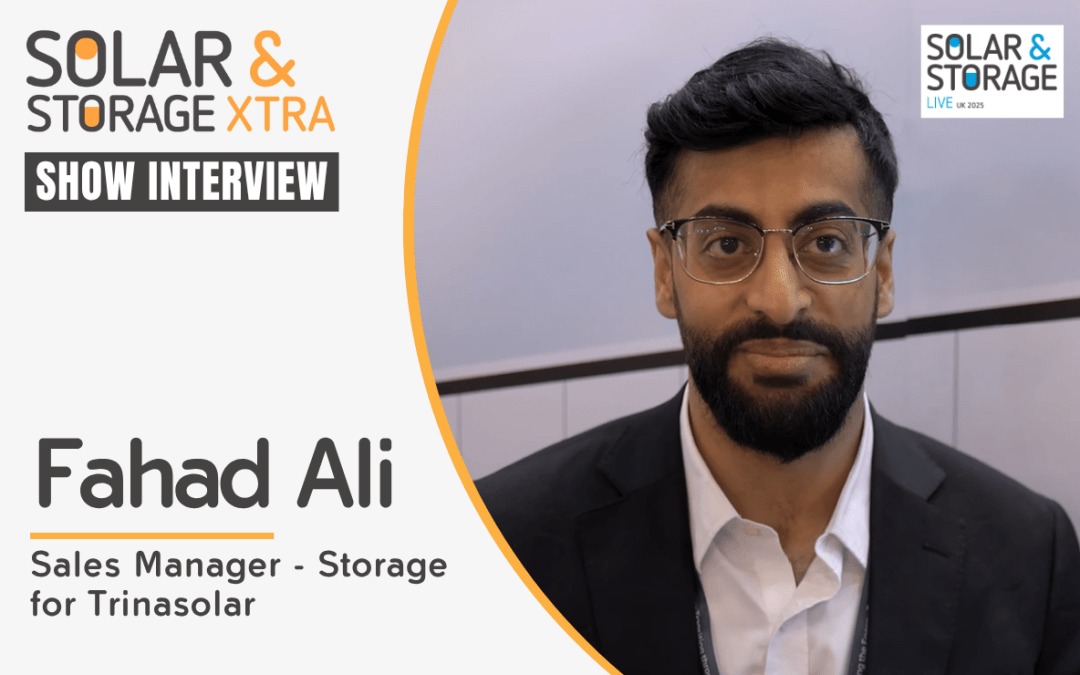
As the company continues to expand its European footprint rapidly, we sat down with Sales Manager Fahad Ali, who shared his perspective on how the storage market is set to evolve over the next three to five years.
How does Trinasolar see the storage market in Europe evolving over the next 3–5 years?
Fahad: It’s clear that we are entering a new phase of product evolution, driven mainly by three things: long-duration storage, higher energy density, and increased system intelligence. Over the next few years, you’ll see Trina respond to this.
We have products in development to deliver long-duration storage tailored to project needs, alongside improvements in energy density for shorter-duration battery systems.
Together with our partners, we’re also developing enhanced software and EMS platforms to support multi-market revenue stacking and optimisation, which is crucial for project finance today.
On top of that, we’re continuously refining the safety and sustainability of our systems to meet both customer expectations and regulatory requirements.
What are the key drivers and obstacles to market growth internationally, and how is Trinasolar addressing them?
Fahad: Globally, the three key drivers for energy storage growth are increasing renewable penetration, grid flexibility, and supportive policy frameworks.
Storage and renewables are inextricably linked, and supportive policies such as capacity markets and storage tenders will continue to drive expansion.
At Trina, we address these challenges by offering flexible and bankable solutions tailored to the specific regulatory and technical needs of each market. Our platform is modular and scalable, so it can be successfully applied across different regions.
We work closely with customers to overcome integration and application challenges, and after commissioning, we support them with local service teams for operations and maintenance.
Right now, we have around 60 people based in Europe, all focused on utility-scale storage projects. That experience translates into over 40 projects signed, representing more than three gigawatt-hours. Importantly, we also manufacture our own LFP battery cells, which gives us tighter control over safety, performance, and supply chain stability.
Our long-term objective is to be the trusted partner for energy storage in Europe, offering end-to-end support and future-ready systems that maximise value and accelerate the clean energy transition.
Can you tell us more about your flagship products that the industry should know about?
Fahad: Our flagship platform in Europe is the Elementa battery cabinet, a high-performance DC-coupled battery energy storage system designed for flexibility, safety, and long lifecycle performance.
Currently, we are deploying the Elementa 2 and Elementa 2 Pro models across Europe. Both use Trina’s own EV-grade LFP battery cells, delivering over 12,000 cycles with zero degradation in the first year.
They also feature an advanced hybrid liquid-air cooling system, flexible installation layouts to boost site energy density, multilayered safety features, and millisecond-level anomaly detection via smart control systems.
The Elementa 2 Pro will be ready for shipment towards the end of the year. It’s ideal for grid services, capacity markets, and renewable integration projects requiring up to eight-hour solutions.
Looking ahead, we will soon launch the Elementa 3, which features 587Ah cells and a very compact 6.25MWh container design. This next-generation system will be even better suited to long-duration applications thanks to optimised thermal control, active cell balancing, higher efficiency, and reduced losses.
What is Trina’s approach to sustainability in storage – for example, sourcing of materials, end-of-life recycling, and second life for battery modules?
Fahad: Sustainability is at the core of Trina Storage’s strategy. The company was founded to accelerate the clean energy transition in solar, and we’ve carried that same ethos into storage.
We produce our own LFP battery cells in-house, which gives us full visibility over material sourcing and supply chain ethics. Our systems are designed for long lifespans, and we support module-level replacement to extend asset life when customers look to repower.
On recycling and second life, we’re actively working with technical partners to develop responsible end-of-life handling programmes that support the circular economy. These efforts are closely aligned with evolving EU regulations and taxonomy frameworks.
What are the advantages of exhibiting at and attending Solar & Storage Live UK?
Fahad: Solar & Storage Live is one of the most relevant events in the UK for energy transition stakeholders. It gives us valuable face time with key customers, developers, and partners, and it helps us stay on top of market trends, regulatory changes, and new technologies in one of Europe’s most dynamic energy markets.
This year, sponsoring the awards dinner gave us a fantastic opportunity to connect and celebrate with our valued partners. Joined by our UK team across battery storage, solar modules, and PV mounting systems, we enjoyed an evening that strengthened our relationships and highlighted the progress we’re achieving together as an industry.
Missed out on Solar & Storage Live UK? Get your free ticket to Solar & Storage Live London – the capital’s most exciting solar event. Or, find a Solar & Storage Live event near you.