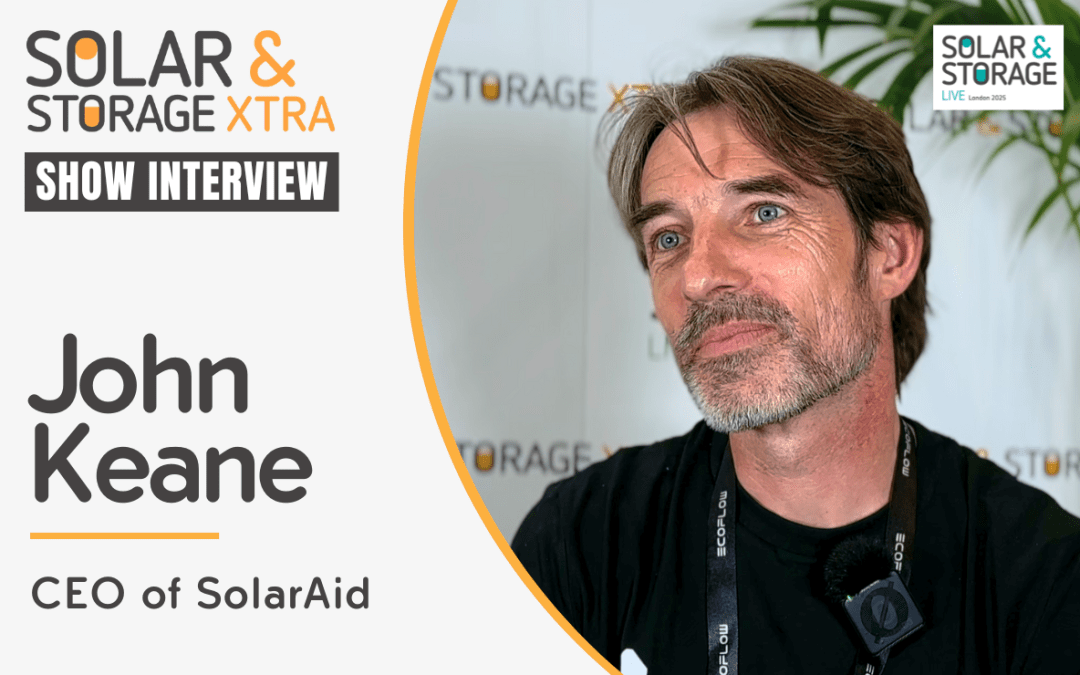
At Solar & Storage Live London, Solar&StorageXtra spoke with John Keane, CEO of SolarAid.
John talked about the organisation’s mission to tackle energy poverty in Sub-Saharan Africa, discussed the evolution of SolarAid’s work, the impact of falling solar prices, and their initiative to bring full electricity access to entire off-grid communities.
Today, more people in Sub-Saharan Africa are accessing solar lights and products than ever before. The technology has advanced significantly, with the price of solar panels and solutions plummeting.
What prompted the launch of SolarAid, and how has the organisation’s approach evolved over time?
John: SolarAid was established in 2006 with the goal of combating poverty and the climate crisis.
Our vision is to create a world where everyone has access to clean, renewable energy. In Sub-Saharan Africa, where we focus our efforts, approximately 600 million people still live without access to basic electricity.
This lack of access affects not just homes, but also rural clinics and schools, trapping people in cycles of poverty. Without electricity, it’s incredibly difficult for communities to develop their economy and improve their quality of life. That’s why SolarAid exists—to tackle this challenge.
Over the past 19 years, much has changed. Today, more people in Sub-Saharan Africa are accessing solar lights and products than ever before. The technology has advanced significantly, with the price of solar panels and solutions plummeting.
Battery storage technology has also vastly improved, making it possible to do more with even small amounts of power.
The development of mobile phones has had a huge impact, too. What we can now achieve with solar power is far beyond what was possible two decades ago.
What are the biggest challenges in scaling access to solar energy in rural Africa?
John: The challenges have evolved over time. When we started, the main issue was that there were no affordable, quality solar solutions designed for rural households in Sub-Saharan Africa.
The systems available were large and expensive, making them inaccessible to most people.
Today, systems have become more affordable and robust, designed specifically for rural settings. However, the poorest people are still struggling to afford even these more affordable solutions.
This is where SolarAid comes in – we focus on finding ways to enable these communities to access basic electricity, even at lower price points.
How does the global solar industry’s growth influence SolarAid’s work?
John: The growth of the solar industry has been a huge benefit to our work in many ways. Technology has improved, and prices have dropped, making solar energy more accessible.
When we first started 19 years ago, the solar industry was relatively small, and there were fewer supporters who believed in its potential.
Now, there’s a much larger community of people who understand the power of solar and storage technologies. This has made it easier for us to communicate the possibilities of solar energy in rural Africa.
We’ve always been passionate about the impact solar energy can have. Even a small solar system can transform a rural household or community overnight, and that’s something that still excites me after 25 years in this field.
However, the biggest challenge remains that the poorest are still left behind. Our goal now is to innovate and create models that enable these households to gain access quickly.
One initiative we’re particularly excited about is our “100%” project, which aims to bring 100% electricity access to entire communities. We’re starting in Kasinthula, a rural area in Malawi, one of the poorest countries in Sub-Saharan Africa.
By the end of this year, we’ll have achieved 100% access in Kasinthula, and we’re using this as a model to show the rest of the world what’s possible – and how it can be scaled and replicated.
Following up on your interview at Solar&StorageXtra in Birmingham, why has SolarAid chosen to attend the London edition?
John: My colleagues attended the Birmingham event, and the response was fantastic. Since then, we’ve seen an increase in interest in our work, which is really encouraging.
A big part of our job is to communicate the challenges faced by communities in rural Africa and to raise awareness of solar energy’s potential.
The more we talk about our work, the more we connect with like-minded individuals who are passionate about the power of solar.
I still remember my first trip to rural Tanzania 25 years ago, coming from a small village in the UK, and seeing firsthand how different life could be with solar energy.
Being at events like these allows us to share those stories and encourage others to join the SolarAid movement. Since Birmingham, we’ve built new partnerships, and we’re excited to continue those conversations at the London event.
Missed out on Solar & Storage Live London, or want to come back for more? Find a Solar & Storage Live event near you.