Switzerland’s solar and storage sector is entering a new phase, with larger-scale projects and innovative business models beginning to reshape the market.
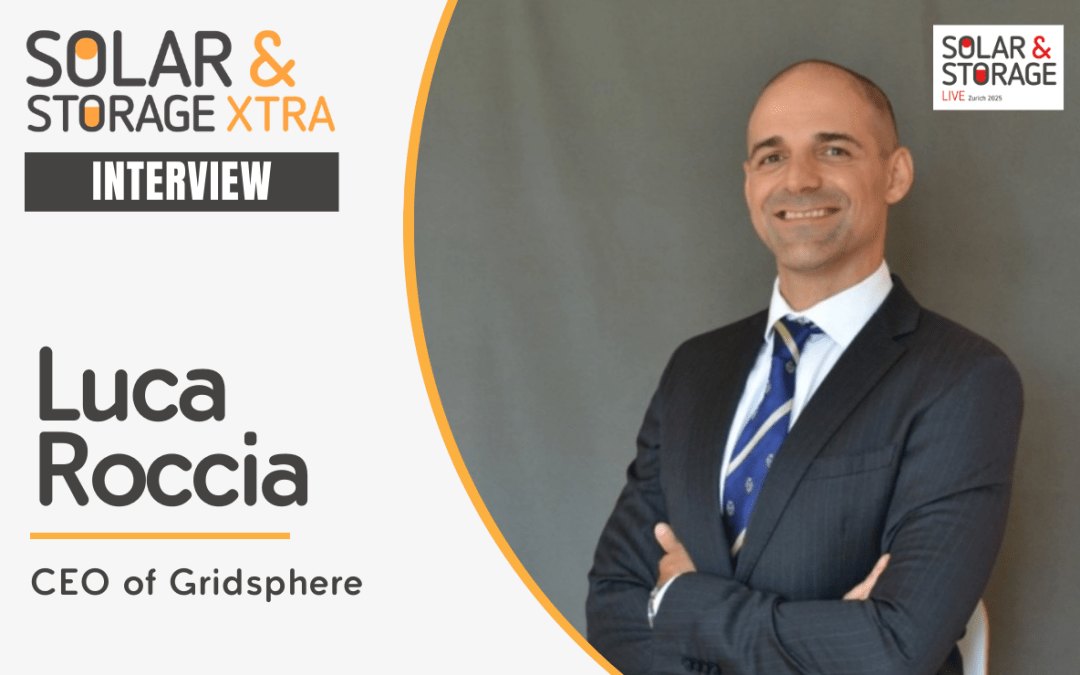
In the lead-up to Solar & Storage Live Zürich, we spoke with Luca Roccia, CEO of Gridsphere, about global technology trends, the future of storage innovation, and how Switzerland can carve out a leadership role in this fast-moving sector.
“Aggregating distributed energy storage systems also requires advanced EMS and aggregation platforms. These are already available in Switzerland and are improving rapidly.”
What have been the key global trends that have significantly influenced your approach in Switzerland?
For the past six years, we’ve been involved in energy storage globally. I’m originally from Italy, then I moved to the US to establish and develop business for a European-listed company. During that time, I’ve witnessed a lot of changes in the market.
From a technical perspective, when I first started in energy storage, lithium iron phosphate (LFP) wasn’t really present in the market. LFP has moved from niche to dominant for stationary storage in the last few years, offering a good price, long lifespan, and firm performance. At the same time, energy density increased significantly.
We are now at over 6MWh in a 20-foot container, whereas in the beginning, 1MWh was already considered a lot. The market has also shifted: from short-term to long-term energy storage, and from ancillary and stabilisation services to more solar surplus shifting.
I have seen this development both in the US and in Europe. In Switzerland, I recognise the same path I saw in other countries a few years ago, and I expect it to continue.
That is, in fact, what we are seeing now: larger and larger systems are being deployed. While there are already many residential storage units installed – and there will continue to be many – C&I and utility-scale storage are now growing.
We’ve already seen hundreds of hours with negative day-ahead prices in Switzerland (173 hrs in 2024, < − 5€ /MWh). That’s a strong signal that energy storage is required.
In the projects I’m following, both utility-scale and C&I, this revenue potential is already factored into the investment case.
To summarise: With 2026 ordinances enabling energy communities, minimum remuneration, and dynamic grid tariffs, the case for storage goes well beyond self-consumption.
Which emerging battery and storage technologies do you find most promising over the next decade?
LFP is absolutely the market leader, and I don’t believe that will change anytime soon. I expect LFP to remain the dominant chemistry.
What I do see, however, is hybridisation. In some large projects I’ve worked on, LFP batteries are combined with other technologies such as flow batteries. This enables both fast, powerful short-term response and longer-duration storage.
Beyond chemistry, I think one of the most important technical aspects is control systems and the ability to aggregate assets into VPPs (virtual power plants). Pools at Swiss utilities already exceed ~1.4 GW of aggregated flexible capacity.
Switzerland is very well positioned to take advantage of this opportunity, and we are already working on such projects with grid operators here.
What practical advice would you give developers and C&I clients in Switzerland looking to invest in battery storage now?
My first piece of advice is: look at the numbers. Use the actual data available and build models that provide reliable forecasts. When designing a system, it’s important to prepare for several types of services and build a revenue stack for the investment.
In Switzerland, demand charges are measured on 15-minute peaks, so right-sizing C&I storage against those windows is critical.
For example, in a C&I application behind the meter, you can increase self-consumption. You can also carry out peak-demand reduction for the customer, plus local grid support for the DSO. (Swissgrid) And, of course, there are services for Swissgrid, such as ancillary services (FCR, aFRR, mFRR) that batteries can provide.
We help developers and investors determine the best technology to deliver these services. I often say that there are OEMs and battery manufacturers with hundreds of megawatt-hours of projects successfully deployed worldwide.
Of course, we want to involve the Swiss ecosystem in developing storage systems, but we also need to learn from proven international technologies. Let’s not reinvent the wheel.
Could Switzerland become a global leader in energy storage innovation? What would need to evolve to make it happen?
Switzerland could certainly be a leader in innovation, but not in manufacturing. Nobody expects Switzerland to become a leader in producing batteries or turnkey solutions.
There are increasing challenges around cybersecurity, software, aggregation, and EMS. Switzerland can contribute expertise here, providing globally competitive systems with higher cybersecurity performance.
Aggregating distributed energy storage systems also requires advanced EMS and aggregation platforms. These are already available in Switzerland and are improving rapidly.
We are working with aggregators here to develop storage systems, and aggregators are key partners in our BESS-as-a-service projects—we operate via a prequalified BSP and integrate dispatch with the client’s BRP portfolio.
This involves distributed storage installed at C&I sites, aggregated to provide not only self-consumption but also grid services.
Talk to us about your BESS-as-a-service projects.
When you look at BESS assets as a standalone, the best you can do in C&I applications is increase self-consumption and offer peak-shaving for the customer. But that’s limiting, because storage can do much more.
The only way to enable more services – and more revenues – is to aggregate these systems and create VPPs that operate via a prequalified BSP and integrate dispatch with the client’s BRP portfolio.
That is the essence of the BESS-as-a-service concept we are launching: aggregating behind-the-meter storage at industrial facilities.
We apply acceptance criteria and select specific projects in Switzerland, then build a VPP to maximise revenues and profitability for investors.
Importantly, “as a service” means clients aren’t required to fully finance the storage investment themselves – different investment schemes bring in external investors to share the costs and benefits.
Can you give us a short insight into what you’ll be discussing on your panel at Solar & Storage Live Zurich?
From my experience with C&I batteries, the numbers are crucial. Without proper data analysis, you risk oversizing, undersizing, or making the wrong decisions. My first point will be: look at the numbers carefully.
Secondly, we need to be open-minded about revenue models. This ties into the BESS-as-a-service concept and the importance of aggregation into VPPs.
We’ll also explore how we expect the market in Switzerland to evolve, and what solutions we’re likely to see here.
Every country has its specifics: for example, in Texas, I’ve seen huge utility-scale projects, whereas in Germany or Italy, the market started with smaller residential systems before moving towards larger-scale projects.
Therefore, when sizing a project in Switzerland, we need to consider the country’s specific context. Our systems must not only meet current requirements but also be prepared for future changes in the market.