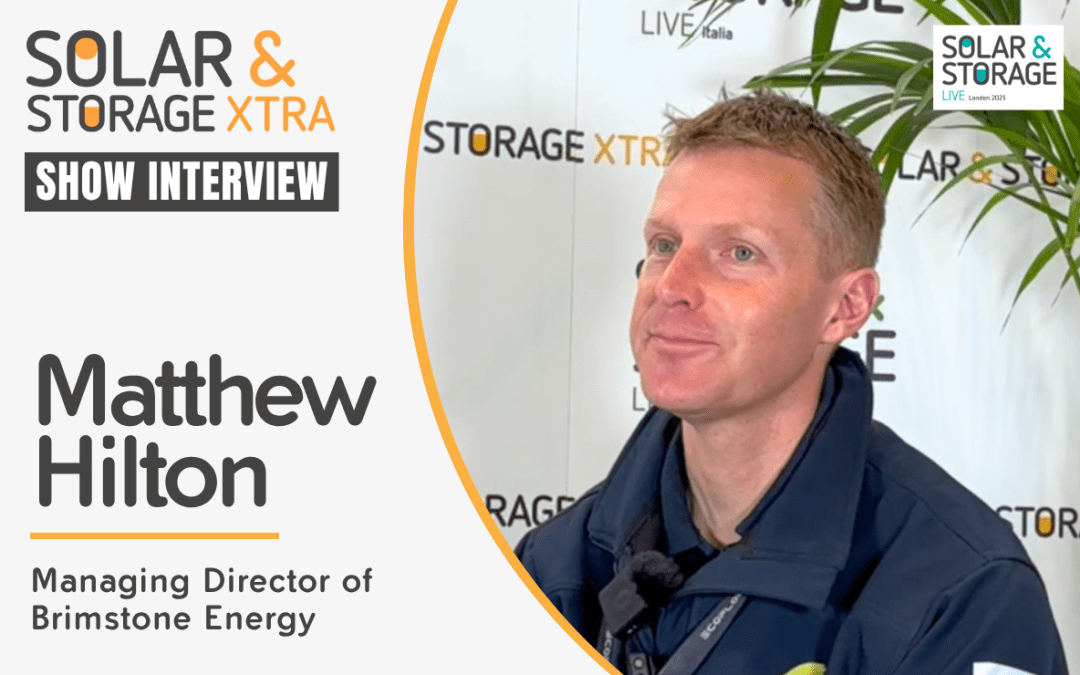
At Solar & Storage Live earlier this year, Solar&StorageXtra sat down with Matthew Hilton, Managing Director of Brimstone Energy, to talk about the company’s mission to bring low-cost, low-carbon energy to UK homes and small businesses.
He also discussed the growing role of battery storage, the challenges of customer awareness, and how smart home energy systems can flip the narrative.
Matthew also shared how Brimstone takes a long-term, whole-home approach to decarbonisation, supporting customers through every step of the transition.
“People – especially domestic customers – understand solar. What’s less well understood is how batteries integrate with solar. But over the past few years, batteries have become the key part of the ecosystem.”
How has Brimstone Energy been transitioning into the solar and storage industry?
Matthew: We’re here to bring low-cost, low-carbon energy to consumers and small businesses. That’s really our mission.
We founded Brimstone Energy in 2023 to deliver affordable energy to the mass market because we’ve found that this is a complex space. What we’re trying to do is work closely with customers to ensure they understand the products they’re buying and can have full confidence in us as a transparent business.
We’re building an ecosystem of products, not just installing solar panels and disappearing. We aim to support whole-home decarbonisation, and that might take place over a number of years.
It’s rarely something customers can do all at once, especially in a self-funded scenario.
For example, someone living in a rural property might currently rely on oil heating. In that case, we’d help them explore electric alternatives – maybe a heat pump, or perhaps something like a Tepio heat storage battery.
We’re technology agnostic. Our goal is to ensure the entire product ecosystem works together, and that installing one solution today won’t limit what you can do tomorrow.
It’s about having open conversations with customers from the start and taking them through that journey.
What challenges should the wider industry be paying closer attention to?
Matthew: Solar is a well-established technology. The cost per unit is now very low, and the reliability and quality are high. People – especially domestic customers – understand solar. It’s relatively easy to grasp.
What’s less well understood is how batteries integrate with solar. But over the past few years, batteries have become the key part of the ecosystem.
A battery manages energy flows and works silently in the background to minimise your energy bills. For people who aren’t familiar with the technology – and who may be busy and not looking into it – it’s not something they’re likely to know about.
Right now, energy prices are going up. But if you have solar and battery storage, you might actually see your energy costs going down, especially as fixed costs reduce.
For example, the standing charge on your electricity bill may shrink, or even disappear entirely in future. Personally, my electricity bill went down in April 2025, even as most people’s bills increased by 6 or 7%. That’s something we need to shout about.
The current narrative is about rising energy prices, but this technology can actually lower your bills.
What are the benefits of attending a Solar & Storage Live show?
Matthew: This is our third Solar & Storage Live event. We came to the London show last year and also attended the NEC in September.
These events are fantastic opportunities to accelerate your learning, meet suppliers, and identify who you really want to work with.
You meet people from all over the world, and it gives you a clear sense of their product offerings and how they operate. Honestly, what better way to do that than by attending in person?
Solar & Storage Live in Birmingham is on the horizon, so don’t miss out on your free ticket to the UK’s largest solar and storage show. Or, find a Solar & Storage Live event near you.