From its launch in 2012, SolaX has grown from residential inverter manufacturing into commercial and utility-scale energy storage.
Today, it partners with developers, funders, and IPPs to deliver large-scale battery systems that help balance the national grid.
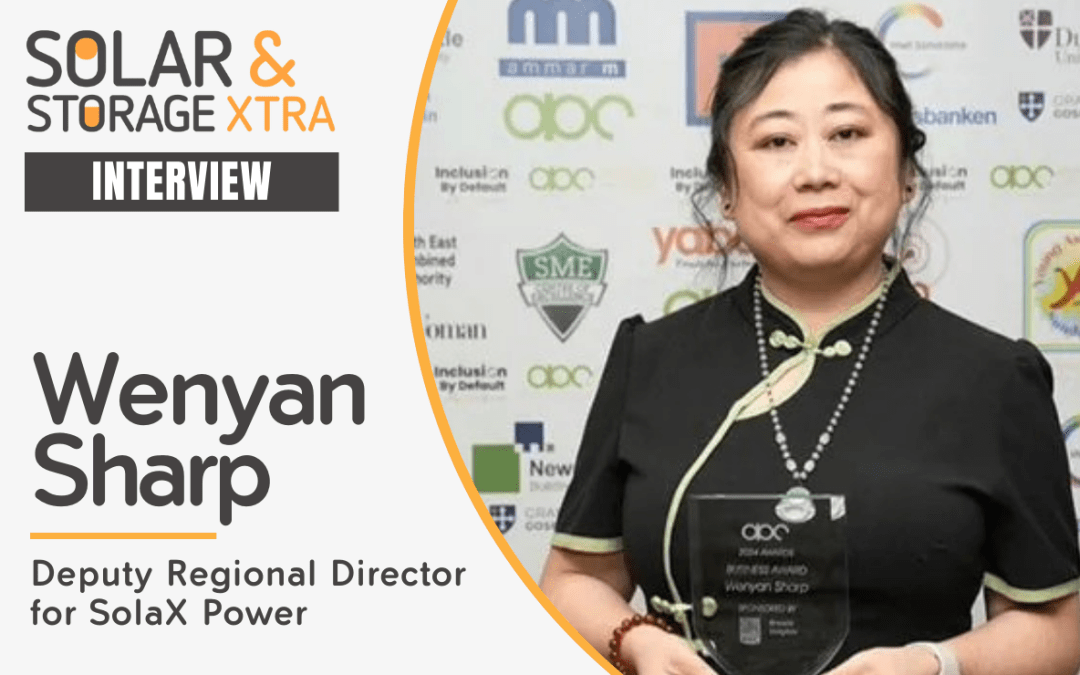
In this interview with Solar&StorageXtra, Wenyan Sharp, Deputy Regional Director for SolaX Power, shares insights on navigating shifting policies, the value of integrated storage solutions, and what’s next for the company ahead of Solar & Storage Live in Birmingham.
“Fortunately, the recent Solar Roadmap has helped to clarify many uncertainties for manufacturers, developers, IPPs, and other stakeholders. It’s connected the dots for people in the industry.”
Talk to me about the evolution of SolaX, and where the company is looking to go next.
SolaX was established in 2012 in China. Since 2013, we’ve had a presence in the UK market, where we started with residential inverter manufacturing.
Over the past decade, we’ve grown significantly. We’ve expanded from residential into commercial, and now into utility-scale projects. In recent years, we’ve developed CN&I battery storage systems for commercial applications.
Currently, our focus is on utility-scale energy storage to help balance the national grid. We’re actively working with developers, funders, and IPPs to build battery farms and, in some cases, co-located solar and storage projects.
What challenges has SolaX overcome during its growth?
One of the biggest challenges has been navigating changing government policies. We’ve seen numerous regulatory shifts – like the Gate 2, CP30, and CP35 frameworks – as well as ongoing reforms under the new Labour government.
Fortunately, the recent Solar Roadmap has helped to clarify many uncertainties for manufacturers, developers, IPPs, and other stakeholders. It’s connected the dots for people in the industry.
For example, a developer might have land but not the financial backing. Through our network, we’ve connected such developers with investors from the UK and abroad who are eager to invest in large-scale battery storage projects.
What have been the results of your conversations with industry stakeholders and decision-makers?
Many of our customers have expressed frustration with systems where the battery and PCS come from different manufacturers. That often leads to onsite conflicts, with one party blaming the other and installers caught in the middle.
Our integrated approach eliminates that problem.
There are many battery manufacturers out there, but they mostly focus only on the hardware of battery cells. SolaX started as an inverter manufacturer, which means our battery systems are fully integrated – we build the power conversion system (PCS) ourselves.
Our standard five-megawatt system comes in two containers: one houses the battery (5 MWh), and the other contains the PCS (2.5 MW) – including transformer and ABB switch gear, all in one.
What governmental and legislative changes would help drive the industry forward?
We need clearer, faster decision-making from the government. Investors and developers are often ready to go – they have the land and the money – but they’re stuck waiting due to long lead times and uncertainty about future connection dates or policy changes.
Some people have heard that projects with connection dates beyond 2027 might be halted. Whether or not that’s true, the speculation itself causes delays and hesitancy. A transparent, long-term strategy from the government would give the industry the confidence it needs.
More broadly, collaboration across the industry is essential. Stakeholders need access to better knowledge and clearer guidance to navigate this evolving landscape.
What can attendees of Solar & Storage Live this September expect from SolaX?
We’re planning to showcase our latest innovations, including the launch of our new utility-scale battery model, Ori. Also, attendees can expect to see new technologies and developments from SolaX, such as XHUB with AI technology to help households predict their electricity consumption according to weather forecasts.
Otherwise, attendees can definitely expect to see new technologies and developments from SolaX.
It’s also a great opportunity to stay up to date with industry trends. The sector is evolving rapidly, and events like Solar & Storage Live are crucial for staying informed about what’s next.
Check out our interview with Wenyan from Solar & Storage Live UK 2024, where she delved into an intriguing case study that highlighted the benefits to consumers when they invest in solar and storage.
Solar & Storage Live in Birmingham is on the horizon, so don’t miss out on your free ticket to the UK’s largest solar and storage show. Or, find a Solar & Storage Live event near you.