According to a new report from energy think tank Ember, the heatwave that swept across Europe in June and early July 2025 pushed electricity systems to their limits.
Temperatures exceeded 40°C in some regions, triggering record-high power demand and prices.
The report notes that, despite these challenges, high levels of solar generation helped maintain grid stability.
Temperature on the rise
The spike in temperature, measured up to 9°C higher than the week prior in Germany, caused electricity demand to rise by as much as 14% in Spain, 9% in France, and 6% in Germany.
France and Spain also saw a 12% and 15% increase in peak demand, respectively.
This surge coincided with outages at thermal power plants, contributing to a sharp increase in prices.
Compared to June 24, average daily electricity prices more than doubled in Poland and France and nearly tripled in Germany, where prices exceeded €400/MWh during peak hours.
“The 2025 heatwave increased the daily power demand by up to 14%. Combined with thermal power plant outages, this led to a 2–3 times increase in average daily power prices,” the report states.
Compounding the issue were heat-related reductions in nuclear output. In France, 17 of 18 nuclear power stations were impacted, with plants along the Garonne, Loire and Rhône rivers especially affected.
Ember found that up to 15% of France’s nuclear capacity may have been offline due to the heat.
Solar saves the day
Yet, record levels of solar energy played a crucial stabilising role. June 2025 marked the highest solar generation month in EU history at 45 TWh.
In Germany, solar provided up to 50 GW during the heatwave, accounting for up to 39% of daily electricity generation.
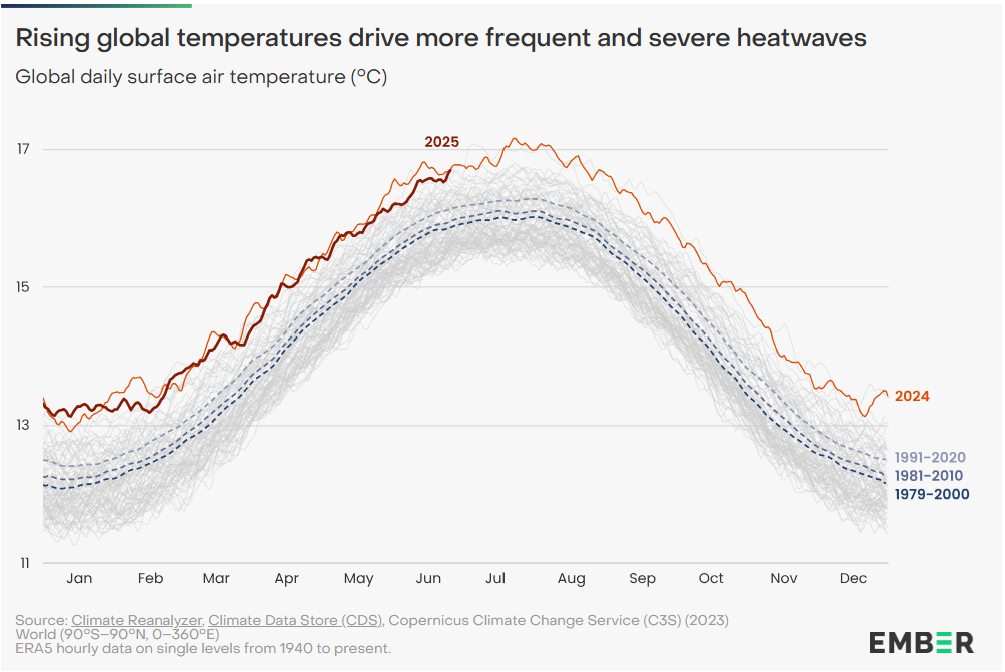
“Heatwaves will not go away – they will only get more severe in the future,” comments Ember’s Europe Programme Director, Pawel Czyzak.
“Solutions that can help mitigate their impacts, such as battery storage, interconnection, demand flexibility and dynamic tariffs, should become a key part of grid planning and power market design.”
The widening gap between daytime and evening electricity prices (spreads exceeding €400/MWh) overall highlighted the value of energy storage and flexible demand.
Grid operators across Europe are now exploring measures to better prepare for extreme weather, including dynamic pricing, grid-forming technologies, and better integration of distributed energy sources.
The full report can be found here.
[Graph credit: Ember]