A new report from SolarPower Europe underscores the critical role solar mounting systems play in supporting Europe’s solar manufacturing base and energy transition.
Mounting systems – typically made from steel or aluminium – secure solar panels in place and determine their angle and orientation. These systems can either be fixed or tracking, with European utility-scale projects seeing an approximate 50-50 split between the two.
“Mounting systems make solar possible, durable, and flexible,” said Dries Acke, Deputy CEO at SolarPower Europe.
“Innovative mounting systems are spreading solar generation beyond the midday peak, bringing the power of the sun for more hours of the day, and improving the business case for solar.”
Mounting technologies are increasingly helping to balance solar generation by shifting output to mornings and evenings.
East-west oriented or vertically mounted panels are particularly useful in northern regions, while tracking systems can deliver up to 30% more value annually than fixed-tilt alternatives.
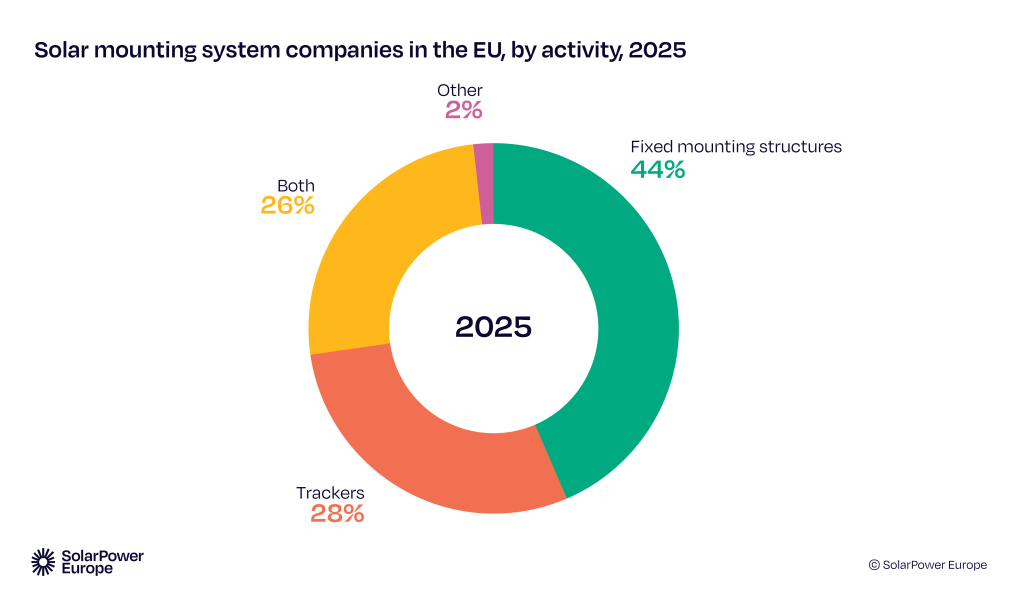
The report, Solar Mounting Structures Explained, maps over 40 EU-based companies developing mounting systems for rooftops, ground-mounted arrays, façades, Agri-PV, and carports.
While Europe currently meets most of its domestic demand, non-European competition is growing.
“Mounting systems prove to be one of the most enduring segments of European solar manufacturing,” said Leah Le Pénuizic, Market Analyst at SolarPower Europe.
“We need distinct customs codes for this technology to properly monitor the trade flows, and robust standards to uphold the quality of solar mounting systems across Europe.”
SolarPower Europe recommends expanding the scope of the Net-Zero Industry Act to include all mounting types, introducing distinct customs codes, and developing harmonised quality standards across the EU.
[Graph credit: SolarPower Europe]