by Catie Owen | Sep 16, 2025 | Commercial & Industrial Solar, Europe, Storage
Switzerland’s solar and storage sector is entering a new phase, with larger-scale projects and innovative business models beginning to reshape the market.
In the lead-up to Solar & Storage Live Zürich, we spoke with Luca Roccia, CEO of Gridsphere, about global technology trends, the future of storage innovation, and how Switzerland can carve out a leadership role in this fast-moving sector.
“Aggregating distributed energy storage systems also requires advanced EMS and aggregation platforms. These are already available in Switzerland and are improving rapidly.”
What have been the key global trends that have significantly influenced your approach in Switzerland?
For the past six years, we’ve been involved in energy storage globally. I’m originally from Italy, then I moved to the US to establish and develop business for a European-listed company. During that time, I’ve witnessed a lot of changes in the market.
From a technical perspective, when I first started in energy storage, lithium iron phosphate (LFP) wasn’t really present in the market. LFP has moved from niche to dominant for stationary storage in the last few years, offering a good price, long lifespan, and firm performance. At the same time, energy density increased significantly.
We are now at over 6MWh in a 20-foot container, whereas in the beginning, 1MWh was already considered a lot. The market has also shifted: from short-term to long-term energy storage, and from ancillary and stabilisation services to more solar surplus shifting.
I have seen this development both in the US and in Europe. In Switzerland, I recognise the same path I saw in other countries a few years ago, and I expect it to continue.
That is, in fact, what we are seeing now: larger and larger systems are being deployed. While there are already many residential storage units installed – and there will continue to be many – C&I and utility-scale storage are now growing.
We’ve already seen hundreds of hours with negative day-ahead prices in Switzerland (173 hrs in 2024, < − 5€ /MWh). That’s a strong signal that energy storage is required.
In the projects I’m following, both utility-scale and C&I, this revenue potential is already factored into the investment case.
To summarise: With 2026 ordinances enabling energy communities, minimum remuneration, and dynamic grid tariffs, the case for storage goes well beyond self-consumption.
Which emerging battery and storage technologies do you find most promising over the next decade?
LFP is absolutely the market leader, and I don’t believe that will change anytime soon. I expect LFP to remain the dominant chemistry.
What I do see, however, is hybridisation. In some large projects I’ve worked on, LFP batteries are combined with other technologies such as flow batteries. This enables both fast, powerful short-term response and longer-duration storage.
Beyond chemistry, I think one of the most important technical aspects is control systems and the ability to aggregate assets into VPPs (virtual power plants). Pools at Swiss utilities already exceed ~1.4 GW of aggregated flexible capacity.
Switzerland is very well positioned to take advantage of this opportunity, and we are already working on such projects with grid operators here.
What practical advice would you give developers and C&I clients in Switzerland looking to invest in battery storage now?
My first piece of advice is: look at the numbers. Use the actual data available and build models that provide reliable forecasts. When designing a system, it’s important to prepare for several types of services and build a revenue stack for the investment.
In Switzerland, demand charges are measured on 15-minute peaks, so right-sizing C&I storage against those windows is critical.
For example, in a C&I application behind the meter, you can increase self-consumption. You can also carry out peak-demand reduction for the customer, plus local grid support for the DSO. (Swissgrid) And, of course, there are services for Swissgrid, such as ancillary services (FCR, aFRR, mFRR) that batteries can provide.
We help developers and investors determine the best technology to deliver these services. I often say that there are OEMs and battery manufacturers with hundreds of megawatt-hours of projects successfully deployed worldwide.
Of course, we want to involve the Swiss ecosystem in developing storage systems, but we also need to learn from proven international technologies. Let’s not reinvent the wheel.
Could Switzerland become a global leader in energy storage innovation? What would need to evolve to make it happen?
Switzerland could certainly be a leader in innovation, but not in manufacturing. Nobody expects Switzerland to become a leader in producing batteries or turnkey solutions.
There are increasing challenges around cybersecurity, software, aggregation, and EMS. Switzerland can contribute expertise here, providing globally competitive systems with higher cybersecurity performance.
Aggregating distributed energy storage systems also requires advanced EMS and aggregation platforms. These are already available in Switzerland and are improving rapidly.
We are working with aggregators here to develop storage systems, and aggregators are key partners in our BESS-as-a-service projects—we operate via a prequalified BSP and integrate dispatch with the client’s BRP portfolio.
This involves distributed storage installed at C&I sites, aggregated to provide not only self-consumption but also grid services.
Talk to us about your BESS-as-a-service projects.
When you look at BESS assets as a standalone, the best you can do in C&I applications is increase self-consumption and offer peak-shaving for the customer. But that’s limiting, because storage can do much more.
The only way to enable more services – and more revenues – is to aggregate these systems and create VPPs that operate via a prequalified BSP and integrate dispatch with the client’s BRP portfolio.
That is the essence of the BESS-as-a-service concept we are launching: aggregating behind-the-meter storage at industrial facilities.
We apply acceptance criteria and select specific projects in Switzerland, then build a VPP to maximise revenues and profitability for investors.
Importantly, “as a service” means clients aren’t required to fully finance the storage investment themselves – different investment schemes bring in external investors to share the costs and benefits.
Can you give us a short insight into what you’ll be discussing on your panel at Solar & Storage Live Zurich?
From my experience with C&I batteries, the numbers are crucial. Without proper data analysis, you risk oversizing, undersizing, or making the wrong decisions. My first point will be: look at the numbers carefully.
Secondly, we need to be open-minded about revenue models. This ties into the BESS-as-a-service concept and the importance of aggregation into VPPs.
We’ll also explore how we expect the market in Switzerland to evolve, and what solutions we’re likely to see here.
Every country has its specifics: for example, in Texas, I’ve seen huge utility-scale projects, whereas in Germany or Italy, the market started with smaller residential systems before moving towards larger-scale projects.
Therefore, when sizing a project in Switzerland, we need to consider the country’s specific context. Our systems must not only meet current requirements but also be prepared for future changes in the market.
by Catie Owen | Sep 12, 2025 | Asia, Commercial & Industrial Solar, Europe
LONGi participated in senior-level discussions on “Building Sustainable Business and Brands” at the Palace of Nations in Geneva, Switzerland, from September 3 to 4, 2025.
The events were organised by the United Nations Conference on Trade and Development (UNCTAD), the United Nations Forum on Sustainability Standards (UNFSS), the China Association for Standardisation (CAS) and its Sustainable Business and Brand Committee (SBBC).
Bringing together government representatives, international organisations and business leaders, the meetings aimed to promote alignment on sustainability standards and advance corporate brand governance. LONGi was the only representative from China’s new energy sector.
On 4 September, Jia Chao, President of LONGi’s Europe Business Centre, joined a senior dialogue with heads of international organisations and multinational firms.
He said clean energy, particularly solar, had become “the backbone of the global energy transition”, noting its value in supporting development in energy-scarce regions such as Afghanistan and Pakistan.
Jia outlined the company’s approach to “creating sustainable businesses and achieving energy equity”, stressing that “technological innovation is the core engine driving enterprise development, and sustainable development is no longer an empty slogan, but a practical action” embedded in strategy, supply chains and operations.
During the event, LONGi signed the “Commitment to Build Sustainable Brands”, alongside more than 20 Chinese companies, including Anta Sports and CATL. The initiative encourages businesses, especially in new energy, to integrate sustainability into brand building.
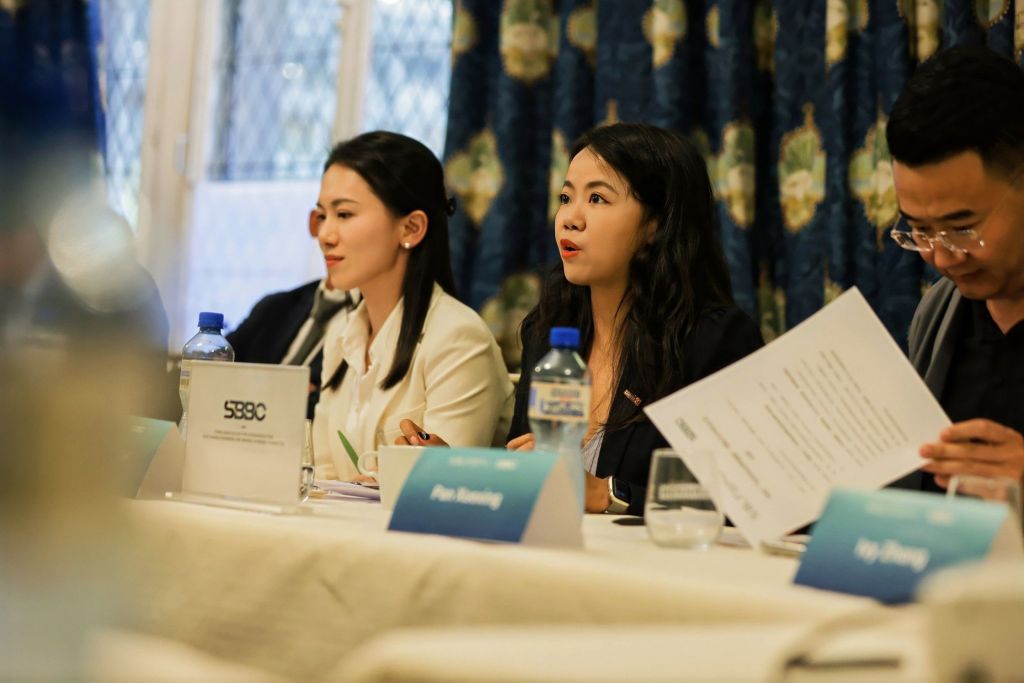
[Image caption: Floria Wang, Head of Global Branding at LONGi, delivered a speech themed “The Inherent Sustainable DNA of the PV Industry and Global Implementation.”]
Long-term sustainability strategy
Floria Wang, LONGi’s Head of Global Branding, addressed an international seminar on 3 September.
Her presentation, “The Inherent Sustainable DNA of the PV Industry and Global Implementation”, highlighted projects such as the “Photovoltaic+” scheme in China’s Kubuqi Desert, which generates renewable electricity while tackling desertification; the Kayapó project in Brazil, supporting indigenous communities through solar development; and a UNHCR solar power station in Uzbekistan, designed to cut costs and emissions.
LONGi said it is embedding green principles across its operations, including “green electricity + green hydrogen” solutions, and has upgraded its Strategy Committee to include sustainability as a core metric for decision-making. The company emphasised that its long-term brand value is tied to contributions to society and the environment.
The showcase in Geneva reflected a shift among Chinese new energy firms from technology providers to active participants in shaping global sustainability standards.
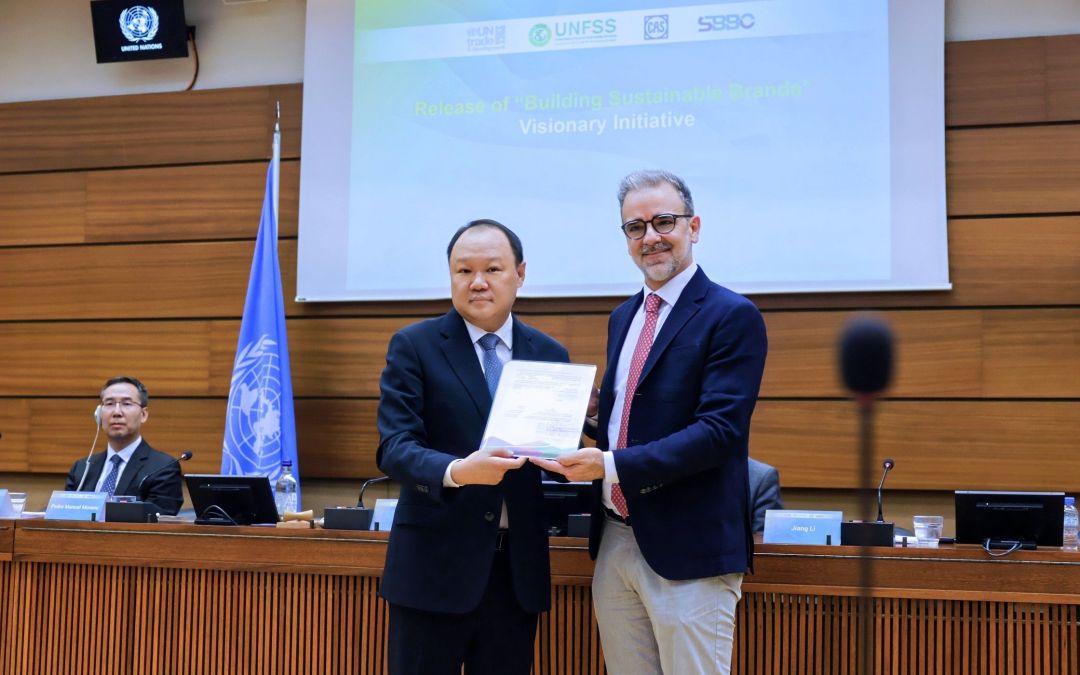
[Images credit: LONGi. Header caption: Jiang Li, Chairman of SBBC and Cheif Coordinator of SBLF (China), represented the signing company and submitted the visionary initiative to Pedro Manuel Moreno, Deputy Secretary-General of United Nations Conference on Trade and Development (UNCTAD).]
Swiss Solar Week marks the leadup to Solar & Storage Live Zürich, taking place 16-17 September. Haven’t registered yet? Don’t miss out on your free ticket by securing your place here.
by Catie Owen | Sep 11, 2025 | Europe, Storage
As part of Swiss Solar Week – held just ahead of Solar & Storage Live Zürich – Solar&StorageXtra spoke with Matteo Racchi, Sales and Business Development Manager at Meri Energy.
Matteo discusses how the Swiss-based company is carving out its place in the global solar-storage market, from supporting installers with hands-on services to responding to evolving technologies and shifting European policy landscapes.
“In Switzerland, environmental awareness is a top priority. Energy independence and reducing pollution are two strong drivers for the local population.”
How does Meri Energy position itself in the international solar-storage industry?
Meri Energy positions itself as a young but innovative company. We aim to offer our customers the benefits of direct contact with the manufacturer.
Our locally trained technical service team provides immediate responses to customer needs. We want to maintain this close connection to listen to our partners and develop increasingly high-performing solutions that meet both technical and commercial requirements.
As a company based in Switzerland, how does your domestic solar-storage market differ from other international markets? How do you adapt your strategy?
In Switzerland, environmental awareness is a top priority. Energy independence and reducing pollution are two strong drivers for the local population. Installing solar systems with storage represents the ideal solution for self-consumption.
Meri Energy’s vision for the future is a widespread production of clean energy, used directly on site with minimal reliance on the grid. In such a scenario, both pollution and operating costs are reduced to a minimum.
How do you expect falling battery prices and advances in chemistry to impact the industry – and your roadmaps?
After a sharp decline driven by economies of scale in recent years, prices have stabilised in recent months. However, cells are constantly evolving, and their technical performance will continue to improve, leading to a gradual (though slower) reduction in the cost per kWh.
There are already cheaper solutions on the market, but it is essential to remember that component quality and technical support come at a cost, which inevitably affects the final product.
What regulatory or policy changes would most accelerate solar-storage adoption across Europe?
Government incentives have always been a concrete support for those installing storage systems. Yet today, the main drivers are energy prices and the risk of supply instability.
Storage systems pay for themselves within a few years, while offering independence and the possibility of becoming producers of one’s own “fuel,” particularly in the context of electric vehicles.
We do not believe in mandatory installation requirements; rather, we see greater value in direct incentives – such as invoice discounts – that can help private households choose this solution.
At Solar & Storage Live Zürich, what message about Meri Energy’s products do you most want visitors to remember when they meet you?
Our main focus is helping installers succeed. When installers can deliver reliable, affordable storage solutions with strong support, the real winner is the end customer – the homeowner or business owner who gets peace of mind, savings, and a sustainable solution.
What makes us unique is not just the product, but the ecosystem of services we provide: warranty, insurance, local assistance, and even lead generation.
Looking forward, we aim to continue expanding our distribution and installation partnerships across Switzerland and establish ourselves as a preferred brand for energy storage among Swiss customers.
Swiss Solar Week marks the leadup to Solar & Storage Live Zürich, taking place 16-17 September. Haven’t registered yet? Don’t miss out on your free ticket by securing your place here.
by Catie Owen | Sep 10, 2025 | Commercial & Industrial Solar, Europe
As Switzerland’s solar and storage industry scales up, ELEKTRON is positioning itself as a trusted partner for resilient, modular solutions.
Ahead of Solar & Storage Live Zurich, we talked to Peter Dietiker, Managing Director of Green Building at ELEKTRON AG, about the company’s role in Switzerland’s evolving solar-storage sector.
“We place great importance on the following aspects: long product life expectancy, adaptability to new customer requirements, technical support for troubleshooting, and expandability for the future.”
How does Elektron position itself in the international solar-storage industry?
ELEKTRON imports solar batteries into Switzerland and sells them to installation companies and industrial customers. We are an added value reseller and support our B2B customers with design, training, commissioning and troubleshooting. We offer solar batteries for indoor and outdoor use.
As a company based in Switzerland, how does your domestic solar-storage market differ from other international markets? How do you adapt your strategy?
ELEKTRON has been supplying discerning installation customers in Switzerland with high-end products, advice and support for 75 years. We know the solar market and the installation industry very well and therefore select the right products for our customers’ needs.
We develop our strategy in dialogue with our customers. It is essential for our customers that technical support is competent, fast and available in Swiss German, French and Italian. Our offerings have open standards for the integration of third-party brands and are highly modular and expandable.
As a solutions provider, how important is resilience – particularly in a Swiss context – for your customers?
ELEKTRON tests products in pilot installations before listing them. We place great importance on the following aspects: long product life expectancy, adaptability to new customer requirements, technical support for troubleshooting, and expandability for the future. Our customers increasingly demand this from us.
What challenges do you foresee in scaling solar-storage uptake in Switzerland – such as regulatory barriers or supply chain constraints – and how is Elektron addressing them?
ELEKTRON sees the biggest hurdle in distorted pricing systems in Switzerland’s basic supply. End customers do not pay the least when the exchange price is at its lowest. This is due to a lack of market openness for customers below 100,000kWh.
In return, the compensation costs increase the average electricity price, which is not economically efficient.
We prepare our customers for dynamic prices so that they can benefit from them with their battery storage systems. And, we address industrial and commercial customers who can already benefit from the open electricity market.
At Solar & Storage Live Zurich, what message about Elektron’s products do you most want visitors to remember when they meet you?
ELEKTRON offers modular and expandable battery systems from Solinteg and Pylontech to installation partners in Switzerland. This enables us to implement projects ranging from 10 to 5,000kWh, indoors or outdoors, DC or AC coupled.
With or without emergency power (3-phase and with full AC power). Our systems are also island- and black start-capable. ELEKTRON also supports you where you do not yet have a solution.
Swiss Solar Week marks the leadup to Solar & Storage Live Zürich, taking place 16-17 September. Haven’t registered yet? Don’t miss out on your free ticket by securing your place here.
by Catie Owen | Sep 9, 2025 | Innovation, Storage
Press Release
Sungrow, leading provider of renewable energy solutions, is expanding its market presence in Switzerland. Sungrow’s portfolio includes PV inverters, energy storage systems (ESS), and EV charging solutions.
The company is working with distributors Krannich, Sonepar, Fankhauser, and Solarmarkt to ensure comprehensive sales coverage of the Swiss market.
To actively participate in industry discussions in the country, the company has joined the solar association Swissolar and will be present at the upcoming Solar&Storage Zürich from September 16 to 17.
“We see a growing demand for smart energy solutions and high-quality services in Switzerland,” says Christian Welz, Country Manager DACH at Sungrow Europe. “Locally, we are already working with strong companies and will continue to expand our presence.”
For over 18 years, Sungrow has been active in Europe, offering innovative products, local sales, technical support, and after-sales services. The company currently operates with over 750 employees, more than 25 local offices, and two R&D teams.
Record expansion of PV in Switzerland
Switzerland aims to increase the share of renewable energies and reduce dependence on fossil fuels with the Energy Strategy 2050.
Last year, a record addition of 1.8MW of PV capacity was installed. By the end of 2024, PV systems with a cumulative capacity of almost 8.2GW were in operation.
In recognition of the needs of the Swiss market, Sungrow has established a local team of experienced professionals for comprehensive technical and commercial support.
From residential and C&I projects to large-scale ground-mounted systems, Sungrow offers solutions with the highest performance and reliability while complying with local standards.
Customer support at the highest level
To provide the best possible support to customers, Sungrow has established a comprehensive structure.
This includes a dedicated service hotline and extensive documentation, a strong sales network through Krannich, Sonepar, Fankhauser, and Solarmarkt, as well as a dedicated team of experts, including a Partner Success Manager (PSM) who supports local distributors, installers, and partners.
To further increase the efficiency and safety of installations with Sungrow products, the company regularly organises meetings and training programs, both online and in person.
These are free, tailored to the Swiss market, and aim to educate technicians, installers, and other key players in the PV sector.
Solar & Storage Zürich
Sungrow will be present at Solar & Storage Zürich from September 16 to 17 with a large booth and numerous experts. The entire product portfolio of efficient energy solutions from residential and C&I solutions to large-scale systems will be showcased, among other things:
- Micro-inverter portfolio (450-1600W), which allows households to efficiently improve their green energy supply.
- The scalable and modular battery storage PowerStack for commercial and industrial applications (C&I) up to 455kWh.
- The liquid-cooled large-scale ESS PowerTitan 2.0 with a capacity of up to 5MWh.
- The software solutions iHomeManager 2.0 and iSolarCloud for effective data and energy management.
- AC and DC charging stations for electric vehicles from 11 to 480 kW for private, commercial, and public customers.
Visit the Sungrow booth C20 to learn about the latest industry developments and products.
More information about Sungrow can be found on the Sungrow Europe LinkedIn account and by subscribing to the Sungrow newsletter.
Swiss Solar Week marks the leadup to Solar & Storage Live Zürich, taking place 16-17 September. Haven’t registered yet? Don’t miss out on your free ticket by securing your place here.
by Catie Owen | Sep 8, 2025 | Europe, Innovation, Storage
As Switzerland accelerates its transition to renewable energy, Solar & Storage Live Zürich has quickly established itself as a key meeting point for the sector.
Mark Lewis, Commercial Director for Solar & Storage Live Zürich, shares what’s new for 2025 and how the show is helping to shape Switzerland’s energy future.
“Our free educational content ensures that everyone – from utilities to small installers – leaves with insights, practical knowledge, and new connections.”
Why did Solar & Storage Live choose Zürich, and what were the key learnings from the inaugural edition?
Terrapinn has been organising the Solar & Storage Live portfolio worldwide for over a decade. We entered Europe around seven or eight years ago, and in early 2022, we looked at how to expand further.
By 2023, we decided to take the event across Europe, continuing our model of connecting technology suppliers and providers with local audiences of installers, project developers, and large end users.
The challenge was to identify countries with both business potential and government support for renewable energy, while avoiding markets that already had established events. Switzerland stood out: there were smaller conferences, but nothing offering a full trade exhibition and conference for the entire supply chain.
Solar energy in Switzerland has grown exponentially. In 2022, solar accounted for 4.7MW – about 6% of total electricity. By the end of 2025, it is projected to reach 8.1MW.
This growth stems from government legislation: the Swiss Energy Strategy 2050 and the Energy Act of 2022, which aim to phase out nuclear power, cut greenhouse gas emissions, and boost renewables.
The Swiss government also supports solar through one-off payments for small and large installations. This created a strong case for launching in Zürich, benefitting both local players and international manufacturers exploring the Swiss market.
As for learnings, the first show was pulled together quickly. We had limited resources, limited local knowledge, and language challenges. But the response was clear: the Swiss audience wanted this type of event and appreciated the format, which differed from the conferences they were used to.
Some expected more international exhibitors, and many assessed the market in year one before committing fully.
Now, we’ve established events not only in Switzerland but also in Spain, and this year in France and Italy, in addition to the UK. That portfolio shows we’re offering regionally distinct audiences and real business opportunities.
What is your overarching vision for the Zürich event’s role in Switzerland’s energy transition?
For our Zürich event specifically, it’s already becoming a one-stop shop for the entire supply chain, tackling unique challenges like Alpine terrain, while showcasing how technology is being adapted to meet them.
We want Solar & Storage Live Zürich to become a marketplace for innovation. This year we’re seeing many new start-ups, often spun out of academic institutions. Zürich itself is known for its innovative start-up culture, particularly in AI and IT, which we’re also seeing reflected in solar software solutions.
The show is also a platform for local cantons, government, and utilities to engage, debate, and collaborate. For project developers and installers, it’s about identifying specific benefits of solar adoption and solutions for major storage projects, ensuring energy is effectively stored and integrated into the grid for both consumer and industrial use.
Can you highlight some stand-out features of this year’s show?
The most striking thing is how quickly the event has grown. This year, we have over 100 speakers across four conference streams, covering academia, government, utilities, and the supply chain, alongside almost 100 exhibitors.
Visitors will see a mix of international brands and Swiss distributors, 50 new exhibitors, plus 13 start-ups – many of them university spin-outs – which bring real innovation to the floor.
We’ve introduced an installer zone for hands-on engagement, where local installers can meet suppliers and explore solutions to challenges like Alpine conditions.
Networking is also a key feature: structured meet-ups and informal sessions bring together cantonal authorities, project developers, utilities, and technology firms. Switzerland’s mix of German, French, and Italian-speaking regions adds to the value, making it a true meeting point.
Finally, our free educational content ensures that everyone – from utilities to small installers – leaves with insights, practical knowledge, and new connections.
Who will benefit from attending?
Utilities, installers, and project developers from across Switzerland – and beyond, including Austria, Germany, and northern Italy – will benefit. International brands such as SolarEdge, SIG Energy, and 7 Sun are on board, reinforcing the event’s credibility.
From the distributor side, we have established names like Solomart, Tritec, Solexis, and Solvetica, alongside newer players such as EP and Fergalen. This shows we’re representing the entire Swiss market.
Importantly, we also have international exhibitors from Spain, Italy, China, the UK, the Netherlands, and even the Middle East. But the event works because of the strong local element: installers, start-ups, and dedicated meet-ups for the supply chain.
End users, such as hospitals, schools, and large businesses, can explore technology options, costs, and suppliers. Installers and developers, many with backgrounds in electrical or heat pump trades, can discover new opportunities and technologies suited to Switzerland’s unique climate.
For example, exhibitors will showcase PV systems designed to withstand heavy snowfall – something also needed in France or Spain.
Can you talk about the topics on the conference programme?
The conference spans four streams: utility-scale, commercial and industrial, storage, and residential. In Switzerland, commercial, industrial, and residential take centre stage.
We’ll cover the impact of the new Swiss Electricity Act, PV integration, battery storage applications, and agri-photovoltaics for farming. Community energy projects and urban carports are also on the agenda, alongside decarbonising buildings with solar.
We’re also very pleased to have the President of the Swiss Green Party speaking.
What’s on the horizon for Solar & Storage Live Zürich’s future editions?
Now that we’re firmly on the map, the next step is further internationalisation. This year we already have Chinese delegations attending, recognising Zürich as a gateway to central Europe. In future, we’re looking at pavilion groups and broader international participation.
At the same time, the local audience remains central. Swiss exhibitors are eager to engage not only with international players but also with German, Austrian, and other central European businesses viewing Switzerland as a growth area.
Outside the UK, Zürich is already our most successful European event, and we look forward to building on that success in year three and beyond.
Swiss Solar Week marks the leadup to Solar & Storage Live Zürich, taking place 16-17 September. Haven’t registered yet? Don’t miss out on your free ticket by securing your place here.
Companies looking to confirm their stand at next year’s event should contact Mark Lewis at , or meet the sales team in person on stand F50 at next week’s event in Zürich