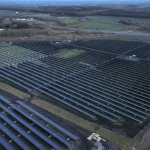
[Image: Sekdoorn floating PV park in the Netherlands – BayWa re]
A country renowned for its lush landscape dotted with wind turbines, the Netherlands is leading the charge towards a renewable future. However, wind isn’t its only asset – the Netherlands’ solar sector is also booming.
Taking up space
The country’s embrace of bifacial solar panels combined with its famously flat land has made the Netherlands a hub for agrivoltaics (AV) plants, with more potential on the horizon. As of March 2024, the Netherlands boasted about ten AV plants.
By investing in AV, the amount of land suitable for plants increases and more Dutch farmers have access to additional income. As an example, renowned renewable solutions provider BayWa r.e. is building one of Europe’s largest AV plants on a raspberry farm in the Netherlands.
Panels aren’t only being installed on the land. The Netherlands’ ‘Zon op Zee’ (Solar-at-Sea) offshore solar project, launched in 2017, is the world’s first offshore solar farm at open sea. This project demonstrates the out-of-the-box innovation currently taking place in the Netherlands’ solar scene.
Furthermore, the Port of Rotterdam has been exploring the idea of deploying large-scale solar installations on industrial sites and the roofs of warehouses, in a bid to maximise unused space.
Community and corporate
For the nation, solar is also a communal commitment. Community-owned solar cooperatives, such as Burgerwindcoöperatie West-Betuwe, allow residents to invest and benefit from solar projects. Such initiatives give the population individual stakes in the Netherlands’ journey to a renewable future.
At a corporate level, companies including Heineken and Philips have committed to sourcing a large amount of their respective electricity from renewable sources such as solar. These commitments align with the companies’ sustainability goals and reduce carbon emissions.
Government and international
The Netherland’s journey to a renewable future is benefiting from Government support. The Stimulering Duurzame Energieproductie (SDE+) subsidy scheme has been instrumental in driving solar energy deployment since its implementation, as it provides financial support to solar projects through competitive tendering.
Meanwhile, net metering policies have allowed owners of solar PV systems to offset their electricity consumption with excess solar power exported to the grid, providing an enticing incentive for both residential and commercial solar installations.
Through collaborations with other European countries, the Netherlands invests in initiatives such as the North Sea Wind Power Hub. This international Hub explores the potential of offshore solar energy in the North Sea so that European countries including the Netherlands can benefit from global expertise.
Additionally, partnerships with organisations such as the International Renewable Energy Agency (IRENA) and the European Union’s Clean Energy for EU Islands initiative allow the Netherlands to participate in knowledge exchange – which supports capacity-building efforts that benefit global solar energy deployment.
To the future
The Netherlands is investing in a green future: a goal clearly laid out in future-impacting policies. The nation currently aims to achieve 100% renewable energy by 2025, with solar taking a starring role through innovation, policy support, and investment in infrastructure.
The future of solar in the Netherlands is also embracing emerging technologies – such as building-integrated PV (BIPV) and perovskite solar cells. Through the future success of these technologies in particular, the country will likely se enhanced efficiency and affordability of its solar systems, continued growth, and a competitive solar market.
This article is part of a series celebrating the announcement of Solar & Storage Live Amsterdam, which will be held 15-16 October 2025 at RAI Amsterdam.
Stay tuned for more insights from the best and brightest of Amsterdam’s solar sector.