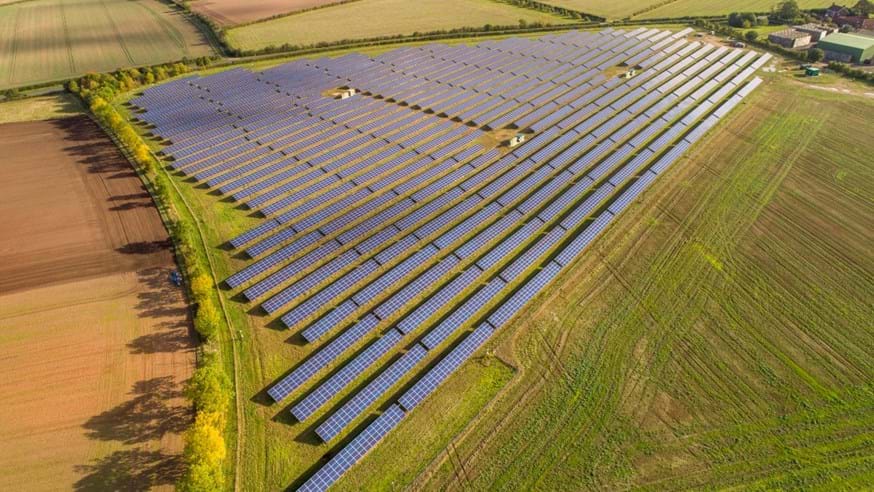
The UK solar industry has received a major boost with the release of the long-awaited Solar Roadmap – a government-industry strategy to accelerate solar deployment, cut emissions, and create skilled jobs.
Developed over two years and under two governments, the roadmap sets out practical measures to expand solar capacity, support local manufacturing, and ease regulatory barriers.
The plan was developed by the Solar Taskforce, co-chaired by the Secretary of State for Energy Security and Net Zero Ed Miliband and Solar Energy UK Chief Executive Chris Hewett. Oversight will now pass to the new Solar Council, which will guide the roadmap’s implementation.
“This is an incredibly exciting time for solar in our country,” said Miliband. “More than 1.5m homes across Britain now have solar installed, and since this Government came to office my department has consented almost 3GW of nationally significant solar projects – nearly three times as much as the previous 14 years combined.
“But we know we need to go further to deliver our goals for clean power by 2030 and beyond.”
The roadmap outlines a future where up to nine million small-scale rooftop systems are installed by 2030, up from 1.8m today, supporting an estimated 35,000 jobs – almost double the current number.
“Solar energy is among the lowest cost, and most popular, forms of power generation in the UK,” said Hewett.
“Unlocking its potential will increase Britain’s energy security, drive down bills as well as be a major contributor to preventing dangerous climate change.”
Rooftop access and consumer awareness
Despite falling costs, upfront investment remains a key barrier to rooftop adoption. To address this, the government will work with the Green Finance Institute, the financial sector, and consumer groups to improve access to finance.
Public awareness is also an issue. To combat this, the government will update its Energy Efficient Home website, and the UK Warehousing Association will produce a commercial-scale solar toolkit and address issues such as leasing and grid access.
Additional actions include revising how solar is reflected in energy performance certificates, encouraging social housing installations, and reviewing consumer protections for retrofits.
Schools, community energy schemes, and local authority projects will receive added support through GB Energy and the National Wealth Fund.
Grid reform
To tackle long grid connection delays, the roadmap proposes procedural reforms to prioritise projects most likely to proceed.
The requirement for residential systems above 3.68 kilowatts to gain distribution network operator approval will also be reviewed.
Other grid-related issues include reforming how battery storage is treated in planning and changing how transformer costs are shared, which the roadmap describes as a “postcode lottery.”
Strengthening the solar supply chain
While large-scale domestic panel manufacturing is unlikely, the roadmap sees opportunities in producing related equipment such as inverters, transformers, and mounting systems.
It also supports R&D in lightweight and perovskite solar technologies. The government is considering support for firms looking to scale up production.
The roadmap confirms government backing for the Solar Stewardship Initiative, which aims to prevent forced labour in supply chains. “The UK Government is clear that there should be no procurement of solar panels where there is evidence of forced labour,” it says.
Workforce development
With the sector expected to grow by up to 17% this year, the roadmap warns of potential skills shortages and calls for a coordinated response. Solar Energy UK has launched Solar Careers UK to help workers understand the skills needed and pathways into the sector.
The roadmap includes 11 skills-based actions, including improving training provision, linking businesses with colleges, and creating materials for schools.
Planning improvements
Though planning reforms have eased some barriers, the roadmap highlights the need for more support – particularly for floating solar projects.
Solar Energy UK has announced that it will produce guidance for planners and councillors and work to ensure training is fit for purpose.
The roadmap concludes by recognising the contributions of the Solar Taskforce’s members and reaffirming the government’s aim of making the UK a clean energy superpower.
[Image credit: Solar Energy UK]