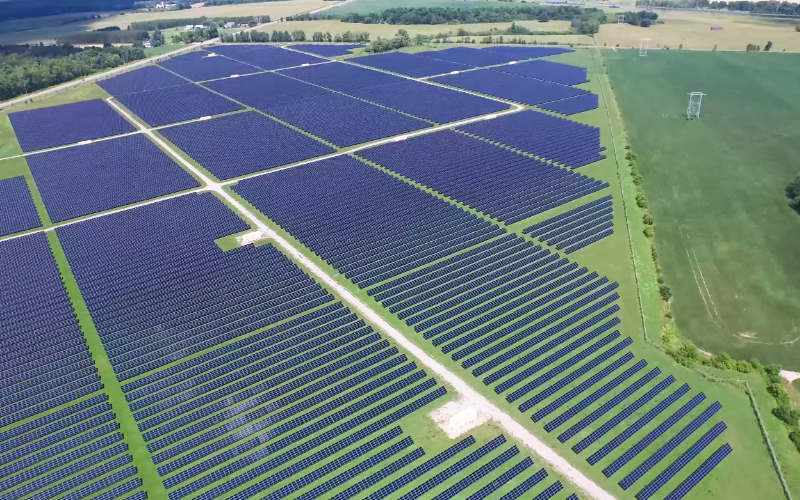
Ukraine could install five times more solar energy capacity than currently planned, according to a new study by Berlin Economics, commissioned by Greenpeace.
Greenpeace campaigners are urging Ukraine to adopt a ‘Solar Energy Marshall Plan,’ reminiscent of the US-funded post-WWII European recovery program.
“Addressing the energy crisis must be central to the Ukraine Recovery Conference,” says Andree Böhling, a Greenpeace energy expert. “A rapid and massive expansion of solar energy should play a key role.”
Since Russia’s full-scale invasion in 2022, over half of Ukraine’s power generation has been destroyed or captured, with power plants targeted by missile and drone attacks.
This has led to nationwide blackouts and fears of a harsh winter without adequate energy supply. Svitlana Romanko, Director of Campaign group Razom We Stand, highlights the urgent need for action to ensure energy security.
Solar energy offers a solution, being easy to deploy, cost-effective, and resilient to attacks. Decentralised solar installations can quickly provide reliable energy to communities.
Romanko sees a “silver lining” in the devastation, presenting an opportunity to rebuild Ukraine’s energy infrastructure in a smarter, localised manner.
Ukraine’s government plans to add 0.7 GW of solar capacity by 2027. However, the Berlin Economics study suggests that 3.6 GW in the next three years is feasible and economically beneficial, potentially growing to 14 GW by 2030.
Realising this potential hinges on international support. Key obstacles include a lack of investor incentives, insufficient grid stability, and workforce shortages. Greenpeace calls for partner countries to offer financial aid, technical expertise, and battery storage technologies.
Current laws in Ukraine need to better define “decentralised electricity generation” and regulate energy storage systems. Simplifying grid access is crucial for more secure projects. EU investment in new interconnection projects and cross-border ventures is also essential.
The Ukraine Recovery Conference in Berlin on June 11-12 presents an opportunity to advance these goals. Svitlana Romanko emphasises the potential for Ukraine to become the first post-war country rebuilt on renewable energy, setting a global precedent for infrastructure-centred climate actions.
Despite a broad focus on recovery and modernisation, energy topics are underrepresented on the conference agenda.