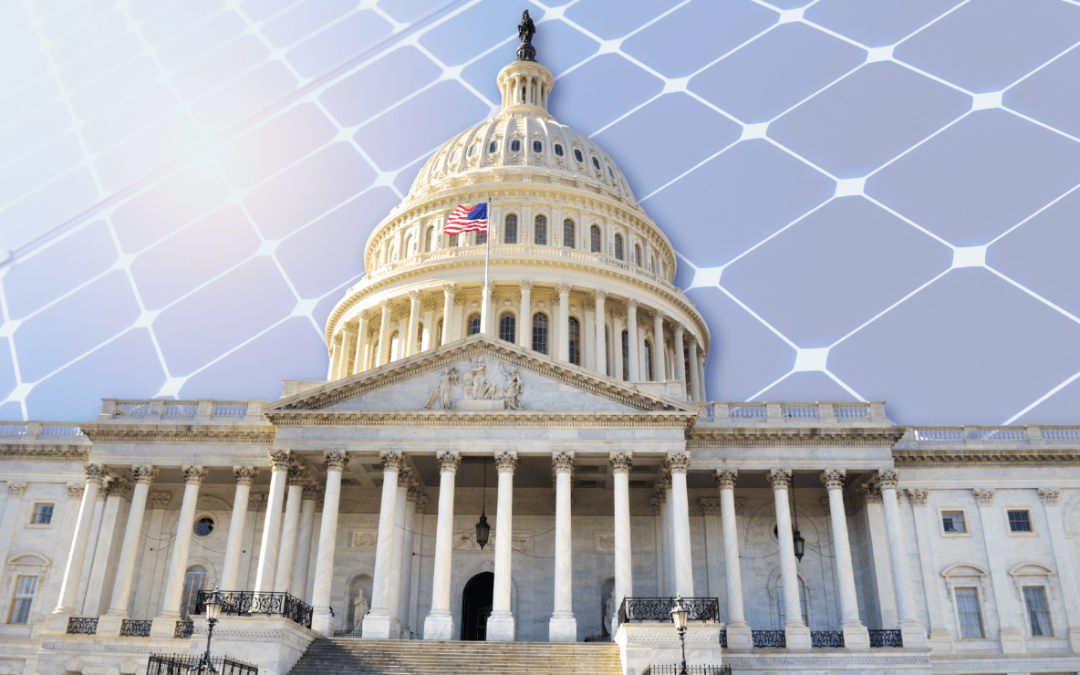
The solar industry has reacted negatively to the US Senate’s reconciliation bill, which narrowly passed 51-50 on 1 July.
- A proposed excise tax which targeted solar and wind projects that used above a certain amount of Foreign Entities of Concern (FEOC) materials was dropped from the final reconciliation bill before it reached the Senate. This was the largest change from the bill’s draft.
- Both the 45Y Production Tax Credit (PTC) and 48E Investment Tax Credit (ITC) for solar and wind will phase out by the end of 2027. This deadline has been brought forward from the Inflation Reduction Act’s date of 2032.
- However, developments which begin before mid-2026 and end ahead of 2027 can still claim credits.
- Energy storage has been excluded from the rollback of several tax credits; however, the definition of a battery module has been changed: “which is comprised of all other essential equipment needed for battery functionality, such as current collector assemblies and voltage sense harnesses, or any other essential energy collection equipment.”
Multiple industry bodies have warned that the bill threatens domestic US manufacturing, job security, and national energy independence.
Addressing the consequences
Abigail Ross Hopper, president and CEO of the Solar Energy Industries Association (SEIA), said the legislation “undermines the very foundation of America’s manufacturing comeback and global energy leadership.”
“Families will face higher electric bills, factories will shut down, Americans will lose their jobs, and our electric grid will grow weaker.”
In SEIA’s official statement, Hopper adds that the bill will prevent millions of American families from accessing the energy savings, resilience, and freedom that utilising solar and BESS provides.
“Every (Senate) member should ask themselves what kind of future they’re voting for. Our communities, our businesses, and our futures are on the line,” Hopper concludes.
Backtracking on support
The Solar Energy Manufacturers for America (SEMA) Coalition echoed SEIA’s concerns, highlighting how the legislation reverses previously promised support for US solar manufacturers.
In SEMA’s official statement, Mike Carr, Executive Director of the SEMA Coalition, touches on the industry’s “price war” following an overabundance of cheap imports worldwide.
“As we have been telling Members of Congress for months, this bill will lead to a flood of Chinese imports, hurting US manufacturing jobs and investments.”
Carr emphasises that US solar companies are not just competing with private businesses, but with “the country of China and all the resources and power that entails.”
“SEMA member companies have invested billions of dollars in state-of-the-art factories to take on that fight with the knowledge that the government has their back to level the playing field.”
Incentives terminated
One of the central criticisms of the bill is its abrupt termination of the Domestic Content Bonus, passed in 2022 under President Biden, which was designed to reward the use of American-made solar components.
Carr cautioned that this move will encourage stockpiling of lower-cost Chinese panels, which could dominate new US energy installations for years to come.
“[It] pulls the rug out from under companies that have taken real risks to restore American solar manufacturing and ensure national energy independence.”
The SEMA Coalition warned that the policy reversal could lead to “grid insecurity” and a loss of trust in federal commitments.
“How are we going to expect any companies to trust that our federal policies won’t flip-flop in the future?” Carr concludes.
As the bill now moves to the US House of Representatives before finalising and Presidential sign-off, both SEIA and SEMA are urging lawmakers to reconsider the bill and safeguard the future of the US solar industry.