Dutch maritime solar specialist Wattlab has completed the first full-scale installation of its “Solar Flatrack” system on a commercial seagoing vessel – the 7,280dwt coaster MV Vertom Tula for Vertom.
The system consists of 44 flat-rack solar arrays totalling 79kWp, expected to supply around 20% of the vessel’s hotel-load electricity.
After two pilot installations, Vertom chose to equip the newbuild coaster with the system. The company operates a fleet of over 100 vessels ranging from 1,500 to 12,000 dwt, focused on short-sea shipping.
Wattlab coordinated production and assembly at its Rotterdam facility, completing the installation in one day at the Port of Harlingen using container-twist-lock fixings. CEO and co-founder Bo Salet said:
“For shipowners, time is money, so speed and ease of use are important. Furthermore, we know that ‘space is money’ too.
Hence, should the panels need to be removed to make way for a special type of cargo, the crew can easily stack and store them all on the footprint of one 20ft container.”
Vertom’s Business Development Manager, Thomas van Meerkerk, said:
“During the pilots, the test results showed that the Solar Flatrack system performs well in the tough coastal shipping environment. … We consider Wattlab’s Solar Flatrack an effective option for reducing GHG and pollutant emissions. … It’s clear that the system can provide both a positive ROI and contribute to CO₂ reduction in shipping.”
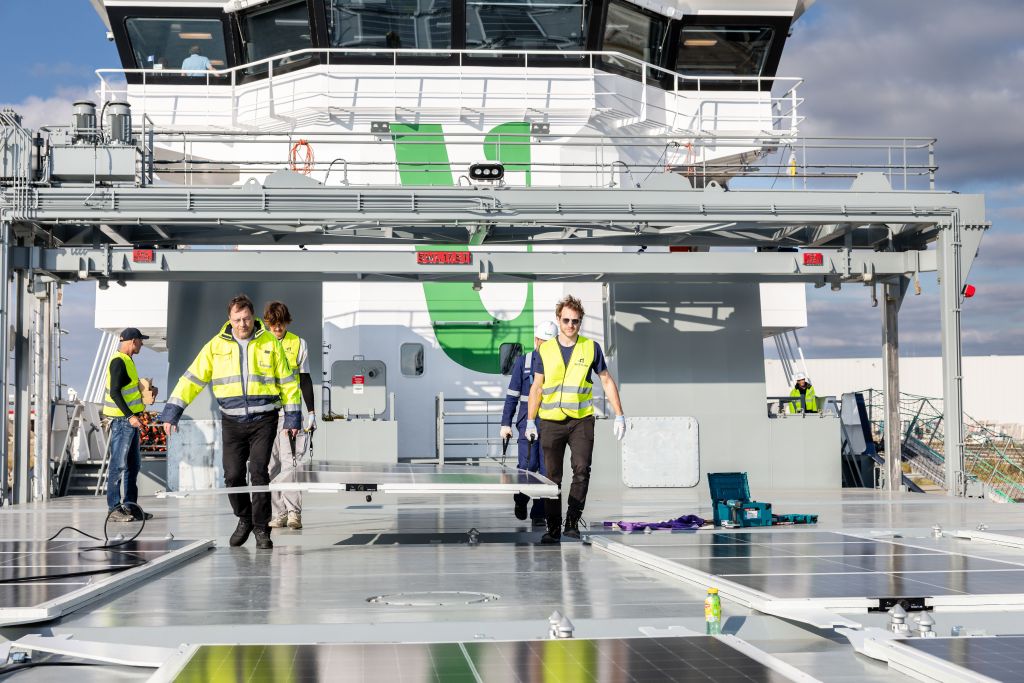
Salet added: “Another benefit is that the panels can stay on the hatch covers during loading and discharging operations. … The crew was sceptical at first, fearing a lot of extra work. However, they soon learned that in practice, Solar Flatracks are easy to use and require minimal maintenance.
“For example, there’s no salt crust formation, because the water can drain freely from the panels.”
The project has received independent validation from Dutch research organisation TNO, which will publish a report on emission reductions and return-on-investment.
Wattlab says the installation marks a milestone in the decarbonisation of coastal and short-sea shipping.
[Images credit: Wattlab]