by Catie Owen | Dec 15, 2025 | Europe, Large Scale Utility Solar
Visiolar has divested a 95MWp utility-scale ready-to-build (RTB) solar PV asset in Brandenburg, Germany.
The single photovoltaic installation was acquired by Sunovis, a platform company owned by Brookfield. Financial advisory firm Capcora exclusively executed the sell-side M&A mandate for the transaction.
The project has achieved full RTB status, and construction is set to commence immediately following the acquisition.
Dr. Janis Meyerhof, CEO at Visiolar, said:
“We are very pleased to have successfully completed the sale of this landmark project with a capacity of 95MWp. The transaction reflects the strength of our development platform and our commitment to bringing high-quality renewable-energy assets to market, even in a challenging environment for stand-alone PV in Germany.
“We look forward to seeing the project realised under its new ownership and to continuing to scale our pipeline across the region.”
The acquisition itself represents one of the larger stand-alone PV assets recently changing hands in the German market, where smaller, fragmented project structures are more common and investor selectivity has increased due to challenging market conditions.
This was acknowledged by Henning Prigge, Director at Capcora:
“This transaction stands out in an increasingly demanding German PV market, where completing a sale of a stand-alone, ready-to-build project requires deep market knowledge and industry network as well as disciplined preparation and an efficient, investor-oriented process.”
The sale highlights both the robustness of the project’s development and the appetite for German solar opportunities. Markus Renz, Managing Director at Sunovis, added:
“This acquisition represents an excellent addition to our growing renewable-energy portfolio in Germany. We remain committed to expanding our footprint in the German solar market and to contributing meaningfully to the country’s energy transition.”
by Catie Owen | Dec 12, 2025 | Europe, Large Scale Utility Solar
RWE has commissioned several new solar farms along the A44n motorway in North Rhine-Westphalia, following approximately eight months of construction. The facilities have a total installed capacity of 86.5MWp.
Utilising about 141,000 solar modules, the plants, located on recultivated land at the Garzweiler opencast mine between Bedburg and Jüchen, are expected to generate enough electricity to supply the equivalent of 27,700 German households.
Katja Wünschel, CEO RWE Renewables Europe & Australia, stated that the project demonstrates RWE’s commitment to expansion, adding: “Next year, we will add several thousand solar modules to the project.
“With wind and solar systems side by side, we are building a renewable energy road on recultivated land along the A44n motorway as a blueprint for further projects in the region.”
A second phase is planned for next year, aiming for 19.9MWp across over 30,600 additional solar modules in the Jüchen municipal area. Subject to planning consent, construction could start in the first half of 2026, with commissioning scheduled for the end of 2026.
Dr. Lars Kulik, CTO Lignite at RWE Power, noted that the projects emphasise that “structural change and the expansion of renewables in the Rhenish lignite area are going hand in hand. There is plenty of space in and around our opencast mines that we are also using for renewables projects.”
He added that RWE Power employees are contributing their expertise to the projects, creating “further prospects for our employees here in the region.”
RWE is also building the Bedburg 3 wind farm, a 60MWp, near the new solar sites. RWE now operates nine solar projects in the Rhenish region, with further photovoltaic schemes, such as the Manheimer Bucht solar farm, currently in the planning stages.
[Image credit: RWE]
by Catie Owen | Dec 11, 2025 | Europe, Large Scale Utility Solar, Press Release
Press Release
Uniper has taken the decision to start construction of Berryhill Solar Farm just north of Dundee, Scotland. The project has been developed jointly with partner Solar2 and Uniper plans to start the construction process as its sole owner.
The site is supposed to have approximately 152,000 solar panels, with the potential to generate 68.8MWp (45MW) – enough renewable electricity to power the equivalent of over 12,500 UK households each year, one fifth of the population of Angus – contributing to the UK’s net zero targets.
Construction is expected to start in early 2026 with power generation due to start later in the year. The District Network Operator (‘DNO’) for this area – Scottish and Southern Electricity Networks – will be responsible for putting in place the 9km medium voltage (MV) cable to connect the solar farm to the grid point of connection at the Charleston substation on the Kingsway in Dundee.
The solar scheme was first granted planning permission by the planning authority (Angus Council) in 2022, modified in 2024, following the submission of plans by Solar2. Once operational, there will be a community benefit fund associated with the project which will be agreed with the applicable local Community Council – Muirhead, Birkhill and Liff Council.
Want to publish a press release? Submit your content here for review by our editorial team.
by Catie Owen | Dec 11, 2025 | Africa, Large Scale Utility Solar, Storage
EDF power solutions has formally joined the Obelisk hybrid energy project in Egypt, acquiring a 20% stake in the project company.
The project, situated in the city of Nagaa Hammadi, near Luxor, is a large-scale facility combining a 1.1GW solar plant with a 100MW/200MWh battery storage system.
The French firm finalised a shareholder agreement with the existing partners: Scatec, a renewable energy solutions provider that holds 60%, and Norfund, the Norwegian investment fund for developing countries, which owns 20%.
Obelisk is set to supply competitive electricity to the Egyptian grid via a 25-year Power Purchase Agreement (PPA). The project’s commissioning is planned in two phases: phase 1 is scheduled for the first half of 2026, with phase 2 following in the second half of the same year.
This initiative supports Egypt’s national objective to achieve 42GW of renewable energy capacity by 2030.
This transaction represents a further step in EDF power solutions’ development strategy within the country. The company already operates two plots in the Benban solar power plant and is the largest shareholder of KarmSolar, a leading solar utility company.
EDF power solutions is committed to supporting Egypt’s energy transition through renewables, storage, and low-carbon electricity production assets.
Commenting on the development, Bénédicte Regnier, EDF power solutions Executive VP Africa, stated: “EDF power solutions is thrilled to announce this partnership with Scatec and Norfund in Egypt.
After its investment in Benban and in KarmSolar, and alongside with promising development in green hydrogen, EDF power solutions investment into the Obelisk project is another demonstration of its long-standing relationship with Egypt.”
Visit Solar & Storage Live Egypt in New Cairo, 6-7 April 2026. Get your ticket here, or find a Solar & Storage Live event near you.
by Catie Owen | Dec 11, 2025 | Commercial & Industrial Solar, Europe, Large Scale Utility Solar, Storage
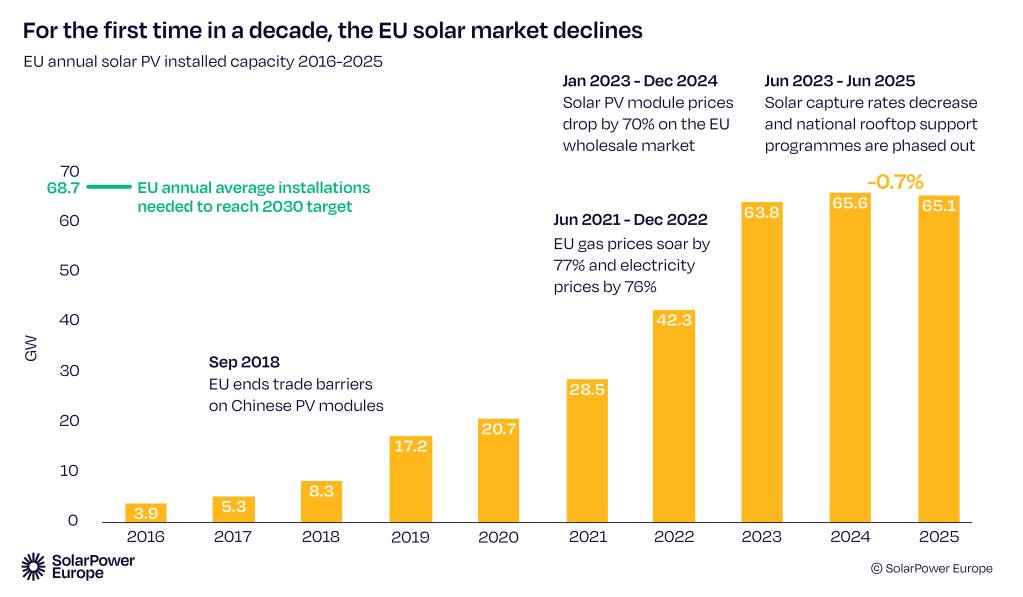
According to a report from SolarPower Europe, the European Union’s solar power boom has faded, with annual installations contracting for the first time since 2016.
The EU installed 65.1GW of solar capacity in 2025, marking a 0.7% decline from the 65.6GW installed the previous year.
Despite the downturn, the bloc surpassed a mid-decade milestone, reaching an estimated 406GW of total installed solar capacity across the EU by the end of the year, exceeding the 400GW target set in the 2022 EU Solar Strategy.
However, the slowdown is projected to continue through 2026 and 2027, with the annual installation returning to 2025 levels only around 2030, with roughly 67GW. This trajectory suggests the EU will fall short of its ambitious 750GW solar target for 2030.
“The number may seem small, but the symbolism is big,” said Walburga Hemetsberger, CEO of SolarPower Europe.
“This interruption in solar market growth comes at a pivotal moment when acceleration is essential. Solar is now delivering for Europe; 13% of Europe’s electricity was solar powered in 2025. In June we provided the most power out of all other sources in the EU.”
Hemetsberger added that it is “critical that policymakers now implement robust frameworks for electrification, system flexibility, and energy storage to ensure solar leads Europe’s energy transition for the rest of this decade.”
The market faltering is attributed to several factors, including an uncertain post-energy crisis environment that has led to cuts in rooftop support schemes and a perceived softening of energy price pressure on households.
Home rooftop solar, which was responsible for 28% of EU installed capacity in 2023, dropped significantly to account for only 14% in 2025.
In a segment shift, solar farms accounted for over 50% of installed solar capacity for the first time. However, this standalone solar segment faces increasing challenges to profitability, with a rising number of negative pricing hours reducing revenues.
Report highlights:
- Germany and Spain retained their positions as the EU’s largest, driven by utility-scale projects.
- France overtook Italy for the third-largest capacity, propelled by strong commercial and utility-scale expansion.
- Italy’s rooftop sector contracted following the phase-out of support schemes.
- Romania and Bulgaria entered the top 10 for the first time.
- The Netherlands’ ranking dropped significantly.
- Half of the top ten markets – Italy, Poland, Greece, the Netherlands, and Portugal – installed less solar in 2025 than in 2024.
Addressing common EU-level barriers, the report’s policy recommendations focus on redefining energy security around renewable sources, adopting a comprehensive strategy for flexibility, improving permitting procedures, boosting the rooftop solar market, and making solar supply chains more sustainable.
[Graph credit: SolarPower Europe]
by Catie Owen | Dec 10, 2025 | Europe, Large Scale Utility Solar
DAS Solar has announced a new cooperation with Hungarian renewable energy company Tiszta Energiák Kft. to supply high-performance photovoltaic modules for an upcoming 18MW ground-mounted solar project in Slovakia.
The installation, scheduled for grid connection in mid-2026, represents a continued expansion of DAS Solar’s market presence within Central and Eastern Europe.
The project will see DAS Solar providing its N-type module series, noting its “high conversion efficiency, strong reliability, and excellent performance in diverse climate conditions.”
The company suggests these characteristics make the product “ideally suited for ground-mounted applications in Slovakia’s rapidly expanding solar sector.”
The 18MW installation is expected to support local and regional sustainability goals by delivering stable, clean power. According to the release, the partnership “underscores their shared ambition to promote high-quality solar solutions across Europe.”
DAS Solar stated it “continues to strengthen its presence in the European market with reliable technologies, scenario-based PV solutions, and long-term partnerships that contribute to the region’s green transformation.”
Tiszta Energiák Kft. is a Hungary-based company with over 16 years of professional experience, focused on developing and implementing PV projects across Central Europe.
by Catie Owen | Dec 10, 2025 | Large Scale Utility Solar, Oceania, Press Release
Press Release
More renewable energy solutions are coming online in Australia, including battery energy storage. To support the education and training needs of this evolving sector, the TAFE Centre of Excellence Clean Energy Batteries launched its inaugural round of competitive Applied Research Grants.
The round attracted 16 proposals from universities, vocational education and training providers, industry, and not-for-profit organisations. Seven projects were selected, and nearly $1.2 million was awarded – exceeding the initial $1 million allocation. Overall, the research will be carried out over 12 months or less.
Successful round one applicants
Australian National University
Australian National University has been awarded $194,252 to develop consumer engagement training to help installers guide consumers through complex energy technology decisions.
CQUniversity
CQUniversity will receive $171,407 to develop safety and recycling training for the battery energy storage system workforce, with a focus on regional Queensland.
Queensland Farmers’ Federation
The Queensland Farmers’ Federation has been awarded $150,000 to fund energy in agriculture training, helping farmers better understand battery options to support their operations.
Queensland University of Technology
Queensland University of Technology will receive $200,000 to review Australia’s lithium-ion battery disposal against international standards to inform battery lifecycle management training.
South Metropolitan TAFE
South Metropolitan TAFE has been awarded $199,694 to review battery energy storage system workforce needs and develop targeted training aligned to job descriptions and tasks.
Sustainable Lithium Cells Australia
Sustainable Lithium Cells Australia will receive $77,633 to develop affordable, scalable second-life lithium battery systems for mobile solar energy use, developing training to support workers to safely assess, build and manage the systems.
TAFE Queensland Commercial
TAFE Queensland Commercial has been awarded $197,200 to create practical training and career pathways to support emerging occupations in Australia’s mining and critical minerals sectors.
The funding will drive the development of innovative training that tackles industry challenges, supporting the Centre to share best practice teaching and learning with TAFEs nationwide, strengthening the vocational education and training system for the benefit of all Australians.
Further Applied Research Grant funding through the Centre will be available in the coming years, with round two opening in January 2026.
To learn more, visit: tafeqld.edu.au/tce-grants
A joint statement from the Queensland and Australian Governments about the round one funding can also be found here: https://statements.qld.gov.au/statements/104131
Join us at Solar & Storage Live Queensland, 18-19 March, to hear from Queensland Farmers’ Federation’s Andrew Chamberlin, Project Manager – Energy.
Want to publish a press release? Submit your content here for review by our editorial team.
by Catie Owen | Dec 9, 2025 | Americas, Large Scale Utility Solar
The US solar industry installed 11.7GW of new capacity in the third quarter of 2025 – its third-largest quarter on record – pushing total 2025 installations past 30GW.
According to the U.S. Solar Market Insight Q4 2025 report by the Solar Energy Industries Association (SEIA) and Wood Mackenzie, solar and storage accounted for 85% of all new power added to the grid in the first nine months of the Trump Administration.
The report highlighted that 73% of all capacity installed this year was built in states won by President Trump, including eight of the top ten states (Texas, Indiana, Florida, Arizona, Ohio, Utah, Kentucky, and Arkansas). Utah surged into the top ten with over 1GW of capacity coming online.
This market growth occurs despite federal actions, such as a U.S. Department of the Interior (DOI) memo, that have created significant business uncertainty for utility-scale projects.
SEIA president and CEO Abigail Ross Hopper said the “record-setting quarter for solar deployment shows that the market is continuing to turn to solar to meet rising demand.”
She warned that unless the administration “reverses course, the future of clean, affordable, and reliable solar and storage will be frozen by uncertainty… America’s manufacturing surge, our global competitiveness, and billions of dollars in private investment are on the line.”
The US has added 17.7GW of new module manufacturing capacity in 2025, with new facilities in Louisiana and South Carolina. With a new Michigan wafer facility, the US can now produce every major component of the solar module supply chain.
However, due to the lack of clarity from the DOI on permitting, the report’s forecast for utility-scale deployment through 2030 remains unchanged.
Michelle Davis, Wood Mackenzie’s head of solar research, stated, “We expect 250 gigawatts of solar to be installed from 2025 – 2030. But the US solar industry has more potential.”
She concluded the industry is “well positioned to meet more of this new demand if existing constraints were alleviated,” referencing the over 73 GW of permitted solar projects vulnerable to politically motivated delays.
by Catie Owen | Dec 8, 2025 | Europe, Large Scale Utility Solar
The European Union plans to intensify efforts to develop cross-border energy infrastructure to alleviate costly bottlenecks and speed up the construction of new power grids, according to draft documents seen by Reuters.
EU member states have heavily funded low-cost renewable energy, but grid upgrades and expansion haven’t kept pace. Consequently, wind and solar output is increasingly being curtailed to prevent network overloads, resulting in wasted electricity and increased costs for consumers.
To tackle this disparity, the European Commission is set to develop a centralised EU plan for cross-border electricity infrastructure. The draft proposal, scheduled for publication on Wednesday 10 December, indicates the Commission will collaborate with grid operators and companies to launch projects.
A lack of grid investment has contributed to Europe’s high energy costs, which are reportedly two to three times greater than those in China and the US – a recurring concern for industries citing that steep bills undermine their competitiveness.
The draft document argues that “Grid development can deliver real added value and cost savings for Europeans.” It estimates that investing €5bn in grids would “shave €8bn off the overall cost of the power system.”
Failure to update infrastructure could lead the EU to curtail as much as 310TWh of renewable power generation by 2040 due to grid constraints. For context, EU households consumed 691TWh of electricity in 2023.
A second draft EU legal proposal shows the Commission intends to modify EU law to permit governments to exempt grid projects from requiring environmental impact assessments, citing years-long delays that can stall projects.
Additionally, small-scale renewable and storage projects would no longer require environmental permits.
The proposal also institutes shorter deadlines for authorities to approve grid-related permits, including a six-month limit for new electric vehicle charging stations.
To cut down years-long delays in some EU countries, permits would be automatically granted if authorities fail to respond within the specified timeframe.
A Commission spokesperson declined to comment on the draft plans. Any changes to EU laws would require approval from EU countries and lawmakers.
by Catie Owen | Dec 8, 2025 | Europe, Large Scale Utility Solar
A major overhaul of Great Britain’s electricity grid connection process was confirmed on 8 December by the National Energy System Operator (NESO).
The initiative will prioritise a new pipeline of “shovel-ready” energy projects that are expected to generate £40bn in clean investment annually. The transformation is designed to accelerate progress towards the government’s Clean Power by 2030 target.
The overhaul of the connections process comes after the queue for grid access grew tenfold in five years, reaching over 700GW – approximately four times the nation’s projected need by 2030.
Chris Stark, Head of Mission Control for Clean Power 2030, said: “This overhaul of the connections process is the single most important step we will take towards a clean power system.
“The energy projects our country needs now have the green light to deploy at a pace we haven’t seen for decades.”
The new approach moves from a first-come, first-served model to one that prioritises projects ready to meet Great Britain’s energy and economic needs.
NESO’s official release states that thousands of projects, including wind and solar farms, battery storage, and hydrogen, will join the new pipeline. This includes 283GW of generation and storage capacity and 99GW of transmission-connected demand.
“Transforming the grid connections process is a vital first step in unlocking the capacity needs for a secure, affordable energy transition,” stated Kayte O’Neill, Chief Operating Officer at NESO.
“These changes will cut grid bottlenecks by prioritising ready-to-build projects, giving certainty about when and where they can connect and unlocking billions in clean energy investment.”
Energy Secretary Ed Miliband said: “We inherited a broken system where zombie projects were allowed to hold up grid connections for viable projects that will bring investment, jobs and economic growth.
“To fix this we embarked on ambitious, once in a generation reforms to clean up the queue and prioritise the projects that are ready to help us deliver clean power by 2030.”
The first protected projects scheduled to connect in 2026/2027 will begin receiving formal offers with confirmed connection dates through December and into the new year. Remaining offers to be finalised by Q3 next year.
Get your free ticket to Solar & Storage Live London – the capital’s most exciting solar event. Or, find a Solar & Storage Live event near you.
by Catie Owen | Dec 5, 2025 | Europe, Large Scale Utility Solar
Great British Energy (GBE) has released a Strategic Plan, outlining a practical five-year roadmap to accelerate the UK’s transition to renewable power and bolster the nation’s industrial capacity.
The publicly owned energy company’s publication details its priorities to drive investment, support workers, and ensure communities benefit from the energy transition.
Through GBE expenditure between now and 2030, the organisation plans to deliver at least 15GW of clean energy generation and storage assets, which is sufficient to power the equivalent of almost 10 million homes.
This investment is projected to mobilise £15bn of private finance over time through GBE’s long-term partnerships and investments. Furthermore, the plan includes support for over 1,000 local and community energy projects, aiming to expand public participation and local control within the energy system.
The initiative is also projected to support more than 10,000 jobs directly through GBE-backed and funded projects, including in regions historically dependent on oil and gas.
GBE will function as a developer and equity investor, granting the public a sustained stake in clean energy infrastructure. The returns from publicly owned assets will be reinvested into new capacity, jobs, and opportunities across the UK, forming an income-generating portfolio.
The plan sets three priority investment areas to support its mission: GBE Local, focusing on direct community and public service benefits; Onshore Energy, aiming to strengthen grid stability and unlock land-based energy potential; and Offshore Energy, intended to accelerate UK leadership in deep-water offshore wind.
The Strategic Plan provides additional detail on the £1bn “Energy – Engineered in the UK” programme, a major initiative scheduled for formal launch later this month.
This programme is designed to strengthen the UK’s industrial base, support the nation’s Industrial Strategy, and build a resilient, long-term supply chain for clean energy, supporting high-quality jobs nationwide.
In comments on the plan, GBE’s CEO, Dan McGrail, said, “We are proud to be putting public ownership to work, unlocking investment, powering communities, creating jobs, and building an energy system that delivers for the UK.
“This Strategic Plan marks a major milestone in our mission to accelerate clean energy and the industries that support it.”
GBE’s Chair, Juergen Maier, stated, “This plan puts the UK public at the heart of our energy future. By investing in clean power, supporting local projects, and unlocking British industry, Great British Energy will help deliver an energy system that works for everyone.”
Energy Secretary, Ed Miliband, added, “We set up Great British Energy to be a national champion that allows us to reap the benefits of Britain’s natural resources. This plan shows what a publicly owned energy company will deliver: an abundance of clean, homegrown energy for British people and thousands of good jobs across the country.”
Get your free ticket to Solar & Storage Live London – the capital’s most exciting solar event. Or, find a Solar & Storage Live event near you.
by Catie Owen | Dec 5, 2025 | Europe, Large Scale Utility Solar
Alight, a Nordic solar developer and independent power producer, has officially commissioned the Lidsø solar park on Lolland, Denmark.
The facility, which is now operational, represents the company’s first asset in the Danish market and is currently the second-largest solar park in the country, boasting an installed capacity of 215 MWp.
The park spans 253 hectares near Rødby Harbour on Lolland. Alight owns and operates the site, which will supply the Danish grid with new renewable energy enabled by a long-term Power Purchase Agreement (PPA) signed with DSB, Denmark’s state-owned railway company.
According to the company’s official release, the Lidsø solar park is an important step in Alight’s growth across the Nordics, diversifying its portfolio into a new market with growing demand for renewable energy.
“We are extremely proud to inaugurate one of Denmark’s largest solar parks today,” said Warren Campbell, CEO of Alight. “Lidsø solar park will be an important part of Denmark’s energy transition and is proof that solar power can contribute on a large scale.
“Thanks to long-term Power Purchase Agreements, we can deliver new, additional sustainable capacity to the Danish grid, while strengthening our position as a leading player in the Nordic market.”
The park features approximately 350,000 solar panels. About half of these panels are mounted on trackers, which generate more energy by following the sun’s path.
Furthermore, the facility is designed as an agrivoltaics project, combining energy production with agriculture by having around 1,700 sheep grazing within the park year-round.
On DSB’s sustainability goals, Aske Mastrup Wieth-Knudsen, Head of Sustainability at DSB, said:
“It is crucial for us to contribute to increased production of renewable energy in Denmark… this project contributes to our goal of more train journeys powered by renewable energy with minimal impact on the climate and environment.”
Alight acquired the park from European Energy in March, with the €127 million acquisition financed by SEB and SEK.
[Image credit: Lidsø solar park]
by Catie Owen | Dec 4, 2025 | Europe, Large Scale Utility Solar, Storage, Video
The future of the UK’s energy sector hinges on a skilled workforce. At this autumn’s Solar & Storage Live UK, we caught up with Sturge Mazzocchi, Head of Solar Careers UK at Solar Energy UK, a key initiative dedicated to meeting the industry’s ambitious growth targets.
With the support of Solar Energy UK, Sturge is driving the programme’s clear vision to guide everyone into solar employment.
In this interview, he details the strategy for supporting recruitment and training, the challenge of securing 15,000 new workers by 2030, and the innovative work being done through the Recruitment Zone and the Installer Training Hub at the show.
“For us to reach our targets, those priority roles need to come mainly from deployment. Once you can fulfil your deployment side… your supply chain follows off the back of that.”
What is the Solar Careers Programme, and how has it evolved since launch?
The Solar Careers programme is a key action stemming from the government and industry solar roadmap, which aims to reach 60GW of solar by 2030. Since its launch, I’d say we’ve become far more crystalline – and by that, I mean clearer – in its vision, which is to guide every person possible into solar careers.
We do that in three principal ways. Firstly, we promote career opportunities to key audiences. We’re very much focused on deployment and maximising the number of qualified people we can get into those roles, primarily to raise awareness of the roles we have.
Secondly, we support recruitment in the area. This isn’t just about awareness but actively getting people into jobs and growing the workforce. And the third part is to promote training opportunities to keep the workforce upskilled and current.
By focusing on these three areas, we are meeting the aims and the vision of the Solar Careers programme.
In your view, what does success look like for the Solar Careers programme?
Given the target of 60GW by 2030, how do we measure the success of the Solar Careers programme by then? In numbers, success looks like an uplift of around 15,000 more people working in the industry.
Our industry needs to grow to 43,000 jobs. At the moment, we have around 20,000 people in the workforce, and by 2035, we need to get to 43,000. That’s an uplift of 23,000 in total.
When designing the strategy for the Solar Careers programme, you need to know exactly how many people you need to grow by per year. It’s quite a difficult forecast to make because there are so many factors that could stimulate that amount of growth. For example, if there aren’t the right specific apprenticeships, how are we going to educate people in the right way?
We recognised that it would take a few years to put these things in place, so in years one and two, we’re starting to make progress. We’re looking to support the growth of the industry by 500 people in year one (2025).
In 2026, we feel we could go to an extra thousand, so 1,500, and then 1,500 by 2027. That gets us to an extra 3,000. From there, you’d be in a position to start ramping up, as much of the necessary infrastructure would be in place. That’d get us to the 15,000 I mentioned.
This is what the runway looks like for the Solar Careers Programme, and we’re monitoring the ways we’re supporting the growth of the industry.
What are some of the biggest challenges the programme has faced so far?
One of our biggest challenges is securing skilled workers for our most in-demand roles.
At Solar Energy UK, we are in a position to mobilise and bring together all the different sectors of the industry, as well as businesses that perform different functions and services. They come together and highlight the most in-demand roles that they may need support fulfilling.
For us to reach our targets, those priority roles need to come mainly from deployment. Once you can fulfil your deployment side – installers, engineers, those sorts of roles – your supply chain follows off the back of that.
Our biggest challenge is essentially developing a skilled workforce. In the domestic and commercial sectors, we mainly need installers, as well as design engineers and project managers. For utility-scale, the main role is operations and maintenance site technicians.
These are the most in-demand roles that we need to grow the industry. Once we can start to fulfil these roles at scale, the rest will follow on afterwards.
What innovations has the Solar Careers Programme developed to encourage interest in the sector?
In terms of innovation, I would say that we’re trying to adopt and use the latest technologies and advancements available at our disposal. But we’ve also created some new functions this year to further our goals.
Our new skills steering group has created standardised job descriptions that have been agreed across businesses. They have an agreed set of roles and responsibilities and required qualifications, which we can then begin to promote as one of the most in-demand roles.
Alongside this, we’ve routes to competence. As part of that, we’ve developed a career map for people coming into the industry. Solar Energy UK has been helping the initiative I’m heading up, Solar Careers UK, to make these. We can then use that to mobilise an audience interested in entering the industry.
We are building a solar talent pool. This addresses the challenge of continuing engagement with interested individuals after their initial interaction, whether through our website or a recruitment event. Instead of relying on them to return unguided, we capture their interest.
How can we continue that engagement, given that they wanted to come into the industry? We ask them to register their interest, and we create a talent pool of people we can communicate directly with, giving them all this guidance over time. We currently have 7,200 people who are interested in joining the industry, which we’ve grown in a short space of time.
We will continue to do as much as we can to meet our vision, which is to guide every person possible into a solar career.
Your partnership with Solar & Storage Live UK has helped establish the Installer Training Hub and the Recruitment Zone. What does this mean for Solar Energy UK?
Firstly, I would really want to thank Solar & Storage Live for working in partnership to put these features on. Without us working together and putting them together each year and providing that platform, it really wouldn’t be possible.
If we look at the Recruitment Zone, across the show’s three days, over 250 candidates will come and meet businesses that have live job vacancies for introductory interviews.
This is really important for us because that’s 250 more people we can promote the different types of jobs, the different technologies, and the different services we have in the industry, and show why it can be an attraction.
For the Installer Training Hub, this addresses the third part of what we aim to deliver: promoting training opportunities and upskilling the workforce.
We’ve got nine businesses in there that are putting on training workshops throughout the three days. There will be over 2,500 installers who will engage with approximately 20-minute workshops and practical installer demos across a range of areas.
We have ground-mount installations, domestic and commercial mount and module installations, battery and inverter technologies, and MCS training, covering the latest fire classifications and how to be certified.
Missed out on Solar & Storage Live UK? Get your free ticket to Solar & Storage Live London – the capital’s most exciting solar event. Or, find a Solar & Storage Live event near you.
by Catie Owen | Dec 4, 2025 | Europe, Large Scale Utility Solar
Enso Energy has received development consent for the 190MW Helios Renewable Energy Project following an examination by the UK’s Department for Energy Security and Net Zero.
The project will be built in the ceremonial county of North Yorkshire.
The scheme involves the installation of ground-mounted solar arrays, energy storage, and all associated grid connection and infrastructure necessary for the construction, operation, and maintenance of the development. It is designed to generate over 50MW of electricity.
The application for the project, to be jointly developed by Enso Energy and Cero Generation, was accepted for examination on 30 July 2024.
The project completed its examination within the statutory timescale set out in the Planning Act 2008, marking the 102nd energy application out of 169 applications examined to date to meet this deadline.
The Planning Inspectorate highlighted the role of local communities in the process. The examination involved a six-month period during which local people, the local authority, and other interested parties were invited to give evidence to the Examining Authority.
The authority noted that local communities continue to be offered the opportunity to participate in the examination of projects that may affect them.
Before submitting its recommendations to the Secretary of State on 3 September 2025, the Examining Authority affirmed that it considered all local views and the evidence collected during the examination.
“It is an important project to deliver the UK government’s Clean Power 2030 targets and support the UK’s transition to homegrown renewable power,” commented Enso Energy’s Managing Director Bill Rees.
Don’t miss out on your free ticket to Solar & Storage Live London – the capital’s most exciting solar event. Or, find a Solar & Storage Live event near you.
by Catie Owen | Dec 1, 2025 | Asia, Large Scale Utility Solar
Huasun Energy has introduced its Himalaya 760 HV heterojunction (HJT) solar module, marking an advancement for the company in ultra-high-power module commercialisation.
The new module delivers an output of 760W, an efficiency of 24.5%, and features an industry-first 2000 V system voltage, designed to boost system returns for customers.
Huasun’s Chairman Xu Xiaohua commented that the photovoltaic industry is now “entering a new phase in which system-level cost reduction and lifecycle value are becoming the primary drivers of competitiveness.”
The 760W module is primarily designed for large-scale utility and desert-based projects, leveraging its high output and high-voltage operation to maximise project economics.
The key innovation is the upgrade from the current industry-standard 1500 V system voltage to 2000 V. This modification, as demonstrated in a simulated 100 MVA utility project in Hami, Xinjiang, unlocks substantial system-level optimisation.
Compared with a 1500 V system, the 2000 V configuration is shown to reduce BOS (Balance of System) costs by approximately RMB 0.1157/W (≈ US 1.6 cents/W), cut foundation pile demand by more than 5,000 units, and significantly improve land-use efficiency.
Further analysis comparing the HJT 760W (2000 V) system with a TOPCon 725W (1500 V) system revealed BOS cost reductions of RMB 0.1521/W (≈ US 2.1 cents/W), resulting in approximately 11.95% in BOS savings and an increase of 0.86 percentage points in the project’s Internal Rate of Return (IRR).
These performance gains translate directly into stronger investment returns for utility-scale solar projects.
The Himalaya 760 HV integrates several design upgrades, including a 132-half-cell dual-string architecture, large-size silicon wafers, negative spacing design, and high screen coverage.
The module achieves an active area ratio of 95.8%, contributing to an approximate 20W power gain and a 0.66% efficiency improvement.
To guarantee safety under ultra-high-voltage operation, the module incorporates an innovative butyl edge-sealing process to enhance insulation without compromising efficiency.
The design is fully compatible with existing high-efficiency production lines, requiring only minor equipment adjustments for mass production.
Combining 760W output, 24.5% efficiency, and the 2000 V platform, the Himalaya 760 HV establishes a new benchmark for next-generation utility PV systems. Xu concluded: “760W is not an endpoint, but a new starting point.
This platform will continue evolving toward higher power, higher efficiency, and higher value for the global clean energy transition.”
by Catie Owen | Nov 28, 2025 | Europe, Large Scale Utility Solar
A new three-way collaboration between global renewable energy firm Zelestra, the Aragón-based nonprofit ECODES, and Microsoft has been announced, designed to boost social and environmental community investment across Aragón, Spain.
The initiative is built upon a long-term Power Purchase Agreement (PPA) under which Microsoft will purchase the clean energy generated by Zelestra’s Escatrón II and Fuendetodos II solar projects in Zaragoza, Aragón. The projects, currently under construction, will deliver a combined capacity of 95.7 MWac.
A key component of the agreement is the funding provided to ECODES to implement direct impact programmes and lead grant-making activities.
These Community Funds are specifically targeted at supporting community-led sustainability initiatives for vulnerable populations, expanding access to sustainable infrastructure and healthy environments, and advancing economic inclusion.
The partnership aligns with Zelestra’s 3 Es (Education, Energy and Environment) strategy and supports Microsoft’s carbon negative goals and Datacenter Community Pledge to create local benefits.
Scarlett Alvarez Uzcategui, Zelestra’s Chief Stakeholder and Sustainability Officer, said the partnership “aligns perfectly with our commitment to deliver meaningful, positive impact in the communities where we operate.
“We will be present in Aragón for the long-term… and we are certain that the benefits of this initiative will also have a lasting positive impact for communities nearby.”
Eoin Doherty, Vice President, EMEA Regional Leader, Cloud Operations + Innovation, at Microsoft, emphasised this local commitment: “As Microsoft grows its presence in Aragon, we are committed to advancing community prosperity, well-being, and sustainability.
“This collaboration with Zelestra and ECODES is an important part of fulfilling this commitment and ensuring that we meet our clean energy goals in a way that delivers lasting benefits to the local community.”
The project also adheres to ECODES’ mission to ensure an inclusive transition. Cecilia Foronda, Head of Action for a Just Ecological Transition at ECODES, called the collaboration a “unique opportunity to help accelerate the transition to a green, inclusive, and responsible economy in Aragon and across Spain.”
She added: “ECODES commits to listen to local stakeholders so that the benefits of this collaboration reach those who need them most, strengthening social participation and territorial balance and leaving no one behind.”
With Spain’s solar market remaining a crucial topic, don’t miss your free ticket for Solar & Storage Live España 27-28 May 2026.
by Catie Owen | Nov 27, 2025 | Americas, Large Scale Utility Solar, Storage
RWE has commissioned the Stoneridge Solar project in Texas, introducing 200MW of solar power alongside 100MW (200 MWh) of battery storage capacity to the state’s grid.
This development aims to provide reliable, cost-competitive, and locally generated electricity to meet Texas’s growing energy needs and support US energy dominance.
The Stoneridge Solar facility is positioned as a significant economic driver for the region. The project created more than 200 construction jobs and will support permanent operational roles going forward.
Furthermore, it is expected to generate millions in tax revenue for Milam County and the Thorndale Independent School District. These investments are specifically earmarked to benefit local schools and first responders.
Andrew Flanagan, CEO of RWE Clean Energy, highlighted the project’s broad positive influence, stating: “Stoneridge Solar is a great example of the power of local partnership and the positive role energy projects play in economic stimulation.
“We are helping Texas and the nation secure their energy future with scalable, homegrown energy while also delivering meaningful benefits to communities across America’s heartland.”
RWE has engaged directly with the local community, contributing to initiatives such as funding renovations at Thorndale Elementary School and partnering with the local volunteer fire department.
Stoneridge Solar reinforces RWE’s overarching goal to accelerate energy independence and secure power for the grid.
The company’s total energy capacity across the US now exceeds 11GW, cementing its position in delivering affordable power solutions to American homes and businesses.
[Image credit: RWE]
by Catie Owen | Nov 26, 2025 | Asia, Europe, Large Scale Utility Solar
ACCIONA Energía, a Spanish renewable energy developer, has been awarded a 20-year power supply agreement for the entire output of two new renewable energy projects in the Philippines.
The contracts were secured through Round 4 of the Department of Energy’s Green Energy Auction Program (GEAP).
The award covers the 101MW Kalayaan 2 wind farm in Laguna, which is currently under construction, and the 180MWp Daanbantayan solar plant in Cebu, for which construction is slated to begin before the end of 2025.
The power supply contract is expected to provide long-term certainty for the energy generated by these facilities, contributing to the Philippines’ renewable energy objectives while supplying clean and reliable power to consumers.
ACCIONA Energía stated that the agreement “supports the Philippines in reaching its renewable energy targets while delivering clean, reliable power to consumers.”
In addition to these two projects, the company is developing a pipeline of more than 2GW in the Philippines.
The firm recently restructured its Southeast Asian partnerships to strengthen its position in key markets like the Philippines and Thailand, where it holds significant portfolios and intends to continue expanding in the coming years.
ACCIONA has maintained a substantial presence in the Philippines since 2016 through its water and infrastructure divisions, completing notable projects such as the Cebu-Cordova Link Expressway (CCLEX) and the Putatan II and Laguna Lake water treatment plants.
Furthermore, ACCIONA’s foundation, acciona.org, has been working to support underserved rural communities in the country since 2021.
Through collaborations with the Ayala Foundation and the Spanish Agency for International Cooperation and Development, the foundation has brought electricity services to areas that previously lacked access.
These efforts have so far reached around 3,500 households, small businesses, and community centres.
With Spain’s solar market remaining a crucial topic, don’t miss your free ticket for Solar & Storage Live España 27-28 May 2026.
by Catie Owen | Nov 25, 2025 | Americas, Commercial & Industrial Solar, Large Scale Utility Solar, Storage
The 30th Conference of the Parties to the United Nations Framework Convention on Climate Change (COP30) convened in Belém, Brazil, from 10 – 21 November 2025.
Dubbed the ‘Implementation COP’, the summit gathered delegates from nearly 200 nations to carry out ‘Mission 1.5’: limiting global warming to 1.5°C above preindustrial levels.
The summit also opened on the promise of finalising frameworks for climate finance, ensuring that developing nations have the capital required for their energy transitions.
Where does renewable energy come into this?
COP30 follows in the footsteps of the historic consensus at COP28 (2023) to transition away from fossil fuels to prioritise renewable energy. However, COP28 struggled to secure a unified global roadmap for phasing out fossil fuels.
Discussions saw stiff pushback from oil and gas-producing nations, including Saudi Arabia and Russia, who resisted a definitive timeline for phase-out.
As such, COP30 faced the highly anticipated task of turning pledges into concrete national policies, as pressure mounts from global institutions, businesses, and citizens alike.
However, as COP30 ran on into the early hours of 22 November, frustrations rose as the chance to both discuss and finalise a roadmap to decarbonisation seemed to be slipping through the delegates’ fingers.
A stalemate had formed between a coalition of 80 developed and developing countries pushing to end reliance on fossil fuels, and a group led by Saudi Arabia, its allies, and Russia – all pushing against decarbonisation. Despite this, the ‘Belém political package’ was finally signed.
“The message coming out of Belém was clear: despite the noise, clean energy and climate action remain the foundation on which the global economy is being remade and rebuilt,” commented Ed Miliband, the UK’s Secretary of Energy Security and Net Zero, and co-chair of the UK’s Solar Taskforce.
The UK’s energy secretary and co-chair of the Solar Taskforce, Ed Miliband, played a role in securing the final agreement.
COP30’s final conclusions
The signatories have agreed to start working on a roadmap to move away from fossil fuels with a report due in 2026. However, engaging in this initiative will be voluntary.
Developing countries have secured financing to help them adapt to extreme weather, and a “just transition mechanism” will be provided to workers in high-carbon industries to help them shift to renewables.
Notably, China and Russia requested that “critical minerals” for renewable energy technology not be included in the transition discussions, despite the human rights abuses discussions surrounding them remaining a hot topic across renewable industries.
Impact on the solar industry
The International Renewable Energy Agency (IRENA) noted that investing in infrastructure for the energy transition was paramount, praising discussions at the conference that covered the need for “expanded, modernised, and flexible grids”.
The agency additionally praised the increased prevalence of supply chain resilience in ministerial discussions and in the Climate Action Agenda. At COP30, UNEZA and the Global Clean Power Alliance (GCPA) announced a strategic partnership to address international supply chain challenges.
Furthermore, leading solar manufacturers used the global stage to reaffirm their commitment to aggressive climate targets.
Longi
Longi released its 2024-2025 Climate Action White Paper during the summit. The company outlined a comprehensive strategy to ‘achieve net-zero emissions across the entire value chain by 2050’, benchmarking its progress against the International Transition Plan Task Force disclosure framework.
Longi reported achieving a ‘monocrystalline silicon cell conversion efficiency of 27.81%’. Li Zhenguo, Longi’s founder, stated: ‘Addressing climate change is a systemic project requiring global collaboration. The value of an enterprise is reflected not only in its economic benefits but also in its contributions to our planetary home.’
JA Solar
JA Solar marked its fourth consecutive year at the summit by launching its ‘4F (Faster, Foster, Fairer, Further)’ environmental climate strategy. With cumulative global shipments now exceeding 317 GW, the company highlighted its role in the transition.
Executive President Aiqing Yang noted that ‘the private sector and the clean energy sector in particular, must play a key role in the shift to a climate resilient world.’ The company also held a one-on-one meeting with the Science Based Targets initiative (SBTi) to discuss its decarbonisation pathway, further solidifying its leadership position.
Statkraft
Europe’s largest renewable energy producer, Statkraft, inaugurated new solar farms and battery facilities in Brazil during the conference. The farms are anticipated to generate 789GWh of electricity per annum and save 111,000 tonnes of CO₂ annually – supporting Brazil’s role in reaching global emission reduction targets.
“These projects directly support the global goals to triple renewable energy capacity, ensure a just transition from fossil fuels, and foster local development in a sustainable way,” said Birgitte Ringstad Vartdal, Statkraft’s President and CEO.
Fernando de Lapuerta, Executive Vice President of Statkraft’s international business, concluded: “Solar energy, in combination with batteries and wind power, is the fastest and cheapest way to cut emissions and ensure a just transition.”
[Images credit: COP30 Brasil Amazonia]
by Catie Owen | Nov 25, 2025 | Europe, Large Scale Utility Solar
Technique Solaire Group has announced the signing of an agreement with Iberdrola to acquire 100% of the shares of Iberdrola Renouvelables, S.A.S., its French onshore renewable subsidiary.
The strategic transaction marks a major milestone for the Group, though completion remains subject to customary conditions precedent, including regulatory approvals and consultation with employee representative bodies.
Iberdrola Renouvelables, S.A.S. holds a portfolio comprising 118MW of operational wind assets, alongside a substantial pipeline of 639MW of onshore wind and solar PV projects currently under development in France.
This transaction represents Technique Solaire Group’s first investment in onshore wind. The strategic diversification will broaden the Group’s expertise and strengthen the resilience of its project portfolio against future changes in energy market regulations and renewable support policies.
The combination of wind, solar, and battery energy storage systems (BESS) is also set to enable the Group to offer customers green electricity tailored to their needs.
Thomas de Moussac, Co-founder and Managing Director, Development, explained: “Entering the wind sector is a strategic milestone for Technique Solaire.
“Following our successes in solar and biogas, this transaction – which gives us immediate access to 118MW in operation and a substantial project pipeline – opens a new chapter in our development.”
Lionel Themine, Co-founder and Managing Director, Finance, added that the acquisition “reflects our strategy to diversify our growth engines.”
“It is also fully in line with our capital discipline and our long-term financial trajectory. It will strengthen our model based on regulated or contracted assets.”
Finally, outlining the operational priorities post-completion, Julien Fleury, Co-founder and Managing Director, Operations, said: “After completion, our priorities will go to safety, operational continuity, asset performance, and the smooth integration of highly experienced teams we will be delighted to welcome.
“We will place industrial excellence and local engagement with our stakeholders at the heart of this transition.”