by Emily Ashley | Nov 28, 2025 | Europe, Large Scale Utility Solar
A new three-way collaboration between global renewable energy firm Zelestra, the Aragón-based nonprofit ECODES, and Microsoft has been announced, designed to boost social and environmental community investment across Aragón, Spain.
The initiative is built upon a long-term Power Purchase Agreement (PPA) under which Microsoft will purchase the clean energy generated by Zelestra’s Escatrón II and Fuendetodos II solar projects in Zaragoza, Aragón. The projects, currently under construction, will deliver a combined capacity of 95.7 MWac.
A key component of the agreement is the funding provided to ECODES to implement direct impact programmes and lead grant-making activities.
These Community Funds are specifically targeted at supporting community-led sustainability initiatives for vulnerable populations, expanding access to sustainable infrastructure and healthy environments, and advancing economic inclusion.
The partnership aligns with Zelestra’s 3 Es (Education, Energy and Environment) strategy and supports Microsoft’s carbon negative goals and Datacenter Community Pledge to create local benefits.
Scarlett Alvarez Uzcategui, Zelestra’s Chief Stakeholder and Sustainability Officer, said the partnership “aligns perfectly with our commitment to deliver meaningful, positive impact in the communities where we operate.
“We will be present in Aragón for the long-term… and we are certain that the benefits of this initiative will also have a lasting positive impact for communities nearby.”
Eoin Doherty, Vice President, EMEA Regional Leader, Cloud Operations + Innovation, at Microsoft, emphasised this local commitment: “As Microsoft grows its presence in Aragon, we are committed to advancing community prosperity, well-being, and sustainability.
“This collaboration with Zelestra and ECODES is an important part of fulfilling this commitment and ensuring that we meet our clean energy goals in a way that delivers lasting benefits to the local community.”
The project also adheres to ECODES’ mission to ensure an inclusive transition. Cecilia Foronda, Head of Action for a Just Ecological Transition at ECODES, called the collaboration a “unique opportunity to help accelerate the transition to a green, inclusive, and responsible economy in Aragon and across Spain.”
She added: “ECODES commits to listen to local stakeholders so that the benefits of this collaboration reach those who need them most, strengthening social participation and territorial balance and leaving no one behind.”
With Spain’s solar market remaining a crucial topic, don’t miss your free ticket for Solar & Storage Live España 27-28 May 2026.
by Emily Ashley | Nov 27, 2025 | Americas, Large Scale Utility Solar, Storage
RWE has commissioned the Stoneridge Solar project in Texas, introducing 200MW of solar power alongside 100MW (200 MWh) of battery storage capacity to the state’s grid.
This development aims to provide reliable, cost-competitive, and locally generated electricity to meet Texas’s growing energy needs and support US energy dominance.
The Stoneridge Solar facility is positioned as a significant economic driver for the region. The project created more than 200 construction jobs and will support permanent operational roles going forward.
Furthermore, it is expected to generate millions in tax revenue for Milam County and the Thorndale Independent School District. These investments are specifically earmarked to benefit local schools and first responders.
Andrew Flanagan, CEO of RWE Clean Energy, highlighted the project’s broad positive influence, stating: “Stoneridge Solar is a great example of the power of local partnership and the positive role energy projects play in economic stimulation.
“We are helping Texas and the nation secure their energy future with scalable, homegrown energy while also delivering meaningful benefits to communities across America’s heartland.”
RWE has engaged directly with the local community, contributing to initiatives such as funding renovations at Thorndale Elementary School and partnering with the local volunteer fire department.
Stoneridge Solar reinforces RWE’s overarching goal to accelerate energy independence and secure power for the grid.
The company’s total energy capacity across the US now exceeds 11GW, cementing its position in delivering affordable power solutions to American homes and businesses.
[Image credit: RWE]
by Emily Ashley | Nov 26, 2025 | Asia, Europe, Large Scale Utility Solar
ACCIONA Energía, a Spanish renewable energy developer, has been awarded a 20-year power supply agreement for the entire output of two new renewable energy projects in the Philippines.
The contracts were secured through Round 4 of the Department of Energy’s Green Energy Auction Program (GEAP).
The award covers the 101MW Kalayaan 2 wind farm in Laguna, which is currently under construction, and the 180MWp Daanbantayan solar plant in Cebu, for which construction is slated to begin before the end of 2025.
The power supply contract is expected to provide long-term certainty for the energy generated by these facilities, contributing to the Philippines’ renewable energy objectives while supplying clean and reliable power to consumers.
ACCIONA Energía stated that the agreement “supports the Philippines in reaching its renewable energy targets while delivering clean, reliable power to consumers.”
In addition to these two projects, the company is developing a pipeline of more than 2GW in the Philippines.
The firm recently restructured its Southeast Asian partnerships to strengthen its position in key markets like the Philippines and Thailand, where it holds significant portfolios and intends to continue expanding in the coming years.
ACCIONA has maintained a substantial presence in the Philippines since 2016 through its water and infrastructure divisions, completing notable projects such as the Cebu-Cordova Link Expressway (CCLEX) and the Putatan II and Laguna Lake water treatment plants.
Furthermore, ACCIONA’s foundation, acciona.org, has been working to support underserved rural communities in the country since 2021.
Through collaborations with the Ayala Foundation and the Spanish Agency for International Cooperation and Development, the foundation has brought electricity services to areas that previously lacked access.
These efforts have so far reached around 3,500 households, small businesses, and community centres.
With Spain’s solar market remaining a crucial topic, don’t miss your free ticket for Solar & Storage Live España 27-28 May 2026.
by Emily Ashley | Nov 25, 2025 | Americas, Commercial & Industrial Solar, Large Scale Utility Solar, Storage
The 30th Conference of the Parties to the United Nations Framework Convention on Climate Change (COP30) convened in Belém, Brazil, from 10 – 21 November 2025.
Dubbed the ‘Implementation COP’, the summit gathered delegates from nearly 200 nations to carry out ‘Mission 1.5’: limiting global warming to 1.5°C above preindustrial levels.
The summit also opened on the promise of finalising frameworks for climate finance, ensuring that developing nations have the capital required for their energy transitions.
Where does renewable energy come into this?
COP30 follows in the footsteps of the historic consensus at COP28 (2023) to transition away from fossil fuels to prioritise renewable energy. However, COP28 struggled to secure a unified global roadmap for phasing out fossil fuels.
Discussions saw stiff pushback from oil and gas-producing nations, including Saudi Arabia and Russia, who resisted a definitive timeline for phase-out.
As such, COP30 faced the highly anticipated task of turning pledges into concrete national policies, as pressure mounts from global institutions, businesses, and citizens alike.
However, as COP30 ran on into the early hours of 22 November, frustrations rose as the chance to both discuss and finalise a roadmap to decarbonisation seemed to be slipping through the delegates’ fingers.
A stalemate had formed between a coalition of 80 developed and developing countries pushing to end reliance on fossil fuels, and a group led by Saudi Arabia, its allies, and Russia – all pushing against decarbonisation. Despite this, the ‘Belém political package’ was finally signed.
“The message coming out of Belém was clear: despite the noise, clean energy and climate action remain the foundation on which the global economy is being remade and rebuilt,” commented Ed Miliband, the UK’s Secretary of Energy Security and Net Zero, and co-chair of the UK’s Solar Taskforce.

The UK’s energy secretary and co-chair of the Solar Taskforce, Ed Miliband, played a role in securing the final agreement.
COP30’s final conclusions
The signatories have agreed to start working on a roadmap to move away from fossil fuels with a report due in 2026. However, engaging in this initiative will be voluntary.
Developing countries have secured financing to help them adapt to extreme weather, and a “just transition mechanism” will be provided to workers in high-carbon industries to help them shift to renewables.
Notably, China and Russia requested that “critical minerals” for renewable energy technology not be included in the transition discussions, despite the human rights abuses discussions surrounding them remaining a hot topic across renewable industries.
Impact on the solar industry
The International Renewable Energy Agency (IRENA) noted that investing in infrastructure for the energy transition was paramount, praising discussions at the conference that covered the need for “expanded, modernised, and flexible grids”.
The agency additionally praised the increased prevalence of supply chain resilience in ministerial discussions and in the Climate Action Agenda. At COP30, UNEZA and the Global Clean Power Alliance (GCPA) announced a strategic partnership to address international supply chain challenges.
Furthermore, leading solar manufacturers used the global stage to reaffirm their commitment to aggressive climate targets.
Longi
Longi released its 2024-2025 Climate Action White Paper during the summit. The company outlined a comprehensive strategy to ‘achieve net-zero emissions across the entire value chain by 2050’, benchmarking its progress against the International Transition Plan Task Force disclosure framework.
Longi reported achieving a ‘monocrystalline silicon cell conversion efficiency of 27.81%’. Li Zhenguo, Longi’s founder, stated: ‘Addressing climate change is a systemic project requiring global collaboration. The value of an enterprise is reflected not only in its economic benefits but also in its contributions to our planetary home.’
JA Solar
JA Solar marked its fourth consecutive year at the summit by launching its ‘4F (Faster, Foster, Fairer, Further)’ environmental climate strategy. With cumulative global shipments now exceeding 317 GW, the company highlighted its role in the transition.
Executive President Aiqing Yang noted that ‘the private sector and the clean energy sector in particular, must play a key role in the shift to a climate resilient world.’ The company also held a one-on-one meeting with the Science Based Targets initiative (SBTi) to discuss its decarbonisation pathway, further solidifying its leadership position.
Statkraft
Europe’s largest renewable energy producer, Statkraft, inaugurated new solar farms and battery facilities in Brazil during the conference. The farms are anticipated to generate 789GWh of electricity per annum and save 111,000 tonnes of CO₂ annually – supporting Brazil’s role in reaching global emission reduction targets.
“These projects directly support the global goals to triple renewable energy capacity, ensure a just transition from fossil fuels, and foster local development in a sustainable way,” said Birgitte Ringstad Vartdal, Statkraft’s President and CEO.
Fernando de Lapuerta, Executive Vice President of Statkraft’s international business, concluded: “Solar energy, in combination with batteries and wind power, is the fastest and cheapest way to cut emissions and ensure a just transition.”
[Images credit: COP30 Brasil Amazonia]
by Emily Ashley | Nov 25, 2025 | Europe, Large Scale Utility Solar
Technique Solaire Group has announced the signing of an agreement with Iberdrola to acquire 100% of the shares of Iberdrola Renouvelables, S.A.S., its French onshore renewable subsidiary.
The strategic transaction marks a major milestone for the Group, though completion remains subject to customary conditions precedent, including regulatory approvals and consultation with employee representative bodies.
Iberdrola Renouvelables, S.A.S. holds a portfolio comprising 118MW of operational wind assets, alongside a substantial pipeline of 639MW of onshore wind and solar PV projects currently under development in France.
This transaction represents Technique Solaire Group’s first investment in onshore wind. The strategic diversification will broaden the Group’s expertise and strengthen the resilience of its project portfolio against future changes in energy market regulations and renewable support policies.
The combination of wind, solar, and battery energy storage systems (BESS) is also set to enable the Group to offer customers green electricity tailored to their needs.
Thomas de Moussac, Co-founder and Managing Director, Development, explained: “Entering the wind sector is a strategic milestone for Technique Solaire.
“Following our successes in solar and biogas, this transaction – which gives us immediate access to 118MW in operation and a substantial project pipeline – opens a new chapter in our development.”
Lionel Themine, Co-founder and Managing Director, Finance, added that the acquisition “reflects our strategy to diversify our growth engines.”
“It is also fully in line with our capital discipline and our long-term financial trajectory. It will strengthen our model based on regulated or contracted assets.”
Finally, outlining the operational priorities post-completion, Julien Fleury, Co-founder and Managing Director, Operations, said: “After completion, our priorities will go to safety, operational continuity, asset performance, and the smooth integration of highly experienced teams we will be delighted to welcome.
“We will place industrial excellence and local engagement with our stakeholders at the heart of this transition.”
by Emily Ashley | Nov 20, 2025 | Commercial & Industrial Solar, Europe, Large Scale Utility Solar
European Independent Power Producer (IPP) Econergy Renewable Energy Ltd. has successfully connected its 52MW Resko solar project in Poland to the national electricity grid.
The facility is expected to reach full commercial operation within the next 30 days.
The project is owned by a partnership in which Econergy UK, a subsidiary 75.24% owned by Econergy Renewable Energy Ltd., holds a 51% stake, with The Phoenix Insurance Company Ltd. holding the remaining 49%.
The long-term commercial operations are underpinned by a Virtual Power Purchase Agreement (vPPA) signed with Apple Inc. Under this agreement, the technology firm will purchase approximately 75% of the project’s electricity output at a fixed price for 19 years from the start of commercial operation.
The remaining 25% of energy generation will be sold on the wholesale market at prevailing prices.
Commenting on the milestone, Eyal Podhorzer, Co-Founder and CEO of Econergy Renewable Energy, said: “The long-term vPPA with Apple, a global leader in technology and innovation, is a testament to the quality of our assets and the strength of our commercial strategy.”
In a further strategic development, Econergy UK confirmed it has received a Distribution System Operator (DSO) licence from Poland’s Energy Regulatory Office (URE). This licence grants the company greater flexibility in developing and connecting future projects across Poland by enabling the utilisation of the Resko site’s network and infrastructure.
Podhorzer concluded that the new licence “further enhances our ability to expand and operate efficiently across Poland, and we remain committed to executing our growth plans with the same momentum into 2026 and beyond.”
[Image caption: The Resko solar project. Image credit: Econergy]
by Emily Ashley | Nov 18, 2025 | Europe, Large Scale Utility Solar
Over 250 schools across England have signed agreements to receive funding for new solar panels and energy efficiency measures as part of an expanded scheme by Great British Energy and the government.
The initiative, which also targets NHS and military sites, will see schools benefit from a share of up to £100m in funding. The goal is to help schools cut energy bills and reinvest the savings into teaching and resources.
Twenty-three schools have already installed Great British Energy solar panels, including Notre Dame RC School in Plymouth and Christ The King RC Primary School in Manchester.
“Great British Energy is helping schools to save money on bills, meaning more money for textbooks and technology,” Energy Minister Michael Shanks commented.
Across the country, solar panels are going up on rooftops to power classrooms with clean, homegrown power. This is our clean energy superpower mission in action, protecting our public services with lower bills and energy security.”
Education Minister Josh MacAlister echoed this sentiment, stating: “Solar panels are slashing schools’ energy bills by thousands of pounds year after year, with the money going straight back into the textbooks and resources pupils need to succeed.”
Rocketing energy bills have put a strain on school budgets, and by allowing schools to generate their own electricity, it is estimated they will save millions, exceeding installation costs.
Great British Energy’s CEO, Dan McGrail, said: “Great British Energy’s ongoing solar rollout delivers tangible benefits to the people that need it most in our hospitals and schools.
“This not only provides clean energy to communities, it also ensures that the public own and benefit from these projects through energy security, good jobs and above all, real tangible local outcomes such as more funds to support teaching and health.”
The scheme prioritises schools and colleges in areas of deprivation across the North East, West Midlands, and North West, ensuring at least 10 schools in each region of England benefit.
Don’t miss out on your free ticket to Solar & Storage Live London 2026– the capital’s most exciting solar event. Or, find a Solar & Storage Live event near you.
by Emily Ashley | Nov 17, 2025 | Europe, Innovation, Large Scale Utility Solar
Velto Renewables has completed the acquisition of Les Îlots Blandin, Europe’s largest floating solar power plant, from Q ENERGY.
The facility is in Perthes, Haute-Marne, France.
Having previously held a 50% stake in the project, Velto Renewables now becomes the sole owner of the plant. The 74.3MWp facility spans over 127 hectares and includes more than 135,000 photovoltaic panels installed on advanced floating structures.
The company stated that the plant is expected to “generate renewable electricity equivalent to the annual consumption of approximately 37,000 people, while avoiding over 18,000 tonnes of CO₂ emissions each year.”
Velto Renewables highlighted the project’s success in converting unused industrial areas, noting that Les Îlots Blandin “illustrates the potential of floating solar technology to convert unused industrial areas into productive renewable assets.”
“By combining innovation, environmental restoration, and regional collaboration, the project strengthens France’s energy transition while supporting sustainable land use,” the company’s statement continued.
Following the acquisition, Velto Renewables will manage the plant’s long-term operation. The company indicated this milestone “marks another step in the company’s expansion in France and reaffirms its commitment to delivering renewable energy solutions that create enduring value for both local communities and the environment.”
Les Îlots Blandin is part of a larger portfolio transfer from Q ENERGY to Velto, following a long-term partnership agreed upon by the two companies last spring, which “already provides a framework for further project sales.”
by Emily Ashley | Nov 14, 2025 | Commercial & Industrial Solar, Large Scale Utility Solar
Solar and wind power grew fast enough to keep pace with rising global electricity demand in the first three quarters of 2025, leading to a stagnation in fossil fuel growth for the period.
The analysis, laid out in Ember’s Q3 Global Power Report, forecasts no growth for fossil fuels in the power sector in 2025.
Record growth in solar power, combined with moderate wind growth, meant that total solar and wind growth (+635 TWh) exceeded the increase in demand (603 TWh) in the first three quarters of the year.
The surge in clean power led to fossil generation remaining similar to 2024 levels, showing a minor fall of -17 TWh (or -0.1%).
Solar dominance and global trends
Solar generation rose by 498 TWh (+31%) in the first three quarters of 2025 compared to the same period in 2024, representing the largest increase ever over nine months.
This record increase was more than three times larger than the next biggest increase from wind power (+137 TWh). The report states that “Solar has become the dominant driver of change in the global power system”.
This growth in solar and wind power pushed their share in the global electricity mix from 15.2% in Q1-Q3 2024 to 17.6% in Q1-Q3 2025. Conversely, the share of fossil generation dropped from 58.7% to 57.1%.
Key regional shifts
Declines in fossil generation in China (-52 TWh, -1.1%) and India (-34 TWh, -3.3%) were instrumental in tipping the balance of the global trend.
- In China, the decline was driven by “fast-growing renewables meeting all new demand”. The report notes that “China is now structurally meeting all new demand with clean power”.
- In India, the fall resulted from renewables growth combined with “unusually low demand growth driven by mild weather conditions”.
These decreases “even balanced out fossil increases in the EU and US”. Ember forecasts that 2025 will be “the first year without notable fossil fuel growth in global electricity generation since the Covid-19 pandemic, when global demand fell”
by Emily Ashley | Nov 12, 2025 | Africa, Large Scale Utility Solar
The World Bank and the Government of Tunisia have signed a $430m financing agreement to support the country’s efforts to modernise its energy sector through the Tunisia Energy Reliability, Efficiency, and Governance Improvement Program (TEREG).
The five-year initiative includes $30m in concessional financing and aims to ensure a sustainable, reliable, and affordable electricity supply.
The programme will help accelerate renewable energy deployment, improve the performance of Tunisia’s national electricity utility, STEG, and strengthen sector governance.
It aligns with Tunisia’s updated Energy Transition Strategy, which seeks to enhance STEG’s operational and financial performance, attract private investment, and reduce the carbon intensity of power generation.
“By fostering renewable energy development, TEREG will strengthen Tunisia’s position in clean energy, creating economic opportunities and ensuring long-term energy security,” said Alexandre Arrobbio, World Bank Country Manager for Tunisia.
“This project reflects our strong partnership with Tunisia and supports its sustainable development goals. It builds on our long-standing engagement in Tunisia’s energy sector and complements ongoing initiatives.”
The TEREG programme is expected to mobilise $2.8bn in private investment, adding 2.8GW of new solar and wind capacity by 2028 and creating more than 30,000 jobs, mainly during the construction phase.
It also aims to reduce electricity supply costs by 23%, improve STEG’s cost recovery from 60 to 80 percent, and cut state subsidies by TND 2.045 billion.
“This is the first project to benefit from the World Bank’s Framework for Financial Incentives, receiving rewards for its size and long-term benefits in recognition of its impact on reducing greenhouse gas emissions,” said Amira Klibi, Senior Energy Specialist at the World Bank and Task Team Leader for the project.
“The programme’s reforms – such as reducing technical and commercial losses and increasing the share of renewables – are expected to deliver lasting improvements in the operational and financial performance of the sector, making electricity more affordable and reliable for households and businesses across Tunisia.”
by Emily Ashley | Nov 11, 2025 | Americas, Europe, Large Scale Utility Solar
Statkraft, Europe’s largest producer of renewable energy, has inaugurated new solar farms and battery facilities in Brazil during the COP30 climate summit in Belém.
The hybrid projects aim to harness the country’s solar and wind potential to support global emission reduction goals.
Norway’s Minister of Climate and Environment Andreas Bjelland Eriksen, Bahia Governor Jerônimo Rodrigues, and Statkraft CEO Birgitte Ringstad Vartdal inaugurated the Morro do Cruzeiro Solar (76MWp) and Santa Eugênia Solar (198MWp) plants in Bahia.
The company is also commissioning the 69MWp Serrita solar farm in Pernambuco later this year. Together, the three solar farms represent a total investment of 2.3 billion NOK and will add 340MWp of clean energy to Brazil’s power system – around 5% of the country’s new solar capacity in 2025.
The farms are expected to generate 789GWh of electricity annually – more than Norway’s total annual solar production – and, together with associated wind projects, produce 3,400GWh each year. Statkraft estimates the projects will save 111,000 tonnes of CO₂ annually.
“These projects directly support the global goals to triple renewable energy capacity, ensure a just transition from fossil fuels, and foster local development in a sustainable way,” said Birgitte Ringstad Vartdal, Statkraft’s President and CEO.
Fernando de Lapuerta, Executive Vice President of Statkraft’s international business, added: “By investing in innovative renewable solutions and working closely with local communities, we are not only supporting Brazil’s energy transition but also contributing to global climate goals.”
According to Statkraft’s latest Green Transition Scenarios, limiting global warming to 1.9 °C remains possible under optimistic conditions, though current progress risks pushing temperatures up by around 2.4 °C.
“Solar energy, in combination with batteries and wind power, is the fastest and cheapest way to cut emissions and ensure a just transition,” said Lapuerta.
With these new installations, Statkraft Brazil’s portfolio reaches 2.3GW, positioning the company among the country’s major renewable energy producers.
“We are committed to generating positive social impact by creating employment opportunities, enhancing local infrastructure, and establishing vocational training programmes,” said Thiago Tomazzoli, Statkraft Brazil’s Country Manager.
by Emily Ashley | Nov 7, 2025 | Commercial & Industrial Solar, Europe, Large Scale Utility Solar
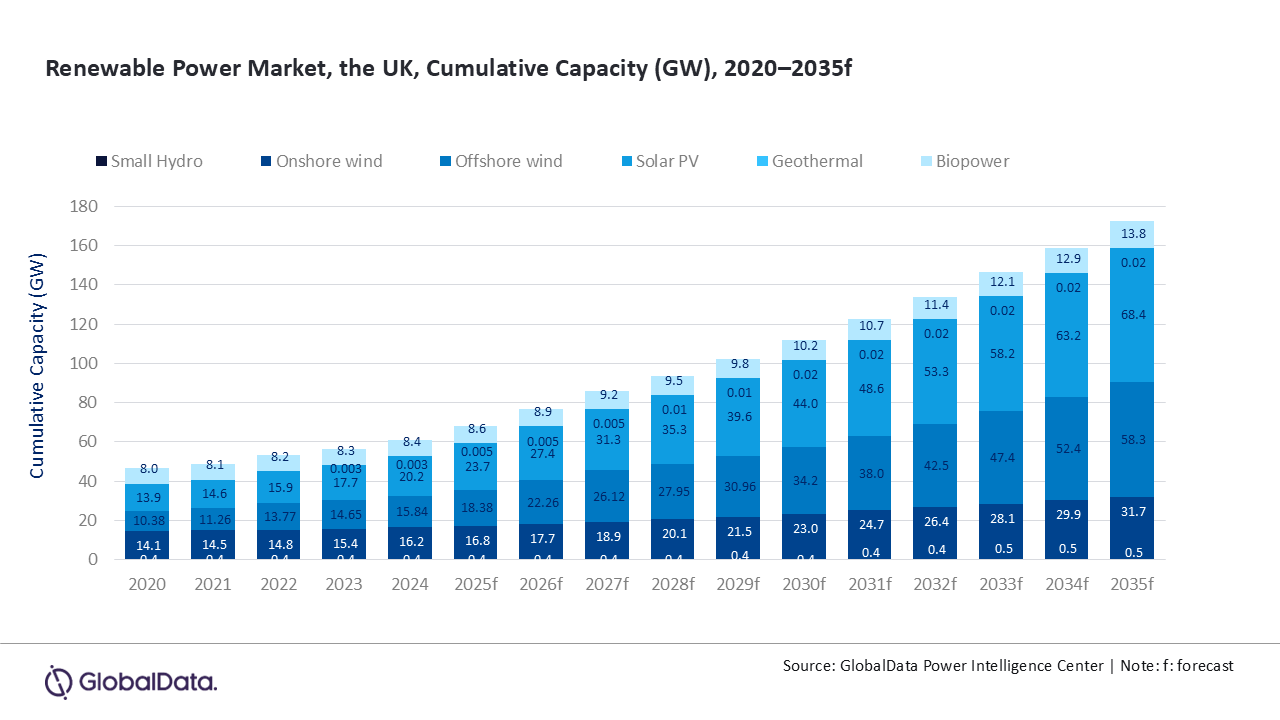
Solar power is set to play a leading role in the UK’s renewable energy expansion over the next decade, supported by government incentives and large-scale investment, according to GlobalData’s latest report United Kingdom (UK) Power Market Trends and Analysis by Capacity, Generation, Transmission, Distribution, Regulations, Key Players and Forecast to 2035.
The data and analytics firm forecasts that the UK’s total renewable power capacity will rise from 61GW in 2024 to 172.7GW by 2035 – a compound annual growth rate of 9.9%. Solar PV is expected to see a fast growth – tripling from 20.2GW in 2024 to 68.4GW by 2035.
This rise will be driven by CfD-backed utility projects, rooftop installations, and community energy schemes.
Wind power will remain a key pillar of the UK’s clean energy mix. Offshore wind capacity is projected to increase from 15.8GW to 58.3GW over the same period, supported by the Clean Power 2030 mission, ongoing CfD auctions, and major grid projects across the North Sea.
The UK’s offshore pipeline is among the world’s largest, strengthened by floating wind development and investment in ports and manufacturing in Teesside, Humber, and Scotland.
Onshore wind capacity is expected to nearly double from 16.2GW to 31.7GW, following the easing of planning restrictions and faster repowering approvals. Biopower will also expand, growing from 8.4GW to 13.8GW, as the UK pursues waste-to-energy and circular economy initiatives.
Mohammed Ziauddin, Power Analyst at GlobalData, said: “The UK’s clean energy growth is being powered by a robust framework that includes the CfD mechanism, the Clean Power 2030 mission, and the Net Zero Strategy, all providing long-term policy stability and investment certainty.”
While nuclear capacity is expected to fall from 5.9GW in 2024 to about 4.1GW by 2035, gas-fired generation will remain vital for system reliability as energy storage and hydrogen capacity scale up.
Zia added: “Offshore wind will be the centrepiece of the UK’s clean energy expansion, supported by record investment, policy stability, and grid modernisation.”
[Graph credit: GlobalData]
Don’t miss out on your free ticket to Solar & Storage Live London – the capital’s most exciting solar event. Or, find a Solar & Storage Live event near you.
by Emily Ashley | Nov 7, 2025 | Large Scale Utility Solar, Press Release
Press Release
DMEGC Solar’s new ultra-high-efficiency PV modules have been certified by TÜV SÜD.
The acclaimed Infinity G12RT-B66 series included in the certification features a golden size of 2382mm x 1134mm, making it highly popular for utility-scale plants and also suitable for rooftop projects. DMEGC Solar is the first in the PV industry to adopt a new approach to apply CJ (Cemented Joint) technology to module design.
This technology uses Butyl Sealant as the encapsulant material between the cells and the frame, significantly enhancing module power and reliability.
According to the certificate issued by TÜV SÜD, the G12RT-B66 module achieves a maximum power of an impressive 655W. In the October TaiyangNews Top Modules List, this module ranked fifth with a mass production power of 635W, only slightly lower than the more expensive BC and HJT modules.
In terms of project BOS cost and LCOE, it currently might be the best PV module option for project developers and operators. DMEGC Solar expects to mass-produce and ship this module at 650W in Q1 2026, which will further strengthen its advantages in system power generation, building upon its high reliability.
It is worth noting that Cemented Joint technology is compatible with currently popular technologies like BC, multi-cutting, and full-screen. DMEGC’s Product and R&D teams revealed that they are researching multiple cell and module technologies and will apply one or two of them in the near future.
This opens up more possibilities for even higher power and brings further anticipation to the market.
In addition to passing this TÜV SÜD certification, the CJ modules also passed extended tests such as DH2000 in the internal PV laboratory, with results superior to previous conventional modules, further verifying the technology’s reliability.
DMEGC Solar is one of the very few module manufacturers simultaneously rated as Tier 1 by BNEF, S&P, and SMM. Its Infinity series modules are renowned for their diverse product portfolio, high efficiency, reliability, aesthetic appeal, and high-level low-carbon and ESG-related certifications.
Global energy research firm Wood Mackenzie ranked DMEGC Solar fifth in its published 2025 Global Solar Module Manufacturer Rankings.
by Emily Ashley | Nov 3, 2025 | Europe, Large Scale Utility Solar, Storage
Distributed Energy Infrastructure (DEI) has completed a 7.1MW solar and 4MW battery storage project in Massachusetts, USA, on a site formerly occupied by a chemical manufacturing facility.
The land had been classified as an EPA Superfund site due to severe soil contamination, including asbestos.
The project, owned by Syncarpha Capital with racking provided by Terrasmart, was named a finalist in Solar Builder’s 2025 Project of the Year Awards in the 1–10MW category.
To ensure safe construction on the contaminated site, DEI implemented a series of environmental and health safeguards. Crews trained in hazardous materials handling followed specialised safety protocols, and excavation was kept to a minimum.
Most electrical infrastructure was built above ground to avoid disturbing the soil, while the system was designed around existing structures, such as old concrete slabs, to reduce site disturbance.
The company also worked with six regulatory agencies and developed contingency plans in case of hazardous material discoveries. When asbestos was found, certified specialists managed its removal under regulatory oversight.
“Projects like Acton show what it takes to responsibly bring clean energy to communities while addressing the challenges of building on historically contaminated land,” said Sean Harrington, President and CEO of Distributed Energy Infrastructure.
“By transforming a brownfield into a productive solar and storage site, we’re expanding access to renewable energy, strengthening the local grid, and putting otherwise unusable land back to work.”
The Acton project is expected to deliver long-term environmental and community benefits by repurposing contaminated land, preserving open space, and creating nearly 40 local jobs during construction.
The community solar model paired with battery storage will enhance grid resilience and generate new tax revenue for the town, supporting Massachusetts’ SMART and Clean Peak Standard programmes.
“Brownfield redevelopment is a powerful way to expand clean energy access while addressing the legacy of industrial contamination,” said Graeme Dutkowsky of Syncarpha Capital.
“This project demonstrates how … building brownfield solar projects can turn an underutilised site into a long-term source of reliable power and local economic value.”
[Image credit: Distributed Energy Infrastructure]
by Emily Ashley | Nov 3, 2025 | Europe, Large Scale Utility Solar
Amazon says it has added nearly one gigawatt (GW) of renewable energy capacity to European electricity grids through 20 new wind and solar projects that came online this year.
The projects span five countries: 12 in Spain, three in Italy, three in Poland, one in Germany, and one in Greece, collectively capable of powering more than 700,000 European homes annually.
The company now supports over 230 renewable energy projects across Europe through power purchase agreements (PPAs).
These contracts provide developers with the financial certainty to build new clean energy infrastructure and feed additional renewable power into national grids.
Among the new projects are Baltic Eagle, one of Germany’s largest offshore wind farms, where Amazon has committed to offtake 189 MW of capacity, and the Miłkowice solar farm in Poland, its first renewable project in the country, with an 87 MW commitment.
Across Europe, Amazon has more than 40 operational renewable energy facilities, including 18 in Spain, eight in Finland, five in Sweden, four in Ireland, and two each in the UK, Italy, and the Netherlands. A further 70 projects are expected to come online by 2030.
The company says it is focusing on expanding in regions with carbon-intensive grids, including Poland and Germany, to accelerate decarbonisation across the continent.
“With more than 160 wind and solar projects in Europe, Amazon is helping to provide new sources of clean energy to local grids, creating jobs, and supporting local businesses as we progress toward powering our operations with 100% renewable energy by 2025,” said Lindsay McQuade, Amazon’s Director of Energy for EMEA.
Amazon claims to be Europe’s largest corporate purchaser of renewable energy and aims to power all its operations with renewables by 2025, five years ahead of its original target.
by Emily Ashley | Oct 31, 2025 | Commercial & Industrial Solar, Europe, Everything Installer, Large Scale Utility Solar, Press Release
Press Release
Terrapinn is thrilled to announce the latest addition to its global clean energy portfolio, Solar & Storage Live Paris, taking place at Le Bourget, Paris, on 5–6 November 2026.
Doors open on Wednesday, 5 November, with more than 3,000 solar professionals expected to attend the debut edition.
France’s Premier Solar & Storage Event
Solar & Storage Live Paris will be France’s most exciting new exhibition dedicated to solar and energy storage. Organised by Terrapinn in partnership with Paris Le Bourget, the show is backed by leading sponsors Solis, Huawei, and SMA France, and supported by renewable energy associations including the Fédération Nationale de l’Énergie Solaire, Energy Storage Europe, France Renouvelables, and the Global Solar Council.
Over 150 exhibitors, including GoodWe, Heliup, FoxESS, Reonic, Rector, Sitetracker, and Sunman, will showcase cutting-edge solar and storage technologies alongside a vibrant mix of startups in the Start-up Zone.
A Must-Attend Event for the French Solar Community
With strong attendance expected from Paris and the Île-de-France region, the event provides a one-stop destination for installers, developers, property owners, landowners, and energy professionals. It’s free to attend for those who register on the website here.
The event offers an unparalleled opportunity to meet suppliers and partners, explore new technologies, and gain insights to grow business, increase revenue, and advance energy independence.
Richard Leach, Commercial Manager of Solar & Storage Live Paris, said:
“Our first edition will deliver a high-value experience focused on commercial outcomes. Exhibitors can expect access to EPCs, developers, and distributors, while attendees will benefit from practical insights, new technologies, and quality networking opportunities.”
Event Highlights
Exhibition:
Key players from across the energy value chain will gather to present the latest innovations driving solar and storage adoption in France. Headline sponsors include Platinum Sponsor Contact Italia, Gold Sponsors Sunman and Failte Solar, and Storage Theatre Sponsor Huawei.
Programme:
The two-day programme features four theatres and more than 150 speakers covering large-scale utility solar, commercial and industrial solar, energy storage and batteries, and residential solar. It opens at 10:00 on Wednesday, 5 November, with a keynote by Dominique Jamme, Director of the CRE – Commission de Régulation de l’Énergie.
Leaders from across the sector will share case studies, insights, and expertise on France’s evolving energy landscape. The conference is free to all attendees registered here.
Start-up Zone:
Over 100 emerging innovators will showcase technologies shaping the next generation of solar and storage solutions.
View more event highlights here.
Opening Times
- Wednesday, 5 November: 09:30 – 17:00
- Thursday, 6 November: 09:30 – 16:00
Find Out More
Discover more about Solar & Storage Live Paris and how to get involved.
France Solar Week marks the lead-up to Solar & Storage Live Paris, taking place 5-6 November. Haven’t registered yet? Don’t miss out on your free ticket by securing your place here.
Want to publish a press release? Submit your content here for review by our editorial team.
by Emily Ashley | Oct 31, 2025 | Europe, Large Scale Utility Solar
The UK government has unveiled its latest strategy, the Carbon Budget and Growth Delivery Plan, aiming to leverage the benefits of the clean energy transition while driving investment into new industries and jobs.
Published on 29 October 2025 by the Department for Energy Security and Net Zero, the plan sets out how the UK will continue to reduce emissions under the Climate Change Act 2008 while delivering tangible benefits for households and businesses.
Key initiatives include:
- Investing in renewable and nuclear power to reduce dependence on volatile fossil-fuel prices.
- Securing around 400,000 additional jobs in the clean-energy sector by 2030.
- Upgrading homes for five million families under the Warm Homes Plan to lower bills and increase warmth.
- Improving air quality through tree planting and energy transitions.
“Over the last 16 months, we have put clean energy and climate action at the heart of our government’s agenda – because we know it is the route to making the British people better off,” Secretary of State Ed Miliband commented in the official government statement.
“This is about delivering better lives for people today – from warmer homes and cleaner air to cheaper transport and increased access to nature – as we tackle the climate and nature crises to protect our home for future generations.”
Business leaders welcomed the direction. The Co-operative Group Chief Executive and co-chair of the Net Zero Council, Shirine Khoury-Haq, added: “Building on the significant progress that the UK continues to make in reducing its emissions, today’s announcement is another important step.
“Clear targets, policy stability and certainty are all key for businesses looking to plan and invest with confidence, and ultimately it’s businesses which drive growth and can unlock the creation of good, green jobs.”
While the plan outlines wide-ranging ambitions and sets out an accompanying investor prospectus, stakeholders emphasised that achieving results will depend on the detail and timely delivery of measures, particularly regarding energy costs and industrial competitiveness.
It has been additionally welcomed by climate advocacy groups, who note that this plan provides avenues for further investment in clean energy solutions such as solar.
Rachael Orr, CEO of Climate Outreach, noted: “This plan is right to highlight the benefits the clean energy transition can bring to people across the country.
“Almost three-quarters of us are worried about climate change… to deliver the ambitions in this plan, we have to ensure we engage people and communities on decisions that will affect them and work together to strengthen our communities, improve our daily lives, and secure a better future for everyone.”
In putting forward this growth-focussed climate plan, the government hopes to reflect its belief that “clean energy is the economic opportunity of the 21st century.”
Don’t miss out on your free ticket to Solar & Storage Live London – the capital’s most exciting solar event. Or, find a Solar & Storage Live event near you.
by Emily Ashley | Oct 30, 2025 | Europe, Large Scale Utility Solar, Middle East
A consortium comprising France’s TotalEnergies and Saudi Arabia’s Aljomaih Energy & Water (AEW) has been awarded a contract by the Saudi Power Procurement Company (SPPC) to develop, build, and operate a 400MW solar power plant in As Sufun, Saudi Arabia.
The project was granted following a competitive tender process and will sell its electricity to SPPC under a 25-year Power Purchase Agreement (PPA). Expected to connect to the grid in 2027, the As Sufun plant will provide clean power to more than 68,400 homes.
Part of Round 6 of the National Renewable Energy Program (NREP), overseen by the Ministry of Energy, the project supports Saudi Vision 2030. The initiative aims to reduce reliance on liquid fuels in power generation and increase the share of renewable and energy storage capacity to up to 50% by 2030, depending on demand growth.
“Together with our partner Aljomaih Energy and Water Co, we are thrilled to contribute to Saudi Arabia’s target of increasing the share of renewables in its energy mix,” said Olivier Jouny, SVP Renewables at TotalEnergies.
“This project marks the second success for our consortium in the Saudi National Renewable Energy Program. TotalEnergies is a close partner of Saudi Arabia, where we are deploying our multi-energy strategy, notably through our participation in major refining and petrochemical assets.”
Ibrahim Aljomaih, Chairman of Aljomaih Energy and Water Company, commented: “We are proud to lead the development of the 400MW As Sufun Solar PV Project in partnership with TotalEnergies.
This milestone reflects our unwavering commitment to supporting the Saudi Green Initiative and advancing the goals of Saudi Vision 2030.”
Adnan Buhuligah, Acting CEO of Aljomaih Energy and Water Company, added: “The 400MW As Sufun Solar PV Project in Hail region demonstrates our ongoing efforts to expand our renewable energy investments in the Kingdom.”
The As Sufun project builds on TotalEnergies’ growing presence in the Kingdom, where it already operates the 119MW Wadi Al Dawasir solar plant and is constructing the 300MW Rabigh 2 project.
by Emily Ashley | Oct 29, 2025 | Europe, Innovation, Large Scale Utility Solar
As France Solar Week draws attention to the nation’s growing renewable energy ambitions, data highlights just how far the country’s solar sector has come – and how much potential remains.
The Solar & Storage Live Paris: French Solar Market Report 2025 outlines steady progress toward national targets, strong policy support, and an expanding base of innovation that continues to strengthen France’s position as a leader in European solar development.
Market growth and trailblazers
France’s solar energy market has expanded significantly over the past decade, becoming one of Europe’s leading renewable sectors. Between 2009 and 2011, solar capacity surged nearly tenfold, reaching 6.7TWh annually by 2015.
In 2023, France’s solar market was valued at several billion dollars, with an expected annual growth rate of 14.24% until 2032. Solar PV generated 4.3% of all electricity in France, with large solar farms driving expansion. Falling solar panel costs, rising energy prices, and new solar technologies continue to boost growth.
Key companies leading the charge in France’s solar market include Engie SA, EDF Renewables, and TotalEnergies SE. Their pioneering efforts are helping to make solar a more viable and attractive option for businesses and industries looking to meet sustainability goals.
Meeting government expectations
France has set ambitious goals for the future of its solar industry. By 2050, the country aims to have 100GW of installed solar capacity, a significant jump from its current level of 17.1GW. The government is also aiming to produce 40% of the solar panels used in France domestically by 2030, reducing reliance on imports.
France has committed to cutting its greenhouse gas emissions by 52% by 2030, compared to 2005 levels. This forms part of a broader effort to meet the European Union’s goal of a 55% emissions reduction by 2030.
To meet these goals, the government has introduced policies to encourage growth, including tax breaks, subsidies, and feed-in tariffs, which guarantee fixed payments for solar energy producers.
In 2023, new laws were passed requiring large car parks to install solar panels – a move expected to add between 6.75 GW and 11.25 GW of solar capacity. The government has also invested €2.2 billion in domestic solar panel production, funding two new factories.
The road ahead
The report identifies several challenges to France’s solar momentum, including the intermittency of solar power, land use competition, and the environmental impact of panel manufacturing and disposal. Solutions cited include investment in energy storage systems, smart grids, agrivoltaics, floating solar farms, and more.
Overall, France’s solar energy market is expected to experience rapid growth in the coming years, driven by robust government policies, innovative technologies, and increasing demand for renewable energy.
With ambitious targets for 2030 and 2050, the country is on track to become a leader in the global solar market.
To read about these developments in full, download the full Solar & Storage Live Paris: French Solar Market Report 2025 or meet the market in person at Solar & Storage Live Paris, taking place 5–6 November 2025.
France Solar Week marks the lead-up to Solar & Storage Live Paris, taking place 5-6 November. Haven’t registered yet? Don’t miss out on your free ticket by securing your place here.
by Emily Ashley | Oct 29, 2025 | Europe, Large Scale Utility Solar
Dozens of NHS trusts across England will receive funding to install new solar panels as part of the government’s expanded solar rollout, led by Great British Energy.
Thirty-four NHS trusts – including ten already in the programme – will benefit from the latest round of investment, with installations planned across around 70 additional sites. The initiative, jointly funded by Great British Energy and the government, now covers around 260 NHS locations, including hospitals and mental health facilities.
According to estimates, the scheme could save participating trusts up to £65 million in energy bills over the panels’ lifetime. Across the wider rollout, the NHS could see total savings of up to £325 million, with the average site saving around £35,000 per year.
Energy Minister Michael Shanks said: “Great British Energy is helping your local hospital save money on its bills, to be reinvested into the frontline, from nurses to medical equipment.
“Across the country, solar panels are going up on rooftops or carpark canopies, to power operating theatres with clean, homegrown power.”
Dan McGrail, Chief Executive of Great British Energy, said: “Great British Energy has been set up as a publicly owned energy company to help deliver the government’s mission to make Britain a clean energy superpower.
“Our ongoing solar rollout delivers tangible benefits to the people that need it most in our hospitals and schools.”
Health and Social Care Secretary Wes Streeting added: “Every pound the NHS spends on rising energy bills is money that can’t be spent on cutting waiting times. By modernising the NHS and cutting wasteful spending, including taking back control of our energy, we will get patients treated faster.”
Chris Gormley, Chief Sustainability Officer at NHS England, said the collaboration would see NHS solar generation triple, driving “significant cost savings and improving patient care”.
Several trusts welcomed the funding, describing it as a step towards sustainability. Michele Moran, Chief Executive of Humber Teaching NHS Foundation Trust, said the project would “reduce our reliance on grid energy and lower our carbon footprint.”
Rachel Barlow, Chief Development Officer at Sandwell and West Birmingham NHS Trust, said the initiative would “save 39,000 kg of carbon annually”, while Sean Greene of Barking, Havering and Redbridge University Hospitals NHS Trust said: “We’re investing in a healthier future for our community and money saved can be spent on patient care.”
operate successfully, but in a more optimised way.
Get your free ticket to Solar & Storage Live London 2026 – the capital’s most exciting solar event. Or, find a Solar & Storage Live event near you.