by Emily Ashley | Oct 27, 2025 | Commercial & Industrial Solar, Europe, Everything Installer, Large Scale Utility Solar
Solar & Storage Live is expanding its European presence with a new event in Paris, targeting one of the continent’s fastest-growing solar and storage markets.
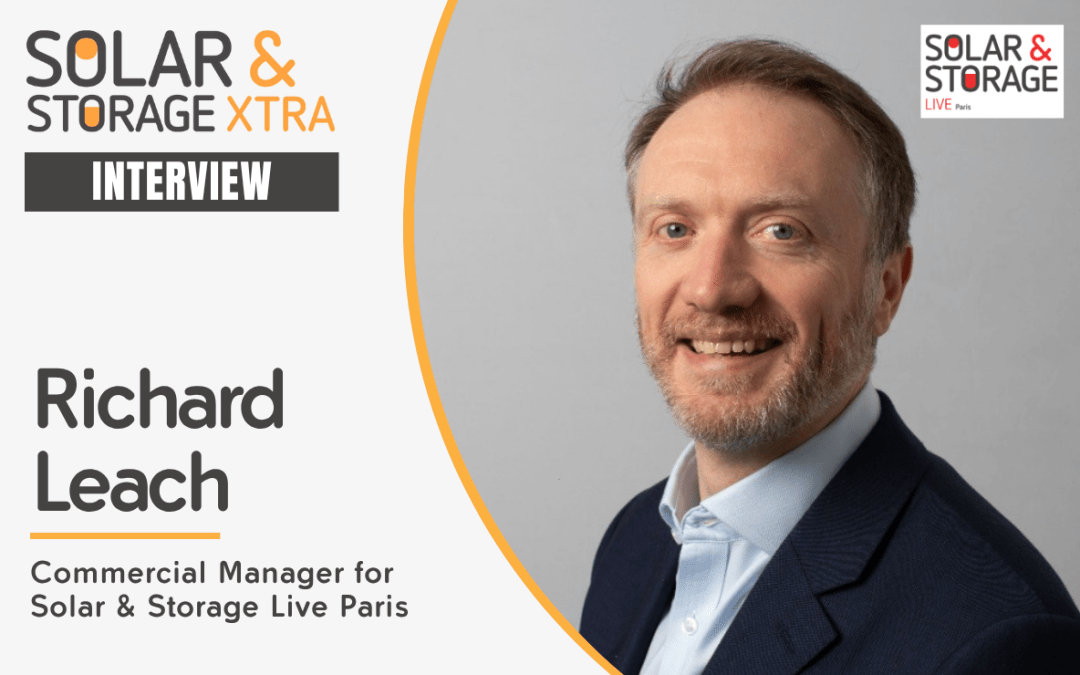
Richard Leach, Commercial Manager for Solar & Storage Live Paris, describes how the show will connect developers and innovators across France and Europe – driving collaboration that accelerates the country’s clean energy transition.
Why did Solar & Storage Live choose Paris, and how does it fit within the Europe portfolio?
Paris offers unparalleled access to one of Europe’s fastest-growing solar and storage markets. France is scaling up its energy transition through increasingly ambitious renewable targets, substantial public support mechanisms and a rapidly maturing utility-scale and C&I segment.
Solar & Storage Live Paris strengthens our European portfolio by establishing a presence in a strategic market that complements our events in the United Kingdom, Italy & Spain, creating a connected platform for innovators, investors, and decision makers across the continent.
What should attendees and exhibitors expect from the inaugural edition, and who will benefit from being there?
The inaugural edition will deliver a curated, high-value experience focused on commercial outcomes. Exhibitors can expect direct access to EPCs, developers, installers, and distributors who are actively engaged in project deployment. Attendees will benefit from practical insights, new technologies, and strong networking opportunities spanning the full value chain.
The event is particularly advantageous for companies seeking to enter or scale within the French market, as well as for stakeholders searching for reliable solutions to increase deployment speed and performance.
Can you highlight some stand-out features of the upcoming show, either on the show floor or in the agenda?
The show floor will prioritise innovation in batteries, PV modules, inverters, energy storage, asset management, and digitalisation. There will be 3 theatres with dedicated sessions that will explore utility-scale build-out, urban integration, regulatory clarity, and grid flexibility.
The agenda includes thought leadership from top-tier developers, financiers, policymakers, and technology providers. Targeted networking opportunities will facilitate business introductions aligned with procurement needs and real project pipelines.
What is your overarching vision for the Paris event’s role in the French energy transition?
Solar & Storage Live Paris is designed to be a strategic accelerator for France’s clean energy ambitions. The event convenes the full ecosystem of market participants to confront persistent barriers in permitting, grid integration, financing, and supply chain capacity. It provides a high-value platform to highlight proven solutions, foster industrial cooperation, and advance innovation that can unlock faster deployment.
By connecting French stakeholders with European expertise and global technological leadership, Solar & Storage Live Paris will contribute to building a more secure, affordable, and resilient power system for the nation’s long-term energy transition.
When the 2025 show wraps, what is on the horizon for Solar & Storage Live Paris?
The Paris event is planned as a long-term platform with annual expansion. Following 2025, our focus will be on growing the show’s scale, deepening engagement with policymakers and regional stakeholders, and advancing cross-border collaboration on innovation and investment.
The objective is to ensure Solar & Storage Live Paris becomes a cornerstone event that supports the continuous growth of solar and storage capacity in France and contributes meaningfully to Europe’s collective clean energy goals.
France Solar Week marks the lead-up to Solar & Storage Live Paris, taking place 5-6 November. Haven’t registered yet? Don’t miss out on your free ticket by securing your place here.
Companies looking to confirm their stand at next year’s event should contact Richard Leach at Richard.Leach@terrapinn.com, or meet the sales team in person on stand G10 at next week’s event in Paris.
by Emily Ashley | Oct 27, 2025 | Commercial & Industrial Solar, Europe, Large Scale Utility Solar
SolarPower Europe has launched a new policy-tool, the Agrisolar Policy Map, to benchmark agrisolar regulation across 18 EU member states. The initiative is designed to support deployment of solar in agricultural contexts, aligning energy and farming resilience.
At its launch in Milan on 21 October 2025 during the Agrivoltaics Industry Forum, the Map provided comparative data across six policy domains: legal definitions, land use and zoning, support schemes, technical requirements, agricultural productivity and environmental safeguards.
According to policy advisor Lina Dubina, “The Agrisolar Policy Map is a vital step in unlocking the full potential of agrisolar. By identifying where Member States are leading or lagging, we can better inform EU-level reforms and empower farmers to harvest the sun twice.”
The findings reveal significant regulatory divergence. Only five of the 18 surveyed countries provide a legal definition for agri-PV, and Environmental Impact Assessment (EIA) requirements vary widely.
Meanwhile eligibility for the Common Agricultural Policy and support schemes remains inconsistent, limiting uptake among farmers.
SolarPower Europe is calling on EU policymakers to harmonise agrisolar regulations and to provide clearer guidance under the CAP, in order to catalyse further deployment of solar in agricultural settings.
The Policy Map can be found here.
by Emily Ashley | Oct 24, 2025 | Commercial & Industrial Solar, Everything Installer, Large Scale Utility Solar, Press Release
Press Release
Terrapinn confirms the success of the latest addition to their global portfolio, Solar & Storage Live Italia, held at the Veronafiere during 8 – 9 October 2025, with over 4865 solar professionals in attendance and 57% of the floorplan rebooked.
Solar & Storage Live Italia secured its place as Italy’s most exciting dedicated solar & storage trade exhibition, taking place for the first time in Verona, Italy. The event is organised by Terrapinn, with the support and cooperation of Veronafiere, Comune di Verona. It is supported at the highest level by sponsors Contact Italia, Failte Solar and Sunman, and associate sponsor Huawei, with renewable energy associations including ANIE Federazione, Kyoto Club, Legacoop, Elettricità Futura and the Global Solar Council.
With 3,000 attendees expected from across Italy, the launch of Solar & Storage Live Italia exceeded its attendance targets, delivering over 4,865 solar professionals, commercial property owners, landowners, and project developers. It provided a one-stop destination for everything needed to deliver Italy’s commercial, industrial and residential solar and energy storage projects.
The first edition included global and Italian suppliers Forniture Fotovoltaiche, ESPE, WiseGlow, Amara NZero, Chint PVSTAR, Huawei, Energy3000, Shanghai Elecnova Energy Storage Co., SolaX Power amongst 100 exhibitors and innovative startups displaying the latest solar and energy storage solutions.
The comprehensive agenda of presentations, case studies and panel debates commenced with a keynote address from Damiano Tommasi, Mayor of Verona. Over 120 speakers took to the stage to address key issues across the themes of residential, utility scale, commercial & industrial and storage.
Terrapinn have announced the dates of Solar & Storage Live Italia 2026 as 7-8 October, at the Veronafiere, Verona. Over 57% of the floorplan for next year has already been sold, with many clients at the 2025 launch securing even larger stand space.
Rebecca Sloan, General Manager for Solar & Storage Live Europe comments:
“We’re thrilled with the attendance at Solar & Storage Live Italia and to be able to launch another renewable energy exhibition that celebrates the technologies at the forefront of industry. We could not be happier with the response from the industry and level of local support for the show.
The event has already established itself as a serious player and the strong rebookings indicate our customer satisfaction and readyness to return. We are currently reviewing feedback to ensure our 2026 event is bigger, better and delivers on our customer needs.”
Want to publish a press release? Submit your content here for review by our editorial team.
by Emily Ashley | Oct 24, 2025 | Commercial & Industrial Solar, Europe, Large Scale Utility Solar
European Energy has agreed to sell a 50% stake in its Saldus solar and storage project in Latvia to Sampension, one of Denmark’s largest pension funds.
The Saldus project combines a 65MW solar PV facility with a 46MW BESS. Construction began in July 2025 and is scheduled for completion in May 2026.
Once operational, it will supply renewable electricity to the Latvian grid and improve system flexibility through its co-located battery installation.
“This divestment is a clear example of our ability to take large-scale renewable energy projects from development through construction and into the hands of long-term institutional investors,” said Jens-Peter Zink, Deputy CEO of European Energy.
“The capital recycled from projects like Saldus enables us to expand our pipeline of wind, solar, and hybrid projects across Europe.”
European Energy currently has more than 1GW of projects in development in Latvia, including onshore wind, solar, and battery storage facilities.
Latvia aims to generate 57% of its electricity from renewable sources by 2030, according to the International Energy Agency (IEA).
Despite these targets, the deployment of solar parks in Latvia has so far lagged behind neighbouring Baltic states. As of 2023, Latvia had installed around 500MW of solar capacity.
Alnis Balins, Country Manager for European Energy in Latvia, commented:
“The project will support Latvia’s efforts not only to increase renewable energy in the national mix, but also improve energy security and network operational stability by having BESS as an integral part of this energy project.”
Rising demand for renewable energy in Latvia is partly driven by the need to reduce reliance on energy imports. Sampension has previously partnered with European Energy in Latvia, acquiring a 50% stake in the 148MW Ventspils solar park – the country’s largest to date.
The divestment aligns with European Energy’s strategy of developing and constructing renewable projects that attract institutional investors, while freeing up capital for further developments across Europe.
by Emily Ashley | Oct 24, 2025 | Asia, Large Scale Utility Solar
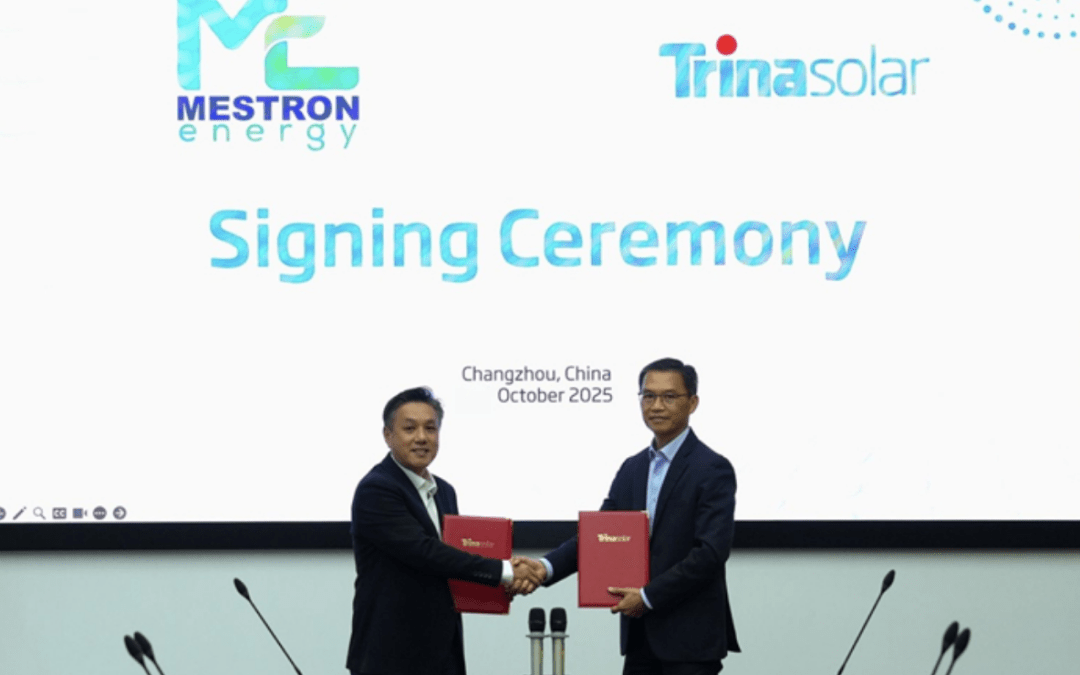
Trinasolar and Mestron Energy have signed a memorandum of understanding (MoU) to support Malaysia’s national energy transition efforts.
As part of the agreement, Trinasolar will supply 50MW of its Vertex N-type solar modules to Mestron for deployment across the country.
Trinasolar describes itself as a global leader in smart photovoltaic (PV) and energy storage solutions, while Mestron Energy is a Malaysian‐based renewable power generation specialist.
Commenting on the partnership, Trinasolar Vice President for Asia Pacific, Middle East and Africa, Ku Jun Heong, said:
“We’re pleased to partner with Mestron Energy to deliver advanced, cost-effective solar solutions that support Malaysia’s clean-energy ambitions. Our Vertex N modules are designed to maximise energy yield and help lower [the] levelised cost of energy.”
On behalf of Mestron Energy, Managing Director Por Teong Eng added:
“Partnering with Trinasolar presents an excellent opportunity to support Malaysia’s and ASEAN’s renewable energy development. We believe that solar installations will significantly reduce greenhouse gas emissions and help create a sustainable future.”
Mestron Energy, part of the Mestron Holdings Berhad group and listed on the Malaysian Stock Exchange, brings established expertise in managing solar and energy-management projects locally.
With Trinasolar’s “cutting-edge technologies”, Mestron aims to scale its portfolio and advance Malaysia’s transition to a low-carbon economy.
The deal is a sign of growing demand for corporate renewable energy solutions in Malaysia. It more broadly underscores the potential of the ASEAN region as a pivot for clean energy development.
by Emily Ashley | Oct 23, 2025 | Everything Installer, Large Scale Utility Solar, Storage
As the UK solar and storage sector gathers momentum, Solar & Storage Live 2025 set the stage for conversations about innovation, infrastructure, and growth.
Among the exhibitors was Aaron Sallows, Divisional Director for sister companies Maintech Power and Dunamis, who shared insights into how the two firms are shaping the future of large-scale solar and storage.
From navigating the bottlenecks of grid connection approvals to tackling harmful SF6 in high-voltage switchgear, Aaron highlights the challenges and opportunities facing the sector.
What are the roles of Maintech Power and Dunamis in the solar-storage industry, and how do the two entities complement each other?
Aaron: Dunamis focuses as an ICP – an independent connection provider – up to 132kV, specialising in design, build and project management, with a particular focus and specialism in battery storage and solar PV. Both gridscale independent and co-located projects.
Maintech Power, the sister company to Dunamis, essentially has many of the boots-on-the-ground teams operating as high-voltage and low-voltage electrical contractors.
We complement each other very well: Dunamis would step in as the ICP contractor, particularly on larger projects, fulfilling the ICP design and build scope requirements and sometimes moving into the balance-of-plant electrical side, depending on the client’s contracting.
Maintech Power would then come in, boots-on-the-ground, to carry out the installation, working alongside Dunamis as a partner. We also sometimes carry that through into the warranty periods post-energisation.
With the growth in solar farms, wind farms, and BESS, what technological innovations or improvements in infrastructure are you most excited about?
Aaron: Personally, I’m excited about moving away from reliance on high-voltage switchgear containing SF6. SF6 is a hugely harmful greenhouse gas, and from my own experience with switchgear leaks, it has a massive detrimental effect on the environment.
Moving away from that – especially in low-carbon renewable technologies – really boosts the benefits of renewable energy from grid-scale solar PV and from BESS as well.
What are your views on the current UK policy and regulatory landscape for large-scale solar-storage? Are there areas that need reform?
Aaron: Without commenting on any specific policies or regulations, I think – as most people in the industry would agree – getting grid connections approved faster would help stimulate the industry.
That would mean more projects being built, and more grid-scale renewable energy and battery storage coming onto the networks.
I also think there’s a huge need for investment to upgrade infrastructure to handle the increased capacity required for these projects. Without that, we risk bottlenecking the industry and slowing delivery.
Where do you see the biggest growth opportunities for Maintech Power and Dunamis over the next three to five years?
Aaron: The biggest opportunities are in transmission projects at 275 kV and 400 kV. There’s huge interest there, but also a big shortage of skills to deliver those projects.
In the next three to five years, we want to explore this area and look at how we can deliver the 300–400 MW projects currently coming through.
What are you hoping to showcase at Solar & Storage Live this year?
Aaron: This year we have a joint stand, showcasing the strength and synergies of Dunamis and Maintech Power.
We’re two side-by-side businesses with a good reputation in the industry, but we don’t usually shout about it too much. A big part of being here is to network and raise brand awareness among attendees.
We also want to showcase our skills by bringing engineers and technical expertise to the show – talking in depth with people about their requirements, helping them feed into tender processes and procurement, and ultimately generating more work.
So far, we’ve had a good mix of people at the stand – suppliers and project opportunities at different stages, from early investment through to more advanced development. It’s been a really positive experience.
Missed out on Solar & Storage Live UK? Get your free ticket to Solar & Storage Live London – the capital’s most exciting solar event. Or, find a Solar & Storage Live event near you.
by Emily Ashley | Oct 22, 2025 | Commercial & Industrial Solar, Europe, Large Scale Utility Solar
The UK Government has launched its first Clean Energy Jobs Plan, outlining how it will train thousands of new workers to meet rising demand across renewables – particularly in the fast-growing solar sector.
Employment in clean energy is expected to double to 860,000 by 2030, with 31 priority occupations identified, including electricians, engineers, and installers.
Backed by over £50bn in private investment since July 2024, the plan aims to expand the workforce required for technologies such as solar, wind, and nuclear.
Energy Secretary Ed Miliband said: “Communities have long been calling out for a new generation of good industrial jobs. The clean energy jobs boom can answer that call”
He continued: “Our plans will help create an economy in which there is no need to leave your hometown just to find a decent job… a generation of young people in our industrial heartlands can have well-paid secure jobs, from plumbers to electricians and welders.”
A new strategy
Solar is a major focus of the new strategy. The government will work with industry and training providers to attract new entrants and retrain skilled workers, including veterans and former oil and gas employees, into solar installation and manufacturing roles.
Through the Mission Renewable programme, ex-service personnel will be matched with opportunities in solar panel installation, wind turbine factories, and nuclear sites.
Training initiatives include five new Technical Excellence Colleges and regional pilots worth £2.5m, funding new courses and career advice in clean energy.
The ‘energy skills passport’ – originally designed for offshore workers – is being extended to help more people transition into renewable sectors such as solar.
On the news, Secretary of State for Work and Pensions Pat McFadden commented: “We’re giving workers the skills needed for the switch to clean energy, which is good for them, good for industry – and will drive growth across the nation.”
Praise from the solar industry
Industry groups, both domestic and international, have welcomed the move. In the official Gov.uk statement, several explain that the plan will aid in finding and retaining skilled workers for upcoming and current projects.
Chris Hewett, Chief Executive of Solar Energy UK and co-chair of the UK Solar Taskforce alongside Ed Miliband, said: “Solar energy and battery storage already support over 20,000 British jobs, with expectations that the sectors will employ more than twice that number in ten years’ time.
“With our Solar Careers UK programme and critical support from government under the Clean Energy Jobs Plan, we have every expectation that our aspirations will be fulfilled.”
“We’re really pleased to see the launch of the Clean Energy Jobs Plan and the recommendations within it,” added Michael Lewis, CEO of Uniper. “Uniper aims to invest approximately €8bn into growth and transformation projects by the early 2030s… contributing to the retention and creation of jobs and supporting the regional economy.”
Matthieu Hue, CEO of EDF Power Solutions, said: “We welcome the plan… EDF Power Solutions has 2GW of wind, solar and battery in operation, and our goal is to have 5 times that amount by 2035, so we will need many more skilled people to help us reach our ambition.”
by Emily Ashley | Oct 21, 2025 | Large Scale Utility Solar, Middle East
The Electricity & Water Authority (EWA) of Bahrain has announced the launch of the country’s first solar-power plant for electricity generation, in partnership with the private sector.
According to a statement issued on 7 August 2025, the new facility will have a planned production capacity of up to 150MW.
It forms part of Bahrain’s efforts to enhance reliance on renewable energy sources and supports the national target of reaching net-zero carbon emissions by 2060.
EWA President Eng. Kamal bin Ahmed Mohammed described the project as “among the most strategic initiatives led by the Authority, reflecting EWA’s commitment to building a sustainable energy ecosystem.”
He added that, by strengthening partnerships with the private sector, the project aims to “scale up renewable energy capacity, reinforce energy security, and support the infrastructure required for continued urban and economic development.”
The plant will be in the southern region of Bahrain, near Bilaj Al Jazayer, covering approximately 1.2 square kilometres. It will employ the latest solar-energy technologies to optimise output and efficiency.
To advance development, EWA will launch a Global Market Sounding exercise on 14 August 2026 to invite local and international developers and stakeholders. The competitive tender is scheduled for September 2025, with commercial operations expected in the third quarter of 2027.
A consortium of firms has been appointed to provide advisory services for the project lifecycle. Financial advising will be handled by KPMG Fakhro, technical oversight by WSP Parsons Brinckerhoff and legal advice by Trowers & Hamlins.
Once operational, the plant is expected to generate enough electricity to meet the needs of approximately 6,300 homes and will contribute to an annual reduction of more than 100,000 tonnes of carbon emissions.
It forms part of Bahrain’s National Renewable Energy Plan, which targets a 20 per cent share of clean energy in the national mix by 2035.
The announcement marks a significant step in Bahrain’s transition to cleaner energy and showcases the role of public-private collaboration in delivering large-scale infrastructure projects.
by Emily Ashley | Oct 20, 2025 | Americas, Large Scale Utility Solar
Over 20 US states have filed legal action against the U.S. Environmental Protection Agency (EPA), disputing the agency’s decision to cancel a $7bn programme designed to expand solar power access for low-income households.
The scheme, known as “Solar For All”, was introduced under the 2022 Inflation Reduction Act and had allocated grants to support rooftop and community solar projects.
This was part of a drive to reduce carbon emissions and make solar power more accessible to households.
The EPA cancelled the programme in August and withdrew roughly 90% of the funds granted to states that had been awarded, according to the lawsuit.
EPA administrator Lee Zeldin commented in July that such actions would be part of the Trump administration’s “One Big Beautiful Bill” spending cuts, which sought to end many Biden-era renewable initiatives as a supposed cost-saving measure.
Challenged by the states
The states behind the legal challenge argued the funding would boost solar deployment, cut greenhouse-gas emissions tied to electricity production and lower energy bills.
“Congress passed a solar energy program to help make electricity costs more affordable, but the administration is ignoring the law and focused on the conspiracy theory that climate change is a hoax,” said Washington State Attorney General Nick Brown.
Demonstrating the impact of this per state, the release noted that the EPA’s decision “jeopardises” about $156m for Washington state.
Leading the complaint are Brown and the attorneys general of Arizona and Minnesota, joined by the attorneys general of
California, Colorado, Connecticut, the District of Columbia, Hawaiʻi, Illinois, Massachusetts, Maine, Maryland, Michigan, New Jersey, New Mexico, New York, North Carolina, Oregon, Rhode Island, and Vermont.
The governors of Kentucky and Pennsylvania, as well as the Wisconsin Economic Development Corporation, are also joining the complaint.
Challenged by the industry
Earlier in the month, a coalition of nonprofits and solar installers filed a similar lawsuit, claiming the EPA had “unilaterally and illegally terminated” the programme.
The claim notes that this is in breach of the Administrative Procedure Act and its “constitutional authority” by cancelling a Congress-approved programme.
A separate lawsuit – filed in Rhode Island by labour unions, solar firms, and community groups – argues the EPA’s action will result in nearly a million people losing access to affordable solar power, and that “hundreds of thousands of good-paying, high-quality jobs will be lost.”
Just as the states’ legal action against the EPA cites, the Rhode Island lawsuit states that many of the grants had already been awarded before the cancellation and asserts that the agency lacked authority to reclaim them.
As lawsuits continue to roll in, complainants hope to end the Trump administration’s continued rollback of Biden-era renewable initiatives.
by Emily Ashley | Oct 16, 2025 | Europe, Large Scale Utility Solar, Storage
A new report from energy think tank Ember suggests that electrification powered by homegrown renewable energy – such as solar – could cut the European Union’s reliance on fossil fuel imports in half by 2040.
The study, Shockproof: How Electrification Can Strengthen EU Energy Security, argues that switching to electric technologies across transport, buildings and industry is key to improving energy security and reducing costs.
Currently, 58% of the EU’s primary energy supply comes from imported fossil fuels – a level of dependence far greater than that of China (24%) or India (37%).
Although reliance on Russian gas has decreased since 2022, the bloc now depends heavily on other major suppliers, including the United States, Norway and Qatar. According to the report, this concentration of supply leaves Europe vulnerable to price shocks and political pressure.
During the 2021–2024 energy crisis, the EU spent €1.8tn on fossil fuel imports – €930bn more than it would have at pre-crisis prices. In contrast, the report notes that electrification, driven by local wind and solar generation, could provide a more stable and affordable alternative.
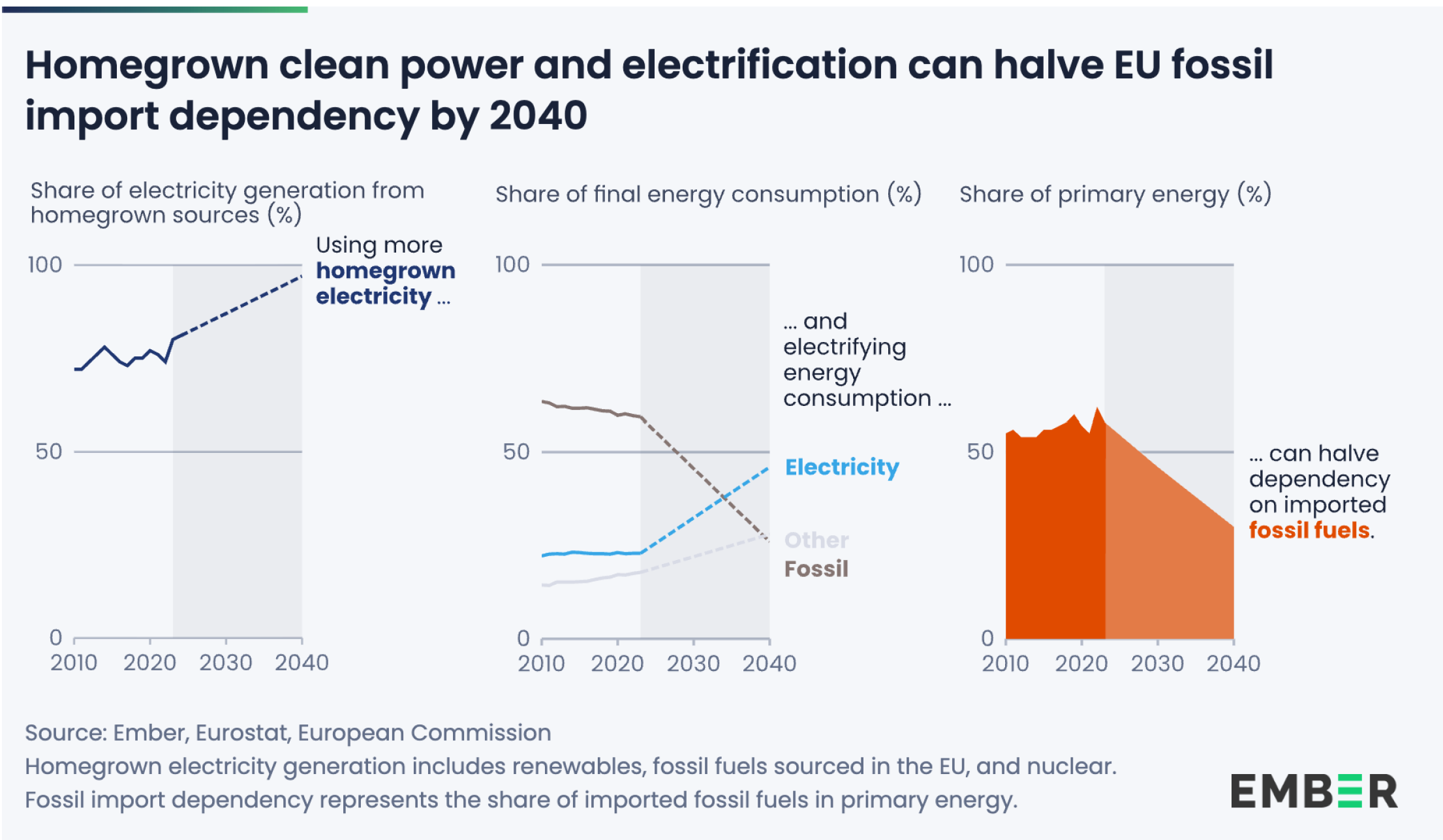
The power sector already shows progress: only 19% of EU electricity generation relies on imported fossil fuels, compared with 88% in transport. Electric vehicles and heat pumps are helping to displace oil and gas imports.
Denmark’s EV fleet, for instance, reduced oil use by 11% in 2024, while Dutch heat pumps offset 10% of residential gas demand.
Study author and Senior Energy Analyst for Ember, Dr Chris Rosslowe, commented:
“Imported fossil fuels are no basis for a secure and affordable energy system – something Europe has learned the hard way. Homegrown energy sources, such as wind and solar, take on more strategic value in a world faced by frequent crises.
“The full potential of Europe’s homegrown power supply is being wasted by a lack of urgency to electrify. Unblocking electrification is the game changing move that can shield the continent from over-reliance on volatile fossil fuel suppliers.”
Despite some gains, just over one-fifth of EU energy demand is currently electrified. The report finds that two-thirds of remaining energy use could be converted using mature technologies, particularly in road transport and heating.
Ember’s policy recommendations include reducing electricity taxes, maintaining the 2035 combustion engine ban, and prioritising grid expansion to accommodate higher electrification.
The report concludes that “unblocking electrification” is Europe’s most effective route to energy independence, cost stability and decarbonisation.
[Infographic credit: Ember]
by Emily Ashley | Oct 16, 2025 | Americas, Large Scale Utility Solar
The U.S. Bureau of Land Management (BLM) has cancelled the planned 6.2GW Esmeralda 7 solar project in Nevada, ending what would have been one of the country’s largest solar complexes.
The project was due to spread over roughly 118,000 acres of public land near Tonopah and consist of seven utility-scale facilities developed by NextEra Energy Resources, Leeward Renewable Energy, Arevia Power and Invenergy.
Each site would have included battery storage systems, although storage capacity and duration were not disclosed.
Its National Environmental Policy Act (NEPA) review had been stalled since President Trump took office, and the cancellation has now been made official on the BLM’s internal listing.
The cancellation aligns with a broader trend under the Trump administration of imposing stricter scrutiny on renewable projects, with the President himself posting “We will not approve wind or farmer destroying Solar” to his social media platform, Truth Social, in August.
Earlier in 2025, the Department of the Interior announced an “elevated review” for solar and wind projects on public lands.
Kabir Green of the Natural Resources Defence Council characterised the policy as creating “unfettered obstruction of wind and solar projects that create jobs, cut pollution, lower costs and strengthen communities.”
Additional federal actions have included heightened qualification criteria for tax credits, reclaiming $7bn in Solar for All grants, ending USDA’s REAP funding for solar, removing “preferential treatment” for renewables, and imposing tariffs on key energy components and materials.
Despite such headwinds, new solar capacity in the U.S. has continued to grow. In the first half of 2025, the country added 17.92GW of solar capacity, although the pace slowed in Q2 amid policy uncertainty.
by Emily Ashley | Oct 14, 2025 | Europe, Large Scale Utility Solar
A major new solar farm in Lincolnshire has been approved by the government, in a move expected to power hundreds of thousands of homes and support over a thousand jobs.
The Tillbridge Solar Farm, developed by an unnamed company, could create around 1,250 jobs and generate enough clean energy to supply hundreds of thousands of British households.
The project is part of the government’s wider plan to make the UK a “clean energy superpower.”
This marks the 17th nationally significant clean energy project approved since July 2024. Together, these developments are projected to generate enough electricity to power the equivalent of more than 7.5 million homes, contributing to national energy security and the transition to renewable power.
The government emphasised its focus on both rooftop and ground-mounted solar. It stated that families could save around £500 a year by installing rooftop panels, while communities hosting larger solar projects could benefit from new funding opportunities.
A consultation is currently underway to make such community benefits mandatory, allowing investment in local initiatives such as education programmes, sports facilities, or transport improvements.
Developers behind the Tillbridge project have pledged to ensure that local residents share in the benefits.
Energy Minister Michael Shanks said: “Families across Lincolnshire and the rest of the country have seen their energy bills go through the roof as a result of our exposure to volatile gas prices.
“Solar is one of the cheapest and quickest power sources we can build, it is crucial in our mission to make Britain a clean energy superpower – giving us energy security, good jobs and growth across the country.”
The government said the expansion of solar power will help protect consumers from the volatility of global gas markets, with gas prices still around 75% higher than before Russia’s invasion of Ukraine.
It argued that boosting homegrown renewable energy is the most effective way to shield households and businesses from future price shocks.
by Emily Ashley | Oct 10, 2025 | Africa, Commercial & Industrial Solar, Large Scale Utility Solar
Ignite Power has announced plans to acquire 100% of ENGIE Energy Access (EEA), forming Africa’s largest distributed renewable energy (DRE) provider.
The Abu Dhabi-based company will relaunch the combined entity as Ignite Energy Access, expanding operations to 14 countries and providing sustainable energy to more than 15 million people.
The acquisition, subject to regulatory and antitrust approvals, is expected to conclude in the coming months. Once finalised, it will mark Ignite’s fourth transaction in two years and more than double its operational footprint across Africa.
Yariv Cohen, CEO of Ignite Power, described the deal as “a transformative milestone for our company and Africa’s energy sector”.
He added: “ENGIE Energy Access has built an exceptional legacy of innovation, operational excellence, and commitment to sustainable impact. By integrating their strengths with our own proven model, we will be creating a full-spectrum energy access company that can scale to meet the continent’s immense energy needs.”
Cohen said the newly formed company aims to “connect millions of people to clean and reliable energy” while supporting economic growth and job creation. Ignite’s goal is to provide sustainable, affordable energy solutions to 100 million people by 2030.
The deal strengthens Ignite’s market position, increasing its total addressable market to more than 250 million people.
The company plans to leverage economies of scale, digital operations, and proprietary platforms for mobile payments, fleet management, and data analytics to enhance affordability and reliability.
Ignite recently secured $15m in funding from Afrigreen to expand its commercial and industrial solar projects.
With over 50MW of deployed capacity and a growing footprint, the combined company aims to serve both rural and urban communities across Africa, contributing to the continent’s ongoing energy transformation.
[Image credit: Ignite Power]
by Emily Ashley | Oct 9, 2025 | Europe, Large Scale Utility Solar
Solar & Storage Live returned to Birmingham this year as the UK’s largest showcase for clean energy innovation, bringing together pioneers driving the transition to a smarter, fairer grid.
Among them was Levelise, a company that has been reshaping how domestic energy assets participate in flexibility markets.
At the show, we spoke with Director Iván Castro, who explained how the company’s mission has evolved, the launch of its new Hub 2, and why empowering households remains central to the energy transition.
What is Levelise’s mission in the industry, and how has it evolved?
Iván: Levelise was founded in 2017, and we were the first in the market to tackle residential flexibility. At the time, no one believed it was feasible, but we proved to NESO (National Energy System Operator) that it could be done commercially.
We’ve been operating commercially since 2019, and our mission is to open these markets so consumers can access lower bills. Back then, customers weren’t getting a fair share – most of the market was dominated by gas peaking plants.
Now, many competitors use large-scale batteries, but we focus solely on domestic assets.
Most of our customers have solar panels with batteries, but we also integrate hot water tanks, heat pumps, and other assets. Our goal is to democratise the system – making it decentralised and fair – so the green transition delivers real payback and returns for consumers. Things need to align for the transition to succeed.
Following your recent launch, could you walk us through the main technical improvements in Hub 2 over the previous version?
Iván: When we launched the original hub in 2019, it was a proof of concept to show that flexibility could work at scale. We now have over 5,500 customers and have made more than 2 million direct payments – typically around £150 per customer each year. Importantly, we pay customers directly into their bank accounts.
The first-generation hub was industrial in design and required more effort from installers, especially during commissioning. The new Hub 2 is designed for the mass market and for scale.
Commissioning takes just 15–20 minutes, compared with around 90 minutes before. That means a regular electrician – not just a certified solar installer – can do it. It’s much more plug-and-play, aligning with how the industry has evolved.
We’ve made it easier for both installers and customers, which is crucial for scaling. The Hub 2 is smaller, manufactured in the UK near Gatwick, with customer service in Gloucester and Cardiff. Having a UK-made product that can scale is a big step forward.
How are you working with installers and battery manufacturers?
Iván: We work across all segments. Installers with large volumes can procure directly from us, and we also partner with OEMs.
For example, we source products directly so installers can buy bundles – like our Hub 2 with a 10kWh battery – for around £3,100, which is a strong value proposition.
We also work with distributors, so installers have multiple options. Manufacturers want their products integrated with our platform because it makes sales easier.
By reducing payback periods by around two years, our platform gives batteries a real competitive edge – customers can clearly see the difference.
Installers can buy directly through our website, go through wholesalers, or take advantage of manufacturer partnerships. We try to offer flexibility in how they access our products.
What incentives or policy changes would you like to see to accelerate the adoption of home battery and flexibility systems?
Iván: The market has already opened up compared to 2019, when we had to meet the same metering and regulatory requirements as large plants.
Things are improving, with more standardisation, and the market facilitator role is helping to make participation easier. NESO has also updated its systems to handle thousands of distributed assets, which wasn’t possible before.
Regulatory changes, such as the P483 reforms we contributed to, mean we don’t have to wait until 2028 for mandatory half-hourly settlement. That brings us much closer to opportunities in wholesale and balancing markets.
There’s still room for more standardisation, but overall, progress is moving in the right direction. The challenges now are often more technical than regulatory.
How important is Solar & Storage Live for Levelise in terms of product launches, partnerships, or visibility?
Iván: It’s the main UK event in this space, so it’s essential for building new connections and maintaining relationships with existing customers and partners. For us, it’s a must-attend event, and there’s no better place to launch a product and maximise visibility.
Missed out on Solar & Storage Live UK? Get your free ticket to Solar & Storage Live London – the capital’s most exciting solar event. Or, find a Solar & Storage Live event near you.
by Emily Ashley | Oct 9, 2025 | Commercial & Industrial Solar, Everything Installer, Large Scale Utility Solar
Women continue to make up 32% of full-time employees in the renewable energy sector, according to a new report by the International Renewable Energy Agency (IRENA).
While this figure is higher than in fossil fuel industries, it has not increased since IRENA’s first gender analysis in 2019 – signalling little progress towards gender equality.
The second edition of Renewable Energy: A Gender Perspective provides IRENA’s most comprehensive assessment of women’s participation in the renewables workforce and the barriers they face.
It warns that without greater equality, the global energy transition risks being neither fair nor sustainable, citing potential labour shortages and a lack of diverse perspectives.
Disparities in workplaces
The study reveals significant disparities between job types. Women hold 45% of administrative roles but just 28% of science, technology, engineering and mathematics (STEM) positions, and 22% of technical trades such as installation and electrical work.
Representation is lowest in senior leadership, where women account for only 19% of roles.
Private companies were found to have the lowest levels of female participation at 25%, compared with 48% in non-governmental organisations and 37% in government or non-commercial institutions. In off-grid and community-based projects, women account for 35% of employees.
Disparities in sectors
In a SolarPower Europe report for International Women’s Day 2023, the trade organisation cited IRENA’s 2019 report, which demonstrates that the solar industry employs proportionally more women than the traditional energy and fossil fuel sectors.
“Advancing gender equality in the renewable energy sector depends on robust data, targeted policy interventions and active collaboration of all stakeholders,” said IRENA Director-General Francesco La Camera in response to the new report.
“Unfortunately, despite performing better than in fossil fuel industries, little progress has been made. The sector still has a lot of work to do. To realise the energy transition’s full potential, women must be recognised as equal partners and leaders in shaping the renewables-based future.”
Solving a systemic problem
The report attributes the lack of balance to systemic barriers at every stage of professional development. It cites cultural stereotypes, bias in recruitment, difficulties balancing work and caregiving, and limited advancement opportunities as key obstacles.
It also explains that women are often the primary users and managers of household energy systems, which means that they unfairly take on the “greatest burden” of energy poverty in developing countries.
IRENA calls for both top-down and bottom-up action to address the issue. It recommends that governments enforce equal pay and anti-discrimination laws, while employers introduce flexible working, transparent promotion systems and mentorship opportunities.
The agency adds that education providers and civil society groups also have a role in dismantling stereotypes and holding institutions accountable.
The full report can be found here.
by Emily Ashley | Oct 9, 2025 | Commercial & Industrial Solar, Europe, Large Scale Utility Solar
The European Commission has referred Sweden to the Court of Justice of the European Union (CJEU) for failing to transpose new EU rules designed to speed up renewable energy permitting.
The move follows “repeated warnings” from Brussels after Sweden missed the 1 July 2024 deadline to incorporate the provisions of Directive (EU) 2023/2413 into national law.
The Directive, which amends the existing Renewable Energy Directive (EU) 2018/2001, aims to simplify and shorten approval processes for renewable projects and related grid infrastructure.
According to the Commission, Sweden “has not yet notified any transposition measures” despite a letter of formal notice in September 2024 and a reasoned opinion issued in February 2025.
The Commission said that, as a result, it is referring the case to the CJEU “with a request to impose financial sanctions” under Article 260(3) of the Treaty on the Functioning of the EU.
Accelerating the transition
The new rules are intended to introduce clearer time limits for permit-granting procedures, strengthen the role of single contact points for developers, and establish the presumption that renewable energy projects are of “overriding public interest.”
According to the Commission, these reforms are “essential to accelerate Europe’s transition to carbon neutrality, strengthen energy security and reduce energy costs.”
The legal case comes as EU institutions move to strengthen renewable deployment frameworks.
In March 2024, the European Parliament adopted the EU Solar Standard, a measure within the revised Energy Performance of Buildings Directive requiring the phased rollout of rooftop solar installations from 2026.
At the time, SolarPower Europe described the measure as “a huge milestone to accelerate renewable deployment,” stating that the EU Solar Standard “puts the power in citizens’ hands” by making solar installations a standard feature of Europe’s buildings.
Missing the deadline
Directive (EU) 2023/2413 entered into force in November 2023, giving Member States eight months to align national legislation with the updated requirements.
While infringement procedures have been opened against all 27 Member States for incomplete transposition, Sweden is the first to be taken to court over the issue.
The referral forms part of the Commission’s October 2025 infringement package, which includes three energy-related cases referred to the CJEU.
Alongside Sweden, the Commission also pursued action against Malta and Slovakia through reasoned opinions for failing to fully implement the same Directive.
The Commission said the measures are necessary to ensure that EU law is “properly applied for the benefit of citizens and businesses” and to maintain momentum in the bloc’s clean energy transition.
More information about the European Commission’s infringement package can be found here.
by Emily Ashley | Oct 8, 2025 | Large Scale Utility Solar
Solar and wind power met all of the world’s electricity demand growth in the first half of 2025, contributing to a small decline in fossil fuel generation, according to new analysis from Ember.
The data show that renewables are reshaping the global power mix, overtaking coal generation for the first time on record.
Global electricity demand rose by 2.6% – equivalent to 369 TWh – in the first six months of 2025 compared with the same period in 2024. Solar power accounted for 83% of this growth, generating an additional 306 TWh, a 31% year-on-year increase.
“We are seeing the first signs of a crucial turning point,” said Małgorzata Wiatros-Motyka, Senior Electricity Analyst at Ember. “Solar and wind are now growing fast enough to meet the world’s growing appetite for electricity. This marks the beginning of a shift where clean power is keeping pace with demand growth.”
Fossil fuel generation fell slightly, with coal declining by 0.6% and gas by 0.2%, resulting in a total drop of 0.3% (27 TWh). This modest decrease led to a 0.2% reduction in global power sector emissions. Renewables generated 5,072 TWh of electricity during the period, surpassing coal’s 4,896 TWh.
China and India both recorded declines in fossil generation as renewable capacity expanded. China’s fossil generation fell by 2% (58.7 TWh) as the country added more solar and wind power than the rest of the world combined.
India’s fossil generation also decreased, with coal down 3.1% (22 TWh) and gas down 34% (7.1 TWh), as clean energy growth outpaced relatively low demand.
In contrast, fossil generation rose in the US and the EU. Higher demand in the US and weaker wind and hydro output in the EU led to increased coal and gas use.
“This analysis confirms what we are witnessing on the ground: solar and wind are no longer marginal technologies – they are driving the global power system forward,” said Sonia Dunlop, CEO of the Global Solar Council.
“The fact that renewables have overtaken coal for the first time marks a historic shift. But to lock in this progress, governments and industry must accelerate investment in solar, wind, and battery storage.”
by Emily Ashley | Oct 7, 2025 | Americas, Commercial & Industrial Solar, Everything Installer, Large Scale Utility Solar
A coalition of labour unions, nonprofits and solar companies has filed suit challenging the Trump administration’s decision to rescind $7bn in grants awarded under the Solar for All programme.
The complaint, lodged in federal court in Rhode Island, argues that the U.S. Environmental Protection Agency (EPA) and its administrator, Lee Zeldin, unlawfully revoked grants that had already been awarded to states, tribes and nonprofits.
Zeldin announced in July that this would be part of the Trump administration’s “One Big Beautiful Bill” spending cuts, which seek to end many Biden-era renewable initiatives to “level the playing field” for fossil fuels.
The plaintiffs include the Rhode Island AFL-CIO, the Rhode Island Centre for Justice, Solar United Neighbours, and several solar installers and community organisations.
Serving households
Having been part of the previous President Joe Biden’s $27bn “green bank” (the Greenhouse Gas Reduction Fund), the Solar for All programme was established during the passing of a climate law in 2022.
According to the lawsuit, it was designed to serve over 900,000 households in lower-income communities.
Additionally, it was projected to save recipients about $400 annually on electricity bills while reducing or avoiding more than 30m metric tonnes of carbon dioxide equivalent in greenhouse gas emissions.
The Conservation Law Foundation (CLF) briefly notes that across the country, Solar for All “is expected to save an estimated $350m annually on energy bills and generate 200,000 new jobs.”
“This program would provide families with low incomes access to clean, affordable solar power: energy that lowers bills, improves air quality, and keeps people safer during extreme heat,” Kate Sinding Daly, Senior Vice President for Law and Policy for the CLF, commented in a statement.
“Stripping those benefits away is unlawful and betrays communities.”
In response, the EPA has declined to comment on pending litigation.
Rescinding the programme
In a previous social media statement from July, Zeldin had defended the cancellation by asserting that “the bottom line is this: EPA no longer has the statutory authority to administer the program or the appropriated funds to keep this boondoggle alive.”
Plaintiffs contend that stripping away the grants would deprive communities of access to clean energy, worsen energy insecurity, and stall job growth in the renewable energy sector.
“The Trump administration’s rollback of the Solar for All program is a shameless attempt to prop up fossil fuel companies at the expense of families,” Daly added.
The lawsuit seeks a judicial order to reinstate Solar for All and restore its funding; it can be read here.
by Emily Ashley | Oct 6, 2025 | Commercial & Industrial Solar, Europe, Everything Installer, Large Scale Utility Solar, Storage
Press Release
Terrapinn are delighted to announce the latest addition to their global portfolio, Solar & Storage Live Italia, to be held at the Veronafiere during 8 – 9 October 2025.
Doors open on Wednesday 8th October, with 3,000 solar professionals expected to attend and headlined by a keynote address from Damiano Tommasi, Mayor of Verona.
Solar & Storage Live Italia is set to be Italy’s most exciting dedicated solar & storage trade exhibition, taking place for the first time in Verona, Italy. The event is organised by Terrapinn, with the support and cooperation of Veronafiere and Comune di Verona. It is supported at the highest level by sponsors Contact Italia, Failte Solar and Sunman, as well as renewable energy associations including ANIE Federazione, Kyoto Club, Legacoop, Elettricità Futura and the Global Solar Council.
The launch edition will bring together global and Italian suppliers Forniture Fotovoltaiche, ESPE, WiseGlow, Amara NZero, Chint PVSTAR, Huawei, Energy3000, Shanghai Elecnova Energy Storage Co., SolaX Power, who are among 100 exhibitors and innovative startups showcasing the latest solar and energy storage solutions.
With 3,000 attendees expected from across Italy, and high attendance from Verona and the Veneto region, it provides a one-stop destination for everything needed to deliver Italy’s commercial, industrial and residential solar and energy storage projects.
The event is free to attend and is a must-attend for installers, property owners, developers, landowners, and professionals working in the solar and energy sector who have registered on the website here.
The dynamic event format will provide Italy’s solar community with the opportunity to gather together to find suppliers and partners, and discover first-hand the tools, technologies and insights to grow their business, increase revenues and achieve energy independence.
Sean Willis, Managing Director, Terrapinn UK, comments:
“We’re thrilled to bring our successful Solar & Storage Live event formula to Italy and to launch another renewable energy exhibition that celebrates the technologies at the forefront of industry.
We’re excited to be opening our doors on 8th October, after a year in the planning, working with Veronafiere and our stakeholders, to realise this show. The co-location of events with McTER Expo provides an exciting new meeting place for the renewable energy sector. We are very pleased with the response and level of local support for the show.”
Event highlights
Exhibition: The event will convene key players from across the energy value chain, alongside pioneers and disruptors, to present the technology and service solutions essential for driving change in solar and storage. Headlining the event will be Platinum Sponsor Contact Italia, Gold Sponsors Sunman and Failte Solar, and Storage Theatre Sponsor Huawei.
Programme: The trade fair features four theatres and a comprehensive agenda covering a range of topic,s including large-scale utility solar, commercial and industrial solar, storage and batteries, and residential-scale solar installation.
Other features on the show floor: The Start-up Zone will feature 50 cutting-edge energy sector innovators and experts who can help deliver solar projects and make them a reality.
View more event highlights here.
Agenda highlights
The programme will commence from 10:00, Wednesday 8th October, with a keynote address from Damiano Tommasi, Mayor of Verona.
Over 150 speakers will participate in the extensive agenda across four stages, and you can expect to hear from representatives from some of the biggest and most innovative energy organisations based in Italy and globally. The programme is free to all event attendees registered for the event here
Leaders from the solar & storage industry will share their insights, case studies and expertise on critical subjects impacting the region, such as:
- Powering tomorrow: solar PV in 2025 and beyond, from solar parks to agrivoltaics and floating photovoltaics
- The role of energy storage in combination with other alternative renewable power sources
- Strategies and challenges in solar energy integration
- Financing projects and securing investment in the Italian battery market
- Raising public support for solar
View the full agenda here and speaker line-up here
Co-located with mcTER Expo
Solar & Storage Live Italia is co-located with mcTER EXPO – one location and two unmissable events for the renewable energy industry.
Opening times:
Wednesday 8 October: 09:30 – 17:00
Thursday 9 October 2025: 09:30– 17:00
Find out more about Solar & Storage Live Italia on our website here.
Want to publish a press release? Submit your content here for review by our editorial team.
by Emily Ashley | Oct 3, 2025 | Americas, Large Scale Utility Solar, Storage
The Trump administration has announced the cancellation of $7.6bn in grants for clean energy projects across 16 states.
The funding supported more than 200 initiatives, including battery plants, solar farms, hydrogen projects, electric grid upgrades, and carbon capture efforts.
The decision was disclosed on Wednesday in a post by White House budget director Russell Vought, who said: “Nearly $8 billion in Green New Scam funding to fuel the Left’s climate agenda is being cancelled.”
The move comes amid an ongoing standoff between President Donald Trump and congressional Democrats over the federal government shutdown.
Cancelled projects
According to the Department of Energy (DOE), 223 projects were cancelled following a review that concluded they did not sufficiently advance US energy needs or were not financially sustainable.
The department stated the grants came from the Office of Clean Energy Demonstrations, the Office of Energy Efficiency and Renewable Energy, and other divisions.
One of the most significant cancellations involves $1.2bn allocated to California’s planned hydrogen hub. Governor Gavin Newsom’s office said the hub had attracted $10bn in private investment and warned that cutting the project could endanger over 200,000 jobs.
“Clean hydrogen deserves to be part of California’s energy future – creating hundreds of thousands of new jobs and saving billions in health costs,” Newsom said.
Senator Alex Padilla of California called the cancellation “vindictive, shortsighted and proof this administration is not serious about American energy dominance.”
Environmental groups expressed concern over the cuts. Jackie Wong, senior vice president at the Natural Resources Defence Council, said: “This is yet another blow by the Trump administration against innovative technology, jobs and the clean energy needed to meet skyrocketing demand.”
The states affected include California, Colorado, Connecticut, Delaware, Hawaii, Illinois, Maryland, Massachusetts, Minnesota, New Hampshire, New Jersey, New Mexico, New York, Oregon, Vermont and Washington.
Previous blows to solar
The news comes over a month since the administration’s August announcement that eligibility rules for clean energy tax credits were being tightened, threatening the country’s upcoming renewable projects. Solar, in particular, was highlighted.
August also saw the cancellation of the $7bn Solar For All programme, which was set to provide easier access to solar power for over 900,000 low-income households.
These targeted blows to the solar – and wider renewable energy – sector are part of a policy shift heralded by the signing of Executive Order 14315, Ending Market Distorting Subsidies for Unreliable, Foreign-Controlled Energy Sources, and the implementation of the One Big Beautiful Bill Act.
The motivation behind this shift is to re-prioritise fossil fuels, according to the US Department of the Interior.