by Catie Owen | Jan 9, 2026 | Commercial & Industrial Solar, Europe, Large Scale Utility Solar, Market Reports, Storage
The UK solar market is accelerating rapidly, with capacity reaching 19.1GW in 2025 and over 1.8m installations nationwide.
 Supported by the launch of Great British Energy (GBE) and a £200m investment in clean energy, the sector is central to Britain’s mission to become a renewable energy superpower.
To navigate this evolving landscape, Solar&StorageXtra presents The UK Solar Market Report 2026, produced by Solar & Storage Live ahead of another busy year of solar and storage shows.
This essential guide offers deep-dive insights into the UK’s 6.8GW battery storage market, forecasts for utility-scale deployment, and the latest trends in commercial and residential solar.
Stay ahead of the UK’s clean energy transition.
Get your free copy of the UK Solar Market Report 2026.
Download the Report
We’re kicking off the year with Solar & Storage Live in London, so don’t miss out on your free ticket to the UK’s largest solar and storage show. Or, find a Solar & Storage Live event near you.
by Catie Owen | Sep 22, 2025 | Europe, Market Reports, Storage
Discover the future of UK battery storage with the UK Battery Energy Storage Market Report 2025.
This essential guide charts the sector’s growth from early hurdles to over 440GWh of pipeline capacity and 22,000 new household systems installed last year.
It highlights market leaders, policy reforms, investment trends, and revenue opportunities across residential, commercial, and utility projects.
With analysis of planning, grid, and adoption challenges, plus forecasts on how storage underpins the UK’s net-zero ambitions, the report delivers actionable insight for investors, developers, policymakers, and suppliers.
Stay ahead in a rapidly maturing market – download the report and power your strategy today.
Download the Report
Don’t miss out on your free ticket to Solar & Storage Live London – the capital’s most exciting solar event. Or, find a Solar & Storage Live event near you.
by Catie Owen | Sep 22, 2025 | Market Reports, Middle East
The Middle East is undergoing a rapid shift toward clean energy, with solar, storage, and green hydrogen reshaping power systems across the Gulf and Levant.
This report offers a clear overview of regional trends, from record-breaking solar parks to emerging hydrogen hubs and battery pilots. It covers detailed country profiles – covering the UAE, Saudi Arabia, Oman, Qatar, Jordan, Kuwait, Iraq, Bahrain, and Syria – outlining policies, capacities, flagship projects, and investment drivers.
It also explores corporate PPAs, localisation mandates, and smart-grid initiatives. Designed for developers, policymakers, and investors, this guide maps opportunities and challenges in one of the world’s fastest-growing renewable markets.
Download the report to unlock one of the world’s largest renewable markets.
Download the Report
Solar & Storage Live Middle East 2025 is taking place 9-10 June 2026 in Dubai. Don’t miss your chance to secure a ticket. Or find a Solar & Storage Live event near you.
by Catie Owen | Sep 22, 2025 | Market Reports, Middle East
This report explores Saudi Arabia’s fast-evolving solar and storage market, charting its role in achieving Vision 2030 renewable targets. Inside, readers will find a clear market overview, including capacity goals, investment trends, and policy drivers shaping solar adoption.
It profiles flagship projects such as Sudair, Sakaka, and Rabigh, alongside initiatives encouraging residential uptake. Dedicated sections examine battery energy storage growth, advanced PV and CSP technologies, and opportunities in hybrid systems.
The report also highlights wind developments and localisation efforts – manufacturing, workforce training, and supply-chain integration – helping position the Kingdom as a regional clean-energy hub.
Download the report and tap into the power of Saudi Arabia’s clean-energy revolution.
Download the Report
Join us at Solar & Storage Live Saudi Arabia in Riyadh, taking place 12-14 October 2025. Secure your ticket here, or find a Solar & Storage Live event near you.
by Catie Owen | Sep 22, 2025 | Africa, Market Reports
Unlock the full potential of Egypt’s fast-growing solar and storage sector with our comprehensive Egypt Market Report.
Inside, you’ll find in-depth insights on national clean energy targets, major projects like Benban, Kom Ombo, and Scatec, the evolving regulatory and investment landscape, and the rise of storage as a strategic priority.
The report also highlights key market drivers, a robust project pipeline, and a snapshot of opportunities across North Africa.
Download the report and discover what’s powering Egypt’s solar-storage boom.
Download the Report
Visit Solar & Storage Live Egypt in New Cairo, 6-7 April 2026. Get your ticket here, or find a Solar & Storage Live event near you.
by Catie Owen | Sep 22, 2025 | Africa, Market Reports
This exclusive market report explores the solar and battery storage landscape across Cape Town, offering a strategic overview of investment potential, emerging technologies, and evolving policy frameworks.
Discover how local and national initiatives, including supportive tariffs and sustainability targets, are accelerating solar adoption.
With over USD 550 – 760m in projected market value and a surge in commercial, industrial, and residential installations, the opportunity has never been greater.
From rooftop solar to battery backup systems and EV charging infrastructure, this report outlines key trends, sector growth, and where the biggest returns are expected in the years ahead.
Download the full report to stay ahead of one of South Africa’s fastest-growing clean energy markets.
Download the Report
Solar & Storage Live Cape Town 2025 is happening 15-16 October, but it’s not too late to get your ticket. Find out more here, or find a Solar & Storage Live event near you.
by Catie Owen | Jul 9, 2025 | Europe, Market Reports
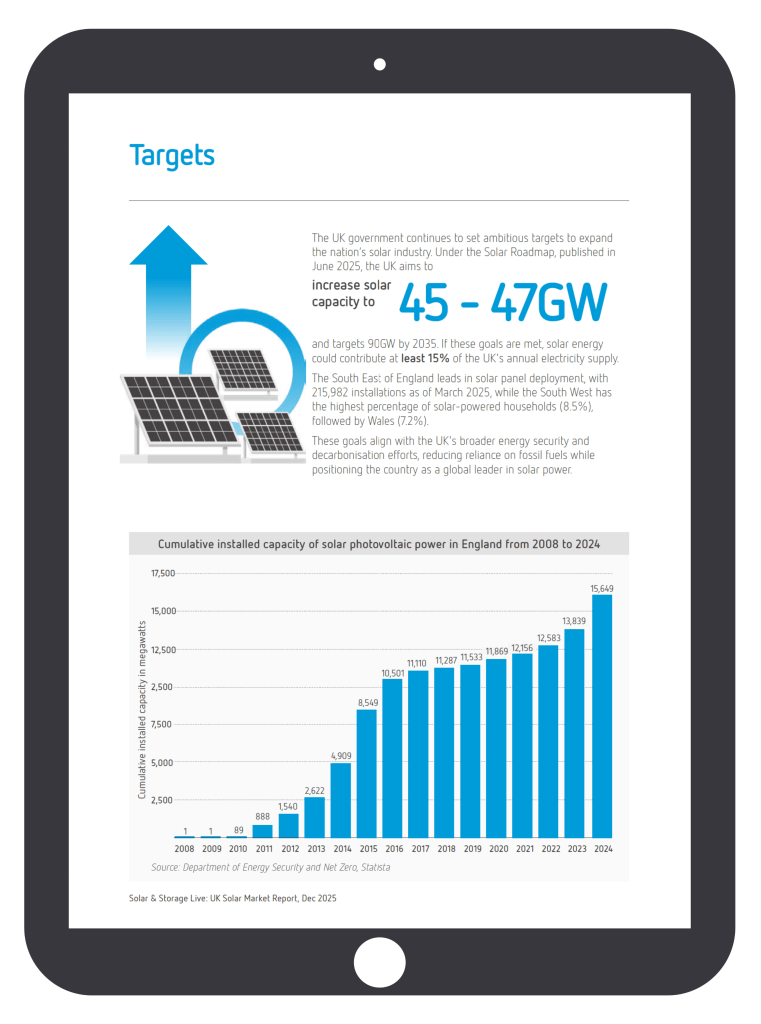
The UK solar industry is entering a transformative era, with installed capacity soaring past 17.2 GW and over 1.4m homes now equipped with solar panels.
The Solar & Storage Live UK 2025 Market Report reveals a sector driven by plummeting costs, strong public support, and ambitious government targets – including plans to triple capacity to 45-47 GW by 2030.
As battery storage scales up and smart grid technologies mature, solar power is set to play a central role in the UK’s energy transition, despite challenges like grid constraints and weather variability.
This report highlights the momentum, innovations, and policies shaping one of the fastest-growing segments in the UK’s clean energy landscape.
Download the full report to stay ahead in this rapidly evolving market.
Download the Report
Solar & Storage Live in Birmingham is on the horizon, so don’t miss out on your free ticket to the UK’s largest solar and storage show. Or, find a Solar & Storage Live event near you.
by Catie Owen | Feb 26, 2025 | Market Reports
Switzerland’s solar energy sector has experienced exponential growth, with capacity leaping from 0.1 GW in 2010 to 6.8 GW in 2024.
This report unpacks the government policies, technological advancements, and market dynamics driving this success, while also addressing the challenges that lie ahead.
Discover how Switzerland plans to meet its ambitious Energy Strategy 2050 targets, with solar poised to supply 50% of electricity by mid-century.
Download the full report to stay ahead in this rapidly evolving market.
Download the Report
Don’t miss out on Solar & Storage Live Zürich, taking place 16-17 September. Haven’t registered yet? Get your free ticket by securing your place here.
by Catie Owen | Feb 18, 2025 | Market Reports
Spain’s solar energy sector has surged to 22.45 GW of capacity by early 2023, with ground-mounted solar farms driving 77% of new installations.
This report delves into the policies, technological advances, and market forces shaping Spain’s rise as Europe’s second-largest solar market. It also highlights the challenges ahead, from grid integration to price stability.
Explore how Spain plans to surpass 120 GW of solar capacity by 2030, reinforcing its position as a global renewable energy leader.
Download the full report to stay ahead in this rapidly evolving market.
Download the Report
With Spain’s solar market remaining a crucial topic, don’t miss your free ticket for Solar & Storage Live España 25-26 June 2025.
by Catie Owen | Feb 11, 2025 | Market Reports
France is emerging as a European solar powerhouse, with capacity surging to 17.1 GW in 2022 and a goal of 100 GW by 2050.
This report explores the country’s innovative policies, groundbreaking technologies like floating solar farms, and the key players propelling the industry forward.
Learn about France’s ambitious roadmap to cut emissions and reduce reliance on imports while becoming a leader in renewable energy.
Get the full insights by downloading the report.
Download the Report
Are you involved in France’s solar market, or looking to get a foothold? Explore the benefits of attending Solar & Storage Live Paris – taking place 5-6 November 2025.
by Catie Owen | Feb 4, 2025 | Market Reports
Italy’s solar market has grown from 4,000 MW in 2005 to over 26 GW in 2023, driven by strong policies and cutting-edge technologies like bifacial panels and agrivoltaics.
With ambitious goals of 52 GW by 2030 and 74.6% renewable electricity by 2050, the report examines Italy’s plans to lead Europe’s energy transition.
It also addresses challenges like regulatory delays and grid expansion needs, offering insights into the country’s strategy for sustainable growth.
Download the report to explore Italy’s renewable energy roadmap.
Download this Report
Get involved in the Italian solar market by attending the debut edition of Solar & Storage Italia – taking place 8-9 October.
by Catie Owen | Jan 23, 2025 | Large Scale Utility Solar, Market Reports
The latest European Electricity Review report from energy think tank Ember has shown that 47% of the European Union’s energy comes from renewable sources, with solar taking the lead over coal in the energy mix for the first time.
According to Ember’s report, solar energy contributed 11% to the EU’s energy mix in 2024, which both improved on 2023’s figure of 9.3% and overtook coal’s share.
Coal fell to under 10% of the EU’s energy mix – a first since the think tank began sharing the electricity mix figures in 2011.
Additionally, Gas-fired power production’s share fell to 15.7% from its 2023 figure of 16.9%. This marks the second year wherein renewable energy sources, including solar, generated more power than gas.
The EU has been making efforts to reduce its reliance on coal and increase its use of renewable energy sources. In doing so, the Union hopes to reduce emissions, improve energy security, and meet international climate goals.
Chris Rosslowe, Senior Analyst and lead author of the report, notes: “For the past two years we have seen sharp declines in both coal and gas in the EU power system and fossil fuels are now at a historic low.
“Fossil fuels are losing their grip on EU energy.”
However, Rosslowe additionally addressed the reasons behind wind’s stagnated figure of 17.4% in 2024 – below the EU’s goal of wind contributing a 34% share by 2030.
He says: “The new capacity added this year was slightly offset by the worse wind conditions.”
Overall, nuclear power production maintained its dominance, increasing marginally to a 23.7% share.
by Catie Owen | Dec 17, 2024 | Large Scale Utility Solar, Market Reports
In SolarPower Europe’s annual EU Market Outlook report, the organisation found that the EU’s solar sector has hit its first 2020s deployment slowdown – after four years of impressive growth.
The sector has dropped from 53% growth in 2023 to 4% in 2024, demonstrating a 92% solar deployment slowdown.
The report additionally shows that 65.5 GW of solar was installed in 2024 thus far, which narrowly beats 2023’s 62.8 GW record. Overall, the EU now boasts 338 GW of solar – which is four times as much as 82 GW ten years ago,
European policymakers and system operators can consider this year’s report a yellow card. Slowing solar deployment means slowing the continent’s goals on energy security, competitiveness and climate,” warns Walburga Hemetsberger, CEO at SolarPower Europe.
“Europe needs to be installing around 70 GW annually to hit its 2030 targets – we need to consider corrective action now, before it’s too late.”
In the report’s release announcement, SolarPower Europe notes that the slowdown has occurred in spite of a decline in prices for both solar components and upfront installation costs.
Dries Acke, Deputy CEO at SolarPower Europe notes: “Low-cost solar is the best option for bringing Europe into a new era of competitiveness. We need to complete our detachment from Russian gas and avoid LNG dependence.”
Europe’s industries need clean and affordable electricity to stay competitive, and Europe’s renewable sector needs more flexible electricity demand to reinforce its business case.
We call on the new European Commission to leverage this mutually reinforcing opportunity and build the Clean Industrial Deal around renewables, flexibility and electrification.”
Quick facts:
EU annual investments in solar dropped for the first time in four years in 2024.
SolarPower Europe’s report shows a fall in investment from €63 bn in 2023 to €55 bn in 2024.
Ground-mounted utility solar projects saw a 28% decline in cost in 2024.
Europe’s rate of electrification has remained at 23% from 2019 -2024.
- Most of the energy system is still dependent on fossil fuels.
The Electrification Alliance has called for 35% electrification by 2023.
- In turn, SolarPower Europe has called for “system flexibility” to catch up to this target.
Projections
Households are less likely to invest in rooftop solar while energy prices are stable.
- Solar and heat pumps saved households 84% on bills during the energy crisis’ most critical times.
- This could lead to large installations taking a more prominent role in the EU’s total solar from 2025 – 2030.
Total rooftop installed capacity will remain 47% larger than utility scale by 2028.
Despite rooftop’s large market share, prospects for growth are expected to stagnate.
Under the Medium scenario, National Energy and Climate Plans (NECP) and REPowerEU targets are expected to be narrowly met.
- This is despite a lower outlook of 8%.
REPowerEU’s target of 750 GW will not be met in the report’s Low scenario for 2030 – achieving only 650 GW.
- This is the first time the Low scenario has shown this.
The report projects that the solar sector may install only 82 GW per annum by 2028.
by Catie Owen | Dec 3, 2024 | Large Scale Utility Solar, Market Reports
Solar Energy UK’s recent analysis has demonstrated a discrepancy between official projections of the UK’s solar sector, and the “real potential”.
In reviewing current market data and surveying over 400 solar industry members, the trade body found that the National Energy Systems Operator’s (NESO) target of 47.4GW by 2030 underestimates the sector’s current momentum.
In its newly released detailed briefing, Solar Energy UK counters NESO with a “more ambitious but achievable target” of 50-60GW by 2030.
To draw this conclusion, Solar Energy UK has used Durham Energy Institute’s modelling – which shows that reaching this revised target could reduce energy costs by 12% and cut reliance on high-carbon generation.
To further its point, Solar Energy UK also stresses that the UK currently stands at 20GW of installed solar, with 3GW under construction and 11GW of consented projects “in the pipeline”.
The trade body concludes that the UK achieved a consistent 1GW annual deployment rate through 2023-2024 – only considering rooftop solar.
Considering the UK government’s “rooftop revolution”, Solar Energy UK has raised its concerns about arbitrarily capping viable projects via region should the sector continue to adhere to outdated predictions.
Additionally, Solar Energy UK highlights that NECO’s target fails to account for various government initiatives which will impact solar generation for rooftops and businesses, such as the Warm Homes Fund, GB Energy, the Local Power Plan, the Future Homes Standard, Future Buildings Standard and retrofitting public buildings.
Taking initiative
“Solar and batteries can be built very quickly, and in the next five years offer the Government a huge opportunity to speed up its mission to deliver clean power,” says Solar Energy UK Chief Executive, Chris Hewett.
“Setting a goal to treble solar to 60GW, rather than a de facto cap implied by the NESO advice, will deliver the lowest cost home-grown energy and thousands of secure jobs,” said Solar Energy UK Chief Executive Chris Hewett.
Announcing the briefing on LinkedIn, Solar Energy UK concludes:
“As we close out 2024, we’re calling for a fundamental reassessment of how we plan for Solar’s growth. The technology is proven, the costs continue to fall, and public support is strong. Let’s ensure our planning frameworks match this reality.”
The full briefing and further details can be found here.
by Catie Owen | Nov 29, 2024 | Market Reports
According to the Department for Energy Security and Net Zero (DESNZ), the UK’s total installed solar capacity has surpassed 17GW, reaching 17.2GW as of October 2024.
This marks a 1GW, or 6.3%, increase compared to October 2023.
In October alone, 76MW of new capacity was added through 20,102 installations, with 73% of these on residential properties, contributing 58MW.
While domestic installations dominate the number of new projects, they account for only about 30% of the UK’s total solar capacity, equivalent to 5.2GW.
Ground-mounted and standalone systems make up the majority of the UK’s solar generation.
By the end of September 2023, at least 45% of the total capacity (7.71GW) was attributed to these installations, including two solar PV plants accredited under the Contracts for Difference (CfD) scheme.
DESNZ estimates that unaccredited ground-mounted projects bring the total share of ground-mounted capacity to around 55%.
In 2023, the UK saw 196,760 new solar installations, the second-highest annual total, surpassed only by 2011’s record of 208,586.
So far in 2024, 155,256 installations have been completed. To exceed last year’s total, 41,504 additional projects would need to be installed by the end of December—a challenging but not impossible target.
This growth highlights the ongoing expansion of solar energy in the UK, with both residential and large-scale installations contributing to the nation’s renewable energy goals.
by Catie Owen | Nov 26, 2024 | Large Scale Utility Solar, Market Reports
The American Clean Power Association (ACP) has released its inaugural Solar Market Monitor report, forecasting over 32GW of solar installations in the US for 2024.
If accurate, Solar Market Monitor predicts a record-breaking milestone for the industry.
Produced in collaboration with S&P Global Commodity Insights, Solar Market Monitor provides a comprehensive analysis of the domestic utility-scale solar sector.
It examines market trends, capacity growth, project economics, technological advancements, policy developments, and power market outlooks.
ACP’s Senior Vice President of Policy and Market Analysis, John Hensley, comments:
“The launch of the Solar Market Monitor represents the leading role ACP plays in providing unique insights and analysis for an ever-evolving solar industry, its growth, and policy and market challenges in the road ahead.
“This inaugural report highlights how solar has solidified itself as a clean and cost-competitive energy resource for the US.”
The report predicts a Compound Annual Growth Rate (CAGR) of 6.6% for the US solar market from 2025 to 2030, with annual installations reaching 37GW by the decade’s end.
Additionally, solar capital costs are expected to drop by 14% by 2035 largely due to decreasing module prices. Total installations are forecast to grow by 16% by 2030.
S&P Global Commodity Insights played a large role in developing the report, leveraging its data capabilities and recently launched daily solar module price assessments.
Eduard Sala, Executive Director of S&P’s Climate and Sustainability Group, adds: “This relationship brings together S&P Global Commodity Insights’ research and consulting teams to provide valuable integrated data and insights on the supply chain, technology, and demand.”
by Catie Owen | Nov 25, 2024 | Innovation, Market Reports
Research by the U.S. Department of Energy’s National Renewable Energy Laboratory (NREL) has explored interactions between solar energy production, habitat, pollinators, and soil at three utility-scale solar sites in Minnesota.
These studies represent the most comprehensive long-term assessment of such interactions to date and indicate positive results.
Research
The research, conducted by NREL’s Innovative Solar Practices Integrated with Rural Economies and Ecosystems (InSPIRE) team over six years, is detailed in three studies:
- Environmental Co-Benefits of Maintaining Native Vegetation with Solar Photovoltaic Infrastructure (Earth’s Future),
- If You Build It, Will They Come? Insect Community Responses to Habitat Establishment at Solar Energy Facilities (Environmental Research Letters)
- Little Prairie Under the Panel (Environmental Research Communications)
These studies focus on the Chisago, Atwater, and Eastwood solar sites, which are part of Enel Green Power’s Aurora solar project.
The findings indicate that prairie restoration is viable beneath solar panels. Once established, these habitats were utilised by pollinators as much as dedicated conservation areas, enhancing vegetation and pollinator diversity.
However, the full development of prairie vegetation took three to six years with some species appearing later.
Planting native vegetation mitigates environmental damage caused during solar installation and protects soil from erosion. Soil restoration after intensive agriculture takes time, and the long-term impact remains uncertain.
Solar generation
Notably, the researchers found minimal impact on annual electricity generation, as cooling effects from native vegetation did not enhance solar panel efficiency.
NREL showed variability across landscapes and climates, suggesting that site-specific factors influence outcomes. “One of the most important results from this research is that we need to study more sites,” said agrivoltaics researcher Chong Seok Choi.
The studies, funded by the U.S. Department of Energy Solar Energy Technologies Office, involved NREL, Argonne National Laboratory, the University of Minnesota, Temple University, and Minnesota Native Landscapes (MNL).
by Catie Owen | Nov 5, 2024 | Market Reports
Reuters has reported that natural gas-fired electricity generation and emissions in Europe reached multi-year lows between January – September 2024 but are expected to rise as winter begins.
Data from think tank Ember shows that, during this period, coal and gas power generation in Europe was 1,236 TWh, marking a 7.5% decrease from the previous year and contributing to a 7% drop in power sector emissions.
This reached 928m metric tons of CO₂, which Reuters noted was the lowest “in at least a decade.”
In the winter
Reduced solar output in winter and rising heating demands will likely drive a rebound in gas-fired electricity generation.
The data from Ember indicates that Europe’s solar output typically drops by over 50% during winter months, from an average of 44 TWh in the summer to under 20 TWh in colder months.
This decline, alongside a seasonal rise in electricity use, pressures power producers to increase gas and coal generation to meet demand.
Last year, electricity consumption in the final quarter was about 14% higher than in the summer, a trend expected to continue in 2024.
If winter temperatures follow typical patterns, heating demand will grow, especially in places like Germany, where average temperatures from October to December are about 5.6°C compared to 17°C in summer.
This shift could push Germany’s gas-fired power generation up 25% in December, equating to around 100 TWh across Europe and potentially yielding 55m tons of CO₂, marking the highest emissions level since January.
These increases would reverse 2024’s emissions trends, as power suppliers rely on natural gas to compensate for lower solar generation during winter.
by Catie Owen | Oct 23, 2024 | Market Reports
Southeast Asia is projected to contribute 25% of global energy demand growth by 2035, ranking second after India, according to the Southeast Asia Energy Outlook 2024 report by the International Energy Agency (IEA).
The report considers Southeast Asia’s energy mix, which includes an assessment of its solar market.
This increase seen in the report is driven by the region’s expanding economy, population, and manufacturing sector. However, the IEA report says that the estimated contribution will not be enough to curb carbon dioxide emissions.
These are projected to rise by 35% by 2050.
The IEA report shows that solar power plays a significant role in the region’s clean energy mix. Southeast Asia has substantial solar potential, especially in countries like Vietnam, where solar photovoltaic (PV) capacity surged due to government incentives.
Despite this growth, Southeast Asia’s renewable energy adoption, particularly solar and wind, lags behind global trends. For instance, solar PV and wind are expected to contribute 25% of Southeast Asia’s electricity generation by 2035.
To align with national net-zero targets and COP28 goals, the IEA calls for increased clean energy investments.
Although Southeast Asia accounts for 6% of global GDP, it currently attracts only 2% of global clean energy investments.
Coupled with strategies to reduce emissions from young coal-fired plants, solar PV and other renewables are seen as critical for reducing the region’s reliance on fossil fuels.
Complications
The news comes following recent US tariffs on solar imports from Southeast Asia.
The region’s solar growth, already lagging behind global trends, may face additional pressures from these tariffs, further complicating efforts to meet rising energy demands and clean energy targets.
As Southeast Asia supplies a significant portion of US solar components, the tariffs are expected to raise solar equipment costs. Investigations are ongoing, with potential changes to the rates expected in 2025.
by Catie Owen | Oct 15, 2024 | Market Reports
Press Release
A new paper from SolarPower Europe and The Nature Conservancy shows that nature-inclusive solar parks can help not only mitigate the impacts of climate change but also help go the extra mile to restore nature.
A new, cross-sectorial EU policy framework is needed.
Nature-inclusive solar parks are solar installations designed to not only produce renewable energy, but also enhance local biodiversity, combining restoration, conservation, and energy production on the same plot of land.
In this model, solar parks are strategically located to minimise negative impacts on native habitats, flora, and fauna, while being designed to maximise benefits for the local ecosystem and local communities.
Lina Dubina, Policy Advisor for Sustainability at SolarPower Europe, (she/her) said:
“The Nature Conservancy and SolarPower Europe are calling for a coherent EU-wide policy framework that defines nature-inclusive solar, aligns with existing EU policies, and incorporates a monitoring and evaluation system.
“This kind of framework could simplify and standardise practices across EU countries, helping nature-friendly solar parks become more widespread and effective.”
In a landmark collaborative policy paper, SolarPower Europe and The Nature Conservancy explore how solar parks can support the EU’s nature protection and restoration goals while creating a win-win for renewable energy and biodiversity.
Rebecca Humphries, Head of Climate Policy Europe for The Nature Conservancy, (she/ her) commented:
“Well-designed and sited solar parks, following the mitigation hierarchy can lead to win-win solutions for both climate and nature. With this report, we explore how solar can contribute to protecting and restoring nature and the policy and financial incentives needed in order to scale up such projects.
“Policymakers now have a window of opportunity to use existing frameworks, such as the Nature Restoration Law or non-price criteria, as well as develop further tools to put in place credible definitions and indicators, in order to drive more investment into solar parks that protect and restore nature.”
Despite solar parks occupying a relatively small portion of land – only 0,3% of the EU’s total land would be needed for current and future solar projects (European Environmental Bureau, 2024) – the strategic siting and design of these facilities are crucial.
The policy paper, drafted by Metabolic on behalf of SolarPower Europe and The Nature Conservancy, outlines how nature-inclusive solar parks can significantly contribute to the EU’s ambitious Nature Restoration Law, which aims to restore at least 20% of degraded land and sea by 2030 and all degraded ecosystems by 2050.
As the concept of nature-inclusive solar gains traction across the EU, there is a need now for clear policies to help define, incentivise and scale up.
This can create a positive momentum towards developing more solar parks with truly nature-inclusive designs while supporting renewable energy deployment and engaging with local communities at an early stage.
To ensure that solar development creates a positive impact on biodiversity, creating an enabling policy framework is key. The paper highlights a significant policy gap within the EU.
While some countries have incentive schemes for nature-inclusive solar, few have established a science-based method for these policies. The lack of a unified approach risks creating misalignment and uncertainty for developers and other involved stakeholders.
The policy paper makes a number of policy recommendations:
- Create a common, clear and ambitious definition of nature-inclusive solar parks at the EU level.
- Provide solar park development guidance to avoid and minimise biodiversity loss in planning during and after the construction phase, alongside practices to restore, offset, and/or add (net gain) biodiversity.
- Develop and implement a robust monitoring and evaluation system.
Rewarding and incentivising nature-inclusive solar through EU policy
Create a common, clear and ambitious definition of nature-inclusive solar parks at the EU level. Provide solar park development guidance to avoid and minimise biodiversity loss in planning during and after the construction phase. Develop and implement a robust monitoring and evaluation system.
Paper can be found here.