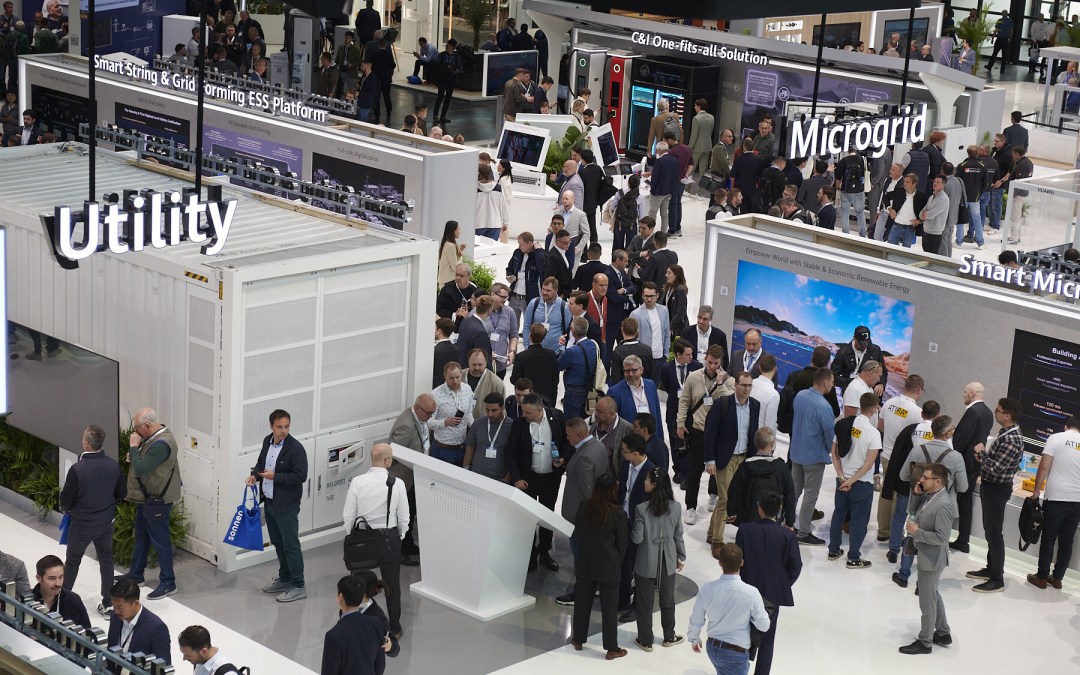
Huawei Digital Power presented its latest grid-forming Smart PV+ESS technologies at Intersolar Europe 2025, held in Munich from May 7 to 9.
The showcased solutions aim to support the construction of new power systems and promote the global transition to renewable energy.
“Carbon neutrality and energy transition are now global missions,” Huawei stated, highlighting the need for energy systems that integrate power electronics across all stages of the electricity chain — generation, transmission, distribution, and consumption.
Central to Huawei’s exhibition offerings is its Smart String Grid Forming ESS, designed for utility-scale applications.
According to Huawei, it “offers all-scenario grid forming, cell-to-grid safety, full-lifecycle optimal investment, and full-link digitalization.” The solution is capable of stabilising grids under varying conditions, including across all states of charge and short circuit ratios.
On the generation side, the system mimics the behaviour of synchronous condensers, offering voltage, frequency, and power angle control. On the transmission side, it supports black start and provides voltage and frequency stabilisation.
Huawei added that “one platform… supports flexible evolution” as energy markets expand. On the consumption side, it enables microgrids that run entirely on renewables with stable on/off-grid operation.
Other offerings
Huawei also presented a 215 kWh Smart Hybrid Cooling ESS for commercial and industrial use, emphasising “proactive safety, premium quality, and higher profitability.”
Certified to international safety standards, it is designed to perform in extreme conditions and features upgraded optimisation and efficiency.
For the residential sector, Huawei launched its Home Energy Management Solution 6.0, which includes the LUNA S1-7kWh ESS. The system offers “over 40% more usable energy than the industry average” and supports expansion up to 252 kWh.
Huawei concluded: “Energy transition is not only technological innovation, but also a global effort to achieve sustainable development.”
[Image credit: Huawei]