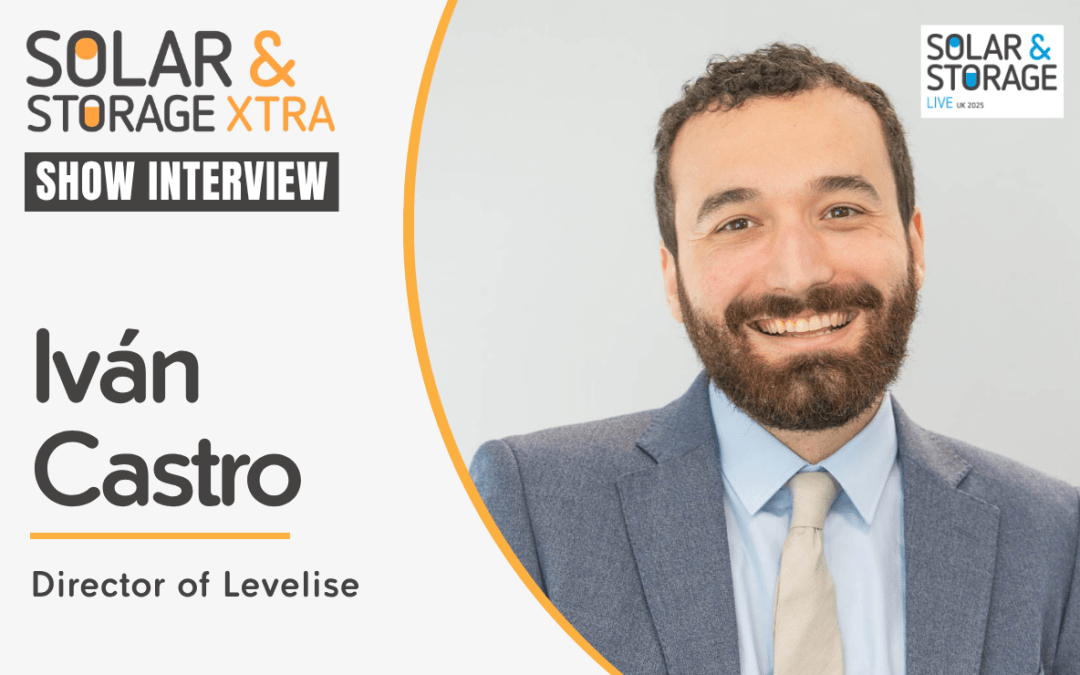
Solar & Storage Live returned to Birmingham this year as the UK’s largest showcase for clean energy innovation, bringing together pioneers driving the transition to a smarter, fairer grid.
Among them was Levelise, a company that has been reshaping how domestic energy assets participate in flexibility markets.
At the show, we spoke with Director Iván Castro, who explained how the company’s mission has evolved, the launch of its new Hub 2, and why empowering households remains central to the energy transition.
What is Levelise’s mission in the industry, and how has it evolved?
Iván: Levelise was founded in 2017, and we were the first in the market to tackle residential flexibility. At the time, no one believed it was feasible, but we proved to NESO (National Energy System Operator) that it could be done commercially.
We’ve been operating commercially since 2019, and our mission is to open these markets so consumers can access lower bills. Back then, customers weren’t getting a fair share – most of the market was dominated by gas peaking plants.
Now, many competitors use large-scale batteries, but we focus solely on domestic assets.
Most of our customers have solar panels with batteries, but we also integrate hot water tanks, heat pumps, and other assets. Our goal is to democratise the system – making it decentralised and fair – so the green transition delivers real payback and returns for consumers. Things need to align for the transition to succeed.
Following your recent launch, could you walk us through the main technical improvements in Hub 2 over the previous version?
Iván: When we launched the original hub in 2019, it was a proof of concept to show that flexibility could work at scale. We now have over 5,500 customers and have made more than 2 million direct payments – typically around £150 per customer each year. Importantly, we pay customers directly into their bank accounts.
The first-generation hub was industrial in design and required more effort from installers, especially during commissioning. The new Hub 2 is designed for the mass market and for scale.
Commissioning takes just 15–20 minutes, compared with around 90 minutes before. That means a regular electrician – not just a certified solar installer – can do it. It’s much more plug-and-play, aligning with how the industry has evolved.
We’ve made it easier for both installers and customers, which is crucial for scaling. The Hub 2 is smaller, manufactured in the UK near Gatwick, with customer service in Gloucester and Cardiff. Having a UK-made product that can scale is a big step forward.
How are you working with installers and battery manufacturers?
Iván: We work across all segments. Installers with large volumes can procure directly from us, and we also partner with OEMs.
For example, we source products directly so installers can buy bundles – like our Hub 2 with a 10kWh battery – for around £3,100, which is a strong value proposition.
We also work with distributors, so installers have multiple options. Manufacturers want their products integrated with our platform because it makes sales easier.
By reducing payback periods by around two years, our platform gives batteries a real competitive edge – customers can clearly see the difference.
Installers can buy directly through our website, go through wholesalers, or take advantage of manufacturer partnerships. We try to offer flexibility in how they access our products.
What incentives or policy changes would you like to see to accelerate the adoption of home battery and flexibility systems?
Iván: The market has already opened up compared to 2019, when we had to meet the same metering and regulatory requirements as large plants.
Things are improving, with more standardisation, and the market facilitator role is helping to make participation easier. NESO has also updated its systems to handle thousands of distributed assets, which wasn’t possible before.
Regulatory changes, such as the P483 reforms we contributed to, mean we don’t have to wait until 2028 for mandatory half-hourly settlement. That brings us much closer to opportunities in wholesale and balancing markets.
There’s still room for more standardisation, but overall, progress is moving in the right direction. The challenges now are often more technical than regulatory.
How important is Solar & Storage Live for Levelise in terms of product launches, partnerships, or visibility?
Iván: It’s the main UK event in this space, so it’s essential for building new connections and maintaining relationships with existing customers and partners. For us, it’s a must-attend event, and there’s no better place to launch a product and maximise visibility.
Missed out on Solar & Storage Live UK? Get your free ticket to Solar & Storage Live London – the capital’s most exciting solar event. Or, find a Solar & Storage Live event near you.