by Catie Owen | Dec 17, 2025 | Electric Vehicles, Europe, Everything Installer
Segen, a UK-based distributor of renewable energy products, has announced an exclusive six-month distribution partnership with EV infrastructure provider 3ti.
The deal focuses on the Papilio3, a rapid-deploy smart solar EV charging “FastHub” designed to bypass traditional installation barriers like grid constraints and lengthy planning processes.
Infrastructure and training
As part of the collaboration, Segen has installed a Papilio3 unit at its Training Academy and Distribution Centre in Medway, Kent. The facility trains approximately 1,600 individuals annually to address the national shortage of qualified renewable energy installers.
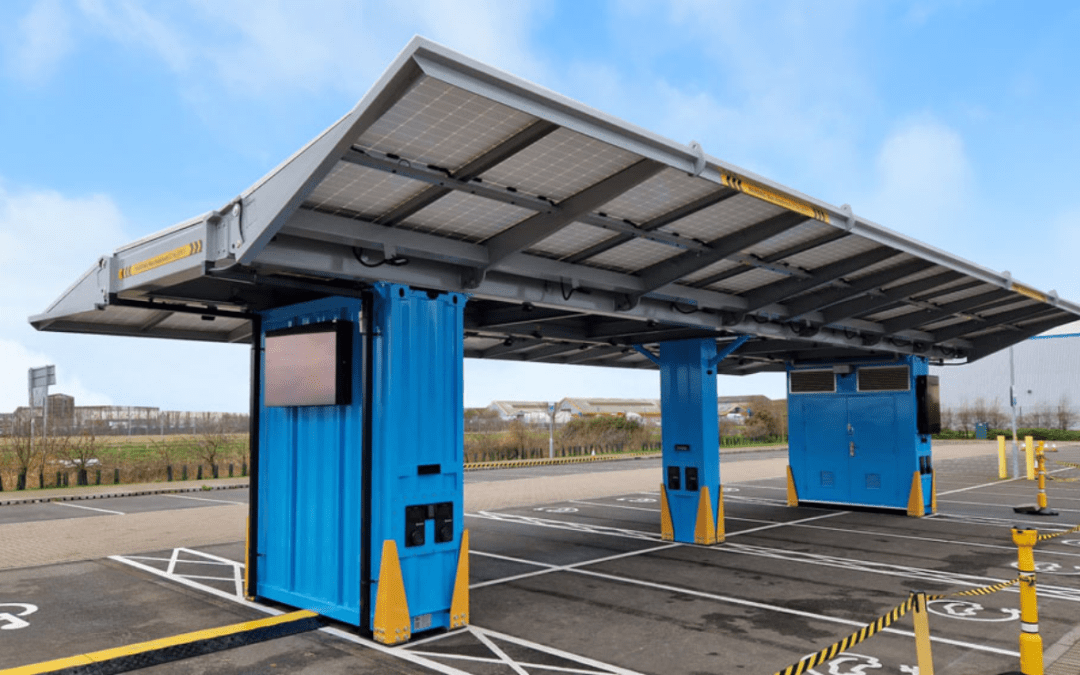
The Papilio3, constructed from an upcycled shipping container, features an integrated 20kWp solar PV array and can charge up to 12 vehicles simultaneously at speeds up to 22kW.
Because the unit is portable and free-standing, it requires no planning permission or major groundworks and can be installed in under a day.
James Galloway, Global Product Director at Segen Ltd, said:
“As a leader in the renewables sector, we are committed to setting an example by using innovative solutions to reduce our carbon footprint. At the same time, we aim to ensure that students have a rewarding and positive experience during their time at the Academy. Providing a convenient and sustainable onsite EV charging solution will help us achieve that goal.”
Market impact
The partnership aims to provide installers with a solution for commercial clients in sectors such as logistics, retail, and business parks. By utilising patented power-management technology, the FastHub operates using a site’s existing electrical infrastructure, removing the need for costly grid upgrades.
Beyond its charging capabilities, the hub includes integrated lighting, CCTV, and a roof cover for weather protection.
While currently serving Segen’s staff and trainees, the hub is also open to the public and nearby businesses, creating an additional revenue stream. The Papilio3 is currently available to order exclusively through Segen.
[Image credit: 3ti]
Get your free ticket to Solar & Storage Live London – the capital’s most exciting solar event. Or, find a Solar & Storage Live event near you.
by Catie Owen | Dec 3, 2025 | Asia, Commercial & Industrial Solar, Electric Vehicles
Octillion has announced the successful conversion of one of its three Indian battery system manufacturing factories to facility-wide solar energy, establishing a site that now operates entirely on carbon-free power.
This achievement anchors a larger initiative to make all the company’s India-based facilities carbon neutral via solar power generation by 2027.
Global President of Octillion, Paul Beach, commented on the commitment: “India’s electric vehicle market is accelerating rapidly, and we’re committed to ensuring this growth is truly sustainable.
“By converting our manufacturing to solar power, we’re closing the loop – producing the clean energy storage solutions of tomorrow, using clean energy today. This is just the beginning of our journey toward our goal of carbon-neutral operations across all our India facilities by 2027.”
The Pune facility, which spans approximately 8,200 square meters, generates 3GWh of total annual battery capacity.
Its new rooftop solar installation is set to provide approximately 545MWh of dedicated clean energy annually, fully covering the factory’s entire power requirements. The conversion began in June 2024 and achieved full operational status by July 2025.
Nikhil Parchure, Senior Vice President at Octillion, noted the company’s role: “Accelerating cleaner, more efficient transportation in India is central to our mission as a global battery company.
“With three large-scale battery manufacturing facilities in India… Octillion is uniquely positioned to serve the fast-growing needs of India’s electric vehicle sector… We will continue to advance our efforts in India and globally by providing cutting-edge, safe battery systems, working to leave the least environmental impact possible in the transportation sector.”
by Catie Owen | Dec 2, 2025 | Electric Vehicles, Innovation, Video
Solar & Storage Live UK 2025, the nation’s largest event for renewable energy innovation, built anticipation for the technologies redefining our power landscape.
Amidst the buzz, we sat down with Cameron Millar, Application Engineer for Eaton, a company actively championing the distributed energy future. In this interview, Cameron outlines Eaton’s mission to transform static energy consumers into dynamic prosumers, driving the concept of “buildings as a grid”.
He also shares his perspective on the most impactful emerging technologies set to revolutionise both storage and EV charging, particularly the promise of solid-state batteries and megawatt charging.
“The current limitations in battery technology revolve around weight, size, and energy density. As these technologies improve over time, we gain more energy per kilogram.”
What is the role of Eaton in the industry?
Cameron: Eaton is fundamentally focused on advancing the idea of buildings as a grid.
Our core role is to encourage people to view their premises as a potential energy hub, making them less dependent on the main grid and enabling them to become prosumers, individuals or entities that both produce and consume their own energy.
This concept is realised by integrating on-site renewable energy, such as solar or wind power, with battery storage systems. Since adequately sized solar arrays often generate a substantial surplus, the storage captures this excess energy for later use.
Additionally, installing EV chargers allows the stored or generated excess power to be utilised for vehicle charging. We tie all these components together with an energy management system to ensure optimal energy flows.
This system allows us to implement predictive control. For example, by ensuring batteries are empty to maximise solar capture on a predicted sunny day or dynamically managing EV charging loads to prevent high building demand from overloading the system. We treat the entire building as a holistic energy ecosystem.
What are you showcasing at Solar & Storage Live UK?
Cameron: At the exhibition, we’re highlighting Eaton as a one-stop shop for comprehensive energy solutions. We are showcasing a wide range of products covering both AC and DC charging, from low-power solutions to high-power units, alongside our integrated battery storage systems.
Specifically on the stand, we have our Duo AC charger (2x22kW), various DC chargers, including the 22kW mobile unit and fixed 30kW and 60kW DC chargers. We also feature the ChargePoint CP6K charger, following our recent partnership.
Completing our display is our xStorage Hybrid BESS. Essentially, we are demonstrating that Eaton is the source for all necessary components: power distribution, EV charging, and energy storage.
Talk to us about the commissioning challenge happening this week.
Cameron: We are running a commissioning challenge onsite to underscore how simple and user-friendly our installation process is – we are ultra confident in the ease of commissioning our chargers!
The challenge uses our Green Motion Building AC charger (7.4kW up to 22kW). We challenge installers to take the unit from a full factory reset state, fully commission it, connect it to the charge point back end, and initiate a charge session within five minutes.
We set this up because, while the physical electrical install is routine for installers, they often find the connection to the software back end difficult and time-consuming. We are here to prove it doesn’t have to be – it is easy.
And, if you are the quickest of the day, you will get a little pack of Torx screwdrivers as a prize.
What feedback have you received from installers and decision makers?
Cameron: We have received very positive feedback from both groups. Installers are particularly pleased with the ease and speed of commissioning our units.
For key decision-makers, the most valued feature is the scalability of the chargers. This allows them to install units initially set at a lower power (e.g., 7.4kW) if they currently lack the necessary DNO connection or overall capacity.
The chargers can then be upgraded later to 22kW simply through a rewire or a settings change, avoiding the expense and hassle of a full hardware replacement. This inherent flexibility is a major selling point.
How do you ensure that the EV chargers meet the UK’s 99% reliability requirements?
Cameron: Achieving the required 99% reliability is a significant objective, driven partly by government initiatives aimed at improving the frustrating experience of drivers encountering broken chargers. Our strategy hinges on robust software intervention.
We utilise Charge Central, a system that sits between the charger and the back end. It performs predictive maintenance by continuously monitoring the unit’s operational parameters, such as detecting a fan running too quickly or the unit running too hot.
This allows us to diagnose potential issues and manage remote firmware updates. By catching these problems early, before they escalate into faults that cause downtime, we effectively maximise the charger’s reliability.
Which emerging technologies are you most excited about for EV charging and energy storage integration?
Cameron: I am most excited about advancements in emerging battery technologies. The current limitations in battery technology revolve around weight, size, and energy density. As these technologies improve over time, we gain more energy per kilogram.
This will benefit EVs (lighter vehicles, greater range) and for battery and building storage systems, where reduced physical size is crucial for fitting megawatt-hours of capacity into limited space. We are excited about technologies like solid-state batteries and the impact they will make on this challenge.
Additionally, I find the development of ultra-high-powered charging interesting. Specifically, MCS charging (megawatt charging) will be a game-changer, and we are interested in seeing the innovations that emerge in that space.
Missed out on Solar & Storage Live UK? Get your free ticket to Solar & Storage Live London – the capital’s most exciting solar event. Or, find a Solar & Storage Live event near you.
by Catie Owen | Nov 13, 2025 | Electric Vehicles, Europe, Innovation
The UK’s Zero Emission Vehicle (ZEV) mandate is driving substantial growth in the automotive industry, with electric car sales consistently surpassing set targets.
The findings were published by the UK arm of The European Federation for Transport and Environment (T&E).
This policy is credited with pushing manufacturers to introduce a greater selection of affordable electric models, significantly boosting adoption by UK drivers.
October marked a new high point, with battery electric vehicles (BEVs) accounting for 26% of all new car sales. Further illustrating this shift, Renault reported that fully electric models comprised half of its total sales for the month.
The market data suggests a clear correlation between the availability of appealing BEV models and strong consumer demand, positioning electric vehicles as the primary engine for industry growth. Carmakers who have made early commitments to electrification are reportedly expanding their market share.

Mini is highlighted as a brand demonstrating this momentum. Since launching its first BEV in 2020, the brand’s B-segment electric share has grown to 20% by 2025, significantly outpacing its petrol lineup.
T&E UK Vehicles Policy Manager Tim Dexter commented: “The electric vehicle market isn’t just an opportunity, it’s a turning point for carmakers ready to lead. Whether it’s Tesla, BYD or Geely, multi-billion-pound businesses have been built by getting ahead of the curve. Legacy manufacturers can do the same if they act boldly and get their BEV strategy right.
“We’re already seeing car brands grow their market share with electric models, even where their petrol and diesel sales have stalled.”
The success of the EV market is intrinsically linked to the ZEV mandate, which has spurred market demand.
Dexter added: “This track record should prove to the government that the ZEV mandate and its 2035 phase-out date are crucial for UK automotive success.
“With robust targets, continued support for innovation, and investment in infrastructure, the UK’s automotive industry is well placed to lead the EV transition, creating new jobs, attracting investment, and placing British-built vehicles as a market leader.”
[Graph credit: T&E]
This series covers the developing electric vehicle market of the UK and its increasing infrastructure, as the nation advances its net-zero goals.
For all things EV, don’t miss out on your free ticket to EVCharge Live UK – taking place 22-24 September 2026.
by Catie Owen | Oct 15, 2025 | Electric Vehicles, Europe, Innovation
Duracell has announced its entry into the UK’s electric vehicle infrastructure market with the launch of Duracell E-Charge, a new nationwide network of ultra-fast charging stations.
The initiative aims to strengthen public charging provision and support the UK’s accelerating shift to electric mobility.
Backed by more than £200m in planned investment over the next decade, Duracell E-Charge is designed to improve accessibility, reliability and charging speed across the network.
“Duracell has always been a trusted companion in people’s lives, delivering long-lasting performance, uncompromising safety and a commitment to sustainability,” said Javier Hernandez Reta, chief marketing officer at Duracell.
“For decades, consumers have relied on us to go the extra mile. Today, electric vehicle drivers can travel even further, confidently and sustainably, with Duracell E-Charge leading the way.”
Operation of the new network has been licensed to Elektra Charge, a newly formed charge point operator, while The EV Network (EVN) will develop and fund the charging hubs. EVN has delivered several of the UK’s largest EV charging sites and will bring its experience to the new rollout.
“The need in the UK for faster, more reliable charging to keep pace with EV adoption is clear,” said Reza Shaybani, CEO of The EV Network.
“Duracell E-Charge is a direct response to that challenge. The EV Network has already delivered some of the UK’s biggest charging hubs, and now we’re bringing that expertise to one of the world’s most recognised brands.”
The first six Duracell E-Charge locations are due to go live in 2025, with rapid expansion planned through 2026 and beyond. Sites will be located at strategic transport, retail and hospitality destinations.
Offering charging speeds of up to 1,000 kW, Duracell E-Charge will feature high uptime, transparent pricing and multiple payment options, including contactless and plug-and-go.
“Duracell has been powering people’s lives for decades. Now, Duracell E-Charge will be powering their journeys,” said Mark Bloxham, managing director. “Charging your car should be as simple as changing the batteries in your remote.”
[Image credit: The EV Network]
This series covers the developing electric vehicles market of the UK and its increasing infrastructure, as the nation advances its net-zero goals.
For all things EV, don’t miss out on your free ticket to EVCharge Live UK – taking place 22-24 September 2026.
by Catie Owen | Oct 8, 2025 | Electric Vehicles, Europe, Innovation
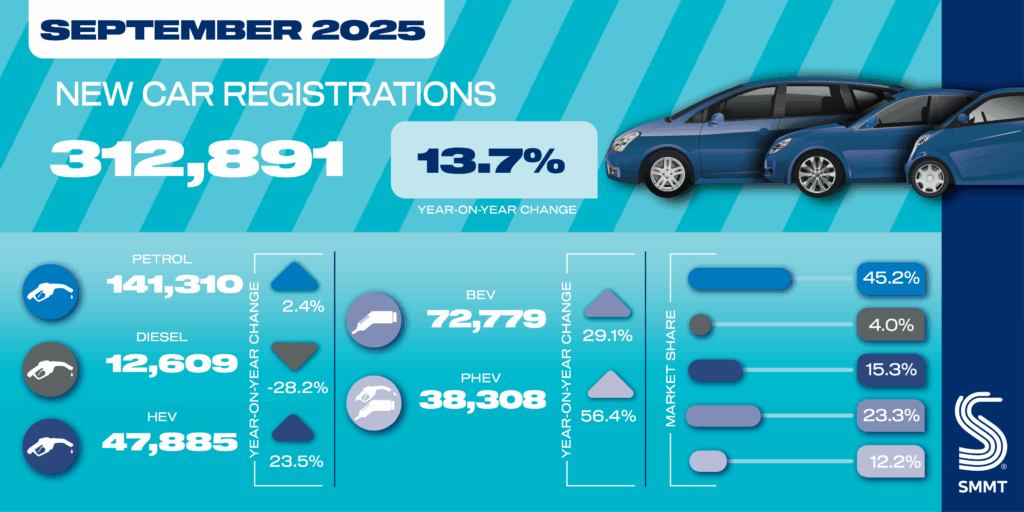
The UK new car market saw strong growth in September, with registrations rising by 13.7% to 312,891 units compared with the same month in 2024, according to the Society of Motor Manufacturers and Traders (SMMT).
All market sectors contributed to the increase, with fleet registrations showing the biggest growth, up 16.9% to 174,336 units. Private consumer demand also increased, rising 8.9% to 131,003 units, while business registrations grew 28.6% to reach 7,552 vehicles.
Battery electric vehicles (BEVs) recorded their highest-ever monthly total, with 72,779 new registrations – a 29.1% rise on last year. BEVs accounted for 23.3% of the market, up from 20.5% in September 2024. Plug-in hybrid (PHEV) registrations also surged by 56.4% to 38,308 units, taking a 12.2% market share, while hybrid electric vehicles (HEVs) increased by 23.5% to 47,885 units.
In contrast, petrol and diesel cars saw reduced market shares. Petrol vehicles grew modestly by 2.4% to 141,310 units but fell from 50.1% to 45.2% of the market. Diesel registrations dropped 28.2% to 12,609 units, representing just 4% of new car sales.
The SMMT said the figures underline the increasing consumer and fleet interest in electrified vehicles but highlighted the need for continued investment in charging infrastructure to sustain growth.
Mike Hawes, SMMT Chief Executive, said: “A record September for electric vehicles shows how quickly the market is changing, with drivers responding to a growing choice of models and improving technology. However, if this transition is to continue at pace, we need public charging to keep up with demand and ensure that no driver is left behind.”
He added that maintaining momentum would require policy consistency and incentives to support private buyers as well as fleets. “Manufacturers are investing billions in new technology, but the benefits will only be realised if consumers have the confidence to make the switch,” Hawes said.
[Image credit: SMMT]
This series covers the developing electric vehicles market of the UK and its increasing infrastructure, as the nation advances its net-zero goals.
For all things EV, don’t miss out on your free ticket to EVCharge Live UK – taking place 22-24 September 2026.
by Catie Owen | Oct 3, 2025 | Electric Vehicles, Europe, Innovation
Sponsored Content
Electric mobility is transforming global transportation, with EV sales soaring past 17 million in 2024. As nations push toward net-zero, innovation in charging, storage, and fleet solutions is critical.
Vestel Mobility, a leader in sustainable mobility solutions, outlines how it is driving this transition, delivering sustainable, scalable technologies that power the next era of clean, connected mobility.
1. Global developments in the electric vehicle industry
Source: Global EV Outlook 2025, IEA. International Energy Agency Website: www.iea.org
The transition to electric mobility is no longer a vision of the future. It is today’s reality. With global zero-emission targets set for 2050, electric vehicles (EVs) are at the centre of the transformation.
2024 marked a turning point: more than 17 million electric cars were sold worldwide, representing over 20% of new car sales. By the end of the year, the global EV fleet reached nearly 58 million vehicles.
The momentum has carried into 2025, with the first quarter alone seeing more than 4 million EVs sold, a 35% year-on-year increase. By year-end, one in every four new vehicles sold globally is expected to be electric.
China, Europe, and the United States continue to dominate, together accounting for 95% of sales.
Europe, however, faced stagnation at a 20% sales share in 2024 due to expiring incentives, especially in Germany and France. Yet stricter EU CO₂ standards are expected to boost sales to 25% in 2025 and close to 60% by 2030.
The UK is already ahead, with nearly 30% EV penetration thanks to strong regulatory frameworks. Norway continues to lead the world, with 88% of its car sales being fully electric.
In 2025, global electric car sales are expected to exceed 20 million, representing one-quarter of total car sales. Worldwide sales are projected to grow by 25%, similar to the growth rate in 2024.
Europe leads on coverage, with fast chargers every 50 km on over 75% of highways. Europe’s public charging infrastructure exceeded the mark of 1 million charge points in 2024, which corresponds to a growth of 35%.
Within the EU, 11 out of 27 countries recorded an increase of more than 50%. The Netherlands is in the lead with 180,000 public charging points, followed by Germany (160,000) and France (155,000).
The ratio of EVs per public charger in Europe is 13:1, a decrease of almost 10% from 2023.
The expansion of the fast and ultra-fast charging infrastructure in Europe has also accelerated significantly. Ultra-fast chargers (150 kW+) grew 50% to 71.000 chargers and now make up nearly 10% of all public fast chargers.
About 20% of ultra-fast chargers in the EU already offer charging capacities of 350 kW and more, even though only a few vehicles can fully use this power.
The Electrification of heavy transport
The electrification wave is also reshaping heavy-duty vehicles, buses, and logistics. Electric truck sales grew by 80% in 2024, reaching 2% of global sales.
Europe and the U.S. are projected to reach cost parity by 2030. In parallel, electric bus adoption is rising in Europe under the Clean Vehicles Directive, targeting 100% zero-emission city buses by 2030.
Light commercial vehicles (LCVs) are also on the rise, with London, Amsterdam, and Brussels promoting electrification through Low Emission Zones. Meanwhile, electric two- and three-wheelers — the most electrified vehicle segment — account for 15% of global sales.
Finally, the growing market for used EVs is democratizing access. As batteries last longer and prices fall, used EVs are becoming the gateway for millions to join the e-mobility revolution.
2. Vestel Mobility Solutions: Redefining the future of transportation
Vestel Mobility is more than a technology provider — we are an enabler of the global e-mobility transition. By combining decades of expertise in consumer electronics with a bold vision for sustainable transportation, we deliver solutions that address the entire mobility ecosystem: from vehicles, to charging, to energy storage, to fleet management.
2.A. Automotive components & the cockpit experience
The car of the future is no longer just a machine — it’s a digital ecosystem on wheels. Vestel’s Cockpit Experience concept is at the heart of this transformation.
- Cutting-edge display technologies: Wide-screen configurations powered by ELED, MiniLED, and QLED deliver high resolution, low energy consumption, and unmatched user focus.
- Smart vehicle intelligence: AI-driven facial recognition for keyless entry, driver monitoring for fatigue and distraction detection, gesture and voice controls, and integrated camera/audio systems.
- Flexible architecture: Scalable infotainment platforms, Body Control Modules (BCM), and Zonal Controllers designed for next-generation vehicles.
- Faster time-to-market: Accredited test labs and consumer electronics agility allow Vestel to deliver innovations quickly without compromising reliability.
At upcoming showcases, Vestel will present:
29″ Side-to-Side Display | 15.6″ Dual QD MiniLED | 12.3″ QLED & MiniLED | Dual 12.3″ ELED Displays | 13.3″ QD MiniLED | Wireless Charging Units | High-performance infotainment platforms.
Vestel is redefining the cockpit not just as a driving space, but as a personalised, safe, and connected experience.
2.B. Electric charging stations:
Vestel Mobility provides advanced EV charging solutions from 7.4 kW to 1.2 MW, integrating Plug and Charge (PnC) technology, OCPP protocol, and over-the-air updates for seamless operation. With decades of expertise in electronics and a vision for sustainable mobility, Vestel ensures reliable, high-performance charging with sophisticated design and 24/7 premium support.
Vestel has been manufacturing AC charging solutions since 2017, starting with models tailored for homes and small businesses. Today, our portfolio covers the entire spectrum of e-mobility needs — from residential use to public charging hubs and heavy-duty transport electrification.
- AC Charging Solutions
Compact, user-friendly, and smart-connected, Vestel’s AC chargers are designed for homes, offices, hotels, and semi-public environments. Their sleek form factors and energy-efficient design make them ideal for private and shared use.
- DC Fast and Ultra-Fast Charging Solutions
Vestel’s DC portfolio ranges from 40 kW to 80 kW units suitable for urban areas and small fleets, to ultra-fast chargers of 160 kW, 240 kW, 320 kW, 400 kW, 720 kW, and 1.2 MW designed for highways, logistics hubs, and large-scale fleet operations. These solutions reduce charging times dramatically, enabling both passenger and heavy-duty vehicles to be road-ready in minutes.
- Advanced Features Across the Range
All Vestel chargers are designed with Plug and Charge (PnC) technology, OCPP compliance, dynamic load balancing, and over-the-air updates, ensuring compatibility with global standards and future upgrades. This not only maximises user convenience but also ensures network operators benefit from seamless integration and long-term reliability.
Vestel’s charging stations empower the widespread adoption of e-mobility by offering flexible, scalable, and sustainable solutions that adapt to every use case from individual drivers to global fleet operators.
2.C. Battery & energy storage solutions
Energy storage is central to the future of mobility and renewable integration. Vestel’s portfolio addresses all scales:
- Telecom Battery: Backup power for towers and data centres, ensuring uninterrupted connectivity.
- Residential Battery Systems: Solar-integrated solutions for independent homeowners.
- Commercial & Industrial Storage: Scalable, high-capacity systems for factories, hospitals, and data centres.
- Utility Scale Systems: Enhanced durability and performance for demanding industrial use cases.
Vestel empowers individuals and enterprises to store renewable energy efficiently, reduce costs, and ensure energy resilience
3. Fleet management & heavy vehicle charging
The electrification of fleets and heavy-duty vehicles is one of the most critical milestones on the road to net-zero transportation. While heavy-duty trucks make up only 10% of vehicles, they contribute more than 70% of CO₂ emissions in road transport — making this sector a top priority for transformation.
Vestel Mobility addresses this challenge with Stella-M, a next-generation megawatt-scale charging solution built specifically for electric heavy-duty vehicles and large fleets.
- High-performance charging for heavy vehicles
With its advanced technological infrastructure, Stella-M delivers unparalleled power and efficiency, enabling logistics operators and public transport providers to keep fleets moving with minimal downtime.
- Future-ready infrastructure
Stella-M and Vestel’s broader fleet charging solutions will reinforce the company’s pioneering role in public transport, logistics, and commercial vehicle electrification — both in national and international markets.
- European leadership example
Vestel is already spearheading its’ first megawatt charging project in the EU with Russell Group, combining MCS (Megawatt Charging System) and CCS (Combined Charging System) connectors in one operation. This dual compatibility ensures adaptability to current and future fleet standards.
- Integrated fleet solutions
Beyond hardware, Vestel supports operators with smart fleet management systems, dynamic load optimisation, remote monitoring, and predictive maintenance, creating a complete ecosystem for zero-emission logistics.
Vestel enables fleet operators to transition smoothly to electrification by providing ultra-fast, scalable, and intelligent charging ecosystems. The result is higher operational efficiency, lower emissions, and a clear path toward sustainable transportation on a global scale.
4. Sustainability: Vestel’s commitment beyond technology
Vestel’s mission extends beyond innovation — we are equally committed to environmental responsibility.
- Net Zero by 2050 Science-Based Targets initiative (SBTi)-approved targets
- 42% reduction in Scope 1 & 2, 25% reduction in Scope 3 by 2030
- Renewable Energy Growth: Scaling solar generation to cut 5,430 tons of CO₂ annually
- Energy Efficiency Projects: Saving 13,278 MWh in 2024 alone
- Circular Economy: 18,289 tons of recycled cardboard used
- Global ESG Recognition: Ranked among the top 10% of companies in S&P Global Sustainability Yearbook 2025, with an A- in the CDP Climate Change score and a B in the CDP Water Security score. EcoVadis score has improved to 64. Included in the Borsa İstanbul Sustainability Index since 2016. It ranks 2nd among 100 companies in the sector on a global basis with a score of 87* in the ESG assessment.
Vestel is not only powering e-mobility but also driving systemic sustainability across industries.
The future of transportation is electric, intelligent, and sustainable. With advanced cockpit systems, ultra-fast charging, scalable battery solutions, and pioneering fleet management initiatives, Vestel is at the forefront of this transformation.
This series covers the developing electric vehicles market of the UK and its increasing infrastructure, as the nation advances its net-zero goals.
For all things EV, don’t miss out on your free ticket to EVCharge Live UK – taking place 22-24 September 2026.
by Catie Owen | Sep 22, 2025 | Electric Vehicles, Europe, Innovation
As the UK accelerates its journey toward net zero, innovative solutions are becoming a critical test for the EV transition. From delivery fleets to public charging access, the pressure is on to ensure infrastructure can keep pace with soaring demand.
With EVCharge Live UK opening its doors this week, we caught up with Giles Shrimpton, Country Director UK for Last Mile Solutions, to discuss how Europe’s largest e-mobility platforms are preparing for the next phase of growth.
Your platform connects over 240,000 charge points, supports more than 850,000 roaming points, and processes over 3.5 million transactions monthly across 22 countries.
How do you maintain reliability and scalability at such a scale?
Giles: We’ve experienced exponential growth in recent years – the number of charge points doubles every year. Reliability in this industry must be built before it’s needed, so we design our systems to anticipate tomorrow’s demand.
That means investing ahead of the curve in both infrastructure and processes. Automation and quality are central, and we were the first in the segment to achieve triple ISO certification in quality, security, and privacy. Our network runs 24/7, 365 days a year, with most incidents resolved automatically before they affect customers.
We’re already testing architecture proven to handle over 500,000 charge points, with scalability to 1 million – the level we believe is necessary for the next phase of the industry.
On roaming, today we connect hundreds of specialist CPOs across Europe. With our one card, you can access over 850,000 charge points. That’s only possible through strict adherence to open standards and close collaboration across the industry – something that makes EV charging unique.
Talk to us about your project with Shell.
Giles: Large-scale migrations are critical operations – it’s not just technical integration, it’s doing it without disrupting end users or operator revenue. This year, with Shell Recharge Solutions and 50five, we’re executing the largest migration in European history: over 100,000 charge points, 10,000 of which are in the UK.
Success depends on four things:
- Certification: Our platform supports over 300 models, covering 98% of charge points in Europe.
- Connectivity: Newer stations with eSIMs can be integrated automatically, but older ones need physical SIM swaps, requiring coordinated changeovers to avoid disruption.
- Data integrity: We clean, reformat, and validate all data before migration.
- Testing: Every station is tested before going live.
Speed matters, but trust is crucial – migrations must never come at the cost of reliability.
We’ve taken over part of Shell’s business while they focus on DC charging. Our partner 50five, a major Dutch installer, is handling Shell’s home and commercial business. This reflects a broader trend in the industry: companies refocusing rather than fully divesting.
Talk to us about your partnership with Visa and its wider impact.
Giles: This combines two market leaders: we lead in EV fleet and roaming technology, while Visa leads in global payments. Together, we’re creating a unified solution for fleet and company car drivers across Europe.
Fleet drivers today mainly use RFID cards running on OCPI. Visa has developed its Fleet 2.0 technology, which brings open-loop payments into the mix, letting customers manage and report on EV charging transactions like corporate credit cards.
The market is evolving. Around 80% of public chargers in Europe are AC with RFID readers, while 20% are DC fast chargers with payment terminals. Regulation is pushing more payment terminals – in the UK, terminals are mandated for chargers over 8kW, and in the EU for over 50kW. In practice, RFID and terminals will co-exist for years.
Our joint offering with Visa ensures fleets can operate seamlessly in both worlds, giving CPOs flexibility to meet future customer and regulatory needs.
What are the biggest challenges you see in 2026 for charge point operators and e-mobility platforms?
Giles: The challenge isn’t just rolling out more charge points – it’s making them active participants in the broader energy system. As Europe shifts from fossil fuels to renewables, charging networks must help stabilise the grid.
We already have projects enabling this future. For example, DHL in the Netherlands uses our EDGE Smart Controller to charge twice as many vehicles overnight, prioritising solar and storage within existing grid connections.
In Rotterdam, with Equans and SMATCH, 15,000 public charge points act as a virtual power plant, balancing supply and demand. And in Utrecht, with Renault and We Drive Solar, we’re piloting vehicle-to-grid technology, enabling EVs to feed power back to the grid during peak demand.
Operators will need to see charge points not just as endpoints, but as intelligent, flexible assets in the wider energy ecosystem.
As Gold Sponsor at EVCharge Live UK, how does your presence at the show reflect your European market strategy?
Giles: The UK is a strategic growth market for us, and EVCharge Live offers the right balance – focused on e-mobility but embedded within the UK’s largest solar and storage event. It attracts CPOs, energy companies, and infrastructure partners.
Our strategy is to be present wherever the energy transition conversation is happening – charging, generation, grid, storage. That’s where the real innovations happen, and EVCharge Live is an ideal platform.
Will you be showcasing any projects at EVCharge Live UK?
Giles: Yes. We’ll showcase our EDGE Smart Charging solution, which optimises charging between stations, the grid, solar, and storage.
We’ll also present our partnership with Mastercard on cloud-based payment terminals. This lets CPOs manage charge points and payment terminals on a unified, hardware-agnostic platform. We believe this cloud-based approach will be the most future-proof solution for CPOs facing rapid growth and evolving payment regulations.
This series covers the developing electric vehicles market of the UK and its increasing infrastructure, as the nation advances its net-zero goals.
For all things EV, don’t miss out on your free ticket to EVCharge Live UK – taking place 23-25 September 2025.
by Catie Owen | Sep 22, 2025 | Electric Vehicles, Europe, Innovation
From democratising access to charging with its wide AC and DC product range, to integrating scalable battery storage solutions and tackling grid constraints, technology manufacturer Vestel is positioning itself at the forefront of the UK’s charging infrastructure rollout.
Ahead of EVCharge Live UK (23–25 September 2025), we heard from Sally Bailey, Head of EVC Sales – UK for Vestel Mobility, to explore how the company is shaping the UK’s electric vehicle (EV) charging landscape.
What is Vestel’s role in the EV sector?
Sally: Vestel Mobility is about driving forward the change to decarbonised transport through democratising EV charging. From 7kW AC consumer chargers like our popular Libra model to the largest DC units with optional BESS, our entire range is designed, engineered and built in Europe.
This significantly reduces transport time, the carbon footprint, and, thanks to our economies of scale as one of Europe’s largest electronics manufacturers, costs. We aim to make EV charging simple, accessible, reliable, and affordable for everyone.
How are Vestel’s BESS solutions being integrated with charging infrastructure in the UK?
Sally: BESS is a significant part of our European portfolio, as we offer a range of products across the full spectrum of the charging industry. Our residential battery systems are gaining traction across Europe for their reliable and low-cost design, while our commercial BESS systems are modular and can be scaled to support our largest 1 MW+ chargers.
These are exceptionally useful for providing reliable charging infrastructure to rural villages where there is no grid supply to support peak-time usage by multiple vehicles. These larger systems will be the first Vestel mobility BESS in the UK, with several exciting projects that we will announce shortly.
How is Vestel preparing to address the UK’s fast‑charging infrastructure needs?
Sally: We have identified the major pain points of evolving the UK’s rapid and ultra-rapid charging network as grid supply, reliability and cost. So, we are developing Europe’s most comprehensive portfolio of DC charging products designed to address these very issues.
At the heart of Vestel’s operation is a large-scale, low-cost, and highly reliable European electronics manufacturer, and we are leveraging those USPs through Vestel Mobility’s portfolio.
The modular construction and scalable architecture of our DC charger products enable CPOs, public authorities, and fleet operators to start small and scale with demand. We see these up-front cost-reducing initiatives as vital in helping speed the rollout of UK charging infrastructure.
Our reputation for reliability, data security, value and speed to fulfilment, built on over 40 years of European manufacturing, means we are already the trusted OEM partner to most of the world’s biggest-name consumer and commercial electronics brands.
We are bringing those same values to our entire Vestel Mobility portfolio to address the rising demand for fast-charging infrastructure across the UK.
What are the greatest challenges for scaling EV infrastructure in the UK, and how is Vestel addressing those?
Sally: Grid supply and the cost/time demand of upgrading connections are the biggest challenges for UK EV charging infrastructure, and we don’t see that changing for some time.
Demand for ultra-rapid EV charging is already outstripping grid capacity at peak times in many areas of the UK, necessitating load-balancing measures that result in slow charging irrespective of the charge points’ advertised output. That is not helping to sway corporate or public opinion to EVs, as slower charging means slower adoption.
We see BESS as a fundamental in addressing the UK’s fast charging infrastructure. Not just in rural areas but also in UK towns and cities, where plans and timeframes to upgrade the grid are a long way behind the predicted growth in EV transportation.
Products like our 1.2MW DC Stella M will only accelerate the grid supply bottleneck. Yet this size of product is fundamental to the transition of haulage, HGV and PSVs to electric, as the sector cannot afford lengthy downtimes for charging.
BESS is a straightforward solution in many cases, particularly when backed up with local renewable energy generation and, eventually, two-way V2G infrastructure.
What are your targets for charger installations, partnerships, and revenue over the next 2–5 years?
Sally: The next 2-5 years will be fundamental to EV sector development in the UK, and we aim to be at the forefront of democratising charging for everyone, everywhere in the UK. Our scale and reputation for reliability mean low-cost and low-maintenance products.
Our European manufacturing base means unrivalled speed to fulfilment, lower costs, and a lower carbon footprint. And our UK operation, with its highly experienced team, means the highest level of service and support for all our UK customers.
Over the next five years, we have all the ingredients to become one of the UK’s go-to suppliers for EV charging products. From high-volume AC units for residential markets to the highest capacity DC infrastructure models, and scalable BESS solutions to renewable integration.
We boast one of the best manufacturing bases in Europe, are set up to OEM and white-label for larger operators, offer a CPMS-agnostic platform, and have top-notch business partners for those looking for a one-stop solution, including our software partner Electric Miles.
We tie that all together with an experienced UK team delivering local sales and support.
Which Vestel products and innovations will you be showcasing at EVCharge Live, and what are the benefits of attending as title sponsor?
Sally: We have taken the title sponsor of the UK’s leading EV charging trade show to demonstrate our commitment to the UK market, meet customers from around Europe, and unveil a groundbreaking new product!
The event will see the world’s first unveiling of our new 1.2MW DC Stella M, which will be Europe’s first ultra-high capacity (over 1MW) commercially available EV charger!
This series covers the developing electric vehicles market of the UK and its increasing infrastructure, as the nation advances its net-zero goals.
For all things EV, don’t miss out on your free ticket to EVCharge Live UK – taking place 23-25 September 2025.
by Catie Owen | Sep 9, 2025 | Electric Vehicles, Europe, Innovation
On World EV Day, we celebrate the vast leaps we’ve made in EV technology, share the benefits of adopting EVs, and encourage the wider transition to sustainable transportation.
The UK’s EV market is thriving, and EVCharge Live has risen to meet its needs. We go behind the scenes with Claudia Davidson, General Manager – Infrastructure at Terrapinn, who is working behind the scenes to ensure EVCharge Live UK meets industry experts where they are.
“What excites us most is how the market is broadening – investment is moving into fleets, storage solutions, grid upgrades and new business models.”
Why launch EVCharge Live UK now?
The UK charging market has shifted from vision to delivery. EV adoption is rising fast, government targets are ambitious, and serious investment is being made in infrastructure.
That creates the need for a national meeting point where everyone involved – policy makers, operators, investors and innovators – can come together.
By co-locating with Solar & Storage Live, we’re taking it a step further. The show will connect EV charging with renewable generation, energy storage and grid flexibility.
That’s where the big opportunities lie – in bi-directional charging, in turning EVs into an energy asset, and in creating a smarter, cleaner system that benefits everyone.
On World EV Day, what UK milestones stand out?
We’re celebrating over a million EVs now on UK roads, and a charging network that’s grown by more than 50% in the last two years. Rapid and ultra-rapid hubs are becoming the new norm.
But what excites us most is how the market is broadening – investment is moving into fleets, storage solutions, grid upgrades and new business models.
We’re also seeing innovative payment systems and bi-directional charging projects gaining real traction. These milestones show that EVs are no longer just about vehicles – they’re becoming a core part of the energy ecosystem.
What does the industry need next – and how will the show help?
The industry needs a clear long-term policy, faster grid connections, a bigger, skilled workforce and charging that’s genuinely customer-friendly. But we also need to think beyond today’s challenges.
Storage, vehicle-to-grid, and the integration of charging with energy flexibility are going to be critical. EVCharge Live UK is designed to reflect that. We’ll have fresh perspectives from new exhibitors and innovators, alongside established players.
The conference will cover regulation, finance, skills and tech, while the exhibition will showcase everything from next-gen chargers and bi-directional solutions to software that makes charging seamless.
Who should attend, and what will they find?
Anyone shaping the EV charging market – investors, charge point operators, local authorities, fleets, and technology providers.
Attendees will get both strategic debate and practical insight. They’ll hear how investment flows are shifting, how fleets are managing transition, and how local authorities are navigating rollout.
On the show floor, there’ll be a mix of established names and new exhibitors bringing fresh ideas, especially around energy storage and bi-directional charging.
And because the event is co-located with Solar & Storage Live, it’s also the perfect place to explore how EVs link into wider energy innovation.
Where is the show heading in future?
We want EVCharge Live UK to become the annual home of the sector – the place where the industry comes together to do business and shape its future.
Over time, the show will broaden as the market broadens. Expect to see more on new business models, international case studies and the deep integration of EV charging with renewable energy, storage, and smart city infrastructure.
Each year, the event will evolve, bringing in new voices, new exhibitors and fresh perspectives that reflect where the industry is really heading.
This series covers the developing electric vehicles market of the UK and its increasing infrastructure, as the nation advances its net-zero goals.
For all things EV, don’t miss out on your free ticket to EVCharge Live UK – taking place 23-25 September 2025.
by Catie Owen | Aug 29, 2025 | Electric Vehicles, Europe, Innovation
Drivers can now access discounts of up to £3,750 on new electric vehicles (EVs), as six models have been added to the government’s Electric Car Grant (ECG) scheme.
From 28 August 2025, the Ford Puma Gen-E and Ford e-Tourneo Courier qualify for the maximum grant of £3,750, while four models from PEUGEOT and DS Automobiles are eligible for £1,500 savings.
Transport Secretary Heidi Alexander said:
“We’re putting money back in people’s pockets and making it easier and cheaper for families to make the switch to electric, by delivering discounts of up to £3,750 on EVs.
“Our measures are driving competition in the UK EV market, boosting economic growth and supporting jobs and skills as part of our Plan for Change.”
The government has committed over £4.5 billion to accelerate EV adoption, with Britain confirmed as Europe’s largest EV market in 2024. According to Autotrader, interest in eligible cars has risen by up to 80% since the scheme began.
Nicola Dobson, Managing Director at PEUGEOT UK, commented: “This government support is welcome to help make the switch to electric more accessible and give consumers greater confidence to choose the electric PEUGEOT that best fits their lifestyle, while driving forward the UK’s transition to cleaner mobility.”
Industry voices also noted the importance of affordability.
Edmund King, AA President, said: “Drivers frequently tell us that the upfront costs of new EVs are a stumbling block to making the switch to electric.
“It is great to see some of these more substantial £3,750 discounts coming online because for some drivers, this might just bridge the financial gap to make these cars affordable.”
Ian Plummer, Commercial Director at Autotrader, stated: “The Electric Car Grant prompted the highest uptick in consumer demand for EVs in 3 years on Autotrader, and interest in cars priced below £37,000 almost doubled.”
The six new eligible models are the Ford Puma Gen-E, Ford e-Tourneo Courier, PEUGEOT E-308, PEUGEOT E-408, DS 3 and DS Nº4.
This series covers the developing electric vehicles market of the UK and its increasing infrastructure, as the nation advances its net-zero goals.
For all things EV, don’t miss out on your free ticket to EVCharge Live UK – taking place 23-25 September 2025.
by Catie Owen | Aug 27, 2025 | Electric Vehicles, Europe, Innovation
Zerova, spun out of Phihong Technology to focus solely on EV charging, has quickly expanded across the USA, EMEA, and APAC, serving clients from Audi to Shell Recharge.
Ahead of EVCharge Live UK (23–25 September 2025), we heard from Keith Wotton, Business Development Director UK & Ireland for Zerova.
Keith discussed the company’s rapid growth, its approach to future-proofing EV infrastructure, and its role in enabling megawatt charging for heavy-duty transport.
Why did Phihong Technology spin out Zerova into a standalone company, and what has the success story been since then?
Phihong spun off Zerova to focus exclusively on the rapidly growing EV charging market. As a standalone brand, Zerova could move faster, innovate more freely, and bring tailored charging solutions to market at a global scale.
Since the spinout, Zerova has grown rapidly across the USA, EMEA and APAC – delivering solutions for major names like Audi, Shell Recharge, and Zenobe, and setting up local operations in key markets.
Our success is built on engineering excellence, global reach, and the agility to tailor solutions to different customer segments – from retail to heavy-duty logistics.
How do features such as dynamic power management and intelligent load balancing help your customers save money or energy?
These features are designed to optimise energy use across multi-charger sites. Dynamic power management ensures that available grid power is distributed intelligently across active charging plugs, while intelligent load balancing shifts power where it’s needed most – avoiding peak demand charges and reducing the need for costly grid upgrades.
For fleet operators and commercial real estate owners, this means lower operational costs and smarter energy use, especially during high-demand periods.
With EV software moving so fast, how do you make sure the chargers you install today won’t feel outdated in the future?
Our hardware is built with future-proofing in mind – modular, upgradable, and built to support the latest communication protocols. Just as important is our software platform, which enables remote updates, diagnostics, and integrations.
Whether it’s adding support for ISO 15118, Plug & Charge, or adapting to new OCPP versions, Zerova chargers stay current through continuous updates. Our goal is to provide peace of mind – that a charger installed today will be compatible with the demands of tomorrow.
You supply chargers to everyone from Audi to Shell. How do the needs of a luxury car brand compare to those of a freight fleet?
The use cases are vastly different. Car brands often need high-performance chargers with sleek design, user-centric interfaces, and seamless integration with the vehicle’s onboard systems – it’s about brand experience as much as power delivery. Freight fleets, on the other hand, prioritise durability, uptime, and load management.
They need a charging infrastructure that can operate 24/7 under demanding conditions, often at depots with limited grid availability. Zerova’s strength lies in being able to serve both – with scalable, customisable solutions built on a single, robust platform.
Everyone’s buzzing about megawatt charging. Is the technology fully ready yet, or is there more work to do before that’s a reality?
Megawatt charging is progressing fast, but we’re still in the early phases of real-world deployment. The technology is ready in principle – we already offer a 1MW charging solution – but infrastructure, standards, and heavy-duty vehicle readiness are catching up.
Widespread adoption will require collaboration across OEMs, utilities, and policymakers.
At Zerova, we’re actively involved in pilot projects and standardisation efforts to help bring this vision into reality. It’s not a question of if, but when – and we’re ready.
Talk to us about your involvement in EVCharge Live in September.
We’re proud to be part of EVCharge Live this September – it’s a key moment to connect with industry leaders, policymakers, and clients shaping the future of e-mobility.
As a sponsor and exhibitor, we’ll showcase our latest fast-charging technologies, including solutions for fleet depots, highway corridors, and urban environments.
More than just presenting hardware, we’re there to listen, collaborate, and explore how we can help our partners accelerate their transition to electrified transport.
This series covers the developing electric vehicles market of the UK and its increasing infrastructure, as the nation advances its net-zero goals.
For all things EV, don’t miss out on your free ticket to EVCharge Live UK – taking place 23-25 September 2025.
by Catie Owen | Aug 20, 2025 | Electric Vehicles, Europe, Innovation
The UK government has confirmed that grants supporting the purchase of electric vans and trucks will continue until at least 2027.
Currently, the plug-in van and truck grant offers discounts of up to £2,500 for small vans, £5,000 for large vans, £16,000 for small trucks, and £25,000 for large trucks.
According to the official government statement, grant levels for the 2026–27 financial year will be announced soon.
Industry figures suggest businesses could save over £2,800 annually on fuel by switching to electric vehicles.
The extension is designed to help companies cut costs, expand operations, and strengthen supply chains, while also reducing emissions from commercial transport, which accounts for more than a third of CO2 on UK roads.
Future of Roads Minister Lilian Greenwood commented: “Extending these grants is another decisive step to power Britain’s transition to cleaner transport while backing the industries that keep our economy moving, driving new investment in EVs and helping businesses cut costs and expand.
“Every EV on our roads means healthier communities and new economic opportunities across the country, which is why grants like these are crucial to both accelerating that transition and building a resilient, competitive economy.”
On the news, Checkatrade CEO Jambu Palaniappan said: “This news is a big boost for tradespeople across the UK. Lower running costs, freedom from charges like ULEZ, and the ability to plan ahead with confidence – it all adds up to real, practical support.”
The grant is available to both businesses and individual drivers, offering greater certainty for fleet operators of all sizes. It builds on recent measures, including a £30m investment announced in July to install over 3,000 new depot chargepoints.
John Boumphrey, UK Country Manager at Amazon, added: “Decarbonising the transportation network is a critical step to enable us to achieve our goal to reach net-zero carbon emissions across our operations by 2040.”
This series covers the developing electric vehicles market of the UK and its increasing infrastructure, as the nation advances its net-zero goals.
For all things EV, don’t miss out on your free ticket to EVCharge Live UK – taking place 23-25 September 2025.
by Catie Owen | Aug 6, 2025 | Electric Vehicles, Europe, Innovation
New figures released by the Society of Motor Manufacturers and Traders (SMMT) have shown that battery electric vehicle (BEV) sales in the UK climbed 9.1% in July, despite a broader decline in new car registrations.
The overall market saw registrations fall by -5.0% to 140,154 units, marking the weakest July performance since 2022 and sitting -10.8% below the same month in 2019.
Demand fell among both private and fleet buyers, down -3.2% and -6.5% respectively, while the smaller business sector saw growth of 10.4%.
The growth in BEV registrations, though positive, slowed compared to the 34.6% rise seen in the first half of 2025, making July the second weakest month of BEV growth this year after April.
BEVs now account for 21.3% of the new car market – up from 18.5% a year ago – but still short of the 28% required by the Zero Emission Vehicle (ZEV) Mandate.
The SMMT attributed the deceleration in part to uncertainty surrounding the newly announced Electric Car Grant (ECG).
While the ECG promises a discount of up to £3,750, full model eligibility has yet to be confirmed, which is reportedly causing some consumers to delay purchases.
“July’s dip shows yet again the new car market’s sensitivity to external factors, and the pressing need for consumer certainty,” SMMT Chief Executive Mike Hawes said.
“Confirming which models qualify for the new EV grant, alongside compelling manufacturer discounts on a huge choice of exciting new vehicles, should send a strong signal to buyers that now is the time to switch.
“That would mean increased demand for the rest of this year and into next, which is good news for the industry, car buyers and our environmental ambitions.”
Despite July’s slump, the market remains up 2.4% year-to-date, with total registrations at 1.18m units – including over 250,000 BEVs. The full-year outlook has been revised upward to 1.9m units, with BEVs projected to take a 23.8% share.
This series covers the developing electric vehicles market of the UK and its increasing infrastructure, as the nation advances its net-zero goals.
For all things EV, don’t miss out on your free ticket to EVCharge Live UK – taking place 23-25 September 2025.
by Catie Owen | Aug 5, 2025 | Electric Vehicles, Europe, Innovation
Cenex, in partnership with C40 Cities and the Greater London Authority (GLA), has launched a major project to develop and trial shared EV charging infrastructure for high-mileage fleets across London.
The initiative is part of a global programme led by C40 Cities and Uber, also running in Boston and Phoenix, aimed at improving access to EV charging for over 55,000 drivers.
The 24-month London project began on 3 June 2025 and will run until February 2027, followed by a year of pilot support and data analysis.
These trials aim to test how EV infrastructure can be shared between operators, improving convenience and affordability, two key barriers to EV adoption.
Sadiq Khan, Mayor of London and Co-Chair of C40 Cities, commented:
“Whether it’s our emergency services, taxis, private hire, delivery vans, or any of the other essential transport moving through the city daily, we know that increasing the number of zero emission vehicles will result in cleaner air and fewer emissions.”
The project
Cenex will lead on stakeholder engagement, pilot design and evaluation, and the development of best-practice models to inform the long-term strategies of GLA, Uber, and C40 Cities.
Lessons learned will also be shared with other cities tackling similar EV infrastructure challenges.
“This project will explore the opportunities, challenges, and best practices for the shared use of electric vehicle charging infrastructure (EVCI) for high mileage vehicle (HMV) fleets in London,” said Juliette Kariuki-Cobbett, Project Lead at Cenex.
“Facilitating the sharing of existing charging assets will be a key step in accelerating the electrification of high-mileage fleets.”
Mark Watts, Executive Director at C40, added: “Ensuring that charging infrastructure is accessible means people living in cities can reap the benefits in terms of cleaner air and quieter streets.”
The pilots aim to offer scalable solutions for shared charging and inform future infrastructure strategy worldwide.
This series covers the developing electric vehicles market of the UK and its increasing infrastructure, as the nation advances its net-zero goals.
For all things EV, don’t miss out on your free ticket to EVCharge Live UK – taking place 23-25 September 2025.
by Catie Owen | Jul 31, 2025 | Electric Vehicles, Europe, Innovation
Cenex and Flexible Power Systems (FPS) have launched Project SLICED2, a UK-South Korea initiative demonstrating how smart data integration can improve the safety, sustainability, and efficiency of urban commercial fleets.
Funded by Innovate UK, SLICED2 builds on the earlier SLICED feasibility study, which identified key areas for innovation, including driver behaviour, road conditions, EV-enabled energy flexibility, and smart city data use.
The new phase moves these concepts into real-world trials, aiming to integrate vehicle, city, and energy grid data for everyday logistics management.
FPS will expand its Operate platform to include South Korean-developed driver and road condition monitoring systems and live data from cities and the energy network.
Cenex will lead the UK-based trials and form a “Voice of the Customer” group, including fleets such as John Lewis Partnership and Welch Group, along with transport authorities like Transport for West Midlands.
“SLICED was an eye-opening feasibility study that told us there is more to do regarding data integration between fleets, cities and the energy grid,” said Victor Lejona of Cenex. “We are very excited to begin the demonstration in the real world.”
Michael Ayres, Managing Director at FPS, added: “Better integration of city and energy network intelligence into fleet decision making will improve the efficiency of these operations as EV adoption gathers pace.”
Fleet partners echoed the importance of the initiative. “We have been able to integrate data from our vehicles and leverage greater operational efficiency,” said Jackie Hewson of John Lewis Partnership.
“For us, SLICED isn’t just about collecting more data,” said Jamie Sands of Welch Group. “It’s about using the right data in the right way to drive real operational change.”
The project will run until March 2027, with demonstrations set to begin in early 2026.
This series covers the developing electric vehicles market of the UK and its increasing infrastructure, as the nation advances its net-zero goals. For all things EV, don’t miss out on your free ticket to EVCharge Live UK – taking place 23-25 September 2025.
by Catie Owen | Jul 17, 2025 | Commercial & Industrial Solar, Electric Vehicles, Europe, Large Scale Utility Solar, Storage
The Solar & Storage Live Awards return this year to celebrate the innovation, excellence and progress driving the renewable energy transition.
Taking place on 23 September 2025 at The Vox, Birmingham, the ceremony will recognise the very best individuals, companies, and projects making a tangible impact in the solar and storage space.
With record-breaking numbers of nominations submitted, competition was fierce. This year’s shortlist highlights not just technical ingenuity but also deep-rooted commitment to sustainability, community benefit, and policy innovation.
Each category has been judged by a panel of independent experts, with the final shortlist showcasing the industry’s most forward-thinking, socially conscious, and technically impressive entries across 13 diverse categories.
Shortlist categories
- Contractor of the Year
- Commercial Project of the Year
- Diversity & Inclusivity Impact Award
- EV Infrastructure Project of the Year
- The Lucy Aitchison Women in Energy Award
- Innovation Award
- Operations and Management Award
- Residential Project of the Year
- Rising Star Award
- Alan Clark Award for Local/Community Energy
- Utility-Scale Project of the Year
- Wholesaler/Distributor of the Year
- Lifetime Achievement Award
The full 2025 shortlist of nominees can be found here.
Book your table
Celebrate the achievements of your peers and network with the industry’s best at the Solar & Storage Live Awards – held in tandem with the UK’s leading solar and storage event, Solar & Storage Live.
Tables are selling quickly; make sure to secure your place now to avoid missing out on this industry-defining event.
An unforgettable evening
The 2025 Solar & Storage Live Awards promise an unforgettable evening and are made possible by our sponsors. Their support ensures we can continue to spotlight the people and projects transforming the energy landscape.
- Trina Solar – Headline Sponsor
- Jinko Solar – Awards Drinks Sponsorship
- Rexel – Contractor of the Year Sponsor
- EcoFlow – Residential Project of the Year Sponsor
- GivEnergy – Wholesaler/Distributor of the Year Sponsor
- GoodWe – Rising Star Award Sponsor
- InstaGroup – Commercial Project of the Year Award Sponsor
- Segen – Innovation Award Sponsor
- Solaraid – Charity Partner
Whether you’re shortlisted, supporting colleagues, or simply celebrating industry progress, join us at The Vox on 23 September to raise a glass to the future of clean energy.
Solar & Storage Live in Birmingham is on the horizon, so don’t miss out on your free ticket to the UK’s largest solar and storage show. Or, find a Solar & Storage Live event near you.
by Catie Owen | Jul 17, 2025 | Electric Vehicles, Europe, Innovation
Drivers across the UK will soon be eligible for discounts of up to £3,750 on dozens of new electric car models under a £650m government scheme unveiled on 15 July.
The Electric Car Grant (ECG) aims to make zero-emission vehicles more affordable and support the government’s pledge to phase out new petrol and diesel cars by 2030.
The ECG will offer point-of-sale discounts on eligible electric vehicles priced at £37,000 or under, with funding available from 16 July 2025 until the 2028–29 financial year.
Transport Secretary Heidi Alexander said: “This EV grant will not only allow people to keep more of their hard-earned money – it’ll help our automotive sector seize one of the biggest opportunities of the 21st century.”
The initiative is designed to reduce upfront costs, a common barrier to EV adoption, and make EVs cheaper to buy and run than ever. The government claims drivers could save up to £1,500 annually in fuel and maintenance.
“This is our Plan for Change in action,” Alexander added. “We’re backing British drivers, British jobs and British growth.”
Industry leaders welcomed the move. Simon Williams, head of policy at the RAC, said: “Discounted cars should start appearing at dealerships within weeks… better for their wallets, but better for the planet too.”
Vicky Read, CEO of ChargeUK, called the announcement “brilliant news,” highlighting the UK’s expanding charging network, now with over 82,000 public chargepoints.
Mike Hawes, SMMT chief executive, said the scheme “is a welcome response to consistent calls from the industry for more support,” adding it could help take EVs from one in four sales today to four in five by 2030.
This series covers the developing electric vehicles market of the UK and its increasing infrastructure, as the nation advances its net-zero goals. For all things EV, don’t miss out on your free ticket to EVCharge Live UK – taking place 23-25 September 2025.
by Catie Owen | May 6, 2025 | Electric Vehicles, Europe, Innovation
Electric vehicles (EVs) are proving useful beyond transport, with new analysis suggesting they can provide critical backup power during blackouts.
According to the Energy & Climate Intelligence Unit (ECIU), the average EV – using just 60% of its charge – could power the average Spanish household for five days.
The findings come as social media reports reveal some EV owners in Spain used their vehicles to supply electricity to their homes during recent power outages.
Colin Walker, Head of Transport at ECIU, said: “As well as reducing emissions and saving their owners hundreds of pounds in running costs, EVs are also capable of adding resilience to their owners’ homes.”
In the UK, where outages often result from damage to the distribution network, such as storm-downed trees, the average EV could provide nearly six days of electricity under the same conditions.
EVs with vehicle-to-grid (V2G) or vehicle-to-home (V2H) capabilities can send power back to the home or grid via a bi-directional charger.
These systems allow owners not only to maintain power during outages but also to reduce energy bills by charging when electricity is cheap and selling it back during peak demand.
ECIU estimates that this could earn owners up to £630 annually, using only 20% of the vehicle’s battery for two hours a day.
“In an unprecedented blackout like the one we just saw in Spain,” said Walker, “these EVs will allow people to keep their lights on, their fridges cold and their wireless routers running for days.”
A similar example was cited in Chile, where a former environment minister used his EV to power his home during a 2024 blackout.
This series covers the developing electric vehicles market of the UK and its increasing infrastructure, as the nation advances its net-zero goals. For all things EV, don’t miss out on your free ticket to EVCharge Live UK – taking place 23-25 September 2025.
by Catie Owen | Apr 25, 2025 | Electric Vehicles, Europe, Innovation
The UK has crossed a milestone in its electric transport transition, with more than 100,000 public electric vehicle (EV) charge points now installed, according to new data from Octopus Electroverse.
This achievement coincides with a sharp rise in EV production, which now makes up nearly half of all vehicles manufactured in the country.
The new Charging Infrastructure Insights report from Octopus has shown that a new public charger has been installed every 13 minutes over the past six months, with rapid and ultra-rapid units emerging as the fastest-growing category.
These now represent 24% of the entire UK public charging network.
Matt Davies, Director of Octopus Electroverse, commented: “This milestone shows we are building real momentum behind electric driving in the UK.
“Drivers can now trust there is a charger at almost every twist and turn of the road – making plugging in an EV feel as easy as charging up your phone.”
The growth supports the UK government’s reaffirmed target of reaching 300,000 public charge points by 2030, alongside its planned phase-out of new petrol and diesel vehicle sales.
Electrifying results
At the same time, data from the Society of Motor Manufacturers and Traders (SMMT) shows that electrified vehicle production rose by 38.5% in March 2025 to 31,661 units – more than twice the rate of total vehicle production growth.
This has brought EVs to 45% of UK car output.
Overall car manufacturing rose 17.1% to 79,018 units, with 73.3% of vehicles exported. The EU remained the largest destination, followed by the US and China.
Mike Hawes, SMMT Chief Executive, said: “Government has rightly recognised automotive manufacturing’s critical role in Britain’s export economy and must now show urgency and creativity to deliver a deal that supports our competitiveness, spurs domestic demand for the latest cleanest vehicles, and helps factory lines flourish.”
This series covers the developing electric vehicles market of the UK and its increasing infrastructure, as the nation advances its net-zero goals.
For all things EV, don’t miss out on your free ticket to EVCharge Live UK – taking place 23-25 September 2025.





 2024 marked a turning point: more than 17 million electric cars were sold worldwide, representing over 20% of new car sales. By the end of the year, the global EV fleet reached nearly 58 million vehicles.

 The ratio of EVs per public charger in Europe is 13:1, a decrease of almost 10% from 2023.