by Catie Owen | Apr 16, 2025 | Electric Vehicles, Europe, Innovation
Islington Council, the body responsible for the London Borough of Islington in the UK, has been hard at work decarbonising its fleet vehicles.
Following the Council’s climate emergency announcement in 2019, it has been making concerted efforts to reduce its measured annual CO2 emissions from its transport through decarbonisation.
Measuring at 109,884 tonnes, the borough’s transport accounted for 16% of the entire borough’s total emissions.
We visited the Islington Waste and Recycling Facilities Office to speak to Chris Demetriou, Assistant Director of Corporate Fleet, Transport and Accessible Community Transport at the London Borough of Islington, about the Council’s fleet decarbonisation project.
What is Islington Council’s overarching strategy for decarbonising its fleet?
Chris: Islington Council declared a climate emergency in 2019, like many other councils, and we’re actively addressing it. Our Vision 2030 strategy, titled Building a Brighter Future, outlines our approach to decarbonising all aspects of the council – from transport to buildings.
We have a fleet of 550 vehicles, and we aim to fully decarbonise it by 2030. We’ve already transitioned about 130 vehicles, including not just cars and vans, but larger ones like refuse collection vehicles, cage tippers, cargo bikes, and sweepers.
While we’re making good progress, we’re also working to reduce the size of the fleet, recognising that we’re a compact borough of just six square miles.
Over the years, service insourcing has expanded the fleet significantly, and our challenge now is to green a diverse set of vehicles and meet that 2030 goal.
Have there been any logistical challenges in implementing EVs, and is the Council anticipating any?
Chris: Absolutely! Transitioning a large and varied fleet is complex. It’s easier to electrify cars and vans, especially those housed at our main depot with charging infrastructure.
 The heavy-duty vehicles, like refuse trucks and buses, are a bigger challenge due to reliability concerns. Many are first- or second-generation EVs, and they need to match the reliability of the diesel ones they replace.
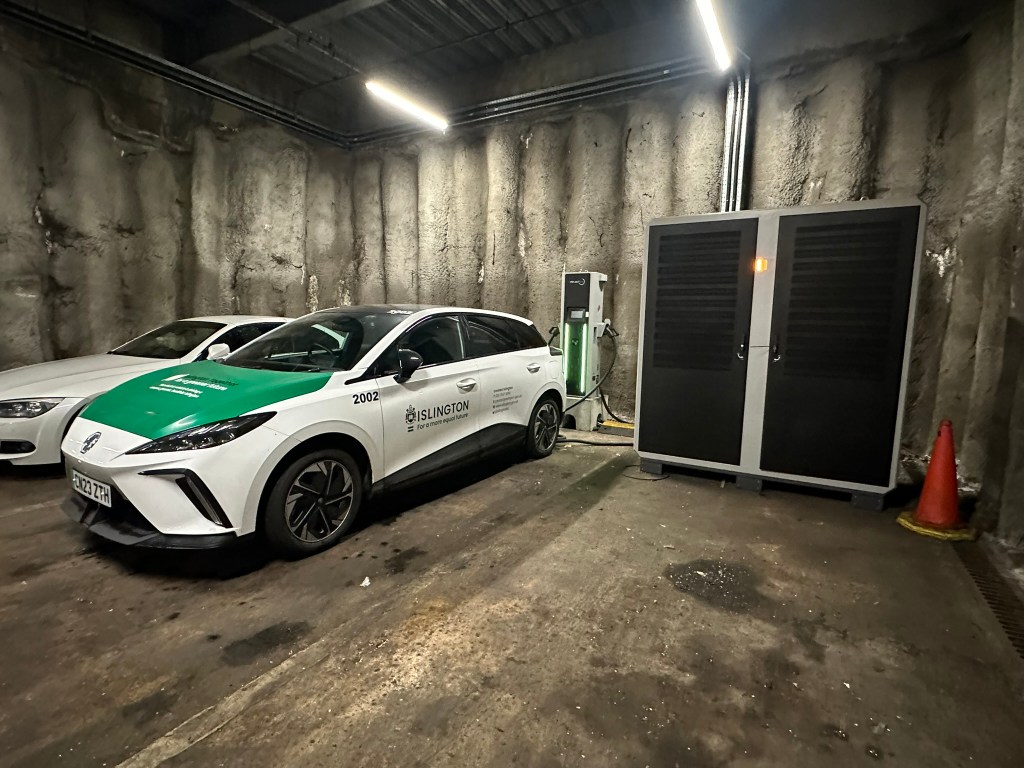
Power infrastructure has been a major hurdle. We quickly maxed out our original 1250 kVA capacity when we had only about a dozen EVs.
It took four years to install a new high-voltage substation. Each site we deploy EVs at needs new meters and power upgrades – no small task in London, where we’re all fighting for energy.
Currently, we have three and a half megawatts available at our depot, which should be enough, but we’ll need to smart-charge vehicles as the fleet expands.
Cost is another issue. Smaller EVs are becoming affordable, but large electric vehicles are still pricey.
What benefits will Islington’s residents see in the future?
Chris: While we often talk about the climate crisis, we’re also facing a health crisis, particularly in urban areas like Islington.
Air quality is poorer in less affluent wards, and we’ve seen rising rates of respiratory disease, especially among children. Decarbonising the fleet will help tackle this.
Our 550 vehicles produce around 3,000 tonnes of CO₂ annually, and eliminating that by 2030 will make a huge difference.
There are also financial benefits. An electric refuse vehicle costs around £3,500–£4,000 per annum to charge, compared to £26,000–£27,000 in diesel fuel costs. Maintenance costs are also lower for EVs.
Over time, taxpayers will see the savings. While upfront costs remain high, EVs are expected to last longer than their diesel counterparts, making them a smart investment.
What has the feedback been from staff, and what schemes are in place to support their transition to EVs?
Chris: Drivers love the EVs! Sure, there was hesitation at first, as with all new things, but that quickly turned into appreciation. They’re fully on board with the change.
We’ve had drivers tell us they no longer permanently suffer from migraines from the diesel and don’t go home stinking of petrol, especially those who previously drove noisy, smelly sweepers. Those were benefits we hadn’t expected, so it has been powerful feedback to receive.
Reliability is still a concern, particularly for the bigger vehicles. They’re essential frontline machines, and we can’t afford service disruptions. But when the EVs work well, staff really get behind them.
Our technicians are adapting too. All are trained to EV Level 1 to 3, though none yet have Level 4 high-voltage certification – that’ll be coming soon.
Fortunately, long vehicle warranties mean manufacturers are still involved in maintenance. As EVs become more common, our team will gain more high-voltage expertise.
We’ve got a mix of older and younger staff. The newer recruits are seeing the transition from diesel to electric systems and will soon be experts in both.
How will the council measure the impact of its fleet decarbonisation?
Chris: Our key metric is the reduction of the 3,000 tonnes of CO₂ we measured back in 2019 – that’s the big target.
But we’re also focused on reducing particulate matter (PM2.5) and nitrogen oxides (NOx), which still come from tyres and brake wear, even with EVs.
We’ve partnered with a company called CASI (Capacity-building Alliance of Sustainable Investment) whose platform lets us track emissions data across our fleet. This helps us compare traditional and electric vehicle performance in real-time.
We’re also looking at air quality data in deprived areas. That’s where we’re deliberately deploying EVs first – to help the people who are suffering the most from pollution.
What advice would you provide other local authorities – or even businesses – considering similar projects?
Chris: Start small. Identify your low-hanging fruit, such as the vehicles doing short trips or light work, and transition them first. Use your telematics data to understand vehicle usage and build from there. That’s what we did.
Next, get your charging infrastructure in place early. Across our sites, we’ve installed more than 140 AC and DC charging sockets.
Once you’ve started, don’t shy away from the heavy-duty vehicles. They’re responsible for most of your emissions. Yes, they’re costly and more complex, but that’s where the biggest impact to the climate and public health lies. We kept this in mind.
Notably, our borough is only six square miles, so range anxiety isn’t an issue. For us, electrification works, and we’re fully committed to it. While range anxiety might be more pressing in rural areas, we believe the principles still apply.
Can you give us a brief preview of what your presentation at EVCharge Live 2025 will include?
Chris: My presentation will cover the real story of our electrification journey – what we did, how we did it, and the hurdles we faced.
It wasn’t easy. From installing our own substation to sourcing and maintaining our vehicles, we’ve done everything in-house. That’s given us a solid understanding of what works and what doesn’t.
We’re now looking ahead to future-proofing our fleet. A big focus for us is vehicle-to-grid (V2G) technology. We’ve got two refuse trucks capable of discharging energy back into our buildings and, potentially, the grid. We’re exploring the idea of turning our depot into a microgrid that can generate and trade energy.
At the show, I’ll be emphasising that electrification isn’t just about swapping vehicles, it’s about energy as a resource. Done right, it can transform how local authorities operate and deliver long-term benefits beyond just cutting carbon.
EVCharge Live 2025, co-located with Solar & Storage Live UK, is the central hub for the EV charging revolution. Join the community of industry leaders by securing a free ticket to the September event.
by Catie Owen | Mar 12, 2025 | Electric Vehicles, Innovation
The UK’s electric vehicle (EV) charging infrastructure remains inconsistent – with significant gaps along motorways – according to a new report from the Public Accounts Committee (PAC).
The report criticises the Government for slow progress in charge point provision and warns that regional inequalities and accessibility issues risk being embedded into the roll-out.
Patchy motorway charging
Motorway service areas are crucial in building driver confidence, yet nearly a third of the UK’s 114 service areas failed to meet the Department for Transport’s (DfT) target of six ultra-rapid charge points by the end of 2023.
Despite announcing £950m in 2020 to boost motorway charging capacity, the PAC found that none of this funding had been allocated nearly five years later.
Sir Geoffrey Clifton-Brown MP, Chair of the Committee, stressed: “Drivers need confidence that they can use an EV without any risk of getting stranded, or they won’t make the switch.”
Regional disparities in EV infrastructure
The report highlights an uneven distribution of charge points, with 43% located in London and the South-East. Many rural areas remain underserved, as they are seen as less commercially viable.
The PAC suggests further government intervention may be necessary to ensure equitable access across the UK.
Sir Geoffrey warned: “Delivering thousands of points allowing Londoners to easily zip around the capital while leaving the rest of the UK’s network patchy is obviously an outcome to be avoided.”
Accessibility and cost concerns
The report raises serious concerns about accessibility for disabled drivers, noting that no UK charge points currently meet full accessibility standards.
Additionally, drivers without off-street parking face higher costs for charging due to VAT discrepancies, paying 20% rather than the 5% home charging rate.
Sir Geoffrey called for urgent action: “Not a single charge point in the country is currently fully accessible. We are risking baking a serious injustice into the fabric of a major part of our national infrastructure.”
Delays in local authority support
The Local Electric Vehicle Infrastructure (LEVI) programme, designed to help councils install charge points, is also behind schedule.
By October 2024, only 10 of 78 planned projects had been approved, raising fears that local authorities will struggle to secure resources before the March 2025 deadline.
The PAC urges the Government to accelerate the roll-out while ensuring all drivers – regardless of location, mobility, or financial status – can benefit from the transition to electric vehicles.
This series covers the developing electric vehicles market of the UK and its increasing infrastructure, as the nation advances its net-zero goals.
For all things EV, don’t miss out on your free ticket to EVCharge Live UK – taking place 23-25 September 2025.
by Catie Owen | Mar 5, 2025 | Electric Vehicles, Innovation
The UK Government has announced significant expansions in electric vehicle (EV) infrastructure and incentives, supporting businesses, schools, and individual drivers in transitioning to cleaner transport.
Future of Roads Minister Lilian Greenwood confirmed that 1,407 EV charging sockets have been installed at schools and colleges across the UK since March 2024, supported by £3m in funding from the Workplace Charging Scheme (WCS).
This initiative aims to integrate EV charging into daily life while providing additional revenue for schools. Greenwood explained in a statement:
“Schools are the beating heart of our towns and communities, and rolling out chargers here shows we are building a practical and reliable charging network designed around people’s daily lives.”
Education Minister Stephen Morgan discussed the role of schools in sustainability, saying: “By making EV charging ports readily available, schools can lead by example, encouraging greener travel options and expanding the community’s charging network.”
Extended grants
On 28 February, the UK Government also extended the WCS and Electric Vehicle Chargepoint Grant for another year to support chargepoint installations at flats, rental properties, schools, and workplaces.
Alongside charging infrastructure, the Government has committed £120m to extend the Plug-in Van Grant for another year, making EV adoption more accessible for businesses and taxi drivers.
- Businesses and van drivers can receive up to £2,500 for small vans and £5,000 for larger vans.
- The Government is removing additional training requirements for drivers of zero-emission vans.
- Taxi drivers will continue to benefit from a £4,000 grant to purchase zero-emission black cabs
- The Plug-in Wheelchair Accessible Vehicle Grant cap is increasing from £35,000 to £50,000, improving mobility options for disabled passengers
- Bikers can also claim a £500 grant for electric motorbikes for another year.
Rapid expansion
With over 74,000 public chargepoints now available and nearly 20,000 added last year alone, the UK is rapidly expanding its EV infrastructure.
“By making the transition to zero emissions a success, we’re helping to drive growth all over the UK, putting more money in people’s pockets and rebuilding Britain to deliver our Plan for Change,” Greenwood added.
The government has allocated £200m for further chargepoint rollouts, with £6bn in private investment in the pipeline.
This series covers the developing electric vehicles market of the UK and its increasing infrastructure, as the nation advances its net-zero goals.
For all things EV, don’t miss out on your free ticket to EVCharge Live UK – taking place 23-25 September 2025.
by Catie Owen | Feb 21, 2025 | Electric Vehicles, Innovation
The County Council for Nottinghamshire, UK, has launched a tender process for electric vehicle (EV) chargepoint suppliers, bringing public charging on residential streets a step closer.
The council is leading the 10-week tender on behalf of four other local authorities as part of the Local Electric Vehicle Infrastructure (LEVI) Project, funded by the Department for Transport (DfT).
The LEVI scheme supports local authorities in deploying EV infrastructure, particularly in areas where residents lack off-street parking.
The consortium, which includes Nottingham City Council, Derby City Council, Derbyshire County Council, and Staffordshire County Council, has secured over £17m in LEVI funding. Each council will manage its own contract with selected suppliers.
Nottinghamshire has been allocated £5.5m to install public chargepoints countywide, prioritising locations without driveways or garages.
The tender seeks two suppliers—one for standard chargepoints, which will be the majority, and another for rapid chargepoints. Installation is expected to begin in spring 2026.
Councillor Neil Clarke MBE, Nottinghamshire County Council’s Cabinet Member for Transport and Environment, said: “The issuing of this tender is great news for residents across Nottinghamshire who may not have access to off-street parking but would like to make more sustainable transport choices.”
Councillor Carmel Swan of Derby City Council highlighted efforts to “future-proof our cities,” while Nottingham City Council Leader Neghat Khan called the project “a significant step” toward greener transport.
Staffordshire County Council’s Councillor Mark Deaville emphasised collaboration, stating: “By working together, we will be in the strongest position to attract the best commercial providers.”
[Image credit: Nottinghamshire City Council]
This series covers the developing electric vehicles market of the UK and its increasing infrastructure, as the nation advances its net-zero goals.
For all things EV, don’t miss out on your free ticket to EVCharge Live UK – taking place 23-25 September 2025.
by Catie Owen | Feb 12, 2025 | Electric Vehicles, Innovation
The UK Government has introduced a new initiative to streamline the procurement of electric vehicle (EV) infrastructure for local officials.
According to the announcement, Crown Commercial Services (CCS), the Department for Transport (DfT), and the Local Electric Vehicle Infrastructure (LEVI) support body will “significantly reduce the burden on procurement teams, allowing local authorities to focus on delivering essential EV services for their residents.”
To assist the procurement of EV infrastructure, local officials can now access customisable templates for procuring publicly available, on-street EV infrastructure services, along with draft contract terms and conditions.
These templates can be tailored to local needs, ensuring infrastructure meets the demands of current and future EV drivers.
Philip Orumwense, commercial director at CCS, says: “This initiative exemplifies our dedication to providing local authorities with the tools and commercial solutions they need to efficiently and effectively procure EV charging infrastructure.
“By offering this service, we are reducing burdens on local government while supporting access to sustainable transport solutions across a rapidly growing supplier base.”
Nick Harvey, senior programme manager at Energy Saving Trust, adds: “This suite of procurement templates and guidance documents, developed in collaboration with CCS, is another example of our commitment to creating effective and user-friendly support.”
The templates account for both current procurement regulations and those under the new Procurement Act 2023, which takes effect on February 24, 2025. They are available on the CCS website.
This series covers the developing electric vehicles market of the UK and its increasing infrastructure, as the nation advances its net-zero goals. For all things EV, don’t miss out on your free ticket to EVCharge Live UK – taking place 23-25 September 2025.
by Catie Owen | Feb 12, 2025 | Electric Vehicles, Innovation
Press Release
Fellten, a leader in battery pack manufacturing and energy storage innovation, has launched its new product – the Charge Qube.
The Charge Qube is a rapidly deployed, UK-made, modular Mobile Battery Energy Storage System (BESS) and Mobile Electric Vehicle Supply Equipment (EVSE) that removes the need for planning permission and speeds up installation time.
The new Charge Qube is designed for versatility, sustainability, and fast installation, and is set to redefine how businesses, fleets, and infrastructure projects access reliable power and EV charging solutions.
Chris Hazell, CEO of Fellten, says:
“With its robust, adaptable design, Charge Qube is the definitive solution for businesses looking to future-proof their energy infrastructure, reduce emissions, and embrace the benefits of sustainable energy storage and high-performance EV charging.
“The Charge Qube addresses the urgent need for flexible, sustainable energy solutions that can be rapidly deployed anywhere.
“By leveraging second-life EV battery packs and modular containerised design, we are delivering a cost-effective, scalable product that supports businesses and public infrastructure with reliable energy and fast EV charging.”
Revolutionising energy storage and EV charging
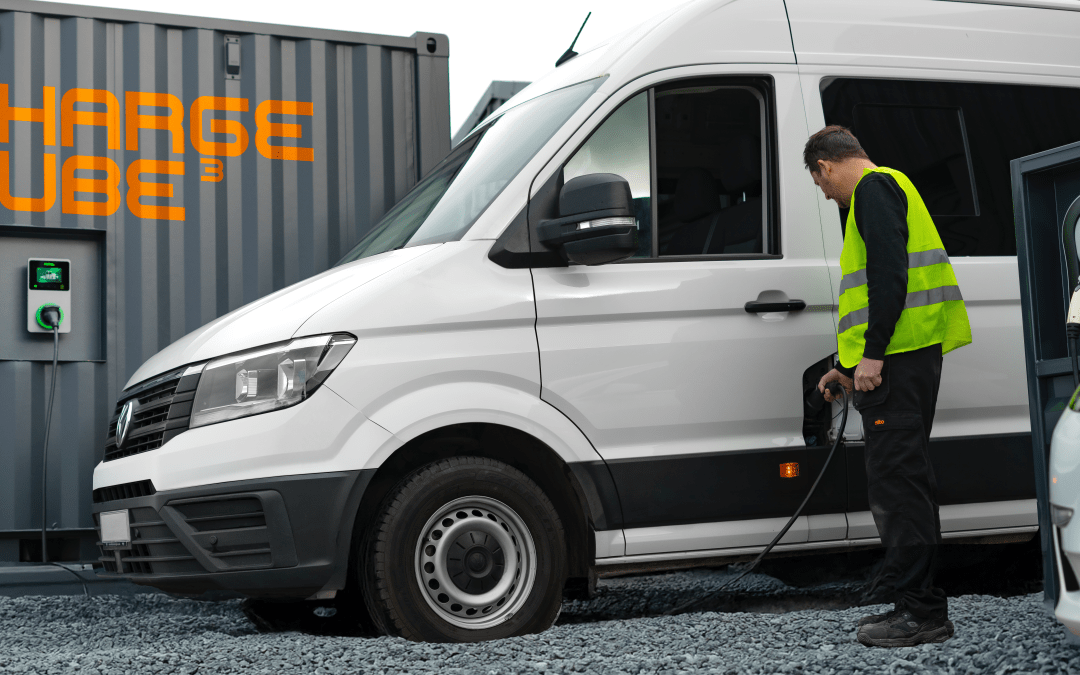
Housed in a durable 10-foot ISO container, Charge Qube is an all-in-one, energy storage and charging system that integrates into existing energy networks or operates as a stand-alone power source. Its Type-2 AC charging version offers up to five satellite stalls equipped with twin chargers.
Charge Qube provides scalable energy storage from 150kWh to 450kWh per unit and supports both AC and DC fast charging.
A larger 20-foot container option offering up to 900kWh capacity will join the 10-foot version in the second quarter of this year.
Designed not to require planning permission and to overcome the limitations of grid-constrained locations, the Charge Qube delivers immediate energy solutions for fleet operators, public charging stations, construction sites, and remote or temporary or semi-permanent power needs.
With integrated solar and wind energy capabilities, it also offers a sustainable alternative to traditional diesel generators.
Designed for practical, high-impact use cases
UK-built in Bristol, the Charge Qube embodies British engineering ingenuity and sustainability, repurposing UK-sourced EV batteries and ISO containers to support local innovation while remaining cost-competitive against overseas solutions.
Unlike conventional energy storage systems, the Charge Qube:
- Requires no planning permission, making it an ideal solution for temporary or semi-permanent charging hubs.
- Stores energy at low-cost periods and supplies it during peak demand, enabling businesses to benefit from energy arbitrage.
- Supports diverse applications from EV fleet charging and industrial backup power to construction site electrification and off-grid event infrastructure.
Key features and configurations
- Scalable, modular energy storage: Configurations range from 150kWh to 450kWh, with daisy-chaining options for extended capacity.
- AC and DC charging capabilities: Available in three variants:
- Energy storage only: Providing flexible, off-grid power solutions.
- Type-2 AC charging: Supporting up to 12 EVs simultaneously at 7kW per port, ideal for fleet operations (Two Type-2 AC chargers on the Qube along with pairs of 7kW chargers on up to five satellite stalls)
- CCS DC fast charging: Featuring dual 240kW CCS chargers, suitable for high-speed public and commercial EV charging.
- Sustainable innovation: Utilises second-life EV battery packs, extending their lifespan by up to 25 years while reducing carbon footprint and costs.
- Rapid deployment and flexibility: It can be operational within two hours of delivery and placed on any stable ground without major infrastructure upgrades.
- Renewable-ready: Accepts direct input from solar panels and roof-mounted vertical wind turbine generators, maximising sustainability and energy efficiency.
- Secure and smart management: Features advanced battery management systems, fire suppression technology, and remote cloud-based monitoring.
Charge Qube is available under multiple acquisition models, including direct purchase, leasing, and rental, ensuring flexibility for businesses of all sizes.
by Catie Owen | Jan 30, 2025 | Electric Vehicles, Innovation
UK ministers are considering guaranteeing consumer loans to boost electric vehicle (EV) sales by making low-interest or interest-free financing more accessible – according to a report from the Financial Times.
Discussions with the auto finance sector aim to lower monthly payments and bring EV costs closer to petrol and diesel vehicles.
The move could help car manufacturers struggling to meet sales targets and suggests the 2022 removal of EV purchase subsidies may have been premature.
While EVs remain more expensive upfront, over 80% of new UK cars are financed or leased, according to the Finance & Leasing Association.
Carmakers are pushing for measures to stimulate demand and expand charging infrastructure. Though EV sales are rising, they remain below targets and are largely concentrated in the company car sector, which benefits from tax incentives.
Under the ” zero-emission vehicle mandate, manufacturers like Volkswagen, Ford, and Renault must meet increasing sales quotas. The mandate requires 80% of sales to be zero-emission by 2030.
Non-compliance could mean fines of £15,000 per vehicle. Stellantis cited these regulations as a factor in closing its Luton van factory, while Ford linked them to UK job cuts.
The government is consulting the industry on adjustments but is unlikely to reinstate direct purchase subsidies. The previous plug-in car grant, initially £5,000 per EV, was phased out by 2022.
Falling used EV prices have increased repayments under “personal contract purchase” finance deals. Adrian Dally, the FLA’s motor finance director, said: “If there was a way where the government could underwrite cheaper loans… that would be extremely helpful.”
A Department for Transport spokesperson called 2024 a “record year for switching to electric,” with 382,000 EVs sold and nearly 20,000 new public chargers.
“We’re investing over £2.3bn to support industry and consumers make the switch.”
This series covers the developing electric vehicles market of the UK and its increasing infrastructure, as the nation advances its net-zero goals. For all things EV, don’t miss out on your free ticket to EVCharge Live UK – taking place 23-25 September 2025.
by Catie Owen | Jan 27, 2025 | Electric Vehicles, Innovation
Electric vehicles (EVs) now have lifespans comparable to or longer than petrol and diesel cars, according to a study published in Nature Energy.
Researchers analysed nearly 300 million UK Ministry of Transport (MOT) test records from 2005 to 2022, revealing that battery electric vehicles (BEVs) achieve an average lifespan of 18.4 years and can travel up to 124,000 miles, surpassing the typical lifespan of petrol cars.
While earlier EV models showed lower reliability than internal combustion engine (ICE) vehicles, the study found significant improvements in newer BEVs.
Each successive year of BEV production showed a 12% reduction in failure likelihood, compared to 6.7% for petrol vehicles and 1.9% for diesel.
“Our findings provide critical insights into the lifespan and environmental impact of electric vehicles,” said Dr. Viet Nguyen-Tien of the London School of Economics and Political Science. “No longer just a niche option, BEVs are a viable and sustainable alternative to traditional vehicles.”
The study, conducted by researchers from the University of Birmingham, LSE, University of California San Diego, and University of Bern, highlighted Tesla as the top-performing BEV brand, with Audi and Skoda leading in petrol and diesel categories, respectively.
“BEVs offer significant environmental benefits, especially as Europe switches to a more renewable energy mix,” said Professor Robert Elliott from the University of Birmingham. He noted that despite higher emissions during production, long-lasting EVs can quickly offset their carbon footprint.
The research provides valuable data for consumers, policymakers, and industries looking to develop strategies for fleet upgrades, vehicle recycling, and sustainable transportation growth.
This series covers the developing electric vehicles market of the UK and its increasing infrastructure, as the nation advances its net-zero goals. For all things EV, don’t miss out on your free ticket to EVCharge Live UK – taking place 23-25 September 2025.
by Catie Owen | Jan 21, 2025 | Electric Vehicles, Innovation
The UK is expected to meet its predicted 2035 zero-emission vehicle (ZEV) production targets, according to the Advanced Propulsion Centre UK (APC) quarterly demand report.
This aligns with the anticipated ban on fossil-fuel internal combustion engine (ICE) sales by 2035, which will drive battery electric vehicle (BEV) demand.
While 2035 forecasts remain unchanged, demand growth is expected to slow in the short term, with global projections for 2027 and 2030 down 14% and 12%, respectively.
In the near term, electric hybrids are expected to see growth, especially in Europe, before BEVs gain wider consumer acceptance. This shift underscores the need for continued investment in advanced battery-cell chemistries.
Julian Hetherington, Automotive Transformation Director at the APC, said:
“While it has been a turbulent 12 months in terms of geopolitical and economic events affecting the global automotive market… it is reassuring to see our predicted figures for 2035 largely on track… acknowledging some near-term reductions reflecting market conditions.”
Hetherington highlighted the growing importance of lithium-iron-phosphate (LFP) batteries, citing their cost-effectiveness and safety advantages.
He continued: “Our forecasts indicate up to a 30% chemistry share for LFP across Europe, with up to a 25% share here in the UK by 2035. Globally… this could reach a 45% share.”
The report emphasises the UK’s competitiveness in LFP and lithium-manganese-iron-phosphate (LFMP) batteries, calling for investment in the battery value chain to support these chemistries and meet future demand.
This series covers the developing electric vehicles market of the UK and its increasing infrastructure, as the nation advances its net-zero goals. For all things EV, don’t miss out on your free ticket to EVCharge Live UK – taking place 23-25 September 2025.
by Catie Owen | Jan 16, 2025 | Electric Vehicles, Innovation
Royal Mail has deployed its 6,000th electric vehicle (EV) at the Manchester Mail Centre, joining 15 others already operating at the site for deliveries and collections.
The company now operates the UK’s largest electric delivery fleet, with over 240 Royal Mail offices across the country using EVs. Royal Mail purchased its first 100 electric vans in December 2017, reaching 5,000 vehicles by July 2023.
Most of the company’s electric vans are charged on-site using 100% renewable electricity, making them zero-emission.
“We are excited to reach this major milestone just as we enter 2025,” said Alistair Cochrane, Royal Mail’s chief operating officer.
“Electric vehicles are an essential part of our plan to be net-zero by 2040 and offer many benefits for both our staff and customers. Our zero-emission vehicles make our deliveries greener, reducing noise and air pollution in local communities.”
In July 2023, Royal Mail announced plans to add another 2,100 electric vans as part of its fleet replacement program. The company later struck a deal with Peugeot to supply the vans, including 1,100 British-built E-Partners and 1,000 fully electric E-Expert vans.
By the time all the new vehicles are operational, Royal Mail’s electric fleet will consist of 7,100 vans.
Electrifying its delivery fleet is a key part of Royal Mail’s strategy to lower vehicle emissions. The company is also using hydrotreated vegetable oil (HVO) as a renewable alternative to diesel for many of its heavy goods vehicles, reducing carbon emissions by up to 90%.
Royal Mail’s ‘Steps to Zero’ strategy aims for net-zero emissions by 2040. The company has already cut Scope 1 and 2 emissions by 18% in four years, intending to reduce them by 50% by 2030.
This series covers the developing electric vehicles market of the UK and its increasing infrastructure, as the nation advances its net-zero goals. For all things EV, don’t miss out on your free ticket to EVCharge Live UK – taking place 23-25 September 2025.
by Catie Owen | Jan 14, 2025 | Electric Vehicles, Innovation
Amazon has requested the UK’s largest-ever order of electric heavy goods vehicles (eHGVs) and invested in new lower-emission delivery methods, including rail and on-foot deliveries.
Focusing on eHGVs
Over the next 18 months, Amazon will integrate more than 140 Mercedes-Benz eActros 600 and eight Volvo FM Battery Electric trucks into its UK transportation network. This marks the country’s largest eHGV purchase to date.
These vehicles are expected to transport over 300m packages annually, covering routes between fulfilment centres, sorting hubs, and customer homes without producing exhaust emissions.
To support the fleet, Amazon is installing fast charging infrastructure, including 360 kW chargers capable of powering the 40-tonne trucks from 20% to 80% in just over an hour. With a full charge range of 310 miles, these vehicles represent a significant step toward decarbonising road transport.
A portion of the Mercedes-Benz trucks is funded through the UK Government’s Zero Emission HGV and Infrastructure Demonstrator (ZEHID) programme, backed by Innovate UK.
Future of Roads Minister Lilian Greenwood comments, “Business has a crucial role to play in decarbonising our roads. It’s fantastic to see Amazon place the UK’s biggest ever order of electric trucks, supported in part by our £200m ZEHID project.”
Progress Toward Net-Zero Goals
Since 2022, Amazon has completed over 150m UK deliveries using electric vans and cargo bikes, covering more than 19m miles. Nicola Fyfe, EU VP of Amazon Logistics, says:
“Decarbonising our transport network is key to achieving our net-zero carbon goal by 2040. Today’s announcement is an exciting step forward for our customers, the environment, and our business.”
This series covers the developing electric vehicles market of the UK and its increasing infrastructure, as the nation advances its net-zero goals. For all things EV, don’t miss out on your free ticket to EVCharge Live UK – taking place 23-25 September 2025.
by Catie Owen | Jan 10, 2025 | Electric Vehicles, Innovation
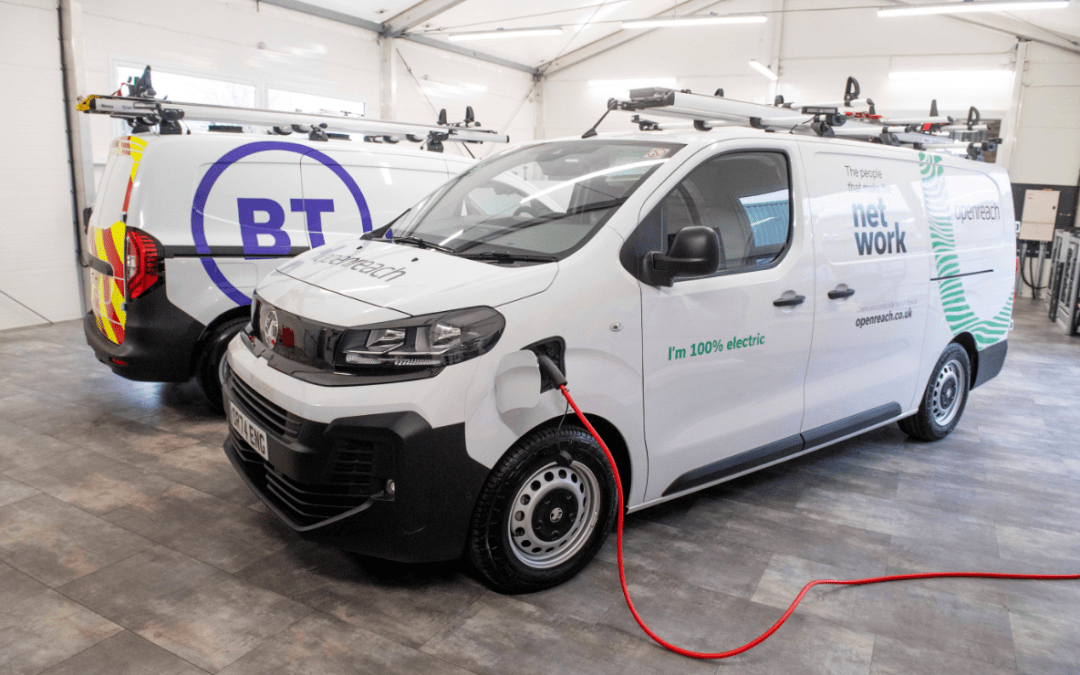
BT Group has announced the UK’s largest-ever commercial electric vehicle (EV) fleet order, with around 3,500 new EVs set to join its operations.
This move will expand the group’s EV fleet to nearly 8,000 vehicles by 2026, solidifying its position as the largest EV fleet operator in the UK.
The company, which includes Openreach—the UK’s largest wholesale broadband provider – manages the second-largest commercial vehicle fleet in the country with over 27,000 vehicles.
The latest order is part of a broader delivery of 6,000 new vehicles, more than half of which will be EVs. BT Group currently operates approximately 4,300 EVs, supporting its goal to achieve net zero emissions by March 2031.
Simon Lowth, Chief Financial Officer at BT Group, stated:
“By integrating yet more electric vehicles into our operations, we are taking another significant step towards reducing our carbon footprint and supporting the UK’s transition to a greener future. Our modern fleet will help us to be more efficient and deliver a better service for our customers.”
The upgraded fleet will support engineers working on the group’s full-fibre broadband network, which covers over 16 million premises and is on track to reach 25 million by 2026. Engineers also maintain the EE mobile network’s 19,500 masts and around 5,600 telephone exchanges.
Future of Roads Minister Lilian Greenwood praised the initiative, saying: “It’s fantastic to see that BT Group have made the most of our plug-in van grant to order 3,500 brand-new EVs, which means they will have the largest electric commercial fleet in the UK.”
The vehicles will be supplied by Ford, Stellantis, Toyota, and Renault over the next two years.
This series covers the developing electric vehicles market of the UK and its increasing infrastructure, as the nation advances its net-zero goals. For all things EV, don’t miss out on your free ticket to EVCharge Live UK – taking place 23-25 September 2025.
[Image credit: BT Group]
by Catie Owen | Dec 11, 2024 | Electric Vehicles, Innovation
William Brown, CEO of International Motors, has urged the UK government to reintroduce incentives for private buyers of electric vehicles (EVs), funded by taxes on petrol and diesel cars.
The previous Plug-In Car Grant, which provided up to £1,500 for EV or plug-in hybrid purchases, was discontinued in 2022. Brown argues that its reinstatement is necessary to increase demand, particularly among private buyers.
Under the current Zero Emissions Vehicle (ZEV) mandate, automakers must ensure a rising percentage of new car sales are zero emissions, with a target of 22% in 2024 and 28% in 2025. However, only 18.7% of new car sales this year are fully electric, predominantly sold to fleets rather than individuals.
“What I’d like [the government] to do is incentivise consumers to buy electric vehicles,” Brown said.
“The problem is we need more demand for electric vehicles, and the only way to do that is to help consumers with the buying decision.”
He pointed to Norway’s success with EV adoption, citing grants as a straightforward and effective approach.
In contrast, the Society of Motor Manufacturers and Traders (SMMT) has called for halving VAT on new EVs and reducing VAT on public charging to match home charging costs. Brown disagrees, stating, “I think a grant would be better.”
To fund such incentives, Brown proposed an environmental tax on internal combustion engine (ICE) vehicles.
“You’re sending a clear message: buying an ICE vehicle will cost more, but that money can be reinvested to support EV adoption.”
Brown also warned of the challenges faced by foreign carmakers in the UK market, particularly smaller brands. He expressed concerns over potential tariffs conflicting with the ZEV mandate, emphasizing the need for competition to lower EV costs.
“The government needs to act – whether through incentives or adjustments to the ZEV targets—to ensure a sustainable transition to EVs,” he concluded.
This series covers the developing electric vehicles market of the UK and its increasing infrastructure, as the nation advances its net-zero goals. For all things EV, don’t miss out on your free ticket to EVCharge Live UK – taking place 23-25 September 2025.
by Catie Owen | Dec 4, 2024 | Electric Vehicles, Innovation
Authored by Grace Dawes. Syndicated from sister resource MOVEMNT.
German-based charge point operator (CPO) Ionity has partnered with Charlestown Shopping Centre in Dublin to develop Ireland’s largest electric vehicle (EV) charging station yet.
Ionity – a joint venture formed by BMW Group, Ford Motor Company, Hyundai Motor Group, Mercedes-Benz AG and Volkswagen Group – will deliver 12 EV chargers to the site that are reportedly powered by 100% renewable energy.
The high-power chargers claim to deliver a 10-80% charge for EVs in less than 20 minutes.
Ionity’s Country Manager for UK&I, Andreas Atkins, said:
“With 115,000 drivers on the M50 every day, providing an EV charging station is hugely important if we’re going make EVs the norm across Europe.”
The development aligns with Ireland’s Climate Action Plan which aims for 40% of the private car fleet to be electrified by 2030 across the nation.
The Charlestown Shopping Centre Manager, Dan O’Connor, said:
“With the installation of these 12 Ionity Fast Chargers, we are proud to offer the largest EV charging hub in Ireland. This initiative reflects our ongoing commitment to promoting sustainability, reducing our carbon footprint, and enhancing the shopping experience for our customers.”
With BlackRock as a financial investor, the CPO claims to operate an EV charging site every 60-80 miles across Europe’s highway network.
This series covers the developing electric vehicles market of the UK and its increasing infrastructure, as the nation advances its net-zero goals. For all things EV, don’t miss out on your free ticket to EVCharge Live UK – taking place 23-25 September 2025.
[Image credit: Ionity]
by Catie Owen | Dec 3, 2024 | Electric Vehicles, Innovation
The UK Chancellor of the Exchequer, Rachel Reeves, is being asked to consider cancelling plans for a luxury car tax on electric vehicles.
This is due to concerns that such a levy would make EVs unaffordable for most, undermining attempts to reach the government’s net-zero targets.
A new tax
EVs registered from 1 April 2025 will incur an additional tax (the “Expensive Car Supplement”) if they cost over £40,000.
The previous UK government, led by the Conservative Party, initially floated plans to include EVs in the Expensive Car Supplement despite being exempt since 2020. The Labour Party, which took over in July, is following through on these plans.
Research from the Society of Motor Manufacturers and Traders (SMMT) shows that EVs usually cost over a third more than regular vehicles, resulting in about 70% of new EVs being subject to tax in comparison to 19% of petrol and diesel.
This will significantly impact a large number of drivers in the UK, with the SMMT noting that in 2024 alone 300,000 EVs have been bought in the nation.
Drivers subject to this levy will pay £425 per annum for five years – during the second and sixth years of the car’s lifespan.
Overall, this will cost drivers over £2,000 – including if the car has a new owner in that period.
Stuart Masson, editor of The Car Expert UK, warned: “We need lower-income drivers to have access to EVs – you have to democratise… The £40,000 cut-off includes many, many EVs, but there will also be cheaper diesel vehicles not paying it.”
Meanwhile, a Treasury spokesperson added: “We want to ensure electric vehicles are affordable which is why, to help keep costs down, we announced at the Budget that we will consider raising the threshold at which electric vehicles pay the Expensive Car Supplement.”
Ongoing concerns
The news comes amidst other concerns regarding the government’s support for the zero-emission vehicle transition.
November 2024 saw car giant Stellantis announce plans to close its factory in Luton, citing the UK’s EV mandate as the driving force behind the decision.
While SMMT warned that a fast-paced transition could hurt manufacturers if demand “failed to meet ambition”, Ford UK called for government incentives to help stimulate EV demand – increasing the chance of meeting transition targets.
This series covers the developing electric vehicles market of the UK and its increasing infrastructure, as the nation advances its net-zero goals. For all things EV, don’t miss out on your free ticket to EVCharge Live UK – taking place 23-25 September 2025.
by Catie Owen | Nov 28, 2024 | Electric Vehicles, Innovation
Authored by Grace Dawes. Syndicated from sister resource MOVEMNT.
Car-making giant Stellantis has announced plans to close its Luton van factory after UK electric vehicle sales rules are held firm by the UK government.
Around 1,100 jobs have been put at risk due to the closure but the manufacturing giant has promised to relocate the workers to the company’s Ellesmere Port manufacturing site, according to reports.
The Vauxhall and Peugeot owner said Britain’s “challenging” UK Zero Emission Vehicle (ZEV) Mandate and firm 2030 ban on petrol vehicles played a “significant part” in the integration of electric van-making at its new plant.
The giant announced the start of a consultation with its employees and Trade Union partners on a proposal to consolidate its UK manufacturing of light commercial vehicles (LCV) to create an all-electric vehicle hub at its Ellesmere Port site in Cheshire through a £50 million investment.
The Society of Motor Manufacturers and Traders (SMMT) said slowing demands for electric vehicles (EV) and the requirement to hit EV sales targets would cost carmakers £6bn in 2024 alone, according to the BBC.
However, ministers remain determined to persist with the goal of phasing out new petrol and diesel car sales by 2030. The target requires 80% of new cars and 70% of new vans sold in Great Britain to be emission-free by 2030, growing to 100% by 2035.
If manufacturers fail to reach these targets they will be subject to fines – £15,000 is required per polluting vehicle sold above the limits.
This series covers the developing electric vehicles market of the UK and its increasing infrastructure, as the nation advances its net-zero goals. For all things EV, don’t miss out on your free ticket to EVCharge Live UK – taking place 23-25 September 2025.
[Image credit: Vauxhall]
by Catie Owen | Nov 27, 2024 | Electric Vehicles, Innovation
Ford UK has urged the UK government to introduce incentives to increase electric vehicle (EV) sales, as concerns grow within the auto industry over ambitious EV sales targets.
Lisa Brankin, Ford UK’s chair and managing director, stated, “Without demand, a government mandate to produce and sell more EVs just doesn’t work.”
The government plans to phase out new petrol and diesel car sales by 2030, with rising annual zero-emission sales quotas and significant penalties for non-compliance.
EVs must comprise 22% of car sales in 2024, increasing to 28% by 2025, with fines of £15,000 per car for falling short.
Ford, which recently announced 800 UK job cuts over three years, has invested over £350m in electrification.
Industry figures argue demand is lagging behind targets, leading manufacturers to discount EVs or buy compliance credits from companies like Tesla.
While EV sales are growing—they made up 20% of new car registrations in October—sources claim this is unsustainable due to heavy discounting.
At the Society of Motor Manufacturers and Traders (SMMT) dinner, Business Secretary Jonathan Reynolds acknowledged concerns, announcing plans for a consultation to address industry feedback but reaffirmed the government’s commitment to the 2030 deadline.
The SMMT has called for urgent action, warning that weak EV demand and stringent quotas could jeopardise business viability and jobs.
This series covers the developing electric vehicles market of the UK and its increasing infrastructure, as the nation advances its net-zero goals. For all things EV, don’t miss out on your free ticket to EVCharge Live UK – taking place 23-25 September 2025.
by Catie Owen | Nov 21, 2024 | Electric Vehicles, Innovation
The UK’s Transport Secretary, Louise Haigh, and Business and Trade Secretary Jonathan Reynolds recently met with automotive and charging industry representatives to discuss the 2030 phase-out of petrol and diesel vehicles and the Zero Emission Vehicle (ZEV) Mandate.
Attendees included leaders from SMMT, Tesla, Nissan, Ford, Volkswagen Group, Stellantis, BMW, Toyota, ChargeUK, and BVRLA.
The government reaffirmed its commitment to the 2030 ban on new internal combustion engine (ICE) vehicles and emphasized delivering the ZEV transition in a way that promotes UK economic growth.
Details on implementation will follow, including a consultation on how the phase-out will apply to cars and vans. The ZEV Mandate requires 22% of cars and 10% of vans sold in the UK this year to be electric, with annual targets tightening until 2030.
Manufacturers face penalties for non-compliance, prompting concerns from some in the automotive sector about the need for stronger incentives to support the transition.
A government spokesperson stated, “Ministers have met with automotive and industry representatives to discuss the EV transition and how the government can support the sector’s growth.
“The UK now leads Europe in zero-emission vehicle growth, with over £2.3bn invested to support this transition and an average of 57 new public chargers installed daily.”
Vicky Read, CEO of ChargeUK, highlighted the charging industry’s progress: “ChargeUK members are installing a new charge point every 25 minutes and are committed to investing over £6 billion by 2030.
Uncertainty threatens this progress, but we welcome the forthcoming consultation and advocate for a strong ZEV mandate.”
Dominic Phinn, Head of Transport at Climate Group, expressed support for the mandate: “This tool has placed the UK at the forefront of the global EV transition. Automakers must seize this opportunity to scale up or risk falling behind.”
This series covers the developing electric vehicles market of the UK and its increasing infrastructure, as the nation advances its net-zero goals. For all things EV, don’t miss out on your free ticket to EVCharge Live UK – taking place 23-25 September 2025.
by Catie Owen | Nov 19, 2024 | Electric Vehicles, Innovation
Major pension funds have cautioned the UK Government that any dilution of electric vehicle (EV) sales targets could harm investment confidence and disrupt progress on net zero initiatives.
Fund managers, including Macquarie, M&G, Aviva, and Schroders, have invested significantly in EV charging infrastructure, relying on the Zero Emission Vehicle (ZEV) mandate to drive EV adoption.
The ZEV mandate requires 22% of car sales to be electric this year, increasing to 80% by 2030.
Reports suggest the Government may relax these targets to ease pressure on carmakers, who argue the goals are misaligned with consumer demand.
Louise Haigh, the Transport Secretary, recently met Nissan, while further discussions with the auto industry are scheduled this week.
James Alexander, CEO of the UK Sustainable Investment and Finance Association, warned: “Investments in projects such as battery factories are highly sensitive to the policy environment and can be easily jeopardised by sudden policy U-turns.
“The ZEV mandate currently underpins billions of investment in the UK’s automotive sector. Investors need certainty, not shifting sands.”
Critics argue policy changes could undermine confidence in green technologies, including wind farms and carbon capture. Companies such as Ovo, SSE, and Octopus Energy have urged the Government to maintain stability.
Fiona Howarth, CEO of Octopus Electric Vehicles, said: “The ZEV mandate is doing what it’s supposed to – providing stability and boosting electric car adoption. Scrapping it would be a huge mistake.”
Carmakers, including Stellantis and Jaguar Land Rover, have lobbied for relaxed rules, citing slower-than-expected demand and potential financial losses.
Nissan reaffirmed its commitment to net zero but called for adjustments to reflect market realities.
Haigh stated: “We’re always open to engaging with industry… to decarbonise our car industry, support jobs, and deliver growth.”
This series covers the developing electric vehicles market of the UK and its increasing infrastructure, as the nation advances its net-zero goals. For all things EV, don’t miss out on your free ticket to EVCharge Live UK – taking place 23-25 September 2025.
by Catie Owen | Nov 7, 2024 | Electric Vehicles, Innovation
Loughborough, UK, 7th November 2024 – From 24th November 2024, all UK public chargepoint operators will be required to share data from their chargepoints openly and freely. This will improve the availability of reliable data for electric vehicle drivers. The National Chargepoint Registry (NCR), which currently serves as an open database for public Electric Vehicle (EV) chargepoint information, will therefore be decommissioned on 28th November 2024.
Under the Public Chargepoint Regulations 2023, from 24th November all public EV chargepoint operators will be required to share open data free of charge on elements such as location, real-time availability, connector types, and payment methods. This will enable the supply of more complete chargepoint data to EV drivers, through existing and emerging data providers.
Following this requirement coming into force, and open data becoming available, the NCR will be decommissioned on 28th November. Since 2011, the NCR has provided a source of open data on EV chargepoints, based on voluntary uploads.
This resource has provided support to developers, local authorities and industry leaders by offering accessible information on the locations, connector types and operational hours of chargepoints across the UK. This data has fuelled growth in both the public and private sectors, empowering mobility providers, app developers and urban planners to enhance EV adoption and improve infrastructure development.
Cenex, the UK’s Centre of Excellence for Low Carbon and Fuel Cell Technologies, was appointed by the Office for Zero Emission Vehicles (OZEV) to manage the NCR in 2017, during which time the dataset has grown from around 3,800 chargepoints to over 63,000 today. In collaboration with Apetrel Systems, Cenex has maintained and improved the NCR as a trusted resource within the UK’s Open Data initiative.
The archived NCR data will be available on request to users and researchers after 28th November, ensuring the continuity of vital information and reflecting the Registry’s legacy in advancing the nation’s EV journey.
Jacob Roberts, Senior Policy & Strategy Consultant, Cenex, commented, “We are proud of the NCR’s role in supporting the UK’s EV revolution. The growth in EV infrastructure it has documented is a testament to the dedication of the entire industry, from local governments to private sector innovators. We look forward to seeing how the EV charging industry continues to grow and evolve as open data becomes more available.”


 Reliability is still a concern, particularly for the bigger vehicles. They’re essential frontline machines, and we can’t afford service disruptions. But when the EVs work well, staff really get behind them.
 Next, get your charging infrastructure in place early. Across our sites, we’ve installed more than 140 AC and DC charging sockets.

 A larger 20-foot container option offering up to 900kWh capacity will join the 10-foot version in the second quarter of this year.