by Catie Owen | Jun 23, 2025 | Asia, Commercial & Industrial Solar, Press Release, Storage
Press Release
China’s largest electrochemical energy storage project – 600MW/2400MWh – has completed installation of all storage cabins in its first site, marking a key milestone as it enters the electrical commissioning phase.
This is China’s first ultra-high voltage (UHV) transmission project integrating wind, solar, thermal, and storage. SINEXCEL (300693.SZ) is proud to power this national-level project with its utility-scale 1725kW Power Conversion System (PCS).
China’s Largest Electrochemical Energy Storage Project 600MW/2400MWh Powered by SINEXCEL’s 1725kW PCS
This site includes 240 battery containers and 60 PCS skids. Once operational, the whole project will integrate approximately 840 GWh of renewable energy into the grid annually. A single charge stores up to 2.4 GWh—enough to meet the daily electricity needs of 480,000 households or power 36,000 EVs with 500km range.
In addition, SINEXCEL supported a 220MW/880MWh storage project that was successfully connected to the grid in Ningxia.
Leveraging the region’s abundant solar resources, the project integrates solar and storage to solve renewable energy curtailment, enhance grid stability and energy shifting. The station is expected to supply nearly 200 GWh electricity annually.
SINEXCEL proudly contributes to these two projects with its 1725kW PCS. Designed to enhance grid stability, the 1725kW PCS features a modular architecture scalable from 215kW to 1.72MW per unit.
It combines advantages for both centralized and string configurations, supports diverse battery types, and enables flexible deployment across various storage scenarios, including large C&I, microgrids, and front-of-the-meter applications.
With peak efficiency of up to 98.5%, the PCS features advanced multi-string technology for enhanced battery protection and supports flexible configurations with 1, 2, 4, or 8 battery strings.
Its combined AC/DC output simplifies control and expansion, while NEMA 3R-rated cabinets ensure outdoor durability. A rapid 10ms response time supports real-time grid balancing, and the product meets major compliance standards in North America, Europe, Australia, Japan and China.
With a global footprint spanning 40+ countries and over 5,000 deployments worldwide, SINEXCEL has installed over 12GW of storage capacity, delivering solutions for utility-scale, C&I, and microgrid applications.
The successful participation in these landmark projects underscores SINEXCEL’s technical strength and ongoing commitment to enabling a more resilient and sustainable energy future.
Want to publish a press release? Submit your content here for review by our editorial team.
by Catie Owen | Jun 13, 2025 | Africa, Large Scale Utility Solar, Storage
The African Development Bank Group has approved up to $184.1m in financing for the Obelisk solar project in Egypt, set to become the largest solar power plant in Africa.
Located in the Qena Governorate, the 1GW photovoltaic plant will include a 200MWh BESS. The Egyptian Electricity Transmission Company will be the sole off-taker under a 25-year Power Purchase Agreement. Total project costs are estimated at over $590m.
Funding includes $125.5m from the Bank’s ordinary resources, $20m from the Sustainable Energy Fund for Africa, $18.6m from the Canada-African Development Bank Climate Fund, and $20m from the Clean Technology Fund.
Additional support will be provided by other development finance institutions.
Granted a Golden License under Egypt’s Nexus of Water, Food, and Energy (NWFE) platform, the project is considered a strategic initiative for national energy transition.
Dr. Rania Al-Mashat, Egypt’s Minister of Planning, Economic Development and International Cooperation, said: “The Obelisk solar project is another important milestone for Egypt under the energy pillar of the NWFE program…with the support of partners such as the Africa Development Bank.”
The plant is expected to begin operation by Q3 2026, generating 2,772GWh of clean energy annually, reducing CO₂ emissions by around one million tons, and creating approximately 4,000 construction jobs and 50 permanent roles.
“Obelisk is another landmark development under NWFE,” said Kevin Kariuki, African Development Bank Vice President, “contributing to Egypt’s ambition of producing 42% of its power generation capacity from renewable energy sources by 2030.”
Ambassador Ulric Shannon added, “Canada is proud to support solar energy development in Egypt…with direct benefits for the Egyptian people.”
The Bank considers the project a model for replicability across Africa.
by Catie Owen | Jun 12, 2025 | Europe, Large Scale Utility Solar, Storage
Solar Energy UK has welcomed the Government’s £13.2bn pledge to upgrade the energy efficiency of homes across the country, as outlined in the latest Spending Review.
The Warm Homes Plan promises to reduce household energy bills by up to £600 through measures such as heat pumps, solar panels, and battery storage systems.
“The Warm Homes Plan will help to cut bills… by upgrading homes through energy efficiency measures, alongside installing heat pumps and other low-carbon technologies, such as solar panels and batteries,” the statement said.
The trade association emphasised the benefits of combining solar with battery energy storage, which can cut reliance on grid electricity and expensive natural gas.
The statement added: “Greater access to solar and battery technology will drive bills down for those in most need and reduce our reliance on expensive natural gas, while contributing to national security, decarbonisation and economic growth.”
With solar capacity expected to grow by up to 17% this year, Solar Energy UK highlighted the need for a larger skilled workforce. The sector could create over 42,000 jobs by 2035.
“We are also delighted to see £1.2bn per year earmarked for training and apprenticeships,” said Chris Hewett, Chief Executive of Solar Energy UK.
“Ensuring that the workforce has the skills to meet our commitments to decarbonise the grid is of vital importance and will be a key theme in the Government-industry Solar Roadmap.”
The Spending Review also includes additional funding for research and development. Solar Energy UK said it looks forward to more information on how innovative solar and battery firms can access this support.
by Catie Owen | Jun 11, 2025 | Americas, Large Scale Utility Solar, Storage
US-based independent power producer Soltage has closed a $260m financing deal to support the rollout of its distributed solar and energy storage pipeline in the US, which exceeds 2GW in total capacity.
The funding will back near-term construction of 250MW of solar and storage installations.
The financing package includes a revolving construction loan, a tax equity bridge loan, and a term loan facility. It was led by the National Bank of Canada and First Citizens Bank, with participation from BankUnited, Cadence Bank, and Siemens Financial Services.
“This financing marks Soltage’s continued deployment of innovative financial structures that enable efficient capital investment in domestic energy infrastructure,” said Jesse Grossman, CEO of Soltage.
“With the support of National Bank of Canada, First Citizens Bank, and our valued financial partners, this facility will enable construction of the next 250MW of distributed solar and storage projects across our national portfolio.”
Based in New Jersey, Soltage develops and operates distributed utility-scale clean energy projects, supplying power to utility, commercial, industrial, and municipal customers.
The company is backed by infrastructure investment manager Igneo Infrastructure Partners and has delivered over 125 clean energy projects totalling more than 500MW.
The financing marks a deepening of relationships between Soltage and its financial partners.
by Catie Owen | Jun 10, 2025 | Americas, Commercial & Industrial Solar, Storage
According to the Solar Energy Industries Association (SEIA)’s US Solar Market Insight Q2 2025 report, the US added 8.6GW of new solar module manufacturing capacity in Q1 2025.
This makes Q1 the third largest for new manufacturing capacity to date, and overall, the US installed 10.8GW of new capacity in Q1. Solar and BESS account for 82% of all new generating capacity.
The report also notes that US solar cell production capacity doubled to 2GW in the same time frame, due to a new factory in South Carolina coming online.
SEIA’s report hails Texas as a returning winner in the US’ solar race, as it added more capacity in Q1 than any other state. Florida overtook California to reach second place.
“Solar and storage continue to dominate America’s energy economy, adding more new capacity to the grid than any technology using increasingly American-made equipment,” said SEIA president and CEO Abigail Ross Hopper.
Uncertain horizons
“The 10.8 GW of solar capacity installed in Q1 2025 represents a significant portion of new US electricity generation, highlighting solar’s growing dominance in the energy mix,” said Zoë Gaston, Principal Analyst at Wood Mackenzie – who worked with SEIA on the report.
However, the report also highlights increasing legislation that could hinder the sector’s growth. It cites economy-wide tariffs, new anti-dumping and countervailing duties (AD/CVD) on cells and modules from Southeast Asia, and shifts in renewable energy policies (such as the reconciliation bill) as culprits.
SEIA warns that these hindrances could result in lost jobs, energy shortages, rising energy bills, factory closures, and a fall in national energy production by 173TWh.
“The proposed changes to federal tax incentives, along with ongoing tariff concerns, could significantly impact this growth trajectory and potentially lead to energy supply challenges,” adds Gaston.
“It’s important to consider the critical role of solar in America’s energy landscape.”
by Catie Owen | Jun 9, 2025 | Americas, Europe, Storage
Daiwa Energy & Infrastructure (DEI) has acquired a minority stake in two BESS projects developed by Enfinity Global, an independent power producer.
Announced on 4 June, the deal gives DEI a 49% equity interest in 380MW of BESS developments.
These include a 250MW/500MWh project located in the ERCOT market in Texas, US, and a 130MW/520MWh project in Veneto, northeast Italy.
As reported in February, Enfinity’s two Texas projects are due to begin construction in the second and fourth quarters of 2025. The Italian project is expected to come online in Q4 of 2027.
Founded in 2018 by Japanese investment bank Daiwa Securities, invests in infrastructure projects such as solar PV, wind, data centres and battery storage.
The company entered the Texas BESS market in April 2024 through a partnership with Stella Energy Solutions to co-develop the 200MW/480MWh Thomas Cameron BESS project, expected to go live in 2026.
DEI has also partnered with Gotion High-Tech, a Chinese battery manufacturer, to pursue 1GWh of BESS projects in Japan.
Enfinity Global was founded in 2019 and manages a 35.5GW global portfolio of operational, in-construction and planned renewable energy and storage projects. This includes 1.1GW of operational capacity.
Interested in Italy’s solar market? Don’t miss your free ticket to Solar & Storage Live Italia – taking place 8-9 October at the Veronafiere exhibition centre.
by Catie Owen | Jun 5, 2025 | Americas, Storage
Energy Vault Holdings Inc. has signed a new agreement with Jupiter Power to deliver another battery energy storage system (BESS) within the ERCOT (Electric Reliability Council of Texas) grid.
The project follows the successful commissioning of a 100MW/200MWh BESS in July 2024 and will match its predecessor in capacity.
Construction on the system is underway, with commercial operation expected by the end of summer 2025. The BESS will use Energy Vault’s X-Vault integration platform and UL9540-certified B-VAULT product and be operated through the company’s VaultOS Energy Management System.
This system supports both AC- and DC-coupled configurations and is designed for flexible integration of battery and inverter suppliers.
“As one of the largest battery storage developers and operators in the U.S., we look for partners who can keep pace with our ambition and scale,” said Michael Geier, Chief Technology Officer, Jupiter Power.
“With more than 2,500MWh in operation or construction, we’re excited to continue building with Energy Vault at this critical site and appreciate their ability to deliver solutions tailored to our needs,”
Marco Terruzzin, Chief Commercial and Product Officer at Energy Vault, added, “Today’s expansion of our partnership with Jupiter Power stands as a testament to the strength of our team’s collaborative approach to delivering reliable, safe, and efficient energy storage solutions to customers.”
The new system forms part of a broader partnership between the two companies, which began in 2022 and includes 2.4GWh of integrated supply chain equipment and services.
Energy Vault’s B-VAULT portfolio currently represents more than 2 GWh of operational or development projects.
by Catie Owen | Jun 5, 2025 | Commercial & Industrial Solar, Europe, Storage
TotalEnergies has acquired a renewable energy portfolio from Low Carbon, including 350 MW of solar capacity and 85 MW of battery storage across southern England.
The portfolio consists of eight solar projects and two battery energy storage systems, all in advanced development. Commissioning is expected by 2028.
Once operational, the projects are projected to generate 350 GWh of electricity annually – enough to supply approximately 100,000 UK homes.
Olivier Jouny, Senior Vice President for renewables at TotalEnergies, said: “The acquisition of these solar and battery projects located in the south of England will complement our integrated electricity portfolio in the UK, which includes 1.1 GW of gross installed offshore wind, 1.3 GW of gross combined cycle gas turbine, and more than 600 MW of solar projects under development.”
The deal supports TotalEnergies’ strategy to expand its renewable energy operations in the UK and internationally. It also contributes to national efforts to meet clean energy targets under the government’s Clean Power 2030 initiative.
by Catie Owen | May 23, 2025 | Europe, Press Release, Storage
Press Release
Jinko ESS, the global leading energy storage company, has secured a 150MWh energy storage project in Germany, deploying 30 units of its G2 System (5MWh per unit) integrated into 20-foot standardised containers.
Deliveries are scheduled from late October to mid-November 2025.
The Jinko ESS G2 System achieves a leading 94% round-trip efficiency and supports long-duration storage, enabling grid frequency regulation and enhanced renewable energy integration to increase ROI for customers.
Its compact design aligns with Europe’s land-resource efficiency goals.
The system employs liquid cooling to maintain cell temperature differentials within ±2.5°C, coupled with multi-level fire isolation and smart early-warning mechanisms to prevent thermal risks.
Integrated with an AI-driven cloud platform, it optimises energy efficiency and reduces auxiliary power consumption by 20% through on-demand cooling, saving operators tens of thousands of euros annually.
Roberto Murgioni, General Manager of Jinko ESS EU, emphasised, “This project validates Europe’s demand for high-efficiency, safe storage solutions.
“Jinko ESS is honoured to provide our liquid-cooled technology to support Germany’s clean energy transition.”
Want to publish a press release? Submit your content here for review by our editorial team.
by Catie Owen | May 23, 2025 | Commercial & Industrial Solar, Middle East, Storage
Turbotim, a UAE-based energy solutions company, has signed an agreement with Emerge – a joint venture between Masdar and the EDF Group – to develop a rooftop solar and battery storage project at its facilities in Ras Al Khaimah.
The deal was signed during the 2025 Make it in the Emirates Forum, which ran from 19-22 May.
The project will replace diesel generators with a hybrid energy system, combining 1.52MWp of rooftop solar PV and a 5MWh battery energy storage system.
Split into two identical installations, each will feature 763kWp of solar and 2.5MWh of battery capacity. Emerge will deliver a turnkey solution, covering financing, design, construction, and 20 years of operation and maintenance.
The shift is expected to reduce Turbotim’s annual carbon emissions by over 2,178 tonnes, equivalent to the yearly electricity consumption of 240 homes or removing 474 petrol cars from the road.
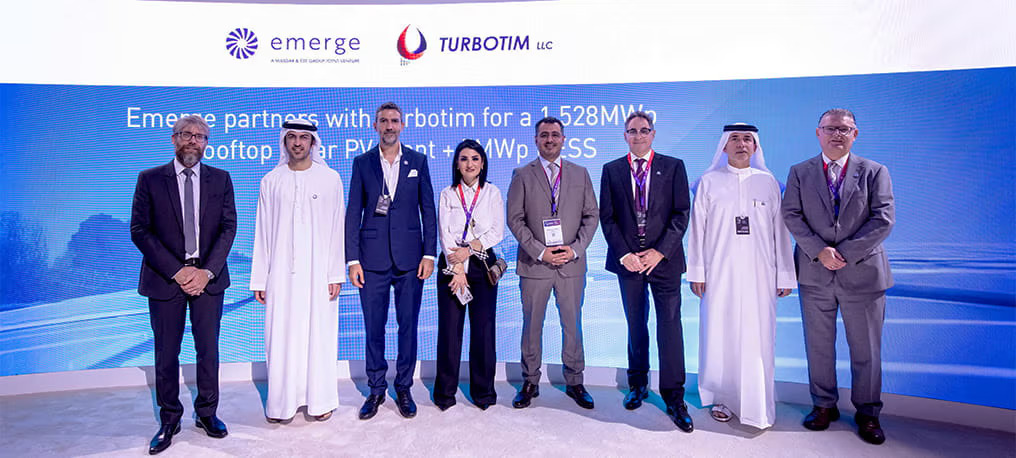
Dr Saad Al Tameemi, Turbotim Chairman, said: “This partnership with Emerge marks a major step forward in Turbotim’s journey toward cleaner, more efficient energy solutions.
“By integrating solar and battery storage into our operations, we’re not only reducing our environmental footprint but also creating long-term value through energy cost savings and greater energy independence.”
Michel Abi Saab, General Manager of Emerge, added: “The agreement signed with Turbotim, a leading industrial player, highlights the value of distributed solar and storage installations in reducing reliance on fossil fuels, while promoting cost-effective and sustainable solutions.”
Emerge, launched in 2021, currently supplies clean power to over 40 sites across the GCC.
[Image credit: Masdar]
by Catie Owen | May 23, 2025 | Americas, Storage
Governor Wes Moore, Maryland, USA, has signed two energy-focused bills into law – the Next Generation Energy Act and the Renewable Energy Certainty Act – supporting battery energy storage and renewable energy development in the state.
The legislation directs the Maryland Public Service Commission (PSC) to procure 800MW of energy storage by October 2026 and establishes clearer siting rules for solar projects.
The Next Generation Energy Act also includes provisions to retain revenue from energy and ancillary services for storage projects and requires siting and design guidelines to be submitted by mid-2026.
Additionally, it reallocates approximately $200m from a state fund to ratepayers, averaging around $80 per household.
Local advocacy group Chesapeake Climate Action Network said the bill “gives battery storage specific, time-bound financial support,” and expressed support for its focus on clean energy.
The Renewable Energy Certainty Act, filed in tandem with the Energy Act, seeks to simplify permitting for solar projects, at times superseding local zoning decisions.
Ceres, a nonprofit organisation working with businesses on sustainability, welcomed the new laws.
“The legislation signed by Gov. Moore proves that states can take action to reduce electricity bills without compromising ambitious climate goals,” said Jeff Mauk, director of Eastern state policy at Ceres.
However, Governor Moore vetoed two related bills, citing concerns about redundancy and inefficiency.
The Data Centre Impact Analysis and Report, designed to study the impact of the state’s data centres on the environment and grid, was vetoed as well.
by Manas Sahu | May 21, 2025 | Storage
Norwegian energy firm Statkraft has received environmental approval for its latest storage initiative in Spain—a 23.97-MW lithium iron phosphate (LFP) battery system planned for development in the Extremadura region.
The approved battery energy storage system (BESS) will be co-located with the existing Talayuela II solar farm, which generates 44.5 MW. With a two-hour storage capacity of 47.74 MWh, the facility is designed to enhance grid stability and optimise the performance of the solar plant.
By integrating storage with renewable generation, the project supports Spain’s broader ambitions for clean energy expansion and improved energy security.
José Miguel Ferrer, Statkraft’s General Manager for Spain and Portugal, highlighted the strategic importance of such technology:
“Renewable energy is essential to tackling climate change and reducing energy price volatility. But to maximise its potential, we must pair it with storage systems that ensure reliability and long-term sustainability.”
This project is part of Statkraft’s wider commitment to modernising energy infrastructure and accelerating the transition to a greener, more resilient energy system in Spain.
To find out more about solar and storage projects in Spain for residential solar, commercial and industrial solar and storage, attend Solar & Storage Live Espana, 25-26 June, Feria Valencia, Valencia and join over 3,000 solar industry professionals. Get free tickets
by Manas Sahu | May 16, 2025 | Storage
Swiss trade association Swissolar has urged the development of a national energy storage strategy to support the growing adoption of home solar-plus-battery systems across Switzerland.
Currently, approximately one in every two residential photovoltaic (PV) installations in the country is coupled with a battery energy storage system (BESS).
“Over the past three years, the total number of battery storage systems has almost doubled annually,” Swissolar revealed in its inaugural storage market report, published yesterday during the organisation’s Members’ Day event in Lucerne.
A major factor driving the surge in home energy storage is the continued reduction in equipment costs, which Swissolar estimates to be around $115 per kilowatt-hour for 2024.
The report analyses newly installed storage capacity for 2023 and anticipates significant growth last year, with nearly 1 gigawatt-hour (GWh) of additional capacity.
“Battery storage systems play a vital role in securing Switzerland’s electricity supply by enabling the utilisation of domestically generated renewable energy,” commented Swissolar Managing Director Matthias Egli. “They enhance the flexibility of solar power usage and help alleviate pressure on the electricity grid.” Solar energy is projected to constitute approximately 14% of Switzerland’s energy consumption this year.
Swissolar has called for the rapid expansion of energy storage capacity, supported by incentives that encourage owners to operate their systems in ways that bolster grid stability.
“The necessary legal framework is established under the Electricity Act,” stated Swissolar President Jürg Grossen. “It is now incumbent upon all stakeholders to act. The solar industry must optimise self-consumption through batteries and energy management systems. Distribution grid operators must adapt tariffs and taxation to reflect the new energy production landscape. Meanwhile, policymakers should continue to refine the regulatory framework. It is crucial that the solution we helped develop—remuneration based on hourly market prices—is implemented without delay.”
The association advocates for a comprehensive national energy storage strategy to further promote the integration of photovoltaic systems with energy storage.
“Battery storage systems capable of storing electricity temporarily and delivering it to the grid within milliseconds when required must be included in future energy scenarios,” said Swissolar Vice President Gabriela Suter. The organisation emphasises that such a strategy should encompass all forms of energy storage—both seasonal and short-term—to avoid excessive grid expansion.
Swissolar’s report concludes with six key recommendations for policymakers, grid operators, and the industry. It calls for decentralised battery storage systems to be properly integrated within the energy system and highlights the importance of well-designed price signals and financial incentives. Targeted support for the intelligent incorporation of BESS is essential, the report states, while district and regional energy storage could reduce the need for costly grid upgrades. Furthermore, Swissolar stresses the need to facilitate access for BESS to grid balancing energy markets and to eliminate barriers to data exchange.
To find out more about solar and storage projects in Switzerland for residential solar, commercial and industrial solar and storage, and to reach the booming Swiss market, attend Solar & Storage Live Zurich, 16-17 September, Messe Zurich and join over 3,000 solar industry professionals. Discover more.
by Catie Owen | May 14, 2025 | Asia, Europe, Storage
Huawei Digital Power presented its latest grid-forming Smart PV+ESS technologies at Intersolar Europe 2025, held in Munich from May 7 to 9.
The showcased solutions aim to support the construction of new power systems and promote the global transition to renewable energy.
“Carbon neutrality and energy transition are now global missions,” Huawei stated, highlighting the need for energy systems that integrate power electronics across all stages of the electricity chain — generation, transmission, distribution, and consumption.
Central to Huawei’s exhibition offerings is its Smart String Grid Forming ESS, designed for utility-scale applications.
According to Huawei, it “offers all-scenario grid forming, cell-to-grid safety, full-lifecycle optimal investment, and full-link digitalization.” The solution is capable of stabilising grids under varying conditions, including across all states of charge and short circuit ratios.
On the generation side, the system mimics the behaviour of synchronous condensers, offering voltage, frequency, and power angle control. On the transmission side, it supports black start and provides voltage and frequency stabilisation.
Huawei added that “one platform… supports flexible evolution” as energy markets expand. On the consumption side, it enables microgrids that run entirely on renewables with stable on/off-grid operation.
Other offerings
Huawei also presented a 215 kWh Smart Hybrid Cooling ESS for commercial and industrial use, emphasising “proactive safety, premium quality, and higher profitability.”
Certified to international safety standards, it is designed to perform in extreme conditions and features upgraded optimisation and efficiency.
For the residential sector, Huawei launched its Home Energy Management Solution 6.0, which includes the LUNA S1-7kWh ESS. The system offers “over 40% more usable energy than the industry average” and supports expansion up to 252 kWh.
Huawei concluded: “Energy transition is not only technological innovation, but also a global effort to achieve sustainable development.”
[Image credit: Huawei]
by Catie Owen | May 13, 2025 | Europe, Storage
Press Release
Sunwoda Energy made a significant impact at EES Europe 2025, Europe’s largest and most international exhibition for batteries and energy storage systems, by unveiling several groundbreaking innovations.
These included the launch of its 6.528MWh liquid cooling energy storage system powered by Sunwoda’s advanced 625Ah high-capacity battery cells and a 179kWh C&I ESS.
The company also presented fully integrated energy storage solutions, covering the entire value chain – from battery cells and packs to integrated systems, reinforcing its commitment to advancing high-capacity battery technology for a sustainable future.
Sunwoda Energy’s groundbreaking ESS innovations
At the heart of the new launch was Sunwoda Energy’s NoahX 3.0 6.528MWh Liquid Cooling ESS, equipped with high-performance 625Ah LFP battery cells that deliver over 15,000 cycles and a 25-year service life.
The system integrates AI-enabled active balancing to optimise charge/discharge consistency and overall efficiency.
With multi-layer fire protection, high energy density (430+Wh/L), and the ability to operate in extreme environments from -30°C to 55°C, the NoahX 3.0 is designed to meet the needs of next-generation utility-scale energy storage.
Additionally, Sunwoda Energy presented its OASIS A180 179kWh C&I ESS, which offers a compact design, flexible deployment, and smart energy management capabilities for C&I applications in Europe.
The company also showcased a comprehensive range of integrated energy storage solutions, including battery cells (280Ah, 314Ah, 625Ah), utility-scale ESS (5MWh), C&I ESS (215kWh), and residential ESS (5-120kWh), underscoring its full end-to-end production capabilities.
Sunwoda NoahX 3.0 6.528MWh liquid-cooling ESS launched
Background
Leveraging Sunwoda Group’s nearly 30 years of manufacturing expertise, the company’s end-to-end capabilities – from battery cell to integrated systems – embody its commitment to “Crafting every battery with care” and ensuring “Quality Assurance for All.”
These strengths enable Sunwoda Energy to maintain rigorous quality control while delivering tailored solutions that meet global demands and uphold the highest safety standards.
By the end of 2024, Sunwoda Energy’s global cumulative installed capacity exceeded 19GWh.
With recognition as a BloombergNEF Tier 1 Manufacturer, the company continues to drive Europe’s green energy transition and solidify its position as one of the global leaders in sustainable energy development.
[Image caption: Image credit: Sunwoda Energy]
Want to publish a press release? Submit your content here for review by our editorial team.
by Catie Owen | May 8, 2025 | Europe, Storage
JinkoSolar has announced that its Danish branch has signed a Memorandum of Agreement (MoA) with distributor SolarToday to supply its SunGiga All-in-One energy storage systems in several European countries.
The deal covers the Benelux region, Romania, Greece, Germany, and Turkey.
The partnership aims to strengthen JinkoSolar’s energy storage presence in these markets by combining the company’s technology with SolarToday’s distribution capabilities.
The agreement will see SolarToday act as a key distribution partner, delivering integrated solar PV and battery energy storage systems (BESS).
Roberto Murgioni, General Manager ESS Europe at Jinko ESS, said: “This collaboration positions SolarToday as Jinko’s key partner in scaling energy storage deployment across the EU, where the need for grid stability and seamless renewable integration is growing rapidly.
“In SolarToday, we have found not only a trusted pan-EU ally but one that shares our core values and long-term vision. Together, we are advancing a one-stop clean energy solution that integrates both PV and BESS, simplifying the transition to smarter, more resilient power systems for customers across the EU region.
“This partnership marks a significant step toward accelerating innovation and delivering a meaningful impact in Europe’s clean energy future.”
Tom Engbers, CEO of SolarToday, added: “We regard Jinko as a KEY-Partner in our Pan-EU distribution model.
“Signing this strategic distribution model for the ESS markets expresses our joint ambition in terms of partnership and determination to make a real difference in the solar energy market – with our focus on Generation (PV), Storage (ESS) and Usage (EV).”
The companies aim to streamline renewable energy adoption across Europe through this agreement.
by Catie Owen | May 6, 2025 | Everything Installer, Podcast, Storage
Where are developers going wrong in their solar contracts?
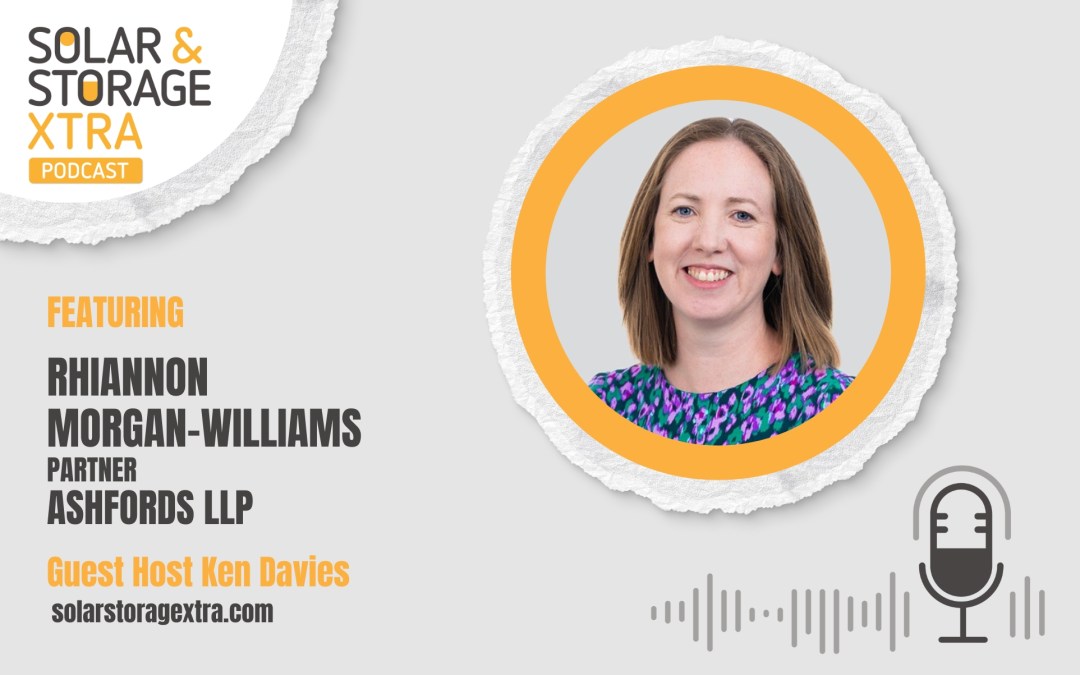
In this episode of Solar&StorageXtra’s podcast, guest host Ken Davies speaks with Rhiannon Morgan-Williams, Partner at Ashfords LLP and a leading legal expert in renewable energy development.
With over a decade of experience advising developers and funders in solar and battery projects, Rhiannon shares her insider perspective on the evolving legal landscape around landowner agreements, option contracts, and the complexities developers face – from initial negotiation to grid connection.
Rhiannon and Ken also dive into emerging legal implications of agrivoltaics and the challenges of integrating agriculture and energy generation on shared land.
“There are a lot of things that could have been picked up by just future-proofing some of the documents at earlier stages. One thing that is always missed off is the consideration given to the ultimate needs of the parties who are likely going to own these projects in the future.”
– Rhiannon Morgan-Williams
From contract tips to agrivoltaics insights, this episode is essential listening for developers, landowners, and legal professionals in clean energy.
Check out the first episode of the Solar&StorageXtra Podcast on Spotify, Apple Podcasts, or Amazon Music, and start listening!
by Catie Owen | May 6, 2025 | Americas, Everything Installer, Storage
Panasonic has announced it will discontinue its solar and battery storage business in North America, marking the end of a decades-long presence in the solar sector.
In a letter sent to installation partners on April 28 and shared publicly, Naoki Kamo, president of Panasonic Eco Systems North America, said,
“This was a strategic decision – not a reflection of the technology’s performance or the commitment of our partners like you. While we continue to believe in the potential of solar and energy storage, it is no longer the right business fit for us at this time.”
Panasonic will continue to support customers, pledging to honour all warranties – including for systems not yet fully installed – and provide guidance for third-party warranty coverage.
“We are still very much in business and remain committed to supporting our partners, customers, and installer base,” the company added.
Panasonic entered the solar industry through its Sanyo acquisition in 2009. Sanyo pioneered HIT (Heterojunction with Intrinsic Thin-layer) technology, launching the world’s first commercially available HJT panels in 1997.
These modules, known for high efficiency and performance in real-world conditions, were rebranded under Panasonic in 2011 and expanded to include Evervolt battery systems.
Despite its strong technology, Panasonic began transitioning away from in-house manufacturing in favour of OEM partnerships amid intensifying price competition, especially from Chinese manufacturers. It officially exited panel manufacturing in 2021.
While stepping away from residential solar and storage, Panasonic will continue investing in clean energy technologies, including EV batteries and heat pumps. Its $4bn EV battery plant in Kansas is on track to open in the first half of 2025.
[Image credit: Panasonic]
by Catie Owen | Apr 30, 2025 | Americas, Commercial & Industrial Solar, Storage
Repsol has announced the sale of a 46.3% stake in a 777MW portfolio of US solar and storage assets to investment firm Stonepeak for $340m.
Including $60m in previously raised tax equity, the transaction values the portfolio at approximately $795m.
The portfolio includes the Frye solar project in Swisher County, Texas – Repsol’s largest operational photovoltaic plant at 632MW – and the Jicarilla solar and storage complex in New Mexico, with 125MW of solar and 20MW / 80MWh of battery storage.
All projects are backed by long-term revenue contracts.
“We are very proud to start a partnership with Stonepeak in our first renewable asset rotation in the US market,” said João Costeira, Executive Managing Director of Low Carbon Generation at Repsol.
“Once again, our portfolio has confirmed its attractiveness to leading investors, validating our strategy on renewables.”
“This investment represents another important step in delivering much-needed cost effective and sustainable electricity to our domestic power grid at a time when communities need it most,” said Anthony Borreca, Senior Managing Director at Stonepeak.
“Repsol is an extremely well-respected company globally, and we look forward to deepening our partnership with them in the coming years.”
This marks Repsol’s sixth asset rotation since November 2021. The company currently has 4,000MW of operating renewable capacity and a global development pipeline of 60,000MW.
In the U.S., Repsol owns the partially operational 629MW Outpost PV project in Texas and is constructing two more facilities – Pinnington (825MW) and Pecan Prairie (595MW).
The Stonepeak transaction is expected to close in Q3 2025, pending regulatory approvals.
[Image credit: Repsol]
by Catie Owen | Apr 29, 2025 | Everything Installer, Innovation, Storage
At Solar & Storage Live in London, Solar&StorageXtra sat down with Francesca Shirley, Sustainable Business Development Manager at VEST Energy.
Francesca shared how the company is helping businesses unlock the full value of battery storage through smart optimisation and trading.
She highlights VEST’s Green Battery innovation, the importance of intelligent software, and why combining solar with storage is key to accelerating the UK’s net zero goals.
Can you give a brief introduction to VEST Energy and its core mission?
Francesca: At VEST, our mission is simple: to accelerate the energy transition by unlocking the full value of battery storage.
We specialise in smart trading and optimisation for batteries, helping businesses maximise performance, revenue, and carbon savings.
Our latest innovation, Green Battery, combines cutting-edge battery intelligence with measurable carbon savings – offered with no upfront costs. It makes it easier than ever for businesses to decarbonise while boosting returns.
Are there any recent projects that highlight the company’s impact in the solar sector?
Francesca: One standout project involved a UK-based manufacturer looking to decarbonise and reduce operational costs.
They already had solar installed, which was great – so we added battery storage and optimised it.
The results were immediate: we reduced peak energy charges, improved site resilience, and enhanced ESG reporting. It’s a great example of how solar and storage together can deliver real, measurable impact.
What technological advancements are needed to make off-grid battery storage more efficient?
Francesca: Efficiency comes from intelligence.
While hardware continues to improve, the real leap forward lies in smart software – things like predictive analytics, AI-driven optimisation, and real-time market response. Green Battery is designed to meet this need.
It continuously analyses site data, weather patterns, and energy markets to ensure batteries charge and discharge at the most optimal times.
This means greater performance, reduced carbon emissions, and lower costs.
How can investing in battery storage improve the effectiveness of the UK’s solar rollout?
Francesca: Solar alone can’t meet our energy needs 24/7 – it’s intermittent, as we all know. But when paired with battery storage, solar becomes much more powerful.
Storage smooths out solar’s variability, ensuring power is available even when the sun isn’t shining.
With Green Battery, you don’t just store excess energy—you optimise it, monetise it, and track its carbon impact in real time.
That’s how we turn solar from a daytime solution into a round-the-clock asset and accelerate the UK’s journey to net zero.
Why is it important for VEST Energy to attend Solar & Storage Live in London?
Francesca: We love this event! It’s the heartbeat of the UK’s clean energy movement. It’s a chance to showcase what’s possible with innovations like Green Battery, and to meet the solar installers, tech developers, and energy users driving real change.
We’re here to collaborate, learn, and lead the conversation on how battery intelligence can transform the way we generate, store, and use clean power.
Missed out on Solar & Storage Live London, or want to come back for more? find a Solar & Storage Live event near you.