by Catie Owen | Dec 9, 2025 | Africa, Innovation, Video
Solar & Storage Live UK 2025 in Birmingham was the essential industry hub where innovators and the energy value chain convened to explore solutions driving the UK’s energy transition.
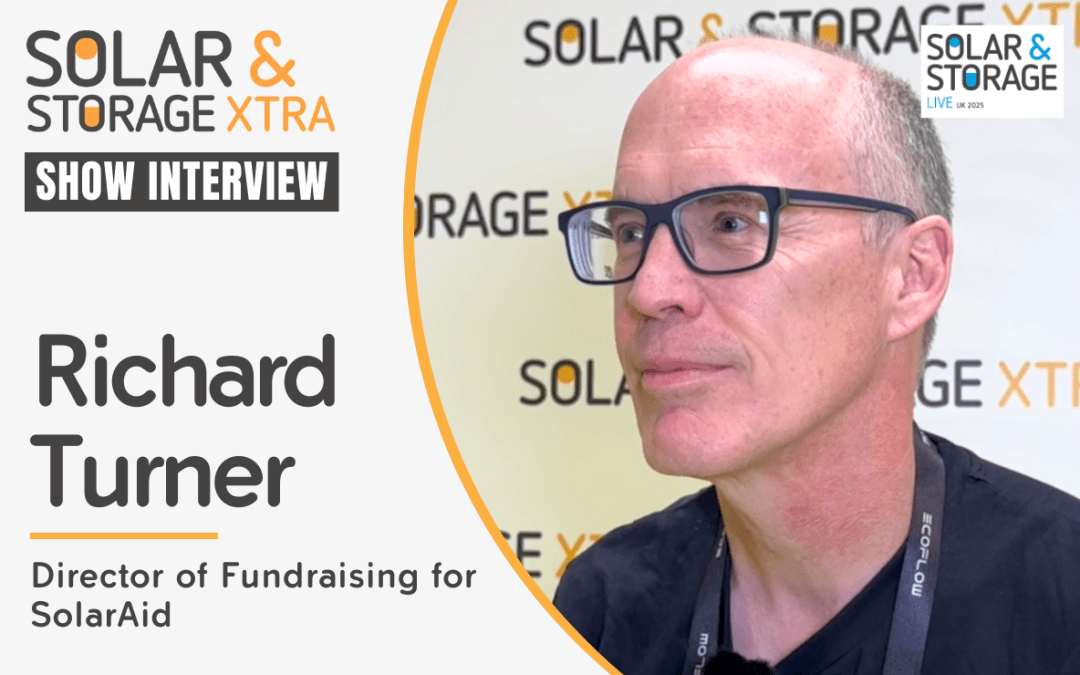
A year after his first interview with Solar&StorageXtra, we caught up with Richard Turner, Director of Fundraising for SolarAid, to hear about the charity’s achievements over the last 12 months.
Richard discussed the success of SolarAid’s ‘Light a Village’ project in Kasakula, Malawi, which has achieved 100% electricity access for one of the poorest communities in the world, and explained its potential for bridging the energy gap for millions across sub-Saharan Africa.
“In contrast to mini-grids, this method of utilising solar home systems allows for rapid deployment and is not significantly constrained by geography.”
Talk to us about the success of your Light a Village project in Malawi.
Kasakula is a community situated in Malawi, and it is recognised as one of the poorest in the country, and Malawi is one of the poorest nations globally.
As such, we deliberately selected this location (in conjunction with the Malawian government) to demonstrate that, if 100% electricity access could be provided to one of the poorest places in Malawi, this achievement could be replicated anywhere.
The Light a Village project has been successfully achieved. The project delivers access to electricity for the first time to many residents; before our intervention, less than 1% of the Kasakula community had access to electricity.
This electricity is financed by the residents through affordable fees, despite 97% of the community living below the poverty line. Therefore, the core challenge was devising a sustainable and workable model for this population.
We devoted significant time to consulting with local leaders, engaging the community, and explaining the concept. The model is fundamentally similar to how most people pay for energy: you don’t pay for the cables or the infrastructure in your home, but you do pay for the energy consumed.
Instead of owning a solar system outright, we install one at no cost to the household, and they subsequently pay a modest daily fee, approximately three pence (GBP), which allows them to activate the unit and have access to lighting. They are also able to charge a mobile phone and potentially a radio.
The initial uptake was significant from the very beginning. We encountered a few unforeseen issues; notably, the rats chewing through the cables, which we had not anticipated.
However, we also gained valuable insights. We discovered that many households would position one of their three provided lights outside their home. When asked about this, they explained that it was a protective measure against the local hyenas!
We proceeded incrementally, starting with 500 homes, then scaling up to 2,500, and this year we successfully reached all 8,813 homes, achieving 100% coverage in Kasakula. We consider this to be a truly significant milestone.
Walk us through the technology and systems SolarAid have brought to Kasakula.
The technology we employ features highly efficient solar home systems. This involves a panel, roughly the size of a laptop, connected to a battery unit, which is mounted on an interior wall of the home.
Once a payment has been made, the unit is activated. The user enters a code to activate it, thereby purchasing seven days’ worth of energy.
The system includes lights which also incorporate wireless switches. Each home receives three of these lights. Furthermore, a battery unit allows for the charging of a radio or a mobile phone, as many residents possess mobile phones.
There are various models available, but we like the one made by Omnivoltaic, manufactured in Hong Kong. We appreciate their willingness to collaborate with us on adaptations. Their model was originally developed for retail, but we require it for a service model, necessitating greater longevity.
Naturally, one component requiring future maintenance, likely after three to five years, is the battery; as such, we are looking to implement enhanced batteries.
To ensure consistent service delivery, we have employed community agents, essentially creating local jobs. They receive a small commission for every payment made, which incentivises them to provide excellent customer care. Throughout the project, we found that the optimal number of customers or households for each agent to manage is 100.
We have community agents who deliver a service directly to the community, with one agent assigned per 100 households. Each agent is also equipped with a specific kit. This includes a graphic displaying the initiative: ‘Light a Village, Kasakula, T/A’, where T/A signifies Territorial Authority.
In fact, Kasakula is named after the Chief, Chief Kasakula, who personally installed the very last light in the 8,813th home. Remarkably, the name of the woman in that household was Charity, which we found particularly apt.
How does working with community agents benefit Kasakulan households?
The community agents are highly effective and mind their customers’ needs. If a replacement is necessary, they manage it because the household does not own the system and therefore bears no risk.
If a lightbulb stops functioning or a battery is somehow faulty, it is replaced at no cost. This is what makes the model viable in a community grappling with such high poverty levels. Moving forward, if we can continue to refine these systems and extend their lifespan, the business model becomes increasingly viable.
We believe this holds immense potential, not just for other regions of Malawi, but throughout sub-Saharan Africa, where 600 million people currently lack access to electricity.
What do you think off-grid solar solutions – such as this project – represent for rural communities worldwide?
We believe the impact is enormous – a paradigm shift. The International Energy Agency (IEA) currently forecasts that by the end of the decade, half a billion people in sub-Saharan Africa alone will still lack access to electricity. This approach can fundamentally alter that prediction.
In contrast to mini-grids, this method of utilising solar home systems, allows for rapid deployment and is not significantly constrained by geography. Traditional grid infrastructure, and even mini-grids, often face challenges due to geographical limitations.
Additionally, the initial cost of deployment for our system is relatively low. We estimate the infrastructure cost to be approximately £100 per household, and the system becomes self-sustaining once the communities begin making payments.
We have established partnerships with other solar enterprises across Africa. The government of Sierra Leone and one of our partners have announced a commitment to reach 40,000 households in Sierra Leone – and have secured funding.
We view this as merely the beginning. We intend to share this model and invite other organisations to participate in this solution. We have established an initiative called REAL, dedicated to enabling others to learn how to develop and implement this energy-as-a-service model.
Can you tell us more about the meet-up session you hosted at Solar & Storage Live UK 2025?
The primary benefit of a meet-up session is the opportunity to network and reconnect with people. SolarAid itself originated from the solar sector. It was founded by a solar business called Solar Century (now acquired), which historically contributed 5% of its annual profits to SolarAid.
A significant number of attendees remember that relationship, including many former employees of that company who now work elsewhere.
As SolarAid has gradually become more widely known, this event serves as a central hub for people to convene, learn about one another’s current activities, receive updates on our progress, and hopefully be inspired to share our story with their own contacts – perhaps within their own organisations.
This type of internal recommendation can sometimes be the decisive factor for a company considering adopting SolarAid as its charity partner.
SolarAid is combating poverty and the climate crisis by collaborating with remote communities on sustainable programmes: creating a local market for solar lights that both provides business opportunities and changes lives for the better.
Donate to SolarAid’s “Big Christmas Challenge 2025” here.
Missed out on Solar & Storage Live UK? Get your free ticket to Solar & Storage Live London – the capital’s most exciting solar event. Or, find a Solar & Storage Live event near you.
by Catie Owen | Dec 4, 2025 | Europe, Large Scale Utility Solar, Storage, Video
The future of the UK’s energy sector hinges on a skilled workforce. At this autumn’s Solar & Storage Live UK, we caught up with Sturge Mazzocchi, Head of Solar Careers UK at Solar Energy UK, a key initiative dedicated to meeting the industry’s ambitious growth targets.
With the support of Solar Energy UK, Sturge is driving the programme’s clear vision to guide everyone into solar employment.
In this interview, he details the strategy for supporting recruitment and training, the challenge of securing 15,000 new workers by 2030, and the innovative work being done through the Recruitment Zone and the Installer Training Hub at the show.
“For us to reach our targets, those priority roles need to come mainly from deployment. Once you can fulfil your deployment side… your supply chain follows off the back of that.”
What is the Solar Careers Programme, and how has it evolved since launch?
The Solar Careers programme is a key action stemming from the government and industry solar roadmap, which aims to reach 60GW of solar by 2030. Since its launch, I’d say we’ve become far more crystalline – and by that, I mean clearer – in its vision, which is to guide every person possible into solar careers.
We do that in three principal ways. Firstly, we promote career opportunities to key audiences. We’re very much focused on deployment and maximising the number of qualified people we can get into those roles, primarily to raise awareness of the roles we have.
Secondly, we support recruitment in the area. This isn’t just about awareness but actively getting people into jobs and growing the workforce. And the third part is to promote training opportunities to keep the workforce upskilled and current.
By focusing on these three areas, we are meeting the aims and the vision of the Solar Careers programme.
In your view, what does success look like for the Solar Careers programme?
Given the target of 60GW by 2030, how do we measure the success of the Solar Careers programme by then? In numbers, success looks like an uplift of around 15,000 more people working in the industry.
Our industry needs to grow to 43,000 jobs. At the moment, we have around 20,000 people in the workforce, and by 2035, we need to get to 43,000. That’s an uplift of 23,000 in total.
When designing the strategy for the Solar Careers programme, you need to know exactly how many people you need to grow by per year. It’s quite a difficult forecast to make because there are so many factors that could stimulate that amount of growth. For example, if there aren’t the right specific apprenticeships, how are we going to educate people in the right way?
We recognised that it would take a few years to put these things in place, so in years one and two, we’re starting to make progress. We’re looking to support the growth of the industry by 500 people in year one (2025).
In 2026, we feel we could go to an extra thousand, so 1,500, and then 1,500 by 2027. That gets us to an extra 3,000. From there, you’d be in a position to start ramping up, as much of the necessary infrastructure would be in place. That’d get us to the 15,000 I mentioned.
This is what the runway looks like for the Solar Careers Programme, and we’re monitoring the ways we’re supporting the growth of the industry.
What are some of the biggest challenges the programme has faced so far?
One of our biggest challenges is securing skilled workers for our most in-demand roles.
At Solar Energy UK, we are in a position to mobilise and bring together all the different sectors of the industry, as well as businesses that perform different functions and services. They come together and highlight the most in-demand roles that they may need support fulfilling.
For us to reach our targets, those priority roles need to come mainly from deployment. Once you can fulfil your deployment side – installers, engineers, those sorts of roles – your supply chain follows off the back of that.
Our biggest challenge is essentially developing a skilled workforce. In the domestic and commercial sectors, we mainly need installers, as well as design engineers and project managers. For utility-scale, the main role is operations and maintenance site technicians.
These are the most in-demand roles that we need to grow the industry. Once we can start to fulfil these roles at scale, the rest will follow on afterwards.
What innovations has the Solar Careers Programme developed to encourage interest in the sector?
In terms of innovation, I would say that we’re trying to adopt and use the latest technologies and advancements available at our disposal. But we’ve also created some new functions this year to further our goals.
Our new skills steering group has created standardised job descriptions that have been agreed across businesses. They have an agreed set of roles and responsibilities and required qualifications, which we can then begin to promote as one of the most in-demand roles.
Alongside this, we’ve routes to competence. As part of that, we’ve developed a career map for people coming into the industry. Solar Energy UK has been helping the initiative I’m heading up, Solar Careers UK, to make these. We can then use that to mobilise an audience interested in entering the industry.
We are building a solar talent pool. This addresses the challenge of continuing engagement with interested individuals after their initial interaction, whether through our website or a recruitment event. Instead of relying on them to return unguided, we capture their interest.
How can we continue that engagement, given that they wanted to come into the industry? We ask them to register their interest, and we create a talent pool of people we can communicate directly with, giving them all this guidance over time. We currently have 7,200 people who are interested in joining the industry, which we’ve grown in a short space of time.
We will continue to do as much as we can to meet our vision, which is to guide every person possible into a solar career.
Your partnership with Solar & Storage Live UK has helped establish the Installer Training Hub and the Recruitment Zone. What does this mean for Solar Energy UK?
Firstly, I would really want to thank Solar & Storage Live for working in partnership to put these features on. Without us working together and putting them together each year and providing that platform, it really wouldn’t be possible.
If we look at the Recruitment Zone, across the show’s three days, over 250 candidates will come and meet businesses that have live job vacancies for introductory interviews.
This is really important for us because that’s 250 more people we can promote the different types of jobs, the different technologies, and the different services we have in the industry, and show why it can be an attraction.
For the Installer Training Hub, this addresses the third part of what we aim to deliver: promoting training opportunities and upskilling the workforce.
We’ve got nine businesses in there that are putting on training workshops throughout the three days. There will be over 2,500 installers who will engage with approximately 20-minute workshops and practical installer demos across a range of areas.
We have ground-mount installations, domestic and commercial mount and module installations, battery and inverter technologies, and MCS training, covering the latest fire classifications and how to be certified.
Missed out on Solar & Storage Live UK? Get your free ticket to Solar & Storage Live London – the capital’s most exciting solar event. Or, find a Solar & Storage Live event near you.
by Catie Owen | Dec 2, 2025 | Electric Vehicles, Innovation, Video
Solar & Storage Live UK 2025, the nation’s largest event for renewable energy innovation, built anticipation for the technologies redefining our power landscape.
Amidst the buzz, we sat down with Cameron Millar, Application Engineer for Eaton, a company actively championing the distributed energy future. In this interview, Cameron outlines Eaton’s mission to transform static energy consumers into dynamic prosumers, driving the concept of “buildings as a grid”.
He also shares his perspective on the most impactful emerging technologies set to revolutionise both storage and EV charging, particularly the promise of solid-state batteries and megawatt charging.
“The current limitations in battery technology revolve around weight, size, and energy density. As these technologies improve over time, we gain more energy per kilogram.”
What is the role of Eaton in the industry?
Cameron: Eaton is fundamentally focused on advancing the idea of buildings as a grid.
Our core role is to encourage people to view their premises as a potential energy hub, making them less dependent on the main grid and enabling them to become prosumers, individuals or entities that both produce and consume their own energy.
This concept is realised by integrating on-site renewable energy, such as solar or wind power, with battery storage systems. Since adequately sized solar arrays often generate a substantial surplus, the storage captures this excess energy for later use.
Additionally, installing EV chargers allows the stored or generated excess power to be utilised for vehicle charging. We tie all these components together with an energy management system to ensure optimal energy flows.
This system allows us to implement predictive control. For example, by ensuring batteries are empty to maximise solar capture on a predicted sunny day or dynamically managing EV charging loads to prevent high building demand from overloading the system. We treat the entire building as a holistic energy ecosystem.
What are you showcasing at Solar & Storage Live UK?
Cameron: At the exhibition, we’re highlighting Eaton as a one-stop shop for comprehensive energy solutions. We are showcasing a wide range of products covering both AC and DC charging, from low-power solutions to high-power units, alongside our integrated battery storage systems.
Specifically on the stand, we have our Duo AC charger (2x22kW), various DC chargers, including the 22kW mobile unit and fixed 30kW and 60kW DC chargers. We also feature the ChargePoint CP6K charger, following our recent partnership.
Completing our display is our xStorage Hybrid BESS. Essentially, we are demonstrating that Eaton is the source for all necessary components: power distribution, EV charging, and energy storage.
Talk to us about the commissioning challenge happening this week.
Cameron: We are running a commissioning challenge onsite to underscore how simple and user-friendly our installation process is – we are ultra confident in the ease of commissioning our chargers!
The challenge uses our Green Motion Building AC charger (7.4kW up to 22kW). We challenge installers to take the unit from a full factory reset state, fully commission it, connect it to the charge point back end, and initiate a charge session within five minutes.
We set this up because, while the physical electrical install is routine for installers, they often find the connection to the software back end difficult and time-consuming. We are here to prove it doesn’t have to be – it is easy.
And, if you are the quickest of the day, you will get a little pack of Torx screwdrivers as a prize.
What feedback have you received from installers and decision makers?
Cameron: We have received very positive feedback from both groups. Installers are particularly pleased with the ease and speed of commissioning our units.
For key decision-makers, the most valued feature is the scalability of the chargers. This allows them to install units initially set at a lower power (e.g., 7.4kW) if they currently lack the necessary DNO connection or overall capacity.
The chargers can then be upgraded later to 22kW simply through a rewire or a settings change, avoiding the expense and hassle of a full hardware replacement. This inherent flexibility is a major selling point.
How do you ensure that the EV chargers meet the UK’s 99% reliability requirements?
Cameron: Achieving the required 99% reliability is a significant objective, driven partly by government initiatives aimed at improving the frustrating experience of drivers encountering broken chargers. Our strategy hinges on robust software intervention.
We utilise Charge Central, a system that sits between the charger and the back end. It performs predictive maintenance by continuously monitoring the unit’s operational parameters, such as detecting a fan running too quickly or the unit running too hot.
This allows us to diagnose potential issues and manage remote firmware updates. By catching these problems early, before they escalate into faults that cause downtime, we effectively maximise the charger’s reliability.
Which emerging technologies are you most excited about for EV charging and energy storage integration?
Cameron: I am most excited about advancements in emerging battery technologies. The current limitations in battery technology revolve around weight, size, and energy density. As these technologies improve over time, we gain more energy per kilogram.
This will benefit EVs (lighter vehicles, greater range) and for battery and building storage systems, where reduced physical size is crucial for fitting megawatt-hours of capacity into limited space. We are excited about technologies like solid-state batteries and the impact they will make on this challenge.
Additionally, I find the development of ultra-high-powered charging interesting. Specifically, MCS charging (megawatt charging) will be a game-changer, and we are interested in seeing the innovations that emerge in that space.
Missed out on Solar & Storage Live UK? Get your free ticket to Solar & Storage Live London – the capital’s most exciting solar event. Or, find a Solar & Storage Live event near you.
by Catie Owen | Nov 27, 2025 | Europe, Innovation, Video
As the UK’s largest renewable energy exhibition, Solar & Storage Live 2025 brought together the entire energy value chain – from manufacturers and installers to investors and policymakers.
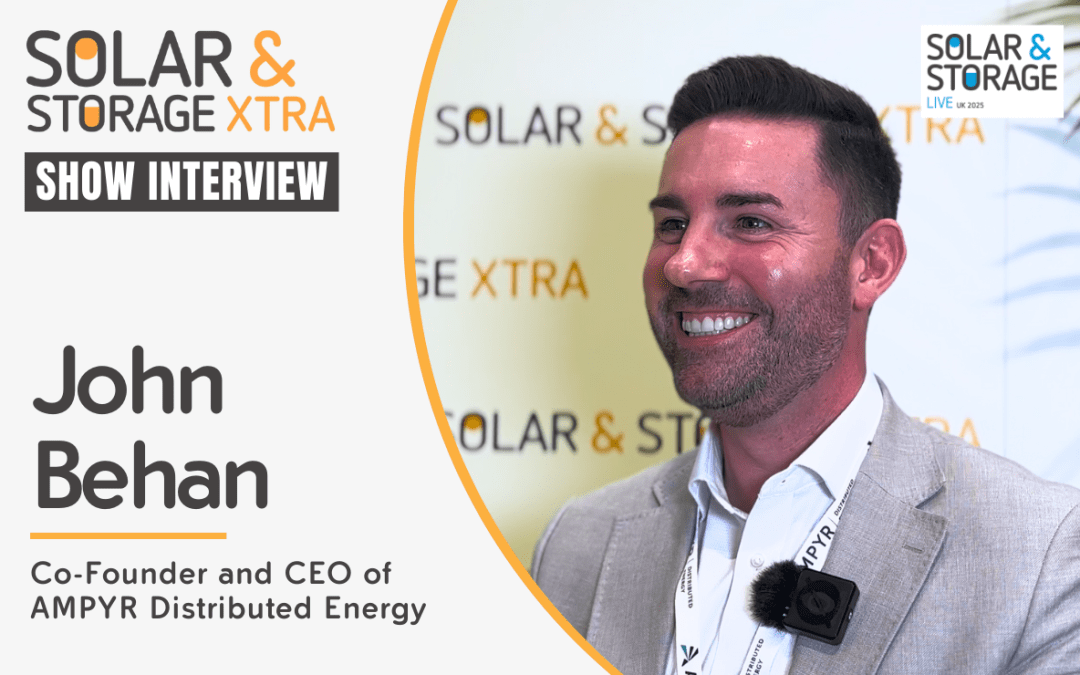
At the show, we sat down with John Behan, Co-Founder and CEO of AMPYR Distributed Energy (ADE). ADE is a rapidly expanding force in the C&I sector, dedicated to making the transition to net zero simple and cost-effective for businesses by providing fully funded, on-site solar and storage solutions.
In this interview, John discusses ADE’s mission to deliver green, reliable power and offers a crucial investor perspective on the distributed energy market.
“We’ve deployed primarily on-site solar, and the trend we’re really highlighting over this decade is the growth in co-located solar and storage behind the meter.”
What is AMPYR Distributed Energy (ADE)’s role in the sector?
John: At ADE, we’re on a mission to simplify net zero for business customers. But what does that mean? It means we deliver fully funded on-site renewables that provide green, reliable power at a lower cost exactly where it’s needed.
This allows our customers to focus on running their business while achieving their sustainability goals.
Tell us about the talk you did at Solar & Storage Live UK.
John: A lot of the talks at the show are typically around products, industry, and the market. I wanted to really focus on an investor perspective on distributed energy, so bringing a bit of a finance angle.
In the talk, we covered some background on the distributed energy market and why it’s growing so much. We had record rooftop deployment last year, and that’s going to continue, potentially reaching around a gigawatt per annum by the end of the decade.
Then I jumped into the investor perspective: why the market is gaining traction for investors like us, but also what the trends and some of the challenges are.
Why is sponsoring the C&I Theatre important for ADE?
John: When we sponsored the theatre last year, we were relative newcomers to the market; we were less than a year old. For us, that was about trying to get our initial foothold in the market.
Since that time, despite being a relative newcomer, we’ve expanded from 14 to 40 employees through acquisition, we’ve trebled our assets under management, and we’ve also expanded into Europe, into Germany.
In the last 12 months, we’ve had really solid growth, and we’re now positioning ourselves as one of the leaders in the C&I market.
What trends in the industry should solar stakeholders be aware of?
John: To date, we’ve deployed primarily on-site solar, and the trend we’re really highlighting over this decade is the growth in co-located solar and storage behind the meter.
Now, the investor side is still trying to get the business model right. Principally, we want to supply more on-site power to the customer via the battery, but ultimately, that doesn’t really utilise the battery in the right way.
You’ve got to really create a floor via contracted returns and then optimise the battery as it should, to capture all the additional revenue streams that are out there. You can typically share those revenue streams with a customer.
To summarise, what you really need is a combination of both: we need contracted returns from the battery, but we also need the upside to be able to unlock material deployment in the market.
That’s really our key trend, and going forward, we have an ambition to put storage alongside every solar asset that we install.
What is the importance of attending Solar & Storage Live UK for ADE?
John: I said the same last year: I think it is the biggest in the UK, certainly probably one of the biggest renewable conferences in Europe, and it is bigger again this year.
For us, Solar & Storage Live UK is really important as brand awareness is key for us. Lots of our partners and customers are here, and potential customers. It’s a chance for us to meet new and existing partners as well, and, as I’ve said previously, this is the best way to network.
At the show, you have short, sharp meetings back-to-back, and everyone’s in the same place. That’s why it’s so beneficial. Of course, attendees also have dinners on, we have socials; the whole team is here to have a bit of fun as well.
Missed out on Solar & Storage Live UK? Get your free ticket to Solar & Storage Live London – the capital’s most exciting solar event. Or, find a Solar & Storage Live event near you.
by Catie Owen | Nov 19, 2025 | Europe, Everything Installer, Innovation, Storage, Video
Early autumn saw the return of Solar & Storage Live UK: the nation’s largest platform for solar installers and manufacturers to meet, network, and discover new innovations.
At the show, Solar&StorageXtra caught up with Craig Bilboe, Country Manager UK & Ireland for EcoFlow.
With his extensive background in energy technology and business development, Craig offers a sharp perspective on navigating market regulations and installer needs.
“As we move into the winter period, we’re now really looking at concerns around grid stability and power outages. Our Gateway will really address some of those concerns, as well as the rising cost of energy.”
Since we last caught up with EcoFlow at Solar & Storage Live London, what has been new for the company?
Craig: Lots of things have happened. So, we have new products to release here at the show. We have the Gateway, which is really important and is being asked for by our installation partners. They’re craving our Gateway, so that’s really good.
And we have some, the new PowerInsight and our AI functionality, which is something unique to the industry. And I think actually, there’s a whole host of benefits to incorporating AI.
Now, we have to be very careful in delivering this message to consumers because everything has AI. But EcoFlow are the only company in this arena that I know of, in our industry, that is offering a specific AI to the energy storage market.
This will have huge benefits to not only the existing consumers, but also people who may never have had access to dynamic tariffs or have been able to capitalise on savings.
This product is probably the most exciting for me as an individual, because there’s a huge opportunity for energy saving for end users that may be in a social housing sector or may have some physical challenges, or might find it very difficult to access traditional dynamic tariffs. We have a product here that could potentially change the industry.
So, as usual, EcoFlow attends Solar & Storage Live UK to present and bring new products to the market.
What drove EcoFlow to open a UK office, and why choose Birmingham as the location?
Craig: We opened our UK HQ in Birmingham this Autumn. Opening an office here is important for our installation partners because we need to demonstrate as a manufacturer that we’re investing not only in the local community but also tin he region and the country as a whole.
Our installers really want to be able to have a location where they can come and get trained. They’ll have the comfort that we’re here for the long period, and that we’re here to support them, not just for now, but for the coming years too.
Overall, we think it’s vitally important that we have a location where everyone can come and learn more about EcoFlow.
What opportunities or challenges are you targeting in the UK residential and commercial solar-storage sectors?
Craig: There are lots of challenges and opportunities we’re looking to tackle. But, to that end, our Gateway is something where end users are really starting to look at.
As we move into the winter period, we’re now really looking at concerns around grid stability and power outages. Our Gateway will really address some of those concerns, as well as the rising cost of energy.
Over time, I think we’ll see an increased demand for our batteries, but also our different solutions, such as off-grid scenarios and all the other functionalities.
What’s your long-term vision for EcoFlow in the UK and Europe?
Craig: We’ve had a presence in the UK for over three years; we wouldn’t have invested in our new office unless we wanted to be here for the long term.
We want to continue to bring new products, new innovations into the European market and beyond, support our installers, and maintain our large presence in the home energy sector.
Really, we want to be able to provide good products for our installers, which add benefits to the end users and continue to play a part in our industry.
Why is EcoFlow a repeat exhibitor of Solar & Storage Live?
Craig: Solar & Storage Live UK is probably our most important vehicle to access new installers.
We’ve put all our focus on this event to demonstrate – or at least showcase – our new products. We want to demonstrate our functions and all the great things about EcoFlow.
This [show] is probably the best vehicle now that we can see to reach all new installers, touch base with our existing installers, and network within the industry as well.
I would say that this is probably the most important thing that we do every single year to generate new business.
Catch more of Craig’s insights in the Solar&StorageXtra podcast, where Craig discusses how AI-driven energy management can transform the storage sector.
Missed out on Solar & Storage Live UK? Get your free ticket to Solar & Storage Live London – the capital’s most exciting solar event. Or, find a Solar & Storage Live event near you.
by Catie Owen | Nov 14, 2025 | Europe, Innovation, Video
This year’s Solar & Storage Live UK was a key meeting point for the energy value chain – including solar innovators and trade bodies.
While there, Solar&StorageXtra spoke with Jason Howlett, Founder and CEO of the newly established Energy Storage Association (ESA).
Howlett revealed the motivation and process behind launching the organisation, its goal of becoming the dedicated voice for the storage sector, and how to tackle significant regulatory gaps.
“We are seeing real encouragement with the policy… but the deep frustration is still the Future Homes Standard. We are still building in legacy challenges by not adding storage to new builds.”
What motivated you to found the Energy Storage Association in the UK, and what are its mission and priorities?
Creating the Energy Storage Association has been a two-year project. I had been in the industry for a number of years, deeply frustrated that storage – across the whole supply chain, from manufacturers to distribution – was always the forgotten element of solar and storage.
I spoke to several trade bodies on solar generation and consistently found this obsession with generation, with storage taking a secondary role.
There was a shared frustration with manufacturers, educators, and companies. There was a common feeling of frustration, particularly across a few areas: behind-the-meter residential and commercial/industrial storage, and long-duration storage with a geological component, such as geo-hydrogen storage.
I met Mark Coyle, now at Good Energy, and we shared this passion. We simply needed to create this body. Mark was originally planned to be the CEO, but his consultancy work made his schedule too busy. I decided to take it on, leaving GivEnergy in March to found the Association.
We achieved a good consensus among manufacturers, educators, and energy companies willing to commit funds to get us off the ground, and we have been adding members since.
What key challenges did you identify when you started, and which have been most difficult to tackle so far?
I have created and launched businesses around the world, but starting a trade body was a new and much harder challenge than a typical business. Firstly, you rely on members putting money in to help you start.
Logistically, getting a business bank account for a not-for-profit company limited by guarantee, which is our structure, was almost impossible.
It took months with various banks to physically secure an account. That was the singular thing I was most frustrated about, because nothing else can work without it. You cannot have a business without banking.
Beyond that, we needed a website, promotion, and skills I didn’t have, but with no money, we couldn’t afford to do anything. We had to leverage help from some of the founders.
In the early days, it was a bit of ‘beg, borrow, and steal’ for things like legal support, with companies like Sunsynk and GivEnergy helping via their lawyers. My wife even did all the marketing and the website in her spare time.
What regulatory or policy gaps do you think are the biggest obstacles in the UK for scaling up storage deployments?
The policy side and the advocacy we are doing are huge elements. As I’ve engaged with DESNZ (Department for Energy Security and Net Zero) and NESO (National Energy System Operator), they have truly embraced us because they have lacked a dedicated voice to engage with on storage.
We are seeing real encouragement with the policy, particularly the flexibility roadmap, but the deep frustration is still the Future Homes Standard. We are still building in legacy challenges by not adding storage to new builds.
Octopus has proven that with solar, a heat pump, and a battery, you can eliminate energy bills for 10 years. Why are we not making this a standard? Why are we adding generation without considering the long-term needs of the community?
Another element, which we are engaged with GB Energy on, is making this technology available to all. We are working with GB Energy, which links into work with the Treasury, so that that this technology can be available to all people, not just those who can pay.
For those who can afford it, we need to simplify the process. For example, the VAT removal on energy storage from a couple of years ago needs to be made permanent.
There are also more structural issues. The government still hasn’t fully grasped the long-duration, geological storage element and how that will work, though it is in the roadmap as a potential if we can store and generate hydrogen.
Our goal is to create a comprehensive roadmap detailing how we believe storage should play out, which NESO, DESNZ, and everyone else can refer to and work towards.
What did you discuss in your talk and panel at the show?
I spoke about energy poverty and storage’s role in tackling it, which led to great interactions with several organisations. Our Chair, Baroness Berger, delivered a keynote on the importance of storage and how we need to think about it.
A panel featured a range of stakeholders discussing the importance of storage, where we explored what we can learn from those who have gone before us.
To you, why is it important that energy storage companies and stakeholders attend Solar & Storage Live?
We are at an exciting juxtaposition! We have been pushing generation hard, and now, with the flexibility roadmap, we are starting to focus on energy utilisation, grid services, and flexibility.
We know that renewable energy generation is intermittent, but demand is constant. The only way we can manage this is through flexibility – managing our generation and storing energy. People are truly starting to get their heads around this now.
This is a great show, and I’ve been really pleased that it has embraced the Energy Storage Association since we launched.
Missed out on Solar & Storage Live UK? Get your free ticket to Solar & Storage Live London – the capital’s most exciting solar event. Or, find a Solar & Storage Live event near you.
by Catie Owen | Aug 5, 2025 | Europe, Everything Installer, Innovation, Video
Earlier this year at Solar & Storage Live, we caught up with Hannah Magowan, Lead Engineer for Storage & Renewables at Dale Power Solutions.
As an engineering professional, Hannah’s career began with an apprenticeship and has since spanned the evolving energy sector.
In this interview, she reflects on the importance of early engagement with schools to break down gender stereotypes in STEM, the real-world challenges businesses face on the road to net zero, and how Dale Power Solutions is helping customers navigate rising energy costs and grid constraints.
“I think rather than just doing school visits to universities, we should be getting young people into industry early – showing them the variety of jobs, the atmosphere, and what it’s actually like.”
You started your career as an engineering apprentice in the energy industry and have stayed in the sector ever since. How can we better encourage other young women to join the energy sector?
Hannah: For me, it’s not so much about running women-in-engineering campaigns. They’re great, but they can sometimes do as much harm as good – people might see it as special treatment.
The biggest thing we can do is work more closely with schools and education to get people into industry at a younger age.
One of our favourite events is Scarborough Science and Engineering Week. It brings together all the local STEM companies for a big show, and we invite all the primary and secondary schools in the area.
You can really see the difference between primary schools, where there are no preconceived ideas about who should be in what job. Additionally, in secondary schools, gender stereotypes have already started to form. There’s so much more engagement and excitement from younger kids of all genders.
It’s also difficult because, when I left school ten years ago, there wasn’t much in the way of careers advice – at least not before age 16. You knew what your parents did, but not much beyond that.
The first time I stepped into an engineering business was for a job interview, and it was kind of by fluke that I found it.
I think rather than just doing school visits to universities, we should be getting young people into industry early – showing them the variety of jobs, the atmosphere, and what it’s actually like.
Unless you’ve seen and experienced it for yourself, you’re not necessarily going to consider it as a career – especially if you’re a high academic achiever.
What is Dale Power Solutions’ role and mission in the solar industry, and how does it inspire your work?
Hannah: We’re a full EPC provider of battery storage and solar. We’re actually a really old company – our core products are generators and uninterruptible power supplies. We do full design and engineering on those.
As solar and storage have become more prominent in the UK, we’ve been focused on supporting our customers on their journey to net zero and helping them reduce their energy bills – two huge challenges everyone is facing.
We want to be the leading turnkey provider for behind-the-meter energy storage and solar, although we also work on front-of-the-meter, larger-scale projects.
Can you talk to us about DPS’ exciting new UK BESS contract award?
Hannah: We’ve just won a project with one of the major UK banking groups. It’s a four-megawatt-hour battery coupled with about 1.4MWp of solar. It’s a huge project.
They’ve installed the solar across carports because they don’t have rooftop space, but their consumption is extremely high. The site is the largest in the UK for that company; it’s a technology centre with a data centre and other high-demand infrastructure.
They needed battery storage because they couldn’t get DNO approval to connect all that solar directly to the grid. So, by adding a battery, they can use 100% of the solar energy they generate and get around the grid constraints they were facing.
What challenges are your customers frequently facing, and what solutions has DPS devised?
Hannah: Energy bills are rising – we’re all feeling that – and that’s driving a lot of interest in self-generation. Many companies also have ambitious sustainability goals as part of their net-zero commitments.
The government is pushing for EV fleets and heat pumps, both of which massively increase a site’s energy consumption.
The problem is that the grid can’t keep up. When companies apply for a grid upgrade, they’re sometimes told it’ll take 10 years – which obviously isn’t viable.
Battery storage and solar help in two ways: first, they reduce energy bills by allowing companies to generate and use their own power; and second, the battery acts as a buffer.
If a business is expanding and its grid connection isn’t large enough, the battery can be charged overnight or with solar and used during the day.
It gives companies flexibility – and options they wouldn’t otherwise have.
Solar & Storage Live in Birmingham is on the horizon, so don’t miss out on your free ticket to the UK’s largest solar and storage show. Or, find a Solar & Storage Live event near you.
by Catie Owen | Jul 2, 2025 | Commercial & Industrial Solar, Europe, Video
At this year’s Solar & Storage Live in London, industry professionals gathered to explore the latest innovations in solar technology and energy storage.
GoodWe, a leading inverter and battery manufacturer, took part not only as an exhibitor but also through hands-on training sessions at the Installer Training Hub.
We caught up with George Mayes-Milner, After Sales Manager at GoodWe for UK and Ireland, to learn more about the importance of technical support and post-installation service, and how the Installer Training Hub offered a unique opportunity to engage directly with installers.
“We’ve had people coming in – mainly installers and some distributors – and it feels like everyone is here with a clear purpose. They want to learn more about the product specifically.”
How is GoodWe participating in Solar & Storage Live in London?
George: I’m here with GoodWe, an inverter and battery manufacturer. We’re holding various talks on commissioning inverter and battery installations, as well as showcasing our latest range of products.
Why did GoodWe decide to join the Installer Training Hub?
George: GoodWe wanted to join the hub to show that our technical support and customer service have really stepped up to the next level.
We’re taking customer service seriously across the whole of Europe, and I think it’s important to get that message out. It’s great to have high-quality materials, but you also need to support customers after installation.
How is participating in the Installer Training Hub different from just exhibiting at the show?
George: It’s been great to see both sides. Exhibiting at the event in Birmingham last year was really fun, and we had a lot of footfall. But being part of the hub is a different experience.
We’ve had people coming in – mainly installers and some distributors – and it feels like everyone is here with a clear purpose. They want to learn more about the product specifically.
They’re not just drifting through the stands – they’re here to see you, and that’s been really nice.
How has the experience been at the Installer Training Hub?
George: I’ve really enjoyed it. So far, I’ve done about five or six talks, and in every single one, people were engaged and genuinely wanted to be there.
They asked questions, and after the talks, many stayed behind to continue the conversation about our products, which has been great. Every customer interaction has felt meaningful.
I think we’ve had around 200 installers attend our workshops. I’ve actually met more than that, as people have dropped into the hub even when we’re not running a session.
The best part for me has been meeting and chatting with so many installers, as well as talking to the other manufacturers in the hub.
It’s always interesting to hear what others are doing. I’ve been impressed with some of the other products on display.
What makes Solar & Storage Live London so distinct?
George: It’s a bit more compact than the Birmingham show, and in some ways, that really helps.
You’d struggle to get around the Birmingham event in one day because there’s so much to see and do, but in London you can definitely see many installers and manufacturers in a single day.
At Birmingham, you have to plan ahead and know exactly what you want to see.
In London, you can take it all in at once, which is definitely a plus in some ways.
Missed out on Solar & Storage Live London? It’s not too late to see the Installer Training Hub in person. Join us at the NEC in Birmingham 23-25 September.
by Catie Owen | May 22, 2025 | Europe, Everything Installer, Video
At Solar & Storage Live in London, GSE Intégration took part in the Installer Training Hub to give installers hands-on experience with its PV mounting systems.
Solar&StorageXtra spoke with Sales Director Julien Dubuisson to learn more about why the company joined the Installer Training Hub, and the value it brings to both seasoned professionals and new installers entering the solar sector.
“For every session, we’ve had between 30 and 40 installers register and attend the training. It gives us a great opportunity to reach a wide audience.”
Why did GSE Intégration join the Installer Training Hub at Solar & Storage Live in London?
Julien: GSE Intégration has been in the UK market for the last 10 years. We are a PV integrated mounting system manufacturer, and we were first invited by Solar Energy UK to join the Training Hub in Birmingham two years ago.
We immediately accepted because it perfectly aligns with how we want to approach installers – by training as many as possible on how to mount our product.
How is participating in the Installer Training Hub different from only exhibiting at the show?
Julien: Of course, we have a stand at every Solar & Storage Live event in Birmingham, and now in London as well. But the Training Hub offers a completely different approach.
We bring a physical training rig, which allows us to really show our product and demonstrate the different steps involved in its installation.
How has the experience been at the Installer Training Hub?
Julien: I believe this is our third participation – twice in Birmingham and now for the first time in London. It’s been very successful.
For every session, we’ve had between 30 and 40 installers register and attend the training. It gives us a great opportunity to reach a wide audience and provide them with a basic understanding of how to install the GSE system.
Having a physical rig on-site means installers can actually touch the product and engage directly with it, which I think is the best part.
This is especially valuable for new installers preparing for their first GSE installation in the coming days or weeks. It gives them the chance to understand the product before working with it in the field.
Even though we offer many other training approaches, this hands-on opportunity is a great way to ensure the system will be installed properly.
Missed out on Solar & Storage Live London, or want to come back for more? Find a Solar & Storage Live event near you.
by Catie Owen | May 15, 2025 | Europe, Innovation, Video
At Solar & Storage Live in London, Solar&StorageXtra spoke with Jessica Jukes, Recruiter at British Solar Renewables.
Jessica touched on the company’s return to the event and its involvement in the Recruitment Zone.
She also shared how BSR is using the show to connect with passionate candidates and promote opportunities across all levels, from entry-level roles to senior positions.
The Recruitment Zone has become a well-known feature. For us, it’s all about raising our profile and sharing what we do and the roles we have to offer.
How is British Solar Renewables participating in Solar & Storage Live in London?
Jessica: This is our second year attending Solar & Storage Live in London. We’re exhibiting again, showcasing the vacancies we’re currently hiring for, and speaking with a wide range of candidates from different levels and backgrounds.
It’s a great opportunity to let people know about the opportunities available at BSR.
We think Solar & Storage Live is a fantastic event. A lot of people from our business attend to explore the exhibition and meet with suppliers.
We know there’s a wealth of talent at these events, and we felt there was no better way to position ourselves than within the Recruitment Zone.
Sturge and the team do a lot of work to promote the event beforehand, and the Recruitment Zone has become a well-known feature. For us, it’s all about raising our profile and sharing what we do and the roles we have to offer.
How has the Recruitment Zone been beneficial to British Solar Renewables?
Jessica: It’s been fantastic. As I mentioned earlier, there are so many different candidates, and everyone’s incredibly friendly.
It’s amazing to see how passionate people are about renewables and their desire to get into the sector and make a real difference for the UK and the planet.
It’s really refreshing. At BSR, we offer opportunities at a range of levels – from entry-level roles to mid-senior and management positions.
What roles have you been advertising at the show?
Jessica: One of the great things about Solar & Storage Live is the diversity of attendees. We’ve met people across all experience levels. There have been a lot of students interested in our entry-level roles, and we’ve also spoken with some fantastic electrical engineers and project managers.
What has been the best part of Solar & Storage Live?
Jessica: There’s been a real variety of people, and I’m definitely looking forward to following up with candidates when I’m back in the office on Monday.
I know I’ve touched on this already, but the passion for renewables really shines through – not just in the Recruitment Zone, but across the entire event. It’s fantastic meeting so many different people who want to be a part of this sector and join the team.
Missed out on Solar & Storage Live London, or want to come back for more? Find a Solar & Storage Live event near you.
by Catie Owen | May 13, 2025 | Europe, Innovation, Video
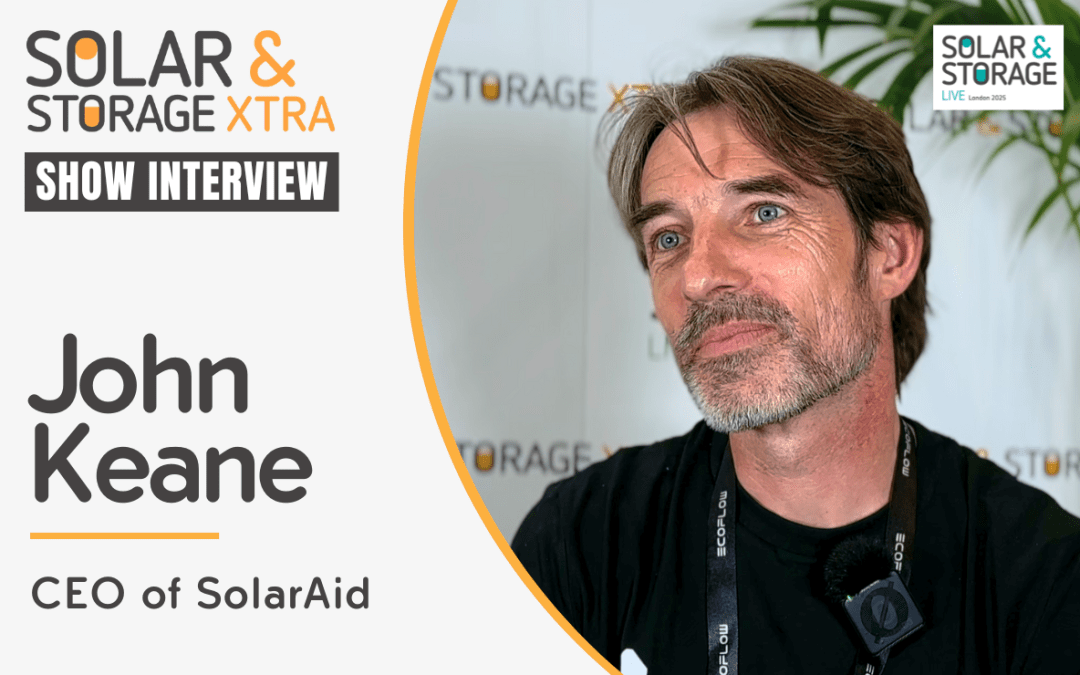
At Solar & Storage Live London, Solar&StorageXtra spoke with John Keane, CEO of SolarAid.
John talked about the organisation’s mission to tackle energy poverty in Sub-Saharan Africa, discussed the evolution of SolarAid’s work, the impact of falling solar prices, and their initiative to bring full electricity access to entire off-grid communities.
Today, more people in Sub-Saharan Africa are accessing solar lights and products than ever before. The technology has advanced significantly, with the price of solar panels and solutions plummeting.
What prompted the launch of SolarAid, and how has the organisation’s approach evolved over time?
John: SolarAid was established in 2006 with the goal of combating poverty and the climate crisis.
Our vision is to create a world where everyone has access to clean, renewable energy. In Sub-Saharan Africa, where we focus our efforts, approximately 600 million people still live without access to basic electricity.
This lack of access affects not just homes, but also rural clinics and schools, trapping people in cycles of poverty. Without electricity, it’s incredibly difficult for communities to develop their economy and improve their quality of life. That’s why SolarAid exists—to tackle this challenge.
Over the past 19 years, much has changed. Today, more people in Sub-Saharan Africa are accessing solar lights and products than ever before. The technology has advanced significantly, with the price of solar panels and solutions plummeting.
Battery storage technology has also vastly improved, making it possible to do more with even small amounts of power.
The development of mobile phones has had a huge impact, too. What we can now achieve with solar power is far beyond what was possible two decades ago.
What are the biggest challenges in scaling access to solar energy in rural Africa?
John: The challenges have evolved over time. When we started, the main issue was that there were no affordable, quality solar solutions designed for rural households in Sub-Saharan Africa.
The systems available were large and expensive, making them inaccessible to most people.
Today, systems have become more affordable and robust, designed specifically for rural settings. However, the poorest people are still struggling to afford even these more affordable solutions.
This is where SolarAid comes in – we focus on finding ways to enable these communities to access basic electricity, even at lower price points.
How does the global solar industry’s growth influence SolarAid’s work?
John: The growth of the solar industry has been a huge benefit to our work in many ways. Technology has improved, and prices have dropped, making solar energy more accessible.
When we first started 19 years ago, the solar industry was relatively small, and there were fewer supporters who believed in its potential.
Now, there’s a much larger community of people who understand the power of solar and storage technologies. This has made it easier for us to communicate the possibilities of solar energy in rural Africa.
We’ve always been passionate about the impact solar energy can have. Even a small solar system can transform a rural household or community overnight, and that’s something that still excites me after 25 years in this field.
However, the biggest challenge remains that the poorest are still left behind. Our goal now is to innovate and create models that enable these households to gain access quickly.
One initiative we’re particularly excited about is our “100%” project, which aims to bring 100% electricity access to entire communities. We’re starting in Kasinthula, a rural area in Malawi, one of the poorest countries in Sub-Saharan Africa.
By the end of this year, we’ll have achieved 100% access in Kasinthula, and we’re using this as a model to show the rest of the world what’s possible – and how it can be scaled and replicated.
John: My colleagues attended the Birmingham event, and the response was fantastic. Since then, we’ve seen an increase in interest in our work, which is really encouraging.
A big part of our job is to communicate the challenges faced by communities in rural Africa and to raise awareness of solar energy’s potential.
The more we talk about our work, the more we connect with like-minded individuals who are passionate about the power of solar.
I still remember my first trip to rural Tanzania 25 years ago, coming from a small village in the UK, and seeing firsthand how different life could be with solar energy.
Being at events like these allows us to share those stories and encourage others to join the SolarAid movement. Since Birmingham, we’ve built new partnerships, and we’re excited to continue those conversations at the London event.
Missed out on Solar & Storage Live London, or want to come back for more? Find a Solar & Storage Live event near you.
by Catie Owen | May 8, 2025 | Europe, Everything Installer, Video
At Solar & Storage Live London, Solar&StorageXtra spoke with Dave Klammer, Pre-Sales Engineer at EcoFlow.
Dave discussed the company’s latest innovations in solar and energy storage, and the crucial points that set their technology apart.
He also highlights EcoFlow’s new product launches, their focus on AI-driven home energy systems, and shares why the company continues to return to the Solar & Storage Live shows.
“We’re helping bridge the gap between installers and manufacturers, ensuring that installers face fewer distribution issues. This makes sales easier and builds greater confidence in manufacturers like us.”
Can you tell us about EcoFlow’s role in the solar and storage industry?
Dave: EcoFlow is at the forefront of innovation in the solar and storage industry. We’re setting a new standard with products that incorporate AI, dynamic tariff integration, and home energy management systems – also known as HEMS.
All of this is interoperable through our PowerInsight tablet, and it connects seamlessly with our PowerOcean series and our universal, streamlined LFP PowerOcean battery.
The battery is compatible with both our single-phase and three-phase systems, as well as our DC retrofit solution.
We’re helping bridge the gap between installers and manufacturers, ensuring that installers face fewer distribution issues. This makes sales easier and builds greater confidence in manufacturers like us.
Talk to us about EcoFlow’s latest launch.
Dave: We’ve just launched our new PowerPulse Version 2 EV charger. On single-phase, it delivers 7.4KW, and on three-phase, it goes up to 22KW.
We’ve also rolled out dynamic tariff integration with Octopus, along with AI integration for our HEMS platform.
What have reactions been like to the launch?
Dave: The response from installers has been really positive. They appreciate the ease of installation, the long warranty, and our strong service support.
We’re helping bridge the gap between installers and manufacturers, ensuring that installers face fewer distribution issues. This makes sales easier and builds greater confidence in manufacturers like us.
What products have you brought to the show that you’d like to highlight?
Dave: I’m especially excited about our PowerOcean Plus – our new three-phase series. It offers full home backup and ranges from 15KW to 29.9.
At the higher end, with our 25 and 29.9KW inverters, it can handle up to 40KW of PV input through four MPPTs.
EcoFlow is a repeat exhibitor – what keeps bringing you back to the Solar & Storage Live shows?
Dave: We’re proud to be a repeat exhibitor – but this time we’re also as the lanyard sponsor!
London is at the heart of the renewable energy division and industry, so the show is a great opportunity to connect with other industry leaders and showcase innovations, like our AI HEMS system. Overall, staying visible at events like this helps us remain at the cutting edge of the industry.
Missed out on Solar & Storage Live London, or want to come back for more? Find a Solar & Storage Live event near you.
by Catie Owen | Feb 27, 2025 | Innovation, Video
At Solar & Storage Live UK, Adam Sweet, Team Manager, and James Rees, Partnership Manager, from Which? met with Solar&StorageXtra to discuss the organisation’s role in the solar industry.
With consumer trust being a major factor in the transition to renewable energy, Which? has introduced an accreditation process to help homeowners identify reliable solar installers.
Adam and James explain how Which? supports both businesses and homeowners in navigating the evolving home energy landscape.
Interview with Adam Sweet, Team Manager, and James Rees, Partnership Manager, from Which?
“The biggest challenge we’ve heard is that traders are finding it harder – or it’s taking them longer – to educate customers about this industry.”
Xtra: What distinguishes a solar installer endorsed by Which? from other solution providers?
Adam: We pride ourselves on our rigorous assessment process, carried out by trade and standards professionals. All traders who have gone through the process have benefited from the advice and information we provide following their assessment.
In a world full of different accreditations, the Which? logo really stands out – 88% of people have said they would recognise an endorsement from Which?.
Xtra: What has the response from solar providers to Which?’s new accreditations been like?
Adam: We’ve had a positive response so far from the traders on board. The biggest challenge we’ve heard is that traders are finding it harder – or it’s taking them longer – to educate customers about this industry.
That’s where Which? steps in, offering sound advice to help educate consumers. We can then direct business-ready customers to our endorsed traders and those on the scheme.
Xtra: What benefits do businesses see when they attend Solar & Storage Live UK?
James: Let’s be honest – Solar & Storage Live is a large event with some huge organisations. It’s a great place to network and have meaningful conversations about the current landscape and what it could look like in the future.
Which? is uniquely positioned to help consumers navigate the home energy land scape. And, of course, we can match them with our gold-standard Which? Trusted Traders.
Interview with Jenny King, Head of Home Energy from Which? – Solar & Storage Live UK 2024.
With the London edition of Solar & Storage Live only weeks away, don’t forget to register for your free ticket and join us at the London ExCeL from 2-3 April 2025 – or find a Solar & Storage Live event closer to home.
by Catie Owen | Feb 18, 2025 | Everything Installer, Large Scale Utility Solar, Video
With Solar & Storage Live London 2025 just six weeks away, the spotlight is on the UK’s solar industry and its path to net zero.
In this interview from the Birmingham show, Wera Hobhouse, MP for Bath and Liberal Democrat Spokesperson for Energy and Climate Change, shares her insights on the policies shaping the solar sector, the need for upskilling new talent, and how to bring communities on board with agrivoltaics.
Interview with Wera Hobhouse, MP for Bath, UK
“The truth is that energy transition and food security are not in competition.”
Xtra: What legislation do you think will positively contribute to the UK’s solar industry?
Wera: We have the net zero legislation, and we have the Committee on Climate Change, which monitors the government’s progress toward net zero. Overall, legislation currently is quite strong, especially in international comparisons.
I think the biggest challenge we currently face is investment – creating a regulatory framework with the right incentives and disincentives to move away from fossil fuels and accelerate the renewable energy transition.
Xtra: How can we incentivise more talent to join the industry?
Wera: We know there are skills gaps, and a lot of the transition will depend on people who actually know how to deliver ed to engage with colleges, schools, and universities – building clear career paths and promoting a positive vision for the future.
Instead of seeing the transition as doom and gloom, we need to show people that green energy offers a bright future with plenty of job opportunities. Some roles require only a relatively short reskilling, while others offer long-term career paths that begin in school and continue through college or university courses.
Xtra: Considering your background in renewables, how do you see the solar industry evolving over the next decade?
Wera: I was disappointed to see that the previous government didn’t meet its targets for rolling out solar across the UK. With the new government, we have an opportunity – but of course, it’s still early days.
As a Liberal Democrat in opposition, our role is to hold the government accountable and push for a fast, transformational rollout of solar.
We will face some backlash from communities that don’t want installations in their backyard or infrastructure like cables and pylons in their area. Persuading people will take effort, and we need to involve communities in decision-making, giving them a sense of ownership. The landscape will change, but it’s for a positive future.
Still, we need to do a lot of outreach to bring some communities on board.
Xtra: How can installers and the government work together to gain more public support for agrivoltaics installations?
Wera: Some concerns are purely about visual impact, and there are ways to mitigate that. We also need to do a lot of myth-busting – for example, the idea that solar takes away good arable land for food production. The truth is that energy transition and food security are not in competition.
Politicians still have a long way to go in making that argument and countering misinformation, much of which comes from the fossil fuel industry and is amplified by certain media outlets. We must acknowledge people’s concerns while ensuring they have access to accurate information.
Building trust between local communities and installers is also key. That’s why mandatory accreditation is important – it should be a properly regulated market where only qualified professionals can call themselves installers.
The MCS is doing great work to ensure installations are carried out by accredited professionals, which is crucial for maintaining public confidence.
Xtra: Why do you think attending Solar & Storage Live UK is important?
Wera: For me, it’s been eye-opening to see how strong the support for solar is and how fast the industry is growing. I understand the event has doubled in size since last year – congratulations! That’s a real success story.
We need you: the solar industry is a key part of our journey to net zero.
With the London edition of Solar & Storage Live only weeks away, don’t forget to register for your free ticket and join us at the London ExCeL from 2-3 April 2025 – or find a Solar & Storage Live event closer to home.
by Catie Owen | Feb 13, 2025 | Large Scale Utility Solar, Video
At the 2024 edition of Solar & Storage Live UK, Edward Morello, MP for West Dorset, spoke to Solar&StorageXtra about the UK government’s impact on the solar sector.
Edward dove into how local authorities and the main government can work together to support the industry, the prosperous growth of the UK’s solar market, and his several-year-long relationship with the Solar & Storage Live show.
Interview with Edward Morello, MP for West Dorset, UK
“There’s nothing more reliable than the sun rising tomorrow. Solar generation guarantees affordable, local energy. We need to push that message.”
Xtra: Why is future-proofing the solar industry so important?
Edward: We’ve seen enormous growth in this sector over the last few years. It reflects the confidence the industry has in the UK renewable market and growing consumer trust in the transition to renewables.
Supporting the industry is key to decarbonising our economy and achieving net zero. It’s crucial that we back the sector, especially our domestic manufacturers, many of whom are here today.
Xtra: Can you tell us about your presentation at Solar & Storage Live?
Edward: Solar Energy UK kindly invited me to share my thoughts. Before I was elected to Parliament, I worked in the solar sector for nearly a decade, so this was a good opportunity to talk about the risks and opportunities ahead.
We need to be critical friends. The sector should tell Parliament what it needs from the government, and Parliament should communicate the changes it wants to see. Achieving net zero will only happen if we work hand in hand.
Xtra: What legislation should the UK’s solar industry be watching closely?
Edward: The Labour government is proposing legislation to create GB Energy, a state or partially state-owned clean energy company. That’s a big step forward. I personally support state ownership of generation assets to reduce our reliance on imports, especially from high-risk countries where energy prices are affected by geopolitical tensions.
There’s nothing more reliable than the sun rising tomorrow. Solar generation guarantees affordable, local energy. We need to push that message – this transition isn’t about covering the country in solar panels but about delivering lower energy bills for households.
Xtra: How do you see the UK’s solar industry evolving over the next decade?
Edward: There’s huge potential for UK solar. We’re seeing some fantastic British businesses growing rapidly and proudly carrying the Made in Britain badge.
We need to support domestic manufacturers. Of course, some components will always come from abroad, but wherever possible, manufacturing at home is a win for Britain.
Xtra: What drove you to speak at Solar & Storage Live?
Edward: I’ve been in the solar sector for nearly a decade and have been coming here for years. I remember when we were just a small corner of the room – you could walk around the whole event in two hours. It’s amazing to see how much it’s grown.
Ultimately, I’m here to show support for domestic manufacturers and the sector as a whole. There are voices for this industry in Parliament. We’ll help you grow, we’ll help the economy decarbonise – but we need to do it together.
Missed out on Solar & Storage Live, or want to come back for more? Don’t miss the London edition from 2-3 April 2025 – or find a Solar & Storage Live event closer to home.
by Catie Owen | Jan 14, 2025 | Everything Installer, Video
At Solar & Storage Live in Zürich, Solar&StorageXtra spoke to Maâty Bouanane – Country Leader for France at Enphase Energy.
Maâty discussed the company’s global mission and its plans going forward, the technology leading its charge into the future, and any trends set to impact the solar and storage industry.
Interview with Maâty Bouanane, Country Leader for France, Enphase Energy
“Installing solar is the first step then adding the battery and its intelligence. In this, Enphase is leading the way.”
Xtra: What is Enphase Energy’s mission, or any achievements from the past year?
Maâty: Enphase Energy was established in 2006 and is an American company listed on the New York Stock Exchange. We are the inventor of micro-inverter technology.
There is a reason why we are called Enphase Energy: we want to be seen as both a micro-inverter company and an energy provider – (ranging) from conversion DCAC to storage, to intelligence, to EV chargers.
We want really to build a complete solution both branded by Enphase and using the software of Enphase. With only one app, you’ll (be able to) have everything in hand.
Xtra: Why does Enphase Energy stand out in the industry?
Maâty: Enphase is a unique company with a unique product: we are both the inventor of micro-inverter technology and leaders in its market.
What makes us stand out first are the warranty and the quality of the product. We are the only company to offer a 25-year warranty on the micro-inverters.
Additionally, customer experience is key for us. We have a dedicated customer service that you can call from 24-7 – this is appreciated by both the installers and the homeowners. They also appreciate the individuality of our app, which is easy to use and install.
Finally, the performance of the product makes Enphase stand out because we make the conversion on the panel-wise, which makes our product both more durable over time and has better performance in the 25-year period.
Xtra: Can you identify any trends in the solar and storage industry that will influence the global uptake of renewable energy?
Maâty: Right now, the market is moving towards self-consumption. People now are trying more to produce energy at the same place where we consume the energy. The market will move this way – where each house and each customer will become the consumer.
Installing solar is the first step then adding the battery and its intelligence. In this, Enphase is leading the way.
For example, with our dynamic tariff, you can charge and discharge the battery automatically on the peak hours when the tariff is high, and discharge when the tariff is low.
Xtra: What was your talk at Solar & Storage Live Zürich about?
Maâty: We had a great conference Solar and Storage Zürich, where we had a lot of enthusiasm from installers because of our distinctive product and solution.
People like the fact that we have a one-stop-shop solution with the inverter, battery, and home energy management system (HEMS). Additionally, we are going to add an EV charger.
Overall, (we shared that) the idea behind Enphase is to bring all the solutions together and to serve the customers with only one company name.
Xtra: What benefits does Enphase Energy see from attending Solar & Storage Live Zürich?
Maâty: I think that for the installers – when they come to this event – they can see all the different technologies available. It’s a good overview of what is happening in the market currently.
There are also a lot of conferences, so Solar & Storage Live Zürich is a great place to discuss the next steps of solar energy and storage in Switzerland.
Additionally, it’s a good time to gather the industry together – the industrial sector and the installer sector – to exchange and establish a partnership and business proposals.
Missed out on Solar & Storage Live, or want to come back for more? Don’t miss the London edition from 2-3 April 2025 – or find a Solar & Storage Live event closer to home.
by Catie Owen | Dec 19, 2024 | Innovation, Video
At Solar & Storage Live in Birmingham, Solar&StorageXtra spoke to several representatives from UK-based consumer organisation Which?.
Jenny King, Head of Home Energy, discussed Which?’s new home energy planning service and its future, and the organisation’s role in the wider energy conversation.
Interview with Jenny King, Head of Home Energy, Which?
“People don’t know… how to find installers that they can trust. It feels like Which? has a really important role to play in that.”
Xtra: What role do you see Which? playing in the larger conversation about energy independence in the UK?
Jenny: We’ve seen that homeowners are increasingly wanting to make their homes more energy efficient and invest in renewables.
That’s because they want to bring down their energy bills, or they just want a more comfortable home, or because they have green motivations, but there’s an awful lot of confusion.
People don’t know what the right things to do are, they don’t know how to find installers that they can trust. It feels like Which? has a really important role to play in that.
We’re known for independent, impartial advice. We review products, we can make independent recommendations, we can give evidence-based and expert-led advice, and we can recommend traders who you can trust to do a good job.
Xtra: How does Which?’s home energy tool help homeowners make informed decisions about solar and energy storage solutions?
Jenny: The home energy planning service tries to take people from the initial research stages through to getting work done in their homes. Afterwards, it guides them through optimising for an energy-efficient home on an ongoing basis.
It’s free and easy to use. You put in your address and then it pulls together information about your home and your priorities to help you build a home improvement plan.
You can then check if you’re eligible for any grants, you can get advice on ways to pay and go through to trusty trader to find a local installer who can do the work for you.
Xtra: How do you plan to develop the new home energy tool following early feedback?
Jenny: We developed plans for the tool with 200 Which? members, which was a great exercise, and the feedback was really positive on the whole.
People found it (the tool) useful, but they also made some really good improvement suggestions that have meant that when we launch it (30/09/2024), we are launching it knowing that it satisfies users’ needs.
Missed out on Solar & Storage Live, or want to come back for more? Don’t miss the London edition from 2-3 April 2025 – or find a Solar & Storage Live event closer to home.
by Catie Owen | Dec 6, 2024 | Commercial & Industrial Solar, Video
At Solar & Storage Live in Birmingham, Solar&StorageXtra caught up with Simona Scanu, Head of Operations at Ethical Power.
Simona discussed the different projects Ethical Power has been working on, such as greyfield sites, how the company is working to meet key renewable goals and the benefits of attending meeting your partners at Solar & Storage Live.
Interview with Simona Scanu, Head of Operations at Ethical Power
“I think that in terms of meeting key deadlines like 2030 and reducing the carbon footprint, this is a great way to utilise land.”
Xtra: Can you talk to us about Ethical Power’s mission?
Simona: Ethical Power is a vertically integrated company because we provide all the services required to develop, design, build, and maintain.
We also handle operations and maintenance (O&M) and asset management for the solar PV and battery parks that we build. This includes substations.
This means we can provide the full package to our partners.
Xtra: What makes Ethical Power different from other renewable energy infrastructure companies?
Simona: Ethical Power is different because we look at a project from its initial stages to its final build and maintenance. We also like to work with our clients and suppliers as partners rather than in a traditional contract-focused relationship.
We aim to establish good relationships with our supply chain and clients to build mutual trust and get the best outcomes from the partnership.
Xtra: Could you share insights on your most impactful solar or storage project to date?
Simona: I am very proud of some of the projects that we are building! For example, (we have projects) on greyfields – like landfills.
These projects show how we can combine green energy with land that is considered unsuitable for construction or cropping. We’re giving a new life to land that couldn’t otherwise be used.
I think that in terms of meeting key deadlines like 2030 and reducing the carbon footprint, this is a great way to utilise land. I’m very proud that Ethical Power is working with several partners to achieve that.
Xtra: How do you ensure long-term operational success for your projects while maintaining sustainability?
Simona: The long-term success of a project comes from looking at our supply chain. As I said, we work with partners to ensure that our supply chain aligns with our values.
We conduct all the necessary due diligence and checks to deliver not only for ourselves but also for our clients, ensuring we provide the best products and the most sustainable solutions.
Xtra: What do installers, developers, and manufacturers gain from attending Solar & Storage Live?
Simona: This event is a good hub for everyone to meet in the same place. Normally, you meet suppliers individually, but here every one is together.
You can see who your competitors are, understand the market, and learn how we can work as a community to make progress and ensure we are all aligned.
Of course, there are competitors, but it’s also good to see how we are all working toward the same goals.
Having all the suppliers in one place is helpful because it ensures the supply chain we’re using shares our targets. It also makes it easier to pick the right partners to work with – so you don’t have to move around (so much).
Missed out on Solar & Storage Live, or want to come back for more? Don’t miss the London edition from 2-3 April 2025 – or find a Solar & Storage Live event closer to home.
by Catie Owen | Dec 3, 2024 | Innovation, Video
At Solar & Storage Live Zürich, Solar&StorageXtra met Maxine Cronier, Head of Global Partnerships and Sales for SmartHelio.
Maxine explained how SmartHelio’s language model is helping the industry better understand solar plants, discussed her presentation at the show, and how customer demand has shifted.
Interview with Maxine Cronier, Head of Global Partnerships and Sales for SmartHelio
“By identifying issues in advance, we ensure minimal downtime and proactively maintain components, maximising performance. After all, it’s always cheaper to fix something before it breaks.”
Xtra: Can you explain SmartHelio’s mission in the industry?
Maxine: Our mission at Smart Helio over the past five years has been to ensure that solar plants built across the planet work as efficiently as possible. This helps prove the profitability of solar investments and accelerates global solar adoption.
Xtra: Can you talk to us about your presentation?
Maxine: I had the opportunity to speak on stage with various players in the Swiss market, sharing insights from our experience with predictive analytics and how we’re implementing “magic” innovative solutions in the solar industry.
It was also a chance to share our journey – how we’ve reached this point, the impact we’ve had on our clients, and the next steps for us.
Xtra: Can you give examples of how predictive maintenance and failure prediction have improved the sustainability effectiveness of the industry?
Maxine: Predictive analytics, for us, means the ability to predict failures by identifying early symptoms.
Let me give an example outside of the solar industry: think of human health. By analysing the frequency and patterns of a heartbeat, we can assess heart health. If the pattern is normal, we know the heart is healthy. If it fluctuates significantly, there might be a potential issue. If it’s flat, there’s a problem.
Similarly, we use patterns in solar systems – such as inverters and connectors – to predict and prevent failures. By identifying issues in advance, we ensure minimal downtime and proactively maintain components, maximising performance.
After all, it’s always cheaper to fix something before it breaks.
Xtra: What trends are you noticing in customer demand for solar and BESS products, and how is SmartHelio evolving to meet them?
Maxine: We’ve observed a shift in the industry, particularly in mindset.
About three years ago, the focus was largely on building new solar installations, which was essential. But now, with increased capacity, there’s a realisation that we don’t have enough personnel to operate and maintain them effectively.
This has led to a transition toward automation, digitalisation, and a more proactive approach to asset management.
In response, we’ve adapted our solutions to handle the massive amounts of information being generated. It’s critical to make this information actionable so that people can address issues effectively.
That’s why we’ve developed large language models (LLMs) – similar to ChatGPT. These allow users to ask specific questions like, “What’s happening with my plant?” or “When should I intervene?” or “Should I invest in this plant?”
These are crucial questions that previously could take hours or even days to answer. Now, with our system, the answers are available within seconds.
Xtra: What benefits can companies, especially start-ups, gain from attending Solar & Storage Live?
Maxine: I would highlight two key points. First, having the opportunity to speak on stage and present our work was invaluable.
It was also inspiring to hear from others in the industry. We’re all working toward the same goal – advancing the energy transition – and it’s motivating to see the progress being made.
Second, the networking opportunities have been fantastic. Although we’re based in Switzerland, there are so many people to meet in this space, particularly in storage.
Events like these provide an excellent platform for meaningful connections across different segments of the industry.
Missed out on Solar & Storage Live, or want to come back for more? Don’t miss the London edition from 2-3 April 2025 – or find a Solar & Storage Live event closer to home.
by Catie Owen | Nov 28, 2024 | Innovation, Video
Solar & Storage Live Zürich, Solar&StorageXtra had the pleasure of meeting Sandra Trittin, Co-Founder and CGO of Beebop.
Sandra discussed Beebop’s mission to help consumers save up to 50% on their energy costs, the importance of flexibility in energy efficiency, and any regulations she sees impacting the industry.
Interview with Sandra Trittin, Co-Founder and CGO of Beebop
“From a technology perspective, we’re well-equipped. The challenge now is twofold: financing these investments and making them accessible to everyone.”
Xtra: Can you explain Beebop’s mission in the industry?
Sandra: At Beebop, our mission is to connect consumer electrical devices to the energy system. By doing this, consumers can save up to 50% on their energy costs. Additionally, they will reduce CO₂ emissions – potentially saving up to 1bn tons of CO₂ annually once we scale to a certain number of connected homes.
Xtra: Can you talk to us about your presentation?
Sandra: I gave a presentation about flexibility (at Solar & Storage Live Zürich), which is a major topic right now. Everyone is discussing flexibility – whether using flexibility as a business model is complex or easy.
On one side, energy flexibility means taking control of devices, such as heat pumps, storage systems, or chargers, and shifting their consumption or production to more favourable times. That’s the definition of energy flexibility.
The question then becomes: how do we monetise it?
First, you need to connect to the device – that’s step one. Step two is understanding how the device normally behaves and what it’s typically doing. For example, this could be a heat pump or a storage system in your home.
Finally, you need to aggregate thousands of these assets into one unit and bring them to trading markets. Traders are used to dealing with large units – like a gas or hydropower station, for instance – but not with thousands of smaller, individual units. That’s where Beebop comes in.
We aggregate these single units into one entity. This aggregated entity can then be presented in trading markets and operated like a standard power station. This is called a virtual power plant.
Xtra: What regulatory or market challenges do you foresee impacting the energy industry, especially solar?
Sandra: Regulations play a significant role here. On one hand, they directly impact consumers.
For instance, in Switzerland, market opening – or the lack thereof – and subsidy programs supporting distributed energy resources like heat pumps and storage systems are examples of this impact.
Solutions like Beebop, TECO, or Radix are heavily influenced by regulations regarding market access for virtual power plants.
Historically, regulations are designed for traditional gas or hydropower stations, not for systems composed of thousands of smaller units. This discrepancy creates difficulties, but it’s manageable!
Xtra: How should the energy industry tackle the challenges posed by energy transition?
Sandra: One major challenge is pre-financing devices for consumers. For instance, storage systems cost around €10,000, and heat pumps can cost €30,000 or more depending on the type. Not everyone can afford to put that much money on the table up front.
From a technology perspective, we’re well-equipped. The challenge now is twofold: financing these investments and making them accessible to everyone. Otherwise, we risk excluding large groups of people from the energy transition.
The last challenge is execution efficiency, given the scarcity of installers. For example, I had to wait nine months to have a heat pump installed – not because of the unit itself, but due to the lack of available installers.
We need to find ways to make the execution process as efficient as possible.
Xtra: What benefits can companies gain from attending Solar & Storage Live?
Sandra: First and foremost, it’s about collaboration. This means exchanging ideas within the industry, staying updated on developments, understanding competitors’ and potential partners’ focuses, and building partnerships to tackle the energy transition together.
None of us can do this alone; it’s only possible if we work together. I believe we’re in the right environment here to foster these partnerships.
Missed out on Solar & Storage Live, or want to come back for more? Don’t miss the London edition from 2-3 April 2025 – or find a Solar & Storage Live event closer to home.