by Catie Owen | Apr 8, 2025 | Asia, Commercial & Industrial Solar
Press Release
SINEXCEL a global pioneer in modular energy storage, EV charging and power quality solutions, unveils the World’s First Grid-Forming Energy Storage System (ESS) for Low-Altitude Logistics Station with Shenzhen Qihay, a prominent technology firm specialising in intelligent vehicles and low-altitude economy.
This milestone validates the feasibility of grid-forming energy storage in low-altitude logistics, setting a new benchmark for integrating next-generation power systems with emerging low-altitude infrastructure.
A Global First: Grid-forming energy storage powers drone logistics
As the industry’s first public service hub, this station features a parcel locker alongside a “Lithium + Sodium” hybrid grid-forming ESS.
The locker enables AI-driven drone dispatch, smart warehousing, and efficient data processing, enabling 5kg deliveries within a 15km radius. Additional commercial pilots for low-altitude logistics hubs and bases are anticipated to commence in June.
Technical breakthrough: Lithium-sodium hybrid grid-forming energy storage
This ESS is a key achievement under Guangdong Province’s major R&D initiative on grid-forming energy storage converters. It offers high reliability, long lifespan, and enhanced energy density, delivering robust support for next-gen urban power systems.
Energy & operation challenges in the low-altitude economy
Drone delivery stations encounter critical challenges; most small drones possess a flight time of only 15–20 minutes, requiring frequent recharging. In remote areas, inadequate power infrastructure disrupts operations, while high electricity costs at rural stations constrain large-scale commercialisation.
Integrated energy hub for low-altitude applications
This grid-forming ESS can seamlessly integrate with solar and charging stations to create a mobile, all-in-one “solar-storage-charging” energy hub, delivering timely and reliable power for remote logistics and agricultural scenarios.
Flexible and cost-effective deployment
Easily re-deployable, the ESS can be swiftly relocated, minimising redundant infrastructure investments and accommodating rural or emergency applications. Its long lifecycle further reduces depreciation and operational costs.
Leading innovation in the low-altitude economy and beyond
SINEXCEL will persist in driving technological innovation, accelerating the deployment of grid-forming energy storage and charging infrastructure in the low-altitude economy. We will also explore new frontiers, contributing to the global energy transition and empowering the growth of emerging industries.
[Image credit: SINEXCEL]
Want to publish a press release? Submit your content here for review by our editorial team.
by Catie Owen | Mar 5, 2025 | Everything Installer, Press Release
Press Release
JinkoSolar, one of the largest solar module manufacturers in the world, announced on 5 March that it was ranked as the most bankable solar module company in the 2024 PV Module Bankability Survey by Bloomberg New Energy Finance.
JinkoSolar was the only solar module company to receive a 100% bankability rating in this year’s survey, thanks to its strong financial position, cutting-edge technological innovations, and proven product reliability.
As one of the most trusted research institutions in the renewable energy sector, BloombergNEF’s annual bankability report is a key reference for financial institutions assessing credit risks for solar projects.
This year’s survey gathered insights from major industry stakeholders, including global banks, investment funds, independent power producers (IPPs), and technical advisors, evaluating module manufacturers based on market share, reliability, after-sales service, project execution, and financial stability.
New products
By the end of 2024, JinkoSolar’s total module shipments surpassed 300GW, with Tiger Neo series modules alone exceeding 140GW in cumulative shipments, serving customers across nearly 200 countries and regions.
The latest Tiger Neo 3.0 series, built on industry-leading N-type TOPCon technology, delivers power ratings exceeding 670W, with a maximum module efficiency of 24.8% and bifaciality reaching up to 85%.
The high bifaciality alone can contribute to an approximate 3.38% increase in overall power generation, with even greater gains in high-reflectivity environments.
Beyond higher energy yield, the enhanced bifaciality also improves project economics, reducing the Levelized Cost of Electricity (LCOE) by 3.14%, ensuring greater financial benefits for solar investments while delivering safe, efficient, and cost-effective clean energy solutions worldwide.
“The results of this survey underscore how JinkoSolar leads the industry as the preferred solar partner for financial institutions and the top choice for project developers,” commented Ms. Dany Qian, Vice President of JinkoSolar.
“Looking ahead, JinkoSolar will continue to invest heavily in R&D, with N-type technology as its foundation while driving collaborative innovation in integrated “solar + storage” solutions.
“JinkoSolar aims to accelerate the global transition to sustainable energy with the most competitive green energy products available.”
Want to publish a press release? Submit your content here for review by our editorial team.
by Catie Owen | Feb 28, 2025 | Commercial & Industrial Solar, Press Release
Press Release
Adani Green Energy Limited (AGEL), India’s largest renewable energy (RE) company has surpassed a record 12,000 MW of operational portfolio.
AGEL is the first and only renewable energy company in India to reach this landmark. AGEL’s 12,258.1 MW portfolio consists of 8,347.5 MW solar, 1,651 MW wind and 2,259.6 MW wind-solar hybrid capacity.
The milestone underscores AGEL’s commitment to deliver 50,000 MW of clean, affordable and reliable power by 2030.
The 12,258.1 MW operational portfolio will power more than 6.2m homes and avoid about 22.64m tonnes of CO2 emissions annually. The emissions avoided are equivalent to carbon sequestered by 1,078m trees.
Adani Green Energy’s 12,258.1 MW contribution to India’s RE goals:
- Largest greenfield expansion in India’s RE sector
- Represents about 10% of India’s installed utility-scale solar and wind capacity*
- Contributing over 13% of India’s utility-scale solar installations*
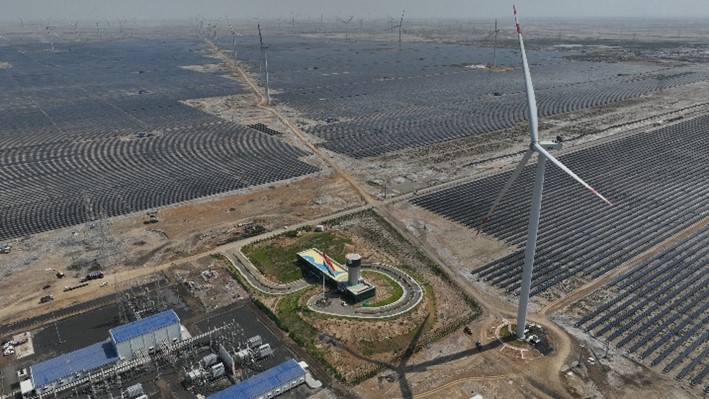
World’s largest renewable energy plant (30,000 MW) at Khavda, Gujarat
Adani Green Energy is developing the world’s largest renewable energy plant of 30,000 MW on the barren waste land at Khavda in Kutch, Gujarat. Built across 538 sq kms, it is five times the size of Paris and almost as large as Mumbai city.
Once complete, it will be the planet’s largest power plant across all energy sources. AGEL has operationalised cumulative capacity of 2,824.1 MW renewable energy at Khavda so far. The accelerated progress at Khavda underscores AGEL’s commitment to India’s goal of 500 GW non-fossil fuel capacity by 2030.
Work at Khavda continues at a fast pace, with AGEL leveraging the project execution capabilities of Adani Infra, the manufacturing expertise of Adani New Industries Limited, the operational excellence of Adani Infrastructure Management Services Ltd. and the robust supply chain of our strategic partners.
* India’s wind and solar cumulative installations as per MNRE Jan 2025 data
[Image credit: Adani]
Want to publish a press release? Submit your content here for review by our editorial team.
by Catie Owen | Feb 28, 2025 | Commercial & Industrial Solar
The China Photovoltaic Industry Association (CPIA) projects solar capacity additions of 215 to 255 GW in 2025, Chairman Wang Bohua stated at the group’s annual conference in Beijing on Thursday.
China added 277 GW of solar capacity in 2023, surpassing the previous record of 217 GW set in 2022. The growth occurred despite industry challenges, including a supply surplus that led to significant losses for major manufacturers.
The rapid expansion of solar power, which generates electricity only when the sun is shining, has increased pressure on grid infrastructure. Investments in transmission lines, energy storage, and digital management tools are needed to optimise power usage.
In response, the government has introduced new power market regulations, set to take effect on June 1. These changes will allow market forces to determine the rates that wind and solar generators receive for electricity, presenting new challenges for the sector.
S&P Global solar analyst Hu Dan noted on Wednesday that a surge in installations is expected in the second quarter of 2024, as developers aim to benefit from existing pricing policies before the transition to market-based rates.
Bohua indicated that the new regulations, stricter policies, and connection challenges for distributed rooftop solar, have put the industry in a “wait-and-see mood, thereby increasing the uncertainty around expected installations in 2025.”
According to Bloomberg Economics, China’s economic targets set at the 2025 National People’s Congress will provide insights into macroeconomic policy, with inflation objectives being particularly significant.
Meanwhile, China is expanding lithium extraction as a byproduct of alumina production to bolster domestic supply. Falling coal prices have also impacted the market, with mining shares declining after Citigroup downgraded ratings due to slower demand and lower prices.
[Image credit: Bloomberg]
by Catie Owen | Feb 19, 2025 | Large Scale Utility Solar
Japan’s government has approved its Seventh Strategic Energy Plan, which is designed to increase renewable and nuclear capacity.
The refreshed energy plan, written as an improvement of its predecessors, has prioritised clean energy sources and cutting-edge renewable technology – such as portable solar panels and solar BESS.
Japan’s Ministry of Economy, Trade, and Industry commented that the revised energy plan “is consistent with the new target of reducing greenhouse gases by 73% in FY [fiscal year] 2040 (from the FY2013).”
Japan currently imports 90% of its fuel, causing pressure for the country to become energy self-sufficient while also reducing its carbon output.
Daishiro Yamagiwa, an MP in Japan’s House of Representatives who worked on the energy plan, told the BBC: “Because of the conflict in Ukraine and the war in the Middle East, even fossil fuels have become difficult to buy.
“Japan is a country without energy resources, so we must use whatever is available in a balanced way.”
A nuclear focus
The plan also emphasises nuclear energy sources. It switches tack from reducing Japan’s dependency on nuclear to Tokyo planning to source 20% of its power via nuclear energy by 2040.
The new focus is likely due to the country’s need to meet the growing power demands of AI data centres and semiconductors.
Notably, the change is a shift away from policies that followed the Fukushima nuclear accident in 2011 and, as such, has garnered criticism from citizens and organisations.
Critics state that Japan should be deprioritising nuclear due to the risks is poses to the seismically-active island nation, and prioritising alternative energy sources instead – such as solar.
by Catie Owen | Feb 18, 2025 | Commercial & Industrial Solar
Singapore-based renewables developer Gurin Energy has completed construction of a 75 MW solar park in the Philippines, marking its first project in the country.
The Palauig Solar Power Plant, located in Palauig, Zambales Province, spans 80 hectares (198 acres) and consists of 136,363 photovoltaic (PV) panels.
The facility is expected to generate electricity that will offset approximately 53,100 tonnes of carbon dioxide emissions annually. Its output is contracted by Adventenergy Inc and Adventpower Inc, the retail electricity units of Philippine power company Aboitiz Power Corp.
“The completion of the Palauig Solar Power Plant, our first operational project, is a milestone in Gurin Energy’s drive to help move Asia to 100% renewable energy,” said Bob Driscoll, Gurin Energy’s chief operating officer.
The solar farm is owned by Shizen Inc, a wholly-owned subsidiary of Gurin Energy. The project was financed with bank support from UnionBank of the Philippines.
Gurin Energy states it has 1 GW of projects in development across the Philippines and a total of 7 GW in various stages of progress in Indonesia, Japan, Malaysia, Singapore, South Korea, Thailand, and the Philippines.
by Catie Owen | Feb 13, 2025 | Commercial & Industrial Solar
Press Release
Cleantech Solar, a leading provider of renewable energy solutions to corporations in India and Southeast Asia, is pleased to announce the commissioning of 10 MWp of floating solar PV systems for Cargill in Thailand.
These PV systems are part of nearly 30 solar PV projects under various stages of operations, construction and development for the food processing giant in Thailand, and numerous other projects in Southeast Asia and India.
The floating solar PV projects add to Cleantech Solar’s existing rooftop solar projects and are located at Cargill’s fully integrated poultry processing units in Korat and Saraburi, providing high-quality, reliable and cost-efficient solar power for operations.
The floating renewable energy systems are expected to generate approximately 285 GWh of clean energy throughout the projects’ lifetimes, reducing nearly 132 kilotonnes of CO₂ emissions.
Safety was paramount throughout the development of these projects, with a strong emphasis on adherence to rigorous safety protocols.
Cleantech Solar’s multiple long-term partnerships with Cargill across Southeast Asia and India underscore the developer’s commitment to providing top-of-the-line renewable energy solutions to the world’s leading corporate consumers.
These reduce environmental impact and advance towards carbon neutrality.
Watacharapon Prasopkiatpoka, Country Representative of Cargill Thailand, said: “We are pleased to strengthen our partnership with Cleantech Solar with the commissioning of these new solar PV systems at our manufacturing sites in Thailand.
“Cleantech’s dedication to providing well-designed and high-quality renewable energy solutions that ensure the protection of both the environment and people working on and around the facilities has made them a continued trusted partner in our journey towards more sustainable plant operations.”
Sanjay Gupta, CEO of Cleantech Solar, commented: “We’re honoured to have Cargill’s continued trust in our renewable energy solutions, and I’m delighted to announce the commissioning of these state-of-the-art floating solar PV systems in Thailand.
“This green partnership, whilst providing clean and cost-effective energy to Cargill, will contribute not only to their long-term environmental and sustainability targets, but also to Thailand’s ambitious renewable energy targets as laid out in the government’s Power Development Plan 2024 that aims to have renewables accounting for 51% of the total electricity generation capacity by 2037.
“Cleantech Solar is honoured to be a part of the energy transition, collaborating with stakeholders in the region in their mission to create a more sustainable future for food and agriculture.”
[Image caption: Cleantech Solar’s rooftop and floating solar PV project in Korat, Thailand. Image credit: Cleantech Solar]
by Catie Owen | Feb 10, 2025 | Large Scale Utility Solar
Press Release
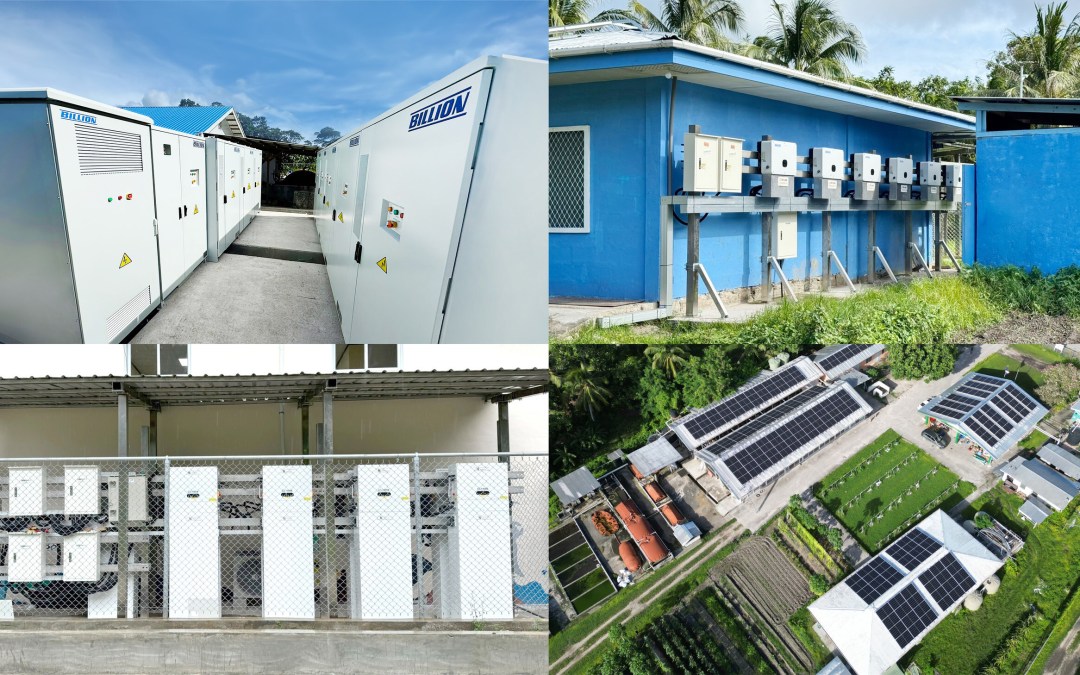
Billion Electric Group, in collaboration with Taiwanese partners, has successfully deployed 495 kWp of solar PV and 1,997 kWh of battery energy storage systems (BESS) in Palau, Tuvalu, and the Marshall Islands.
These modular microgrids reduce reliance on imported fossil fuels, ensuring stable green energy supply for agriculture, aquaculture, and local communities. The project is expected to cut carbon emissions by 800 metric tons annually, with over 50% renewable energy self-sufficiency at aquaculture centres and demonstration farms.
Meanwhile, livestock farms, offices, and dormitories now operate on 100% green energy, significantly lowering both energy costs and environmental impact.
Advanced smart energy solutions with full-scale integration
Billion Electric Group provides end-to-end energy solutions, from R&D and manufacturing to system integration and deployment.
The project features MIT (Made In Taiwan) renewable energy technologies, including Billion’s Fusio series BESS, Giga series PV inverters, and an AI-driven EMS (Energy Management System).
The system enables real-time power optimisation, bidirectional energy transmission, and a cloud-based monitoring platform, significantly enhancing grid stability and energy efficiency.
It prioritises solar power utilisation and incorporates black start capability, allowing diesel generators to restart autonomously in the event of power grid failures.
[Image credit: Billion Electric Group]
by Catie Owen | Feb 3, 2025 | Large Scale Utility Solar
Enphase Energy, an international energy technology company, is expanding its presence in Southeast Asia by entering the solar markets in Vietnam and Malaysia.
The company has begun shipping its IQ8P™ Microinverters, designed for high-powered solar modules, to both countries. This follows its initial shipments to Thailand and the Philippines last year.
Phan Ngoc Anh, CEO of Alena Energy, a distributor in Vietnam, highlighted the market’s potential growth, stating, “The Vietnamese solar market is poised for explosive growth thanks to the new Decree 135/2024/ND-CP on October 22, 2024.
“This will be a major boost to the government’s ambitious 2050 net-zero carbon goal. Enphase IQ8P Microinverters are a game-changer, delivering unparalleled performance and safety – perfect for our solar installations.”
Bernard Fok, general manager of Malaysia’s MYSOLARPOWER SDN BHD, emphasised the rising demand for energy savings, adding, “As the global leader in microinverter technology, Enphase offers the IQ8P Microinverters, which provide an ideal blend of efficiency and reliability.
“This empowers our customers to enjoy consistent energy production while reducing both their carbon footprint and utility costs.”
The IQ8P Microinverters, Enphase’s most powerful to date, have a peak output of 480 W and are compatible with solar modules up to 640 W DC. They come with a 25-year limited warranty and feature built-in rapid shutdown technology for enhanced safety.
Ken Fong, senior vice president and general manager of the Americas and APAC at Enphase, reaffirmed the company’s commitment, stating, “Our focus remains on expanding access to leading-edge, reliable energy technology across Southeast Asia.”
by Catie Owen | Jan 9, 2025 | Commercial & Industrial Solar
Press Release
LONGi Solar, a leading global producer of photovoltaic modules, has extended its current partnership with Israeli energy investor NOFAR to supply modules for a range of European solar projects.
The two companies have cooperated since 2023 on utility-scale installations across Europe with a total capacity of 600 MW, and the newly extended agreement, signed with NOFAR’s Romanian office, will drive the total supply of LONGi modules above 1GW.
For existing solar projects, NOFAR ordered LONGi’s advanced Hi-MO 7 modules, which have an efficiency of up to 22.6% and a bifacial ratio of approximately 80%, notably higher than the market standard. Going forward, the investor plans to deploy the LONGi Hi-MO 9 module in future developments, released in mid-2024.
This new product offers an efficiency rate of up to 24.4% and unusually high performance under uneven irradiation conditions like cloud cover. It also includes LONGi’s usual durability promise through a 30-year power warranty.
“We’re proud to play a role in the fast growth of European clean power production, and LONGi is an ideal partner. Technological reliability and ESG transparency are essential for our projects’ success,” commented Favi Stelian, CEO of NOFAR Energy Romania.
“Our team was able to visit the LONGi Lighthouse Factory and see exactly how they’ve achieved their higher production speed and quality. Along with the company’s exceptional ESG compliance, we know we can depend on LONGi modules.”
LONGi Romania’s Mirel Jarnea added, “NOFAR is playing an important role in building out solar in Europe and we are honoured to have their continued trust. It’s particularly exciting to expand this already strong partnership into new products. With the Hi-MO 9 module, we can look forward to deploying some of the most advanced back contact solar technology available on the market.”
With its Lighthouse Factory, the first solar manufacturing facility ever to receive this designation, LONGi achieved an 84% reduction in production and delivery cycles and a 20% decrease in energy consumption per unit, while enhancing product quality through automated controls.
The company has also expanded its ESG compliance, with a verified SDM traceability system, and stayed on track to meet an ambitious set of carbon neutrality and broader sustainability targets.
[Image credit: LONGi Solar]
by Catie Owen | Dec 16, 2024 | Commercial & Industrial Solar
VCI Global Limited is setting its sights on developing and acquiring up to 100 MW of solar photovoltaic projects across Southeast Asia (SEA) and Europe over the next five years.
This initiative is expected to generate approximately $200m in revenue over the next two decades, fuelling the Company’s long-term growth.
In SEA, VCI Global plans to source at least 70% of the targeted capacity from Malaysia, leveraging government programs such as the Corporate Renewable Energy Supply Scheme (CRESS).
Through CRESS, VCI Global will directly supply renewable energy to its data centre, enhancing energy independence and supporting its sustainability goals.
VCI Global also aims to acquire 30 MW of solar capacity in Eastern and Southeastern Europe, expanding its renewable energy portfolio to meet the growing global demand for clean energy.
This aligns with the Company’s strategic vision and commitment to national renewable energy targets.
The total investment for these solar initiatives is projected at $50m over five years, with expected annual revenues of approximately $10m over 20 years.
By capitalising on the increasing demand for solar energy, particularly for AI-driven data centres, VCI Global aims to deliver stable, long-term returns and value to shareholders.
“As renewables become the largest source of electricity generation by 2025, we see solar energy as a key opportunity to meet the growing demand for clean power, driven by AI and global needs,” said Dato’ Victor Hoo, Group Executive Chairman and CEO of VCI Global.
This sustainable growth strategy underscores VCI Global’s commitment to clean energy and a greener future.
by Catie Owen | Dec 9, 2024 | Commercial & Industrial Solar, Large Scale Utility Solar
According to the World Economic Forum, Pakistan imported 13 GW of solar panels in the first half of the current fiscal year, making it the third-largest importer of Chinese solar panels worldwide.
This surge in imports has been instrumental in advancing the country’s renewable energy sector, with solar panels now contributing over 30% of Pakistan’s total electricity production, which stood at 46 GW in 2023.
The rapid adoption of solar energy is primarily driven by households and businesses seeking to offset high electricity costs. This trend has been bolstered by a 90% reduction in solar panel prices over the past decade, making solar power increasingly accessible.
Government policies have also played a crucial role in promoting solarization. The elimination of a 17% sales tax and the implementation of a net metering policy have encouraged wider adoption of solar energy solutions.
Rising electricity costs, partly attributed to unfavourable agreements with Independent Power Producers (IPPs), have further amplified the demand for alternative energy sources.
Between 2019 and 2023, Pakistan made capacity payments of 6 trillion rupees ($21.5 billion), according to the Institute for Energy Economics and Financial Analysis.
Beyond economic benefits, the transition to solar energy has reduced dependence on imported coal, enhanced energy security, and delivered environmental gains.
Additionally, it has spurred job creation, attracted foreign investment, and promoted sustainability within the energy sector.
by Catie Owen | Dec 6, 2024 | Commercial & Industrial Solar, Storage
Press Release
Trina Storage, the global leading energy storage product and solution provider, has released a white paper exploring the safety and reliability of energy storage systems, co-authored with TÜV NORD.
The document serves as a critical resource for industry stakeholders, addressing essential challenges and innovative solutions that ensure the safety and effectiveness of energy storage technologies worldwide.
Safety Challenges and Market Trends: Key Insights for the Industry
The first part of the white paper provides an analysis of the current landscape of energy storage systems, highlighting emerging market trends and application scenarios across generation, transmission, and demand sides.
It emphasises significant safety challenges, such as thermal runaway and electrical hazards, while outlining a framework for risk assessment and mitigation.
Product Safety: The Foundation of Energy Storage Systems
The safety of energy storage systems fundamentally relies on the safety of their constituent products. The white paper emphasises that ensuring intrinsic battery safety is key to stable system operation.
Beginning with electrochemical development, in-depth analysis of failure mechanisms enables the design of cells capable of withstanding extreme mechanical, electrical, and thermal stresses, thereby reducing risks of fire or explosion.
Comprehensive safety testing, such as GB/T 36276, UL 1973, IEC 62619, and UL 9540A, further ensures cell stability and reliability under a wide range of conditions.
Additionally, the white paper highlights that electrical, structural, thermal management, and fire protection designs within energy storage products are critical to system safety.
The design in these aspects should fully consider potential safety risks and take corresponding preventive measures to ensure the system remains stable under various extreme conditions.
Quality Control: Essential for System Reliability
Beyond product safety, quality control is a crucial factor in ensuring the reliability of energy storage systems.
The white paper underscores that a comprehensive quality management system should encompass end-to-end oversight from R&D through production to after-sale support. In the R&D phase, rigorous simulations and testing protocols are recommended to preemptively address potential safety risks.
During production and after-sales, strict process controls and robust monitoring ensure that quality standards are maintained, and operational issues are promptly addressed.
Rigorous Testing and Validation: Ensuring Reliable System Safety
The ultimate assurance of safety and reliability in energy storage systems is achieved through stringent testing and validation.
The white paper highlights essential safety tests, reinforcing the importance of comprehensive testing to identify risks and implement effective mitigation strategies. It also advocates for active third-party validation to further enhance safety, providing critical data for performance verification and continuous improvement.
“As the global demand for energy storage systems continues to surge, ensuring their safety and reliability has become a shared responsibility across the industry,” said Dr. Kai Yang, Director of Advanced Institute for Energy Storage at Trina Storage.
“At Trina Storage, we are committed to driving the energy transition forward safely and reliably, and we encourage all industry players to join us in raising the standards for energy storage safety.”
Backed by a strong track record of delivering reliable energy storage solutions, Trina Storage continues to demonstrate its commitment to excellence through the advanced designs and robust safety features of its products, ensuring top-tier performance in real-world applications.
Click here to view and download the complete white paper: Energy Storage | Trinasolar
by Catie Owen | Dec 3, 2024 | Commercial & Industrial Solar
The US Commerce Department has announced a new round of tariffs for solar panel imports from Southeast Asia.
Considered to be part of the US’ anti-dumping drive, Reuters reports that analysts were not surprised by the decision. They are anticipating cut profit margins for producers and higher consumer prices.
According to Reuters, the new round of tariffs is the second determination in a trade case brought forward by Hanwha Qcels, First Solar, and more – who have raised concerns about Chinese companies selling solar parts to the US undercutting market prices.
Citigroup (Citi) analyst Pierre Lau explained his belief that the tariffs would improve production in the US solar industry and reduce reliance on imports.
He adds: “PRC module makers generally think the impact limited near term, assuming much of the incremental cost would be passed through to US customers without alternatives.”
Relocation
However, Yana Hryshko, Head of Global Solar Supply Chain Research at Wood Mackenzie, warns that, following the new tariffs, producers may source from countries such as Laos and Indonesia instead of China.
Speaking to Reuters, Hryshko adds: “They want to stay competitive for the U.S. market. The actual manufacturing cost in Southeast Asia is not that high compared to the prices that they are selling to the United States.”
In line with this concern, Hryshko told Bloomberg in August that some Chinese manufacturers were looking to relocate: “The mood of the suppliers is to pack the lines, especially the cell lines, and move them to either Indonesia, Laos or the Middle East.”
Chinese-owned solar plants are already present in Indonesia and Laos, where the tariffs do not currently extend to, however, analysts believe that this may change if exports increase.
Numbers
The US’ solar imports hit a record-breaking $15bn in 2023, with 80% coming from Cambodia, Malaysia, Thailand, and Vietnam. However, the US only accounts for 4-10% of Chinese module manufacturers’ sales – according to Citi.
The US Commerce Department has calculated anti-dumping rates as:
- Vietnam: 271.28%
- Cambodia: 125.37%
- Thailand: 77.85%
- Malaysia: 21.31%
A final decision, with possibly revised tariffs, will be released by the Commerce Department on 8 April 2025.
by Catie Owen | Nov 27, 2024 | Large Scale Utility Solar
The British Embassy in Manila marked two significant milestones in the UK-Philippines renewable energy partnership.
On November 20, a celebratory dinner highlighted the collaboration between Citicore Renewable Energy Corporation and Actis, a UK-based infrastructure investment firm. This partnership will develop four wind farms across Luzon and Visayas, adding a combined capacity of 380 megawatts.
These projects, supported by a $150m equity investment, secured offtake agreements under the Department of Energy’s Green Energy Auction Program (GEAP), emphasising the potential of international cooperation in advancing clean energy.
Solar development
The following day, Actis broke ground on the Terra Solar Project in Nueva Ecija, which is set to become the largest solar energy initiative in the Philippines.
Developed by Solar Philippines New Energy Corporation with $600 million in equity investment from Actis, the project promises to deliver affordable, reliable, and sustainable energy to millions of Filipinos.
His Majesty’s Ambassador to the Philippines, Laure Beaufils, says:
“The United Kingdom is proud to be a partner in the Philippines’ renewable energy journey. These investments reflect our shared vision for a sustainable future and underscore the strong ties between our two nations.
Projects like these not only provide clean energy to millions but also create opportunities for innovation and progress in the fight against climate change.”
by Catie Owen | Nov 25, 2024 | Large Scale Utility Solar
The Asian Development Bank (ADB) has partnered with the Solomon Islands and Tonga to support their energy transitions, with solar power playing a central role.
Agreements were finalised during COP29 in Azerbaijan, focusing on renewable energy projects in both nations.
For the Solomon Islands, ADB has allocated a $15m package, comprising a $10m concessional loan and a $5m grant.
The funds will support the Solomon Islands Renewable Energy Development project, which includes 2.5MW of solar PV power plants in Guadalcanal and Malaita provinces.
It will also support the development of the country’s first utility-scale battery energy storage system (BESS).
The initiative also aims to attract private sector investment in renewable energy.
In Tonga, ADB will provide $4.6m in grants for the Tonga Grid Enhancement for Sustainable Energy Transition project.
This effort will help meet Tonga’s goal of 70% renewable energy by constructing a new 33kV electricity network for solar power transmission and upgrading parts of the existing grid.
Scott Morris, ADB’s vice president for East and Southeast Asia and the Pacific, said these projects will “significantly reduce the Solomon Islands and Tonga’s reliance on fossil fuels” while improving disaster resilience.
He added, “These transformational energy projects demonstrate ADB’s steadfast commitment to improving energy security, affordability, access, and sustainability across the Pacific.”
COP29
These efforts are part of broader energy transition initiatives confirmed at COP29.
Australia also announced an $80m investment package to support renewable energy in the Pacific, focusing on off-grid and community-scale solar projects through programs like REnew Pacific and the Australia-Pacific Partnership for Energy Transition.
COP29 concluded with a $300bn finance deal for climate action in developing nations, a significant increase from previous pledges but below the $1.3tn demanded.
by Catie Owen | Nov 19, 2024 | Commercial & Industrial Solar
CHN Energy’s Guohua Energy Investment Co. Ltd. has connected the first phase of its 1 GW offshore solar project to the grid. Located 8 km off the coast of Dongying.
Shandong province, China, this open-sea project spans approximately 1,223 hectares.
The installation includes 2,934 photovoltaic (PV) platforms, each measuring 60 meters long and 35 meters wide. The platforms are mounted on large-scale offshore steel truss foundations designed for durability in marine environments.
JinkoSolar provided its n-Type tunnel oxide passivated contact (TOPCon) Tiger Neo bifacial modules for the project.
The company stated that the modules are customised for marine conditions, utilising dual-glass, semi-tempered glass, and POE encapsulation to resist moisture, salt fog, seawater exposure, strong winds, and extreme temperatures.
Once fully operational, the solar array is projected to supply electricity to approximately 2.67 million urban residents in China.
CHN Energy has adopted a combined fishing and PV development model, integrating fish farming with solar power generation to maximise resource use.
This connection follows the completion of CHN Energy’s 3 GW Mengxi Lanhai solar facility earlier this week, now the second-largest solar project globally.
For context, the largest completed offshore floating solar installation to date is a 440 MW project in Taiwan, which began operations earlier this month.
by Catie Owen | Nov 18, 2024 | Commercial & Industrial Solar
Maxeon Solar Technologies Ltd, a Singapore-based panel manufacturer, continues to face restrictions on importing its products from Mexico to the United States. This is due to compliance reviews under the Uyghur Forced Labor Prevention Act (UFLPA).
Despite submitting extensive evidence to U.S. Customs and Border Protection (CBP) to verify its clean supply chain, Maxeon’s residential and commercial solar panels remain detained, causing significant financial and reputational harm to the company and its U.S. customers.
Shipments of Maxeon’s Mexico-made panels have been held by CBP since July for UFLPA compliance checks.
The uncertainty surrounding the resumption of imports into its largest market forced the company to withdraw its full-year revenue and adjusted EBITDA guidance.
Maxeon asserts that its supply chains do not involve China’s Xinjiang region or any entities listed under the UFLPA. CEO Bill Mulligan, who plans to retire in January 2025, expressed frustration over the delays.
“We are strong proponents of the UFLPA and have provided CBP with tens of thousands of pages of documentation, including numerous walkthroughs for explanation of standard manufacturing and shipping processes.
“None of our supply chains involve entities on the UFLPA list, two of our supply chains do not even enter China, and yet the reviewers have declined to make the appropriate determination that UFLPA does not apply,” Mulligan adds.
The company has filed formal protests against the detentions and requested a review by a new CBP team. Mulligan concludes: “We remain optimistic that this new team will be able to expeditiously reach the right conclusion and clear our products for importation.”
by Catie Owen | Nov 11, 2024 | Commercial & Industrial Solar
India exported around $2bn worth of photovoltaic (PV) modules in fiscal year (FY) 2024, a more than 23-fold increase from FY2022, according to a report by IEEFA and JMK Research.
The United States is the largest destination for Indian PV exports, receiving 97% and 99% of the exports in FY2023 and FY2024, respectively. India also exports PV products to South Africa, Kenya, the UAE, Afghanistan, Nepal, and Bangladesh.
Despite higher logistics costs, Indian manufacturers can earn 40-60% higher profit margins on exports to developed nations like the US compared to domestic sales.
Factors contributing to the export surge include a delay in the implementation of India’s Approved List of Models and Manufacturers in April 2024, and countries seeking alternatives to China through the “China Plus One” strategy.
With the US imposing tariffs on Chinese PV products and considering extending these to Southeast Asia, India has the potential to become a leading PV exporter to the US.
The report suggests that India should balance export and domestic market demands, particularly for segments like residential rooftop solar, to avoid price volatility.
In FY2024, India exported over 5.8 GW of PV modules, a threefold increase from FY2023. Major exporters included Waaree Energies, Adani Solar, and Vikram Solar.
Other companies like Grew Energy and Navitas are also exploring export opportunities. Waaree and Vikram are planning to set up PV manufacturing in the US to benefit from Inflation Reduction Act incentives.
by Catie Owen | Nov 11, 2024 | Commercial & Industrial Solar
STMicroelectronics (ST) has signed a 21-year Power Purchase Agreement (PPA) with BKH Solar Sdn Bhd, a joint venture between Engie and Conextone Energy, to source renewable energy from a new 30MW solar farm in Bukit Kayu Hitam, Kedah, Malaysia.
This agreement will supply approximately 50GWh of solar energy annually to ST’s operations.
The PPA is part of Malaysia’s Corporate Green Power Program, launched by the Malaysian Single Buyer in 2023, which promotes long-term renewable energy partnerships for corporate clients.
Geoff West, STMicroelectronics Executive VP and Chief Procurement Officer, said:
“This long-term power purchasing agreement in Malaysia, ST’s first one in Asia, marks yet another important step towards ST’s goal of becoming carbon neutral in its operations (Scope 1 and 2 emissions, and partially scope 3) by 2027, including the sourcing of 100% renewable energy by 2027.
“PPAs will play a major role in our transition. Starting in 2025, this PPA with ENGIE will provide a significant level of renewable energy for ST’s operations in our high-volume test and assembly site in Muar, Johor, Malaysia.”
Amit Jain, Engie managing director for India and Southeast Asia, added, “ENGIE is delighted to join forces with STMicroelectronics in the global transition towards sustainable energy solutions.
By supplying approximately 50GWh of renewable energy annually from our new 30MW solar project in Malaysia, we are proudly contributing to ST’s transition towards 100% renewable sourcing.
This partnership with ST demonstrates our commitment to providing green, clean and reliable energy to our clients.”
ST’s assembly and testing site in Muar, Johor, employs over 4,700 people and supports a range of technologies and products, including high-reliability applications for the automotive industry. Additional ST operations are located in Penang and Kuala Lumpur.