by Catie Owen | Sep 3, 2025 | Americas, Large Scale Utility Solar
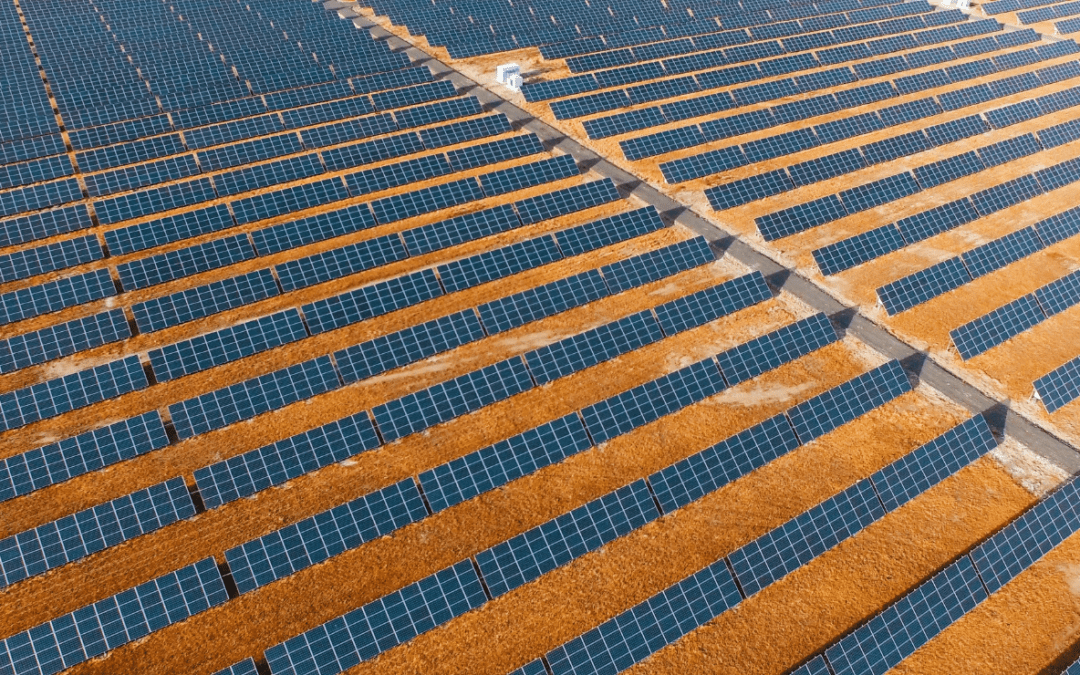
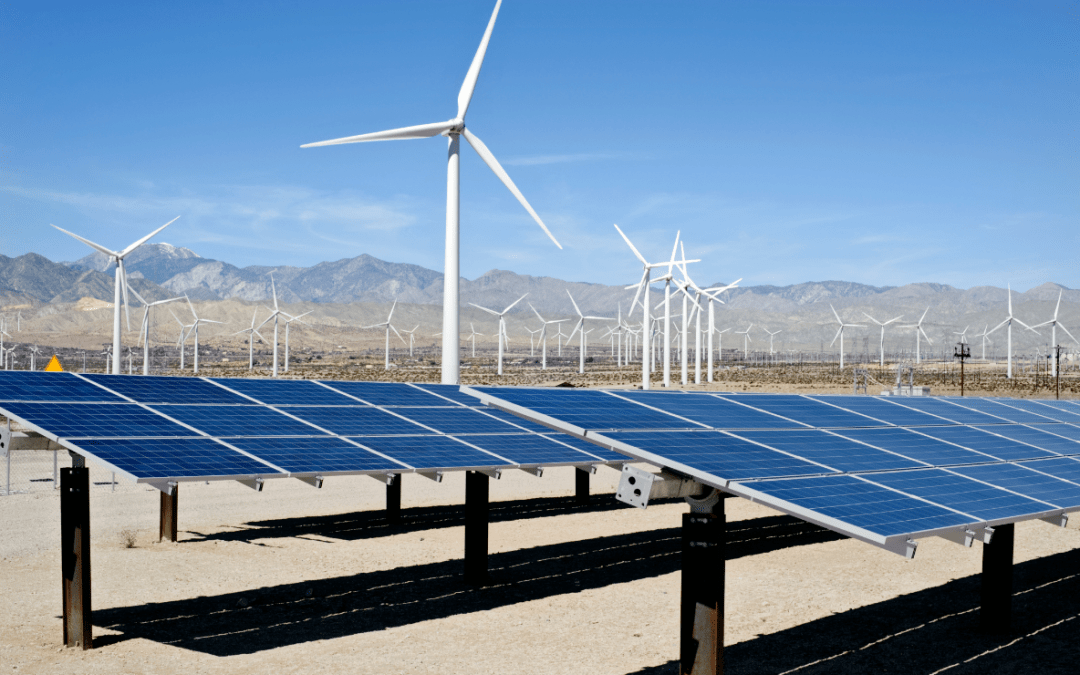
Ingeteam has provided photovoltaic inverters for Parliament Solar, a 640 MWdc project in Waller County, near Houston, Texas.
The development, led by Parliament Energy, represents the company’s largest inverter installation in the United States to date.
The site is expected to generate around 1,100 GWh of electricity annually, equivalent to the consumption of approximately 140,000 Texan households.
For the project, Ingeteam supplied 149 INGECON® SUN 3Power Series C liquid-cooled central photovoltaic inverters.
These were integrated into 80 UL-certified transformer stations and delivered as a turnkey solution. The company also carried out commissioning work from its Milwaukee production facility.
Ingeteam said the use of grid-forming technology enabled faster commissioning than originally anticipated.
Nohra Nasr, Vice President & General Manager for Solar PV & BESS in the United States at Ingeteam, said:
“Our experience in the market and the fact that we have a consolidated subsidiary on US soil have been key factors when awarding and executing the project. We hope it will be the first in a long list with this client.”
To date, Ingeteam has supplied more than 6 GW of solar inverters and energy storage solutions across the US. The company views the market as one with strong prospects for further renewable energy deployment.
Figures from the Federal Energy Regulatory Commission (FERC) underline this outlook. According to the regulator, utility-scale solar capacity overtook nuclear generation in January 2024.
Solar accounted for 81.5% of all new generating capacity brought online that year, with additions almost nine times greater than the combined total for natural gas and nuclear.
by Catie Owen | Aug 29, 2025 | Americas, Asia, Everything Installer
High US tariffs and possible anti-dumping duties on Indian solar panel exports are set to deepen a supply glut in India next year as domestic project bidding slows, industry officials and analysts said.
US President Donald Trump’s 50% tariffs on Indian shipments will restrict sales to its largest overseas market, which accounts for 90% of exports.
The situation could worsen if the US Commerce Department imposes anti-dumping duties following a 17 July petition from American solar companies targeting imports from India, Indonesia and Laos.
“The 50% tariff will squeeze margins, and potential anti-dumping duties will make competing in the US even tougher,” said Raj Prabhu, CEO of consultancy Mercom Capital.
India’s awards of new solar projects slowed sharply in the June quarter. “We expect that India will enter overcapacity stage already in 2026, which will feel even worse with the loss of the US market,” said Wood Mackenzie analyst Yana Hryshko.
Government incentives have doubled annual module capacity to 74 gigawatts by March, with forecasts of 190 GW by 2027. Yet factories are running at only 25% utilisation on average, said Vinay Rustagi of Premier Energies.
“Some companies are running at 80%-85% like us, others are running at much lower capacity,” he added.
Finding new export markets will be difficult. Indian modules using Chinese cells are 48% more expensive than Chinese modules, while those made with Indian cells are 143% costlier, Mercom data shows.
India plans to mandate domestic cell use from June 2026, though these are more than three times the cost of Chinese alternatives, said Rystad Energy analyst Fei Chen.
Analysts expect a short-term surge in Chinese imports before the rules take effect.
“Reliance on cell imports is likely to increase in the short term, potentially leading to stockpiling, price spikes, and supply chain pressures,” Prabhu said.
India has seen a solar success in recent months, with the country announcing in July that 50% of its installed capacity now comes from renewable sources – five years ahead of target.
by Catie Owen | Aug 28, 2025 | Americas, Everything Installer, Large Scale Utility Solar
Solar energy supplied nearly 9% of US electricity in the first half of 2025, according to a review of U.S. Energy Information Administration’s (EIA) data by the SUN DAY Campaign.
Figures from the EIA’s latest Electric Power Monthly show that wind and solar combined produced over one-fifth of the nation’s electricity, while renewables overall accounted for 27.7%.
Solar generation set records in June and across the six-month period. Utility-scale solar grew 37.6% year-on-year in January-June, with small-scale systems up 10.7%. Together, solar expanded by 29.7%, providing 8.7% of total generation, up from 6.9% a year earlier.
In June alone, solar supplied 10.2% of national output, rising 25% compared with June 2024. Utility-scale plants grew by 30.1% while rooftop solar rose by 10.5%.
The review found solar produced 45% more electricity than hydropower, and more than hydropower, biomass, and geothermal combined.
Wind power contributed 11.6% of US electricity in the first half of 2025, 2.4% higher than the same period last year. Wind and solar together generated 20.3% of the total, overtaking coal and nuclear.
All renewables increased output by 9.2% year-on-year, compared with 3.0% growth in total US electricity generation. Natural gas remained the leading source, though its output fell 3.7%.
“EIA’s latest data reflect the situation prior to enactment of the Trump/Republican megabill which may adversely future renewable energy growth,” said Ken Bossong, executive director of the SUN DAY Campaign.
On July 7, the US President signed an executive order that scaled back tax incentives for renewable projects, including solar and wind, which is forecasted to negatively impact the nation’s renewable progress.
Bossong adds: “Nonetheless, EIA notes that US developers expect half of new electric generating capacity to come from solar in 2025 and another 13% from wind.”
The EIA released its latest report on 26 August.
by Catie Owen | Aug 26, 2025 | Americas, Large Scale Utility Solar
The U.S. Energy Information Administration (EIA) has forecast that solar power will account for more than half of new electric generating capacity coming online in 2025.
According to the EIA’s latest survey of planned capacity changes, developers added 12GW of utility-scale solar in the first half of the year.
A further 21GW is expected during Q3-Q4, meaning solar could represent over half of the 64GW of new capacity scheduled to be installed this year.
Battery storage, wind, and natural gas will make up most of the remainder.
If all planned projects are completed, 2025 would set a new record for US generating capacity additions, surpassing the 58GW added in 2002. That earlier record was driven almost entirely by natural gas, which contributed 57GW.
While developers have continued to add natural gas capacity since then, the EIA noted that “other technologies such as wind, solar, and battery storage have become more prevalent options for new capacity.”
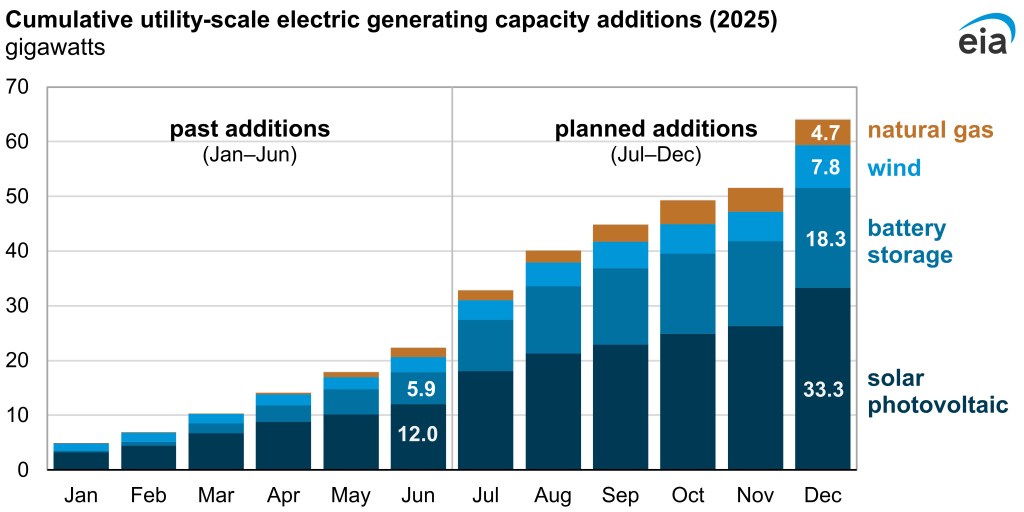
PV and storage growth
Both solar photovoltaic and battery storage are expected to add more capacity this year than in any previous year. Much of this growth is being driven by activity in Texas.
The state was responsible for 27% (3.2GW) of new solar capacity installed in the first half of 2025, with developers planning to add another 9.7GW before the end of the year. Texas overtook California in 2024 as the state with the most utility-scale solar capacity.
Battery storage was the second-largest contributor to new capacity in the first half of the year, representing 26% (5.9GW). Around half of this was installed in Arizona and California.
Developers in Texas are also expected to bring 7GW of storage online in 2025, most of it in the latter half of the year.
In contrast, relatively little generating capacity has been retired. Of the 8.7GW that operators planned to retire in 2025, only 2GW had closed in the first six months. Some retirements have also been postponed or cancelled.
More than 3.6GW of planned closures – including coal, oil, and gas units in Maryland and Texas – have been delayed.
If current retirement plans proceed, coal-fired power plants will account for 71% of closures in 2025, with natural gas at 19%.
[Graph credit: U.S. Energy Information Administration, Preliminary Monthly Electric Generator Inventory, June 2025]
by Catie Owen | Aug 22, 2025 | Americas, Commercial & Industrial Solar, Everything Installer
Enphase Energy, a US-based microinverter manufacturer, has signed its second safe harbour agreement this month to secure residential solar tax credits.
The deal will see Enphase supply domestically produced IQ8HC microinverters to a “leading solar and battery financing company”, which will provide third-party ownership (TPO) agreements for home solar and storage systems.
Enphase expects the agreement to generate around $50m in revenue.
Safe harbour provisions will allow the projects to qualify for the 30% 48E Investment Tax Credit (ITC) until its scheduled end in July 2026, following the recent Republican budget reconciliation bill.
The deal will also support access to the 10% domestic content bonus credit for projects using sufficient US-made components.
Ken Fong, senior vice president and general manager of the Americas and APAC at Enphase Energy, said safe harbour agreements “are a critical tool for keeping solar projects on track despite changing policy landscapes”.
He added: “These agreements allow developers and financiers to move forward with confidence, safeguard project economics, and accelerate clean energy deployment.”
Background
The reconciliation bill introduced stricter eligibility requirements for clean energy tax credits.
Both the ITC and the Production Tax Credit (PTC) will be phased out from 4 July 2026. Projects that start before this date have four years to commence operations, while others must be operational by the end of 2027.
New Treasury guidance, following an executive order from President Trump, clarified that residential projects under 1.5MW can qualify by spending 5% of estimated costs and maintaining “continuous construction”.
Larger systems must demonstrate substantial physical work.
Enphase said it plans to expand its safe harbour pipeline. Analyst firm Wood Mackenzie recently noted that while the US residential solar sector may contract in the short term, TPO eligibility for the 48E ITC remains a “major upside” for long-term growth.
by Catie Owen | Aug 18, 2025 | Americas, Commercial & Industrial Solar, Everything Installer
On Friday, 15 August, the US’ Trump administration introduced stricter eligibility rules for clean energy tax credits, raising concerns over the future of numerous renewable projects, Bloomberg reports.
New Treasury Department guidance issued on Friday alters the criteria for investment and production tax credits by tightening definitions of when construction is considered to have begun.
Developers must now demonstrate “physical work of a significant nature” on an ongoing basis, replacing the previous threshold that allowed projects to qualify if at least 5% of costs had been spent.
“Projects are going to have a difficult time achieving these levels of performance,” said Rhone Resch, Chief Executive of Advanced Energy Advisors. He added:
“What it is going to do is reward sophisticated companies that have projects that are farther along in their development. The companies that are going to suffer are the smaller medium medium-sized developers that aren’t going to be able to meet this time frame.”
The decision forms part of a wider push from the administration to curb solar and wind development, following an executive order directing new limits on tax credits and a series of additional permitting reviews. A planned wind farm in Idaho has already been cancelled.
Shares of major solar companies rose after the announcement, with Sunrun climbing as much as 28%, NextEra Energy up 5%, and NexTracker almost 9%.
BloombergNEF estimates more than 2,500 proposed projects, equivalent in capacity to about 383 nuclear reactors, could be affected. However, large developers have indicated they are well-positioned.
NextEra said it has sufficient projects under construction to meet its plans through 2029, while AES Corp. reported most of its pipeline will not be impacted.
Industry feedback
Industry analysts warn that the tighter rules add pressure to a sector already facing declining support, with US clean energy installations forecast to fall 41% after 2027 as tax credits phase out.
“This is yet another act of energy subtraction from the Trump administration that will further delay the buildout of affordable, reliable power,” commented Abigail Ross Hopper, President and CEO of the Solar Energy Industries Association (SEIA).
“American families and businesses will pay more for electricity as a result of this action, and China will continue to outpace us in the race for electricity to power AI. SEIA is carefully reviewing the guidance and evaluating next steps to protect the industry’s and America’s interests, as we have been since this side deal was announced last month.
“In the meantime, we urge the Trump administration to stop the political games, stop punishing businesses, and get serious about how to actually build the power we need right now to meet demand and stay competitive.”
[Edited 20 August 2025 to include commentary from SEIA]
by Catie Owen | Aug 14, 2025 | Americas, Asia, Commercial & Industrial Solar, Everything Installer
South Korea has called on the United States to grant leniency to its companies in an ongoing investigation into imported polysilicon, warning that wide-ranging restrictions could harm both countries’ clean energy and semiconductor sectors.
According to a filing with the US Bureau of Industry and Security, Korea’s Ministry of Trade, Industry and Energy urged Washington to apply “flexible consideration” for Korean firms during its review under Section 232 of the US Trade Expansion Act of 1962.
The probe, launched on 1 July, is assessing whether low-priced polysilicon imports pose a national security risk.
“Korea is a net importer of high-quality polysilicon from the United States. At the same time, Korea and its companies have established a secure supply chain for polysilicon to US importers and US companies,” the ministry said.
“If import restrictions on polysilicon are introduced, we respectfully request that special consideration be given to allow for flexible application to Korean companies.”
Polysilicon prices have fallen sharply in recent years, largely due to China’s dominance in the sector.
IBK Securities reports that Chinese products, backed by state support, sell for around USD 5 per kilogram, compared with USD 18–25 for non-Chinese equivalents.
US officials have warned that such price pressures are causing domestic plant closures.
The ministry noted that restrictions could hinder US ambitions to expand domestic solar and semiconductor manufacturing, citing Hanwha Qcells and OCI Holdings as Korean firms active in US projects.
“Broadly applied tariffs or other import restrictions… risk disrupting supply chains that are important to both economic and national security,” it added.
Both companies said their supply chains avoid low-cost Chinese polysilicon. Industry sources have cautioned that sweeping measures could “face indirect damage” for allied companies investing in US manufacturing.
New development, same problem
This is not the first time organisations have pushed back against the Trump administration’s tariff rollout.
The tariffs are part of a wider initiative designed to encourage the use of domestic manufacturing, supply chains, and products.
The tariffs have included both the materials used in PV manufacturing and the solar panels themselves – primarily targeting Asian imports.
In April, the administration announced tariffs of over 3,000% on solar panel imports from various Southeast Asian countries in a bid to circumvent the influx of “subsidised, low-cost” products from China.
by Catie Owen | Aug 13, 2025 | Americas, Commercial & Industrial Solar, Everything Installer
Pivotal Manufacturing Partners has acquired around 140 acres at the former planned Phipps Bend Nuclear Plant in Hawkins County, Tennessee.
The real estate investment platform has also signed a long-term ground lease with Highland Materials, which plans to build an advanced manufacturing facility valued at over $1bn on part of the site.
The wider Phipps Bend Advanced Manufacturing & Technology Campus is intended as a high-power, heavy infrastructure location for operators requiring large-scale facilities, high-voltage connections, and flexible zoning.
It has on-site access to a Tennessee Valley Authority (TVA) regional transmission interconnect, serving Northeast Tennessee and Southwest Virginia, and benefits from development-friendly permitting.
“We are honoured to be investing behind the growth of Northeast Tennessee at such a unique site at Phipps Bend,” said David Robbins, Managing Partner of Pivotal Manufacturing Partners.
“This campus combines striking mission critical infrastructure, a rare high-voltage interconnect, and a permitting environment shaped by its nuclear legacy – all within a region eager to welcome transformational capital investment.”
Originally developed by the TVA in the late 1970s as a nuclear power facility, Phipps Bend saw over $2.6bn in federal investment before its cancellation in the early 1980s.
Although no reactors were completed, the site retains significant infrastructure, a strategic transmission location, and a history of energy-intensive industry.
Highland Materials manufactures high-purity polysilicon for the solar and semiconductor sectors.
CEO Richard Rast said, “Partnering with Pivotal Manufacturing Partners is a critical step needed to move the Highland polysilicon manufacturing facility forward at Phipps Bend.
“We are excited about the market opportunity, the job creation, the capital investment, and the continued community and state level support this project enjoys.”
by Catie Owen | Aug 8, 2025 | Americas, Large Scale Utility Solar
The US Trump administration has intensified its measures against renewable energy, with policy changes now including the cancellation of established programmes.
Recent actions include new permitting reviews, restrictions on federal land use for projects, and the rescinding of Biden-era renewable policies.
The Environmental Protection Agency (EPA) is set to cancel the $7bn Solar For All programme, designed to provide solar access to over 900,000 low-income households.
EPA head Lee Zeldin announced the programme’s termination as part of the “One Big Beautiful Bill” spending cuts. The scheme’s 60 recipients – including state energy departments, tribal organisations, and multi-state initiatives – had aimed to deliver community solar projects and direct support.
Some states, such as Massachusetts, projected 20% electricity bill reductions for tens of thousands of residents.
Senator Elizabeth Warren called the cancellation “reckless”, while Senator Ed Markey said it would remove billions in savings from households.
Industry groups and analysts warn these measures will increase reliance on fossil fuels, delay or cancel projects, and raise consumer energy costs.
The E2 advocacy group estimates more than $22bn in clean energy projects have been delayed or cancelled since January, with over 16,500 job losses – the majority in Republican districts.
The administration argues the changes “level the playing field” for coal, gas, and nuclear, prioritising “always-on” power. Interior Secretary Doug Burgum now personally approves dozens of renewable permits; a process developers say will mire projects in red tape.
While larger firms claim they can weather the policy shift, smaller developers may struggle, and analysts warn that impacts could extend to projects on private land as well.
by Catie Owen | Aug 7, 2025 | Americas, Storage
US-based SolarMax Technology Inc has announced plans to broaden its operations beyond residential solar with a new utility-scale battery storage project in Texas.
The company’s subsidiary, SolarMax Renewable Energy Provider Inc, has signed an engineering, procurement and construction (EPC) contract with Longfellow BESS I LLC for a 430MWh battery energy storage system in Pecos County.
The agreement includes full EPC services, covering design, installation, testing, start-up and commissioning.
The project is expected to generate around $127.3m in revenue. SolarMax also confirmed it will acquire an 8% equity interest in Longfellow BESS I LLC.
“This contract represents a key step in scaling our commercial footprint in the United States and validates our strategy to diversify beyond residential solar into commercial-scale EPC services,” said David Hsu, CEO of SolarMax.
The Longfellow BESS I project forms part of the portfolio of Infinite Grid Capital (IGC), an energy storage investment fund. It is being co-developed at the Gas Century Processing Plant owned by Mitchell Malone’s Longfellow Ranch Partners.
The battery system will be integrated with the existing natural gas facility, with plans for future additions including solar generation and an AI-powered data centre.
by Catie Owen | Aug 6, 2025 | Americas, Large Scale Utility Solar
Governor Jared Polis announced new measures to expand access to affordable renewable energy in Colorado, USA.
These include an executive action to prioritise clean energy across state agencies and the launch of the Colorado Energy Savings Navigator (CESN) – a digital platform that connects residents to over 600 energy rebates and 18 bill assistance programmes.
“Today we are taking action to ensure that Coloradans can easily access clean energy savings, especially ones that expire soon,” said Governor Polis.
“We continue to do all we can to make people aware of how you can reduce costs on energy bills and keep money in your pocket.”
With average household energy costs in Colorado projected to rise by up to $500 annually by 2035 due to new federal policies, Colorado’s steps aim to lower energy bills, speed up clean energy development, and secure economic certainty for businesses.
Public Utilities Commission Director Rebecca White said the CESN tool was designed to solve the “time-consuming” process of accessing rebates.
Environmental and energy leaders welcomed the announcement. “This Executive Action will give people tools they need to save money on energy and accelerate clean energy deployment,” said Kelly Nordini, CEO of Conservation Colorado.
Washington targets renewables
The signing of Executive Order 14315: Ending Market Distorting Subsidies for Unreliable, Foreign-Controlled Energy Sources and the One Big Beautiful Bill Act on July 7 2025, heralded the end of subsidies for renewable energy projects in the US.
The Executive Order cited costs to taxpayers and dependency on supply chains “controlled by foreign adversaries” as the motivations behind cutting the tax cuts.
In cutting discounts for wind and solar projects, the US plans to revert its focus to fossil fuels.
In retaliation, Colorado Governor’s executive action instructs state agencies to streamline project development and maximise federal tax credit opportunities before they expire.
Advanced Energy United’s Emilie Olson commented: “It sends a clear signal that Colorado will move forward in spite of Washington, D.C.”
by Catie Owen | Jul 28, 2025 | Americas, Large Scale Utility Solar
The latest Electric Power Monthly report from the U.S. Energy Information Administration (EIA), covering data through May 2025, shows solar remains the fastest-growing source of electricity in the United States.
In May, utility-scale solar generation (installations >1 MW) rose by 33.3% compared to May 2024. Small-scale solar, such as rooftop systems, increased by 8.9%.
Together, solar accounted for more than 11% of the country’s electricity that month – a 26.4% year-on-year increase.
For the first time, combined utility- and small-scale solar output (38,965 GWh) exceeded wind generation (36,907 GWh).
From January to May 2025, utility-scale solar generation grew by 39.8%, while small-scale solar rose by 10.7%, totalling an overall increase of 31.1% compared to the same period in 2024.
Solar made up 8.4% of the nation’s electricity in the first five months of 2025, up from 6.6% the year prior.
Solar generation also surpassed output from hydropower (6.1%) and now exceeds the combined output of hydropower, biomass, and geothermal sources.
Wind generation accounted for 12.2% of U.S. electricity between January and May 2025, 3.9% more than the previous year and nearly double that of hydropower. Combined, wind and solar provided 20.5% of U.S. electricity in that period, surpassing coal and nuclear.
In May alone, renewables generated 29.7% of U.S. electricity, second only to natural gas, which declined by 5.9% from the previous year.
The report follows EIA’s June findings, which demonstrated that the US’s renewable energy generation reached a record high in 2024. However, eyes on the country’s 2025 changes to its renewable policies, which threaten the US’ clean energy development.
by Catie Owen | Jul 24, 2025 | Americas, Commercial & Industrial Solar
Engie North America has acquired a portfolio of distributed solar projects from developer Prospect14.
The deal includes 22 net energy metered (NEM) solar PV projects in Pennsylvania, totalling over 70MW of capacity. Kristen Fornes, head of distributed solar and storage at Engie North America, said the projects support both the company’s goals and the state’s energy transition.
“These projects align with the company’s mission to deliver locally sourced energy while supporting Pennsylvania’s transition to a more resilient and decarbonised energy system,” she said.
Prospect14, based in Ardmore, Pennsylvania, was founded in 2018 as Glidepath Ventures and rebranded in 2020. Since then, the company has overseen several large-scale transactions.
In 2020, Prospect14 sold a 278MW, 12-project portfolio to Grasshopper Solar and another four projects, totalling 887MW, to an unnamed independent power producer.
All projects were located in Pennsylvania, although the value of the Grasshopper deal was not disclosed.
Another notable transaction involved CleanChoice Energy acquiring the 29.42MW Kylertown solar project, spanning 150 acres.
Engie North America’s total installed renewables and energy storage capacity reached 51.6GW by the end of March 2025. Its parent company also recently expanded operations in Chile, where it is building its first solar-plus-storage facility in the country’s Metropolitan Region.
The 151MW project is backed by a $130m investment and is scheduled to begin commercial operation in Q3 2026.
by Catie Owen | Jul 21, 2025 | Americas, Asia, Commercial & Industrial Solar, Europe
US-based independent power producer Enfinity Global has sold a 49% equity stake in its 402MW solar portfolio in Italy to the State Oil Fund of the Republic of Azerbaijan (SOFAZ), Azerbaijan’s national sovereign wealth fund.
The portfolio includes 14 solar PV plants – both operational and under construction – across the Lazio and Emilia-Romagna regions. Once complete, the plants are expected to produce around 685GWh of electricity annually.
Enfinity will retain a 51% majority stake and continue managing the assets. “SOFAZ will act as Enfinity’s long-term partner and investor in Italy,” said Carlos Domenech, CEO of Enfinity Global.
The partnership is expected to support Enfinity’s broader pipeline, which includes 2.6GW of solar and 5.3GW of energy storage projects.
SOFAZ, which manages over $65bn in assets, was founded in 1999 to oversee Azerbaijan’s oil and gas revenues. The acquisition aligns with its goal of securing stable returns while supporting the transition to renewable energy.
Enfinity was supported by Mediobanca (financial), Legance (legal), and Fichtner (technical). SOFAZ was advised by JLL (M&A), Dentons Europe Studio Legale Tributario (legal), EY (financial and tax), and DNV (technical).
Founded in 2019, Enfinity has a global solar portfolio of 35.5GW, including 1.1GW of operational capacity and 1.3GW under construction. Its battery energy storage portfolio totals 12.9GW, with projects in the US, Italy, UK, India, and Japan.
The company also recently secured up to €100m from Eiffel Investment Group to fund its European solar and storage projects through four of Eiffel’s sustainable investment vehicles.
by Catie Owen | Jul 21, 2025 | Americas, Commercial & Industrial Solar
The California Energy Commission (CEC) has awarded a $4m grant to perovskite developer Tandem PV to support third-party testing of its perovskite-silicon tandem solar panels.
According to the company, the funding will cover performance testing in real-world environments and assessments of the panels’ long-term durability.
This external validation will complement Tandem PV’s internal testing efforts and marks a step towards commercialisation of the perovskite-silicon tandem technology.
Tandem PV states that its panels currently reach a 28% conversion efficiency and are 30% more powerful than typical silicon panels.
Research from Oxford PV, another perovskite developer, indicates that perovskite-silicon tandem cells could theoretically reach 43% efficiency, well above the 29% ceiling for conventional silicon cells.
“This award accelerates our durability testing to bring us closer to delivering a new standard for clean energy and delivering high-efficiency solar that’s proven, reliable and ready for the market,” said Tandem PV founder and CTO Colin Bailie.
Both Tandem PV and Oxford PV have recently focused on scaling production. Tandem PV secured $50m in March to fund a commercial-scale perovskite manufacturing facility in the US.
In April, Oxford PV signed a perovskite technology patent licensing agreement with Trinasolar.
Meanwhile, California’s solar sector continues to evolve. The removal of a proposed amendment that would have sharply reduced compensation for residential solar exports under net energy metering was welcomed by the California Solar & Storage Association.
However, increasing curtailment due to high renewable capacity remains a challenge. In March, the California Independent System Operator curtailed over 900,000MWh of solar and wind generation – a record monthly figure – underscoring the need for grid infrastructure upgrades.
by Catie Owen | Jul 17, 2025 | Americas, Commercial & Industrial Solar
Independent power producer Sol Systems has announced a $675m revolving construction finance facility to support its upcoming solar and storage developments.
The funding will back construction loans, tax equity bridge loans, and letters of credit for an initial 500MW of projects across Illinois, Ohio, and Texas. The first group of projects is expected to go online by the end of 2026.
“This facility is a major step forward in scaling Sol’s operating portfolio,” said Richard Romero, CFO of Sol Systems.
“It gives us the capital to reliably and quickly deliver clean energy projects across the country. We’re grateful to our partners and lenders for their vision, trust, and alignment to accelerate this shared mission.”
The company noted that the financing demonstrates strong investor confidence in the long-term value of clean energy assets. The pipeline includes shovel-ready projects that align with both state and corporate decarbonisation goals.
“We’ve seen long term energy supply and demand market dynamics drive continued investment into renewables,” said Dan Diamond, Chief Development Officer at Sol Systems.
“Customers continue to leverage utility scale solar for cleaner, faster, cheaper generation supply. This sizable financing paves the way for the growth of our IPP platform.”
Sol Systems says the funding will enable it to expand its operations more efficiently, supporting the broader deployment of renewable infrastructure and reinforcing its position as a leading independent power producer.
[Image credit: Sol Systems. Image caption: The three-year commitment will initially fund 500 MW of solar and storage projects across Illinois, Ohio, and Texas]
by Catie Owen | Jul 14, 2025 | Americas, Commercial & Industrial Solar
SolarBank Corporation has cleared a milestone for its 7.2 MW ground-mount solar project in upstate New York, as the Hoadley Hill Road project has passed the Coordinated Electric System Interconnection Review (CESIR).
This will allow the company to move forward with permitting, financing, and construction.
The project is expected to generate enough electricity to power approximately 850 homes and will feed directly into the local grid.
It is backed by New York’s Value of Distributed Energy Resources (VDER) program, with a projected year-one compensation rate of $0.0971/kWh.
“With the interconnection review now in the rearview mirror, we’re shifting into high gear,” said Dr. Richard Lu, CEO of SolarBank. “We’re now full speed ahead on permitting and project financing to bring this clean energy solution online.”
SolarBank is also pursuing incentives through NYSERDA’s NY-Sun Program, which could provide a one-time payment of up to $0.395 per watt (DC). These incentives aim to support solar development and reduce financial risk for developers.
Once fully permitted and financed, the project will operate as a community solar installation. Residents and businesses will be able to subscribe to the solar farm and receive utility bill credits without the need for on-site solar panels.
SolarBank has completed over 100MW of projects and has a development pipeline exceeding 1GW. The company says the Hoadley Hill project demonstrates its scalable model and commitment to long-term clean energy infrastructure.
New York currently leads the US in community solar capacity and is targeting 6 GW of installed solar by the end of 2025 as part of its Climate Leadership and Community Protection Act.
The company notes that the project’s success depends on permitting, financing, and stable policy support.
by Catie Owen | Jul 10, 2025 | Americas, Commercial & Industrial Solar
President Donald Trump has issued a new executive order aimed at tightening remaining loopholes in renewable energy subsidies, further reinforcing his administration’s shift away from federal support for wind and solar projects.
The order follows passage of the “One Big Beautiful Bill,” which already repealed major clean energy tax credits under the Inflation Reduction Act (IRA).
It directs the Treasury Department to narrowly interpret what qualifies as “under construction,” restricting eligibility for subsidies unless “a substantial portion of a subject facility has been built”.
Critics argue the move undermines bipartisan agreements that allowed projects a 12-month grace period under existing rules.
Jason Grumet, CEO of the American Clean Power Association, said, “The executive order and commitments to the Freedom Caucus seem at odds with that agreement.
The administration’s next steps are a clear test of whether Senate leadership or the House Freedom Caucus has more influence on national policy”.
In addition to narrowing tax credit eligibility, the order escalates restrictions on Chinese-backed clean tech by tightening “Foreign Entity of Concern” (FEOC) rules.
It also instructs the Interior Department to eliminate policies favouring wind and solar development on federal lands, potentially impacting large-scale projects.
Abby Hopper, president of the Solar Energy Industries Association, emphasised, “Business certainty, predictability, and even-handedness are bedrocks of federal policy that cannot be undone by the stroke of a pen”.
Supporters argue the crackdown could prevent abuse of subsidies and reduce the federal deficit.
“The Trump administration could… make it very specific in terms of what is under construction,” said Thomas Pyle of the Institute for Energy Research.
As solar accounted for 50GW of new capacity in 2024, the industry now faces heightened uncertainty amid growing energy demand and global calls for decarbonisation.
by Catie Owen | Jul 8, 2025 | Americas, Commercial & Industrial Solar
On 7 July, US President Donald Trump signed an executive order instructing federal agencies to implement provisions that scale back tax incentives for solar and wind energy projects.
The “One Big Beautiful Bill Act” calls for the US Treasury Department to oversee the phaseout of renewable energy tax credits, as laid out in the recent budget bill passed by Congress and signed into law by the president.
Additionally, the Interior Department has been tasked with reviewing and revising any existing policies that prioritise renewables over other energy sources.
In the executive order, as reported by Reuters, Trump stated that renewable energy resources are “unreliable, expensive, displaced more dependable energy sources, were dependent on foreign-controlled supply chains and were harmful to the natural environment and electric grid.”
Impact
Under the One Big Beautiful Bill Act, tax credits for renewable energy will effectively cease for projects that have not started construction by the end of 2026.
Projects initiated after this deadline must be completed and operational by the end of 2027 to be eligible for any remaining incentives.
This marks a significant departure from prior legislation, which allowed developers to claim a 30% tax credit for eligible projects through 2032.
Both the Treasury and Interior Departments are required to submit reports to the White House within 45 days, detailing the steps taken to implement the executive order.
Reactions
The changes drew strong reactions from solar Industry groups prior to being signed into law.
The US solar industry, in particular, has voiced opposition to the rollback. As previously reported by Solar&StorageXtra, leading solar companies and trade associations have condemned the legislation, warning that it could slow growth, cost jobs, and stall private investment in clean energy infrastructure.
Many in the sector had hoped to see tax credit extensions or permanent policy support to encourage long-term planning and stability in the future. However, doubts arose in January following Trump’s rollback of environmental legislation made under his predecessor, President Biden.
The administration has emphasised that the policy changes are designed to promote what it describes as energy independence and reliability, despite demonstrating a de-prioritisation of domestic renewable energy generation.
by Catie Owen | Jun 12, 2025 | Americas, Large Scale Utility Solar
The United States produced more energy in 2024 than previous years, driven in part by record output from solar, wind, and biofuels, according to the U.S. Energy Information Administration (EIA).
Total domestic energy production exceeded 103qd British thermal units (Btu), surpassing the previous record set in 2023 by 1%.
“Biofuels, wind, and solar production each set records in 2024, contributing to record total renewable energy production in the United States,” the EIA reported.
Solar energy saw the biggest leap among renewables, growing 25% compared to 2023, while wind generation increased by 8%. Biofuels – including ethanol, biodiesel, and sustainable aviation fuel – hit a record 1.4m barrels per day, up 6% from the previous year.
Despite this growth, fossil fuels remained dominant. Natural gas accounted for about 38% of total energy production, maintaining its lead since 2011.
Crude oil followed at 27%, with production reaching a record 13.2m barrels per day. Coal, by contrast, fell to its lowest level since 1964, making up just 10% of output.
Older energy sources such as hydropower and nuclear remained flat or declined slightly.
“Output from other energy sources that are primarily used for electric power generation either peaked decades ago… or fell slightly from their 2023 values,” noted the EIA.
The data reflect a steadily shifting US energy landscape – one still dominated by fossil fuels but with renewables claiming a growing share.