by Emily Ashley | Jul 21, 2025 | Americas, Asia, Commercial & Industrial Solar, Europe
US-based independent power producer Enfinity Global has sold a 49% equity stake in its 402MW solar portfolio in Italy to the State Oil Fund of the Republic of Azerbaijan (SOFAZ), Azerbaijan’s national sovereign wealth fund.
The portfolio includes 14 solar PV plants – both operational and under construction – across the Lazio and Emilia-Romagna regions. Once complete, the plants are expected to produce around 685GWh of electricity annually.
Enfinity will retain a 51% majority stake and continue managing the assets. “SOFAZ will act as Enfinity’s long-term partner and investor in Italy,” said Carlos Domenech, CEO of Enfinity Global.
The partnership is expected to support Enfinity’s broader pipeline, which includes 2.6GW of solar and 5.3GW of energy storage projects.
SOFAZ, which manages over $65bn in assets, was founded in 1999 to oversee Azerbaijan’s oil and gas revenues. The acquisition aligns with its goal of securing stable returns while supporting the transition to renewable energy.
Enfinity was supported by Mediobanca (financial), Legance (legal), and Fichtner (technical). SOFAZ was advised by JLL (M&A), Dentons Europe Studio Legale Tributario (legal), EY (financial and tax), and DNV (technical).
Founded in 2019, Enfinity has a global solar portfolio of 35.5GW, including 1.1GW of operational capacity and 1.3GW under construction. Its battery energy storage portfolio totals 12.9GW, with projects in the US, Italy, UK, India, and Japan.
The company also recently secured up to €100m from Eiffel Investment Group to fund its European solar and storage projects through four of Eiffel’s sustainable investment vehicles.
by Emily Ashley | Jul 18, 2025 | Africa, Americas, Asia, Europe, Large Scale Utility Solar, Middle East, Oceania
Global renewable energy capacity grew by more than 15% in 2024, according to the Renewable Energy Statistics 2025 report released by the International Renewable Energy Agency (IRENA) this week.
However, the agency warns that regional disparities in growth are widening.
Asia accounted for 71% of new capacity additions, maintaining its lead for a second consecutive year. Europe and North America followed, contributing 12.3% and 7.8% respectively.
In contrast, Africa, Eurasia, Central America, and the Caribbean together made up just 2.8% of global additions. Despite its potential, Africa’s renewable capacity increased by only 7.2%.
IRENA Director-General Francesco La Camera said: “The renewable energy boom is transforming global energy markets, driving economies and creating vast investment opportunities.
“However, the growing regional divide highlights that not everyone is benefiting equally from this transition.”
He added: “Bridging the divide and closing the investment gap between countries and regions is critical. It requires targeted policies, international financing, and partnerships that unlock capital and technology where they are needed most.”
UN Climate Change Executive Secretary Simon Stiell echoed these concerns, saying: “The global shift to renewables is increasingly inevitable, but its massive human and economic benefits are not yet being shared across all countries and regions.”
“To deliver on the global agreement at COP28 to triple renewables by 2030, we need to move much further and faster… The investments required will pay huge dividends – cutting emissions, driving economic growth, creating jobs, and supporting affordable, secure energy for all.”
Despite a record-breaking 582 GW being added last year, IRENA notes that the world remains off track to meet the 11.2 TW target needed by 2030.
by Emily Ashley | Jul 16, 2025 | Asia, Large Scale Utility Solar
India has reached a significant milestone in its energy transition, announcing that 50% of its installed electricity capacity now comes from non-fossil fuel sources.
This is five years ahead of its 2030 target under the Paris Agreement.
As of June 30, 2025, the country’s total installed power capacity stood at 484.82GW, with 242.8GW sourced from non-fossil fuels. This includes 8,780 MW from nuclear, 49,378.16 MW from hydro, and 184,621.04 MW from renewables.
Within the renewable segment, solar power leads with 116,247.83 MW, followed by 51,674.85 MW of wind, 11,596.31 MW of bio power, and 5,102.05 MW of small hydro.
“In a world seeking climate solutions, India is showing the way,” said Minister of New and Renewable Energy Pralhad Joshi. “Achieving 50% non-fossil fuel capacity five years ahead of the 2030 target is a proud moment for every Indian.”
This progress comes as India’s renewable energy output rose at its fastest pace since 2022 during the first half of 2025.
The country added nearly 28GW of solar and wind capacity in 2024 and 16.3 GW more in the first five months of 2025 alone.
Despite this momentum, fossil fuels still accounted for over two-thirds of the increase in total power generation last year. India also plans to expand coal-fired power by 80GW by 2032 to meet rising electricity demand.
The government remains committed to its clean energy goals, targeting 500GW of non-fossil capacity by 2030.
It is also promoting battery storage, green hydrogen, and circularity in solar and wind components to support deeper decarbonisation.
by Emily Ashley | Jul 9, 2025 | Asia, Innovation
LONGi’s tandem research team has reported a record 34.6% power conversion efficiency (PCE) for perovskite-silicon tandem solar cells, as published in Nature on 7 July 2025 under the title “Efficient perovskite/silicon tandem with asymmetric self-assembly molecule.”
Tandem solar cells combine perovskite and silicon layers to reduce energy losses and surpass the theoretical efficiency limit of 33.7% for single-junction cells.
However, progress has been limited by interfacial non-radiative recombination – energy lost at material junctions.
In earlier research published in Nature in September 2024, LONGi introduced a bilayer passivation method using lithium fluoride and diammonium diiodide.
This approach achieved a certified efficiency of 33.9%, marking the first tandem cell to exceed the Shockley-Queisser limit. “This work is a milestone achievement in photovoltaics,” said the research team.
To build on this, LONGi collaborated with Soochow University to develop a new asymmetric self-assembled molecule (SAM), HTL201, designed as a hole-selective layer.
Unlike conventional symmetric SAMs, HTL201 offers better coverage on textured silicon surfaces and reduces recombination at the buried interface. Combined with a double-side-textured silicon bottom cell, it enabled a PCE of 34.6%.
In a separate project with the Changchun Institute of Applied Chemistry, researchers developed donor-acceptor diradical SAMs.
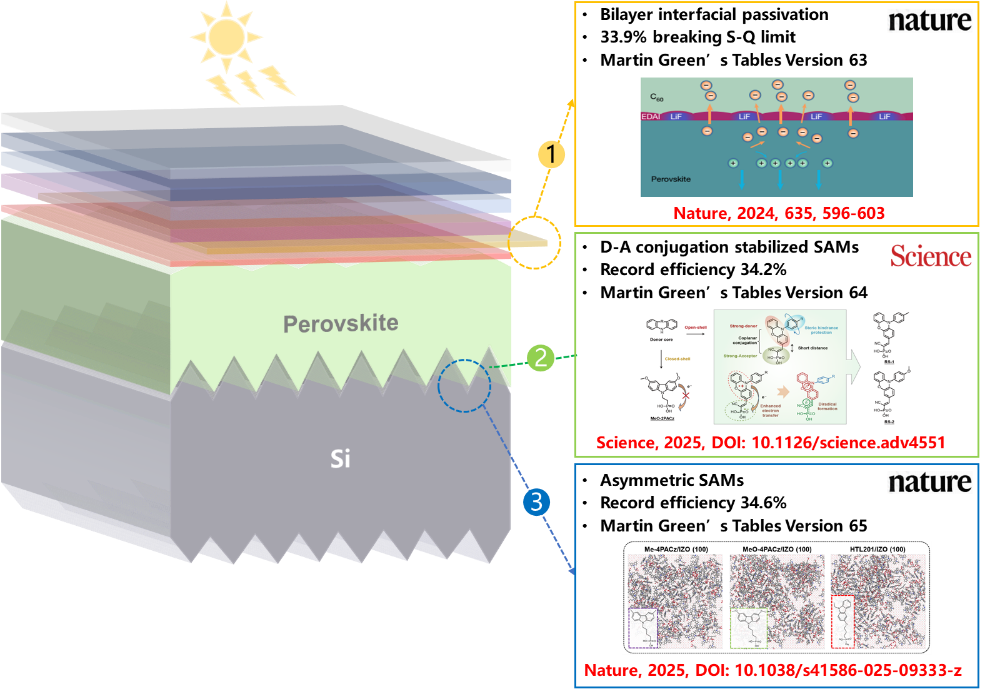
Published in Science on 26 June 2025, the study noted these materials offer “exceptional carrier transport properties, remarkable structural stability under practical operating conditions, and superior assembly uniformity.”
LONGi’s recent innovations – spanning bilayer passivation, asymmetric SAMs, and stable diradical materials – correspond to world-record efficiencies of 33.9%, 34.2%, and 34.6% These are featured in Martin Green’s Solar Cell Efficiency Tables.
The company highlighted its collaborative research model as key to driving progress in next-generation photovoltaic technology.
[Image credit: LONGi]
by Emily Ashley | Jul 7, 2025 | Asia, Commercial & Industrial Solar
Philippine National Oil (PNOC) is seeking consultancy services for the development of a 7 MW ground-mounted solar project in Cagayan province, located at the northeastern tip of Luzon.
The planned solar array will be installed at the Magapit Main Canal.
According to the tender, the selected consultant will be tasked with delivering a detailed feasibility study, covering technical, environmental, financial, and legal considerations necessary for project implementation.
A budget of PHP 10 million (approximately $176.4m has been allocated for the project.
Eligibility is open to Filipino citizens, as well as sole proprietorships, partnerships, or organisations with at least 60% Filipino ownership. Foreign entities may also participate if their countries offer reciprocal rights to Filipino firms. Applications are due by July 15.
The project aligns with broader efforts in the Philippines to expand solar deployment over irrigation canals.
The National Irrigation Administration commissioned the country’s first canal-top solar irrigation system in October 2023, with the largest to date beginning operations in June 2024.
by Emily Ashley | Jul 7, 2025 | Asia, Commercial & Industrial Solar, Large Scale Utility Solar
China’s Ministry of Industry and Information Technology (MIIT) held a high-level meeting with solar industry leaders last week to discuss stabilising the sector and implementing recent directives from the Central Financial and Economic Affairs Commission.
The government aims to address what it calls “disorderly” competition and guide the industry toward more sustainable growth.
Chaired by MIIT Minister Li Lecheng, the meeting brought together 14 major companies, including Longi, Trina, JA Solar, Tongwei, and Sungrow, alongside the China Photovoltaic Industry Association (CPIA).
It followed a July 1 economic policy session where officials called for tackling “irrational” pricing, phasing out outdated capacity, and improving industrial quality.
The MIIT said the industry must “firmly implement the central government’s decisions, resolutely crack down on low-price disorderly competition, and promote the orderly exit of outdated capacity.”
Li also urged companies to maintain “self-discipline” and emphasised the importance of innovation and long-term competitiveness.
The meeting took place amid growing public and official concern over excessive competition, often referred to in China as “involution.”
In the days leading up to it, the state-run People’s Daily published a front-page editorial criticising price wars and calling for structural reform.
Some parts of the supply chain have already begun adjusting. Ten glass producers, including Xinyi Solar and Flat Glass, plan to cut output by 30% in July.
In the polysilicon segment, companies like GCL Technology and Daqo New Energy have indicated that mergers and acquisitions are under consideration.
Despite investor optimism – solar stocks rose sharply after the meeting—analysts remain cautious. Overcapacity persists across the value chain, and structural changes may take time to materialise.
by Emily Ashley | Jun 30, 2025 | Asia, Storage
Jinko ESS, a global leading energy storage company, has successfully delivered 476MWh of its SunTera G2 5MWh liquid-cooling systems as the first batch under a 1GWh PV+storage framework agreement signed with a major customer in northern Jiangsu.
Designed to support centralised PV power plants, the project leverages an integrated “solar + storage” approach to improve renewable energy consumption and enhance regional energy structure and reliability.
To address the comprehensive needs of centralised PV projects in northern Jiangsu for safety, cost-efficiency, and environmental adaptability, the SunTera G2 system features an industry-leading liquid thermal management system that keeps cell temperature differences within 2.5°C.
It also includes five-layer protection across the battery, module, rack, container, and system levels, providing strong resilience against high humidity and temperature fluctuation.
With a 94% RTE and lifecycle exceeding 8,000, the system delivers high-performance output and optimal economic value. It supports the establishment of a stable, efficient, and secure clean energy supply system and accelerates the region’s energy transition.
“This marks a major step forward for Jinko ESS in scaling up solar-plus-storage applications,” said Damon Duan, General Manager of Jinko ESS China.
“Energy storage plays a vital role in shaping the new energy landscape. With its safety, efficiency, and intelligence, the SunTera G2 is becoming a preferred choice for utility-scale energy projects.
We will continue advancing our R&D efforts to provide tailored storage solutions for utility-scale PV and other major energy applications.”
Want to publish a press release? Submit your content here for review by our editorial team.
by Emily Ashley | Jun 23, 2025 | Asia, Commercial & Industrial Solar, Press Release, Storage
Press Release
China’s largest electrochemical energy storage project – 600MW/2400MWh – has completed installation of all storage cabins in its first site, marking a key milestone as it enters the electrical commissioning phase.
This is China’s first ultra-high voltage (UHV) transmission project integrating wind, solar, thermal, and storage. SINEXCEL (300693.SZ) is proud to power this national-level project with its utility-scale 1725kW Power Conversion System (PCS).
China’s Largest Electrochemical Energy Storage Project 600MW/2400MWh Powered by SINEXCEL’s 1725kW PCS
This site includes 240 battery containers and 60 PCS skids. Once operational, the whole project will integrate approximately 840 GWh of renewable energy into the grid annually. A single charge stores up to 2.4 GWh—enough to meet the daily electricity needs of 480,000 households or power 36,000 EVs with 500km range.
In addition, SINEXCEL supported a 220MW/880MWh storage project that was successfully connected to the grid in Ningxia.
Leveraging the region’s abundant solar resources, the project integrates solar and storage to solve renewable energy curtailment, enhance grid stability and energy shifting. The station is expected to supply nearly 200 GWh electricity annually.
SINEXCEL proudly contributes to these two projects with its 1725kW PCS. Designed to enhance grid stability, the 1725kW PCS features a modular architecture scalable from 215kW to 1.72MW per unit.
It combines advantages for both centralized and string configurations, supports diverse battery types, and enables flexible deployment across various storage scenarios, including large C&I, microgrids, and front-of-the-meter applications.
With peak efficiency of up to 98.5%, the PCS features advanced multi-string technology for enhanced battery protection and supports flexible configurations with 1, 2, 4, or 8 battery strings.
Its combined AC/DC output simplifies control and expansion, while NEMA 3R-rated cabinets ensure outdoor durability. A rapid 10ms response time supports real-time grid balancing, and the product meets major compliance standards in North America, Europe, Australia, Japan and China.
With a global footprint spanning 40+ countries and over 5,000 deployments worldwide, SINEXCEL has installed over 12GW of storage capacity, delivering solutions for utility-scale, C&I, and microgrid applications.
The successful participation in these landmark projects underscores SINEXCEL’s technical strength and ongoing commitment to enabling a more resilient and sustainable energy future.
Want to publish a press release? Submit your content here for review by our editorial team.
by Emily Ashley | Jun 23, 2025 | Asia, Commercial & Industrial Solar, Large Scale Utility Solar
The Energy Transitions Commission (ETC) has released a new briefing note, Global Trade in the Energy Transition: Principles for Clean Energy Supply Chains and Carbon Pricing, outlining key policy guidance to support a faster and fairer global energy transition.
The cost of key clean energy technologies has fallen dramatically over the last decade, with solar PV module prices down 94% since 2011 and lithium-ion battery prices dropping over 92% since 2010, while doubling in energy density.
The report shows that China has led this progress and now dominates global markets in several clean technologies.
The ETC attributes this to “strategic vision, low capital costs, technological innovation and dynamic entrepreneurship,” rather than just low labour costs.
Supply chain considerations
China’s dominance has prompted other countries to reconsider the resilience of their supply chains. In response, many governments are pursuing nearshoring strategies to improve energy security and boost domestic employment.
The ETC warns that poorly designed policies could increase the cost of the energy transition and has proposed six guiding principles to help policymakers avoid inefficiencies.
“The world is entering a new industrial era powered by clean energy,” said Faustine Delasalle, ETC Vice-Chair. “Well-designed policies, including carbon pricing, supply-side financial incentives, and demand-side regulations, are essential to make projects viable.”
The policies include avoiding total self-reliance, tailoring nearshoring efforts to technologies with domestic potential, and ensuring tariffs comply with WTO rules.
The ETC also emphasises the importance of collaboration with China to accelerate clean energy deployment in low-income countries.
“In an ideal world, free from geopolitical tensions or supply chain risks, China’s stunning technological progress and cost reduction would be welcomed as enabling a faster and cheaper energy transition worldwide,” said Adair Turner, Chair of the ETC.
“But there are economic and security-related reasons for seeking to develop domestic supply chains.”
by Emily Ashley | Jun 19, 2025 | Asia, Commercial & Industrial Solar, Europe, Press Release
Press Release
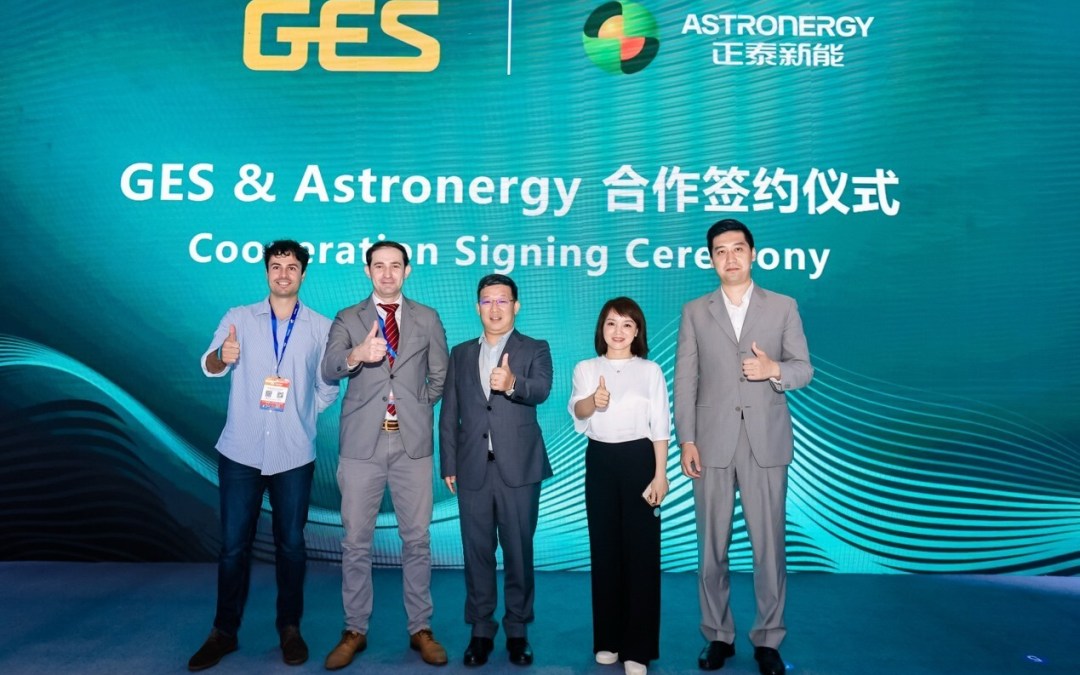
At SNEC 2025, Astronergy officially signed a landmark cooperation agreement with Spanish EPC company Global Energy Services Siemsa, S.A. (GES Siemsa), marking the first-ever global project order for its advanced ASTRO N8 PV modules.
According to the agreement, Astronergy will begin delivering ASTRO N8 modules later this year to support a major solar project in Spain developed by GES Siemsa.
This collaboration not only signifies a breakthrough for the ASTRO N8 series in the European high-end solar market but also represents a shared commitment to accelerating the region’s renewable energy transition.
“We are pleased to partner with Astronergy and adopt their latest ASTRO N8 technology in our upcoming project,” said Mr. Rodolfo Gonzalez Mata, representative of GES Siemsa.
“This cooperation reinforces our shared vision of delivering efficient and sustainable energy solutions to the Spanish market.”
As Astronergy’s advanced product, the ASTRO N8 series combines G12 wafer-based design with next-generation TOPCon cell technology, offering higher power output of over 700Wp and system-level cost advantages—making it a strong fit for utility-scale solar applications.
“This first global project order for ASTRO N8 underscores the market’s confidence in our latest high-efficiency technology,” said Samuel Zhang, the CMO at Astronergy.
“We’re proud to partner with GES Siemsa to deliver clean, reliable solar energy to Spain, and to open a new chapter of growth in the European market.”
The partnership serves as a strong signal of Astronergy’s growing influence in Europe and lays the groundwork for deeper collaboration between the two companies across future utility-scale solar developments.
[Image credit: Astroenergy. Image caption: A group photo of GES representatives (two at the left) and Astronergy representatives after the signing ceremony at SNEC 2025]
Want to publish a press release? Submit your content here for review by our editorial team.
by Emily Ashley | Jun 16, 2025 | Asia, Commercial & Industrial Solar, Press Release
Press Release
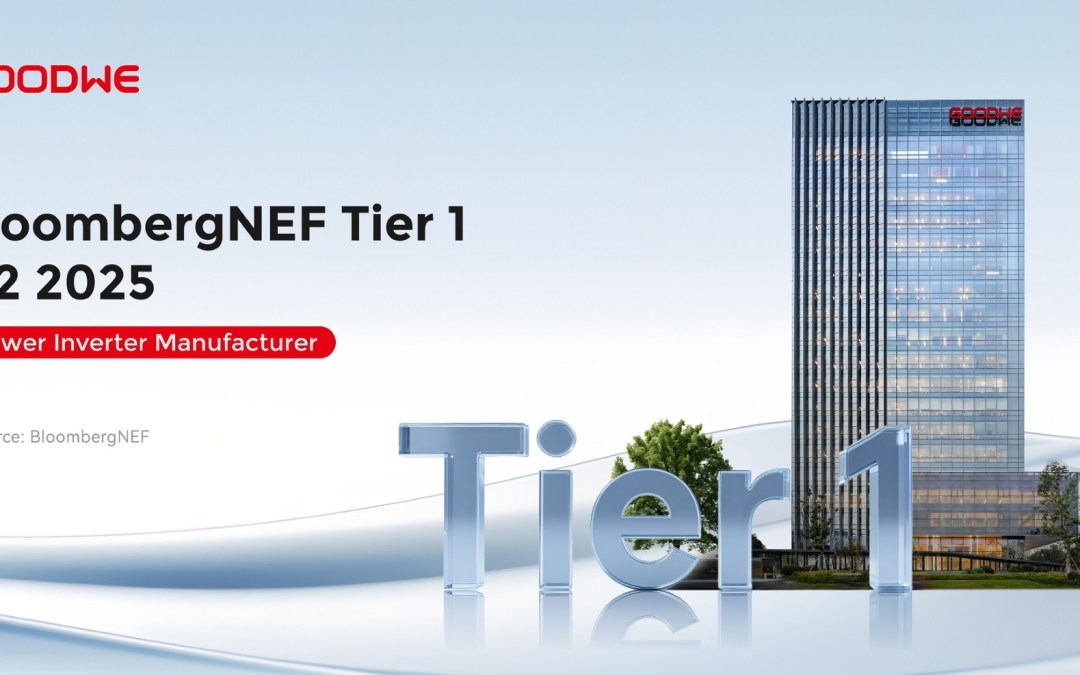
For the second quarter of 2025, GoodWe has been named as a Global Tier 1 Power Inverter Manufacturer by BloombergNEF (BNEF), continuing its track record of delivering trusted, high-performance solutions to the global clean energy market.
The Tier 1 rating highlights GoodWe’s strong bankability, demonstrated by its inclusion in projects financed by leading financial institutions.
“This recognition affirms our role as a trusted partner in the global transition to clean energy,” said Yingge Wang, Vice President of GoodWe. “Backed by over a decade of renewable energy expertise, we deliver reliable products and lasting system value to customers worldwide.”
The BNEF power inverter Tier 1 is widely regarded as an industry benchmark. The key criterion for tiering is whether projects using a manufacturer’s inverters are likely to receive non-recourse debt financing from various commercial banks.
This makes the Tier 1 list a key reference point for financial institutions, EPCs, and project developers when evaluating a manufacturer’s credibility and project readiness.
GoodWe’s inclusion in the Tier 1 list reflects years of consistent investment in technology, manufacturing, and global deployment excellence.
Headquartered in China, GoodWe operates five R&D centres.
Over 28% of its workforce is dedicated to technological innovation, and nearly 8% of its annual revenue is invested in R&D.
Stringent quality standards are upheld across GoodWe’s inverter, storage system, and heat pump production lines at its four global manufacturing sites.
The company’s current inverter production capacity stands at 35 GW. As of Q1 2025, it has reached a cumulative global installed capacity of 100GW.
At Intersolar Europe 2025, GoodWe debuted its next-generation solar power storage solutions under its EcoSmart Home and EcoSmart Commercial umbrellas.
These systems feature enhanced safety, AI-powered smart features, and improved system flexibility.
Designed to adapt to diverse market needs, GoodWe’s utility solutions are also trusted by large-scale developers, with its utility inverters deployed in projects across Germany, Ireland, Spain, Italy, Greece, China, Malaysia, and India.
Want to publish a press release? Submit your content here for review by our editorial team.
by Emily Ashley | Jun 11, 2025 | Asia, Commercial & Industrial Solar, Large Scale Utility Solar
India has seen a drop in fossil fuel power generation in 2025, driven by a sharp rise in solar electricity output.
New Data from energy think tank Ember shows a 32.4% year-on-year increase in solar generation from January to April, supporting overall electricity supply while holding coal-fired output steady and cutting gas-fired power by 27%.
Solar power generation reached a record 57.8 TWh in the first four months of 2025 – nearly a third higher than the same period in 2024.
This growth followed a 30% rise in installed solar capacity over the past year. In March and April, solar contributed 10% of India’s electricity mix, up from a 2024 average of 7%.
Overall, clean energy generation rose by 23% year-on-year between January and April, accounting for a record 23.3% of total electricity production. This allowed utilities to reduce fossil fuel output by around 0.5%.
While modest, such a decline is uncommon given India’s fast-growing energy demand. The last similar drop occurred in 2020 during COVID-19 lockdowns.
Coal remains the dominant energy source, powering roughly 75% of the grid. However, India’s clean energy supply has grown by about 10% annually since 2020. During times of lower demand, this expansion gives room to scale back fossil fuel use.
Hydropower may further reduce coal dependence in the coming months. “Above-average” monsoon rainfall, forecast at 6% above normal, is expected to boost hydro output.
Combined with ongoing solar growth, this may prompt deeper cuts in coal generation and potentially lead to the first annual drop in coal use since 2020.
by Emily Ashley | Jun 10, 2025 | Americas, Asia, Commercial & Industrial Solar, Innovation
Qcells, a solar manufacturer based in Seoul, South Korea, has launched ‘EcoRecycle by Qcells’ – the company’s new solar panel recycling arm.
In a company statement, Qcells explained that EcoRecycle “addresses the growing challenge of solar panel waste”, thus reducing the solar industry’s environmental footprint as the volume of end-of-life panels begins to rise.
EcoRecycle will begin operations at the company’s facility in Georgia, USA, as the first foothold in what the company plans to be a nationwide network.
According to Qcells, the Georgia facility will be able to recycle around 250MW of panels per annum – equal to 500,000 panels – retrieving materials including glass, silver, copper, and aluminium.
“With this new business, Qcells will emerge as the first-ever crystalline silicon (C-Si) solar panel producer to possess a full value chain, conducting both solar panel manufacturing and recycling on US soil,” comments Kelly Weger, Senior Director of Sustainability at Qcells, in the company’s statement.
“Effectively managing solar waste is essential to ensure the long-term sustainability and resilience of the clean energy sector.”
Qcells also provides PV and BESS products, large-scale solar projects, and renewable energy contracting across Europe, North America, Asia, South America, Africa, and the Middle East.
by Emily Ashley | Jun 9, 2025 | Africa, Americas, Asia, Commercial & Industrial Solar, Europe, Middle East, Oceania
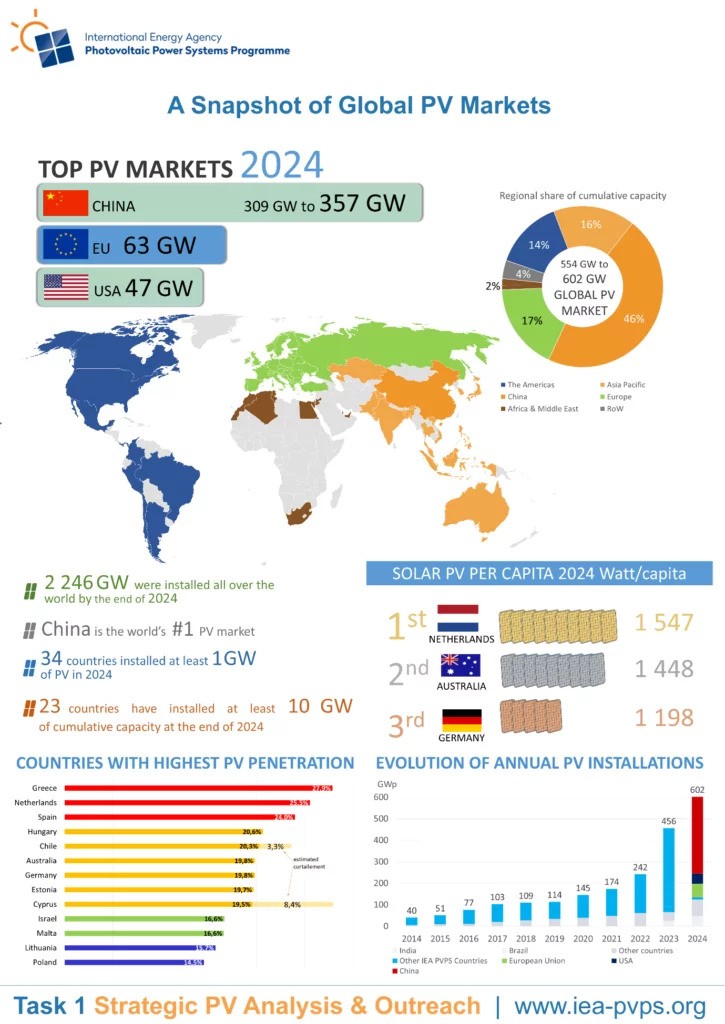
The International Energy Agency’s (IEA) PVPS 2025 Snapshot of Global PV Markets reveals record-breaking growth in solar PV worldwide, with over 600GW of new PV capacity added in 2024.
This pushed global cumulative installed capacity to more than 2.2TW, up from 1.6 TW the previous year.
China accounted for nearly 60% of all new PV installations, commissioning between 309GW and a possible 357GW, bringing its cumulative total to over 1TW – almost half the global total.
The rest of the world contributed 244.6GW, with strong growth in Europe (71.4GW), the USA (47.1GW), India (31.9GW), and Brazil (14.3GW).
Expansion and fall
While the global PV market expanded by over 30%, the growth rate fell from 89% in 2023.
Oversupply in module manufacturing has driven prices down but strained profitability for producers. According to IEA’s data, this price drop catalysed market growth, especially in utility-scale segments, which dominated 2024 installations.
PV provided over 10% of global electricity consumption for the first time. In 27 countries – including Greece, the Netherlands, and Germany – solar generation surpassed 10% of national electricity use, though curtailment is increasingly an issue where grid flexibility lags behind deployment.
Policy developments in 2024 focused on energy transition goals, storage integration, and boosting local manufacturing.
However, local production faces challenges amid intense price competition from Chinese imports. The USA, India, Türkiye, and Brazil responded with tariffs and incentives to protect or stimulate domestic PV industries.
Forecast
Looking ahead, the IEA expects steady growth in most markets, though local policy shifts and infrastructure bottlenecks may influence deployment.
As storage, hybrid systems, and new applications like green hydrogen scale up, global solar deployment must exceed 1 TW annually to match manufacturing output and decarbonisation targets.
For stakeholders in the international solar and storage industry, 2024 underscored the urgency of grid adaptation, the risks of supply chain overcapacity, and the continued rise of solar as the dominant renewable power source.
Infographic credit: IEA-PVPs
Explore the international solar landscape through our series of Market Reports, available for free here.
by Emily Ashley | Jun 6, 2025 | Asia, Commercial & Industrial Solar
A new financing agreement has been signed to support the development of rooftop solar power projects in Singapore.
Tokyo Electric Power Company Holdings (TEPCO HD) and ESR Group Limited, through a jointly established Special Purpose Vehicle (SPV), secured SGD 9.5m from Bank SinoPac to fund the first phase of a portfolio of rooftop solar installations.
The financing, signed May 15 2025, is structured to scale up to SGD 35m, supporting the future expansion of the project to 40 MW of capacity.
This marks TEPCO’s first portfolio asset project financing of its kind and reflects the company’s growing focus on renewable energy initiatives outside Japan.
The SPV has already signed power purchase agreements with multiple electricity users in Singapore. These deals form part of TEPCO’s wider plan to deploy 100MW of rooftop solar capacity across the Asia-Pacific region.
TEPCO aims to increase the availability of small-scale and distributed renewable energy sources to help advance carbon neutrality.
In addition to projects in Singapore, the company plans to enter the Australian energy market through its subsidiary TEPCO Global Energy Pte. Ltd., introducing storage batteries and energy management systems under its “TEPCO Area Energy Management” initiative.
In partnership with ESR, which specialises in logistics real estate and infrastructure across Asia-Pacific, TEPCO intends to provide low-carbon energy solutions to commercial customers across the region.
The collaboration supports shared goals of decarbonisation and sustainable development.
Bank SinoPac, the lender, has previously facilitated green energy projects across Asia, including solar and hydropower plants in Vietnam, Hong Kong, and Cambodia.
The rooftop solar initiative aligns with TEPCO’s broader push to transition to cleaner energy and contribute to regional sustainability goals.
by Emily Ashley | Jun 6, 2025 | Asia, Commercial & Industrial Solar
Press Release
Trinasolar, a global leader in smart PV and energy storage solutions, has officially released its 2024 Sustainability Report, showcasing key ESG advancements in innovation, sustainable manufacturing, supply chain transparency, social responsibility, and corporate governance.
While achieving remarkable milestones in solar and energy storage technology, Trinasolar demonstrates more than just world-leading innovation.
Through the 2024 Sustainability Report, Trinasolar emphasises its dedication to seizing opportunities and managing risks in the journey toward sustainable development.
Customer-centric, scenario-oriented solutions
In 2024, Trinasolar launched scenario-based solutions designed to meet the demands of diverse environments. These innovations tackle challenges in extreme conditions such as deserts, high humidity, strong winds, and severe weather, ensuring reliable performance and safeguarding customer value.
By integrating solar projects into natural settings like deserts, farmlands, and fisheries, Trinasolar achieves a synergy between ecological preservation and economic returns.
By year-end 2024, Trinasolar’s cumulative global shipments of PV modules surpassed 260 GW, reducing CO2e emissions by approximately 349.95 million tonnes worldwide, the equivalent of planting 19.1 billion trees.
These efforts support energy transitions in diverse applications while helping build a sustainable future on a global scale.
A leader in sustainable solar
In 2024, Trinasolar reaffirmed its commitment to sustainable manufacturing, earning multiple third-party recognitions, including an MSCI rating of BBB, a Wind ESG rating of A, and a Sustainable Fitch rating of “2.”
Its “SOLAR” sustainability management philosophy is embedded throughout operations, with notable progress in emissions reductions, water conservation, and circular practices:
- On-site PV generation increased by 64%, reaching 223,794 MWh in 2024.
- 12 products received carbon footprint certifications from UL, EPD International, and Certisolis
- The Yancheng Dafeng facility earned “Zero Carbon” and “Zero Waste Landfill” certifications from TÜV Rheinland
- The Yiwu facility received a four-star “Zero Carbon” factory certification
- GHG emissions intensity per unit decreased by 36.44% (cells) and 65.55% (modules) compared to 2020
- Water consumption intensity fell 86.85% (cells) and 67.68% (modules) over the same period
- Trinasolar introduced the world’s first fully recycled PV module and recycled over 2,200 tons of packaging materials.
Gao Jifan, Chairman and CEO of Trinasolar, emphasised, “Green development is an integral part of Trinasolar’s core principles. We are committed to providing green energy products and actively addressing climate change across our entire value chain.”
A digital, traceable supply chain
In 2024, Trinasolar enhanced supply chain governance by leveraging its Supplier Relationship Management (SRM) platform and big data tools to map suppliers and launch a digital ESG performance system.
This platform enables multi-tier classification and data-driven ESG rankings while enhancing traceability for carbon footprints, critical materials, and conflict minerals.
- The CSR Code of Conduct signing rate among suppliers rose from 95.67% to 98.41%
- Certifications obtained include:
- SA8000 for social accountability
- TÜV Rheinland AA rating for full-chain traceability
- Silver Certification of the Solar Stewardship Initiative (SSI) ESG Standard for two major production sites
- The company targets 100% traceability for key raw materials within three years
Empowering communities and the future
In 2024, Trinasolar invested approximately $2.2m in community development and charitable initiatives, demonstrating its commitment to fostering social well-being and empowering local communities.
Internally, the company increased its investment in occupational health and safety by 34%.
Trinasolar also deepened collaboration with global academic institutions, including:
- Universidad Politécnica de Madrid
- Nanyang Technological University (NTU)
- Centro Universitário Facens
Looking ahead
The 2024 Sustainability Report reflects Trinasolar’s long-standing commitment to responsible growth while laying the foundation for continued ESG excellence. As a global clean energy leader, Trinasolar will continue to prioritise innovation, transparency, and collaboration to help build a greener, more inclusive future.
The full 2024 Sustainability Report is available at https://www.trinasolar.com/en-glb/esg/download.
Want to publish a press release? Submit your content here for review by our editorial team.
by Emily Ashley | May 14, 2025 | Asia, Europe, Storage
Huawei Digital Power presented its latest grid-forming Smart PV+ESS technologies at Intersolar Europe 2025, held in Munich from May 7 to 9.
The showcased solutions aim to support the construction of new power systems and promote the global transition to renewable energy.
“Carbon neutrality and energy transition are now global missions,” Huawei stated, highlighting the need for energy systems that integrate power electronics across all stages of the electricity chain — generation, transmission, distribution, and consumption.
Central to Huawei’s exhibition offerings is its Smart String Grid Forming ESS, designed for utility-scale applications.
According to Huawei, it “offers all-scenario grid forming, cell-to-grid safety, full-lifecycle optimal investment, and full-link digitalization.” The solution is capable of stabilising grids under varying conditions, including across all states of charge and short circuit ratios.
On the generation side, the system mimics the behaviour of synchronous condensers, offering voltage, frequency, and power angle control. On the transmission side, it supports black start and provides voltage and frequency stabilisation.
Huawei added that “one platform… supports flexible evolution” as energy markets expand. On the consumption side, it enables microgrids that run entirely on renewables with stable on/off-grid operation.
Other offerings
Huawei also presented a 215 kWh Smart Hybrid Cooling ESS for commercial and industrial use, emphasising “proactive safety, premium quality, and higher profitability.”
Certified to international safety standards, it is designed to perform in extreme conditions and features upgraded optimisation and efficiency.
For the residential sector, Huawei launched its Home Energy Management Solution 6.0, which includes the LUNA S1-7kWh ESS. The system offers “over 40% more usable energy than the industry average” and supports expansion up to 252 kWh.
Huawei concluded: “Energy transition is not only technological innovation, but also a global effort to achieve sustainable development.”
[Image credit: Huawei]
by Emily Ashley | May 12, 2025 | Asia, Commercial & Industrial Solar, Europe, Everything Installer
The European Solar Manufacturing Council (ESMC) has raised concerns about the cybersecurity risks associated with internet-connected photovoltaic (PV) inverters, particularly those supplied by non-European manufacturers.
The organisation points to a recent study by DNV, commissioned by SolarPower Europe, which highlights potential vulnerabilities in the current approach to inverter security.
“Today, over 200GW of European PV capacity is already linked to inverters manufactured in China – the equivalent of more than 200 nuclear power plants,” said Christoph Podewils, Secretary General of the ESMC.
“This means Europe has effectively surrendered remote control of a vast portion of its electricity infrastructure.”
Modern PV inverters are typically connected to the internet to provide grid services and interact with energy markets.
These connections also allow for remote software updates, which can be used to adjust performance. However, the DNV report notes that this functionality introduces potential cybersecurity risks, including the possibility of coordinated disruptions.
Listed concerns
The ESMC flagged several points from the DNV paper, including the reported statistic that 70% of inverters installed in Europe in 2023 were from Chinese companies.
Two manufacturers currently have remote access to 168GW of European capacity, with projections indicating this could rise to over 400GW by 2030.
In response, the ESMC has proposed an EU “Inverter Security Toolbox,” based on the existing 5G Security Toolbox.
Recommendations include mandatory risk assessments for inverter manufacturers, restrictions on remote access by high-risk vendors, and consideration of national legislation such as Lithuania’s ban on certain inverters.
These calls align with recent recommendations from SolarPower Europe, which has advocated for harmonised EU-level cybersecurity rules for solar systems above 50kW.
“We support the European Commission’s upcoming assessment of cybersecurity risks in the solar value chain and are ready to contribute our expertise,” Podewils concluded.
by Emily Ashley | May 9, 2025 | Asia, Commercial & Industrial Solar, Everything Installer
Reuters reports that Chinese-backed solar panel manufacturers in Indonesia and Laos have rapidly increased their share of the US market following the imposition of steep tariffs on imports from Vietnam, Malaysia, Thailand, and Cambodia.
The US finalised additional duties in April after two earlier rounds in June and November 2024, aimed at curbing what it described as unfair trade practices by mostly Chinese-owned factories in those four Southeast Asian countries.
In response, Chinese firms ramped up production in Indonesia and Laos, significantly boosting exports to the US.
According to Reuters’ analysis of US trade data, Indonesia’s and Laos’ combined market share rose from under 1% in 2023 to 29% in the three months after the latest tariffs.
Yana Hryshko, head of global solar supply chain research at Wood Mackenzie, comments:
“All solar manufacturing capacity in the four Southeast Asian countries hit with high tariffs would now likely be shut down or reduced dramatically.”
Dropping imports
US imports from the penalised nations dropped 33% in the nine months following the initial June tariffs, while imports from Indonesia and Laos grew eightfold.
Overall, solar panel imports to the US have declined by 26%, with the share from the four affected countries dropping from 82% in 2024 to 54% after the November measures.
Despite rising import costs, US solar cell imports have tripled. Cells from Indonesia and Laos alone have surged by 17 times, making up 28% of imports since June, up from 6.5% in 2023.
Fei Chen of Rystad Energy cites concerns that tariffs could expand:
“Several solar manufacturers plan to set up production bases in non-Southeast Asia regions such as Turkiye, Oman, Saudi Arabia, UAE, Ethiopia,” says
Meanwhile, Chinese exports have shifted toward Asia and Africa. Asia now accounts for 37% of Chinese solar exports, up from 25.4% in 2024, while Europe’s share has dropped to 34%, according to Ember.
by Emily Ashley | May 2, 2025 | Asia, Commercial & Industrial Solar
Press Release
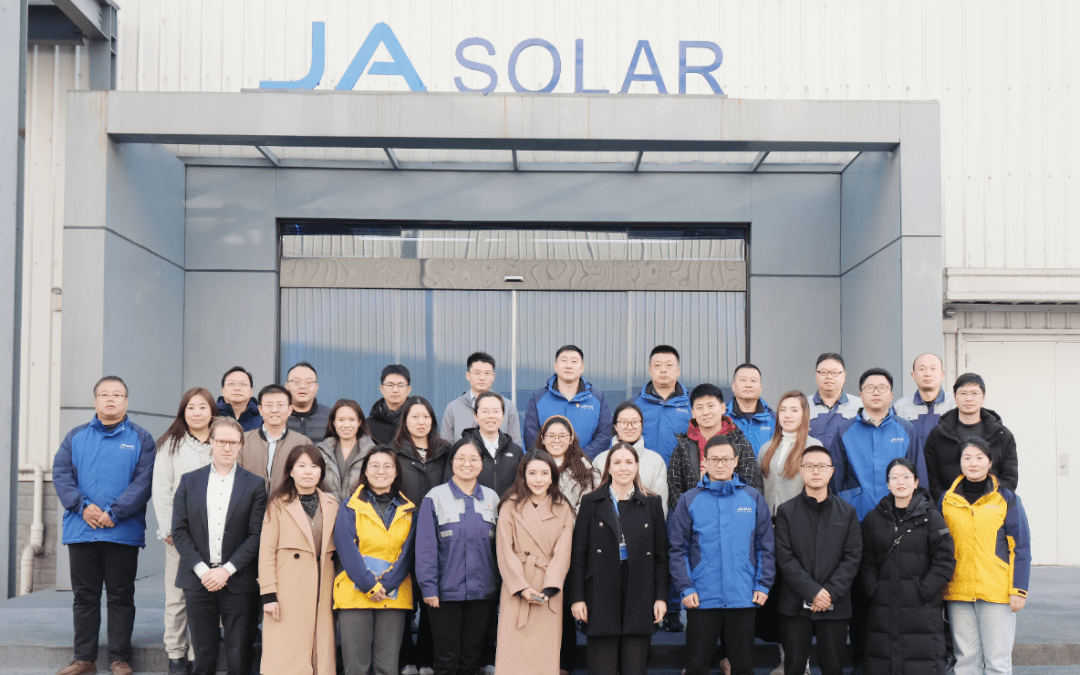
Sinovoltaics, the Dutch-German technical compliance and quality assurance firm specialising in solar PV and battery energy storage systems (BESS), announces the successful completion of SSI ESG certification at two JA Solar manufacturing sites in China, in partnership with the Solar Stewardship Initiative (SSI).
Both factories achieved Silver status, validating JA Solar’s efforts toward sustainable, transparent, and responsible solar production.
As sustainability standards tighten across the solar industry, Environmental, Social, and Governance (ESG) audits have become a critical metric for evaluating supplier reliability and risk.
JA Solar, one of the world’s leading solar module manufacturers, engaged Sinovoltaics and SSI to conduct thorough, independent ESG assessments—covering areas such as governance and business ethics, environmental sustainability, and the protection of human and labour rights.
“Achieving Silver ESG certification is a strong endorsement of the standards upheld by JA Solar,” said David Li, General Manager at Sinovoltaics.
“Our collaboration as official Assessment Body (AB) with SSI demonstrates the value of independent ESG verification and strengthens confidence across the global renewable energy supply chain. We’re proud to support JA Solar and other manufacturers in aligning their operations with the highest international sustainability benchmarks.”
The audits were conducted using SSI’s proprietary methodology, which was aligned with leading international ESG frameworks.
The assessment included on-site audit, document reviews, stakeholder interviews, and transparency evaluations, ensuring a robust and independent verification process.
JA Solar’s achievement comes amid growing pressure across the solar supply chain to meet stricter ESG expectations from developers, investors, and regulators.
As countries roll out green energy incentives and compliance mechanisms, such certifications are increasingly essential for global project eligibility.
Sinovoltaics’ ESG audit services form part of a broader portfolio that includes quality inspections, factory audits, and traceability programs.
The company’s presence in key manufacturing hubs – including China, Vietnam, Türkiye, and India – enables it to conduct audits efficiently and impartially across global supply chains.
To learn more about Sinovoltaics’ ESG and supply chain services, visit: www.sinovoltaics.com
Want to publish a press release? Submit your content here for review by our editorial team.





 The BNEF power inverter Tier 1 is widely regarded as an industry benchmark. The key criterion for tiering is whether projects using a manufacturer’s inverters are likely to receive non-recourse debt financing from various commercial banks.

 While the global PV market expanded by over 30%, the growth rate fell from 89% in 2023.